


 Home
HomeWhat is Gemini 2.5 Conversational Image Segmentation and how to use it in 2025?
Conversational image segmentation is transforming how we interact with and extract meaning from images. With Gemini 2.5, users can leverage natural language commands to precisely identify and isolate objects within any picture, unlocking new levels of efficiency and precision. This breakthrough promises significant impact across industries, from digital media to autonomous technology.
Key Points
Gemini 2.5 introduces a conversational approach to image segmentation, allowing users to direct the process with simple language.
It fundamentally removes the requirement for custom, labeled datasets and the development of specialized segmentation models.
This capability enables novel applications in fields such as creative content, industrial inspection, retail, and robotics.
For each identified object, Gemini 2.5 provides a structured JSON output containing bounding box coordinates and a detailed segmentation mask.
The system processes and segments images in real time, delivering accurate results even for complex scenes and intricate objects.
Unveiling Gemini 2.5's Conversational Image Segmentation
The Power of Conversational Image Segmentation
Traditional image segmentation has depended on manual annotation, bounding boxes, and models trained on specific datasets. Gemini 2.5 redefines this with conversational image segmentation, a system that interprets natural language instructions to pinpoint and extract specific elements from an image.

Users simply describe the target, and Gemini 2.5 executes the precise segmentation.
Conversational AI meets pixel-perfect precision. This combination allows the AI to comprehend user intent accurately, eliminating the extensive ML training typically required for custom tasks. The process is driven entirely by natural language, bypassing the need for dedicated training data and model fine-tuning.
Where older methods falter with irregular forms or abstract descriptions, Gemini 2.5 uses its contextual understanding to achieve meticulous, pixel-level segmentation. It handles complex outlines and relational descriptions ("the cat farthest away") with ease, removing the dependency on custom models and labeled data.
How Gemini 2.5 Eliminates Custom Training
A major breakthrough with Gemini 2.5 is its capacity to perform accurate segmentation without any custom training data. This capability, introduced in the new Gemini release, lets users type any instruction related to an image. The AI not only locates the described objects but also provides their exact pixel masks, enabling clean extraction regardless of shape complexity.
Conventional segmentation models demand large, meticulously labeled datasets, which are costly and time-intensive to produce. Gemini 2.5 bypasses this hurdle entirely. It leverages its vast pre-trained knowledge and language comprehension to segment images directly from user prompts.
Say goodbye to label data. This allows teams to immediately apply segmentation to their unique challenges without the overhead of data preparation. The system interprets verbal descriptions to select anything in an image, replacing manual clicking, drawing, and complex software tools. The core advantage is that no machine learning training is required for custom segmentation, as the AI operates solely on natural language input.
Empowering New Use Cases: From Drones to Medical Imaging
The conversational approach of Gemini 2.5 unlocks transformative applications across diverse sectors:
- Content Creation: Instantly remove backgrounds, apply effects to specific elements, or generate dynamic masks using simple commands—all without extra software.
- Quality Control: Identify defects, anomalies, or non-compliance by verbally describing the correct standard or what constitutes a flaw.
- Retail Analytics: Monitor inventory, analyze shopper behavior, and optimize store layouts through conversational queries, harnessing natural language for consumer insights.
- Autonomous Systems: Equip robots and vehicles with the ability to interpret complex visual environments using natural language instructions, enhancing their perception and decision-making.
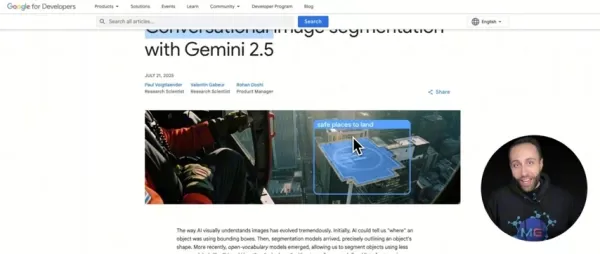
For instance, Gemini 2.5 can analyze drone footage to automatically identify safe landing zones. Users simply upload the video for analysis with its pixel-perfect segmentation.

The software accurately maps all viable and hazardous landing areas for the drone.
Autonomous drone landing zone detection powered by Gemini 2.5 pixel-perfect Segmentation.
Furthermore, in medical imaging, Gemini 2.5 can assist in reviewing chest X-rays to flag areas with potential abnormalities. Using natural language to guide the analysis can save medical professionals considerable time, thanks to the system's advanced language comprehension.
The Evolution of Computer Vision and Gemini 2.5
From Bounding Boxes to Conversational Understanding
Computer vision has evolved significantly with AI advancements. Gemini's conversational understanding represents a new frontier, moving beyond basic recognition to interactive, language-driven segmentation.
Bounding Boxes: Early AI systems could only place rectangular boxes around objects, offering coarse localization with limited detail.

Pixel-Perfect Outlines: Subsequent progress enabled AI to trace the exact contours of objects through segmentation, creating precise masks even for irregular shapes.
Conversational Understanding: With Gemini 2.5, the system comprehends context and descriptive phrases. Instead of just finding "a cat," it can identify "the cat that is farthest away" based on the user's language.
Benefits of New AI technology with Gemini. Conversational image segmentation delivers tangible advantages: it removes the need for manual clicking, drawing, or complex tools, replacing them with simple natural language descriptions. This approach eliminates the burdens of training data collection and model fine-tuning.
Gemini's Capabilities By moving beyond single-word labels, the system unlocks a more intuitive and powerful interface for visual data. It excels at several query types, including:
- Object relationships: such as "the person holding the umbrella," "the third book from the left," or "the most wilted flower in the bouquet."
- Conditional logic: like identifying "food that is vegetarian" or "the people who are not sitting." Gemini 2.5 understands these nuanced attributes.
- Abstract concepts: Its advanced semantic knowledge allows segmentation based on ideas like "a messy area" or "an opportunity," making previously impossible tasks practical.
Frequently Asked Questions
What is conversational image segmentation?
Conversational image segmentation is an AI-powered technology that allows users to identify and isolate specific objects within an image using natural language instructions instead of manual tools.
How does Gemini 2.5 differ from traditional image segmentation?
Unlike traditional methods, Gemini 2.5 does not require custom training datasets or specialized segmentation models. It uses its pre-trained knowledge and natural language processing to segment images based purely on user descriptions.
What industries can benefit from Gemini 2.5's conversational image segmentation?
Numerous sectors stand to gain, including content creation, manufacturing quality control, retail and analytics, and the development of autonomous systems like robots and self-driving vehicles.
What output format does Gemini 2.5 provide for segmentation results?
It outputs results in a structured JSON format that includes both bounding box coordinates and detailed segmentation masks for each identified object, facilitating easy integration into other software and applications.
Is Gemini 2.5 suitable for images with irregular shapes or abstract concepts?
Yes. Gemini 2.5 is designed to handle complex shapes and abstract descriptions by leveraging its deep contextual understanding, delivering precise segmentation even for challenging targets defined by relational terms.
Related Questions
How can Gemini 2.5 be applied to content creation?
For content creators, Gemini 2.5 streamlines workflows by enabling quick background removal, targeted effect application, and dynamic mask generation—all directed by natural language. This efficiency allows creators to focus more on creative vision, complementing tools like Photoshop.
What role does Gemini 2.5 play in quality control?
In quality control, it allows inspectors to detect flaws or deviations by verbally defining what a correct product or component should look like. This ensures consistent quality without the need for creating extensive fault databases, thanks to its pixel-perfect segmentation accuracy.
How does Gemini 2.5 improve retail analytics?
It enhances retail analytics by enabling inventory tracking, customer behavior analysis, and shelf layout optimization through simple conversational queries. This data-driven approach helps retailers improve customer experience and boost sales through AI-powered insights.
In what ways can Gemini 2.5 enhance autonomous systems?
It enhances autonomous systems by enabling robots and vehicles to interpret complex visual scenes via natural language commands. Applications range from identifying safe drone landing zones to recognizing pedestrians for self-driving cars, improving both safety and operational efficiency while reducing development time and costs.
Related article
 Inside Details Exposed About Next-Gen Gemini: Strained Computing Power, Internal Teams Disagreed on Development Priorities and Resource Allocation
Reports indicate that the launch of Google’s highly anticipated next-generation Gemini model has been pushed back. Internal disagreements over development priorities and resource allocation, combined with limited computing capacity and complex approv
OpenAI Dismisses Growth Slowdown Concerns, Says Multiple Business Units Accelerating
In response to external scrutiny regarding decelerating sales growth and missed internal benchmarks, AI leader OpenAI issued a confident statement on Tuesday, April 28. The company clarified that its consumer products and enterprise services are adva
Alibaba Super Cup: Qwen3.8-Max Debuts with Boosted Coding and Office Tools
Alibaba has officially unveiled Qwen3.8-Max, a next-generation foundation large model boasting 2.4 trillion parameters. This significant AI advancement delivers substantial performance gains in core areas like coding and professional office tasks, sh
Related Special Topic Recommendations
Music composition
Inside Details Exposed About Next-Gen Gemini: Strained Computing Power, Internal Teams Disagreed on Development Priorities and Resource Allocation
Reports indicate that the launch of Google’s highly anticipated next-generation Gemini model has been pushed back. Internal disagreements over development priorities and resource allocation, combined with limited computing capacity and complex approv
OpenAI Dismisses Growth Slowdown Concerns, Says Multiple Business Units Accelerating
In response to external scrutiny regarding decelerating sales growth and missed internal benchmarks, AI leader OpenAI issued a confident statement on Tuesday, April 28. The company clarified that its consumer products and enterprise services are adva
Alibaba Super Cup: Qwen3.8-Max Debuts with Boosted Coding and Office Tools
Alibaba has officially unveiled Qwen3.8-Max, a next-generation foundation large model boasting 2.4 trillion parameters. This significant AI advancement delivers substantial performance gains in core areas like coding and professional office tasks, sh
Related Special Topic Recommendations
Music composition
 Best AI Melody Writing Tools for Song Drafts
2026 Latest Best Top-Rated AI Melody Writing Tools for Song Drafts! XIX.AI has curated a highly powerful game-changing collection that goes through rigorous real-world tests to deliver the best writing experience. You can find detailed free vs paid comparisons, accurate rankings, and must-try options designed to help you create stunning song drafts effortlessly and boost your creative productivity significantly. Explore now to discover your perfect tool!
 8 tools
 xix.ai
chatbot
Best AI Conversation Trainer Tools for Interview Practice
xix.ai
chatbot
Best AI Conversation Trainer Tools for Interview Practice
2026 Latest Best Top-rated AI Conversation Trainer Tools for Interview Practice are here on XIX.AI! This curated collection features powerful, game-changing tools that go through rigorous real-world tests to deliver accurate feedback. You’ll find a free vs paid comparison and detailed rankings to help you choose the must-try option that boosts your confidence and skills. Explore now to Discover your perfect tool for interview success!
12 tools
xix.ai
Design & Art
Best AI Style Transfer Tools for Creative Experiments
2026 Latest Best Top-rated AI Style Transfer Tools for Creative Experiments! XIX.AI has curated a powerful, game-changing collection of must-try tools that deliver exceptional results through real-world tests and rigorous rankings. These top solutions help creatives boost productivity significantly by accelerating content creation and unlocking endless creative possibilities. Explore now to discover your perfect tool and start creating today!
9 tools
xix.ai
Comic Creation
Best AI Dialogue Bubble Tools for Visual Storytelling
2026 Latest Best Top-Rated AI Dialogue Bubble Tools for Visual Storytelling are here on XIX.AI! This curated collection features powerful, game-changing tools that help creators boost productivity and overcome creative bottlenecks. Get a free vs paid comparison, see real-world tests, and check the latest rankings to find the must-try solutions perfect for crafting engaging visual narratives. Explore now to discover your ideal tool!
10 tools
xix.ai
Meeting Assistant
Top AI Meeting Summary Tools: Track Decisions and Follow-Ups Clearly
2026 Latest Top-Rated Best AI Meeting Summary Tools for Clear Decision Tracking and Effortless Follow-Ups. This curated list showcases powerful, game-changing solutions that boost productivity dramatically by automating meeting notes, identifying key action items, and streamlining team coordination across all projects. Get a free vs paid comparison along with real-world tests and weekly updated rankings to help you find the perfect tool. Explore now to unlock your AI edge!
9 tools
xix.ai
Data Analysis
Best AI Data Cleaning Tools: Fix Missing Values and Duplicates Fast
2026 Latest Best Top-rated AI Data Cleaning Tools for quick fixing of missing values and duplicates. This curated list showcases powerful, game-changing solutions that boost productivity significantly. Each option has undergone rigorous real-world tests to ensure reliability. Get a free vs paid comparison and discover the must-try tool that fits your needs best. Explore now at XIX.AI to Unlock your AI edge.
11 tools
xix.ai

 Comments (1)
0/500
Comments (1)
0/500
![ThomasMiller]()
Ces avancées en segmentation d'images par commande vocale me font rêver ! 😍 Imaginez pouvoir simplement dire 'montre-moi tous les chiens sur cette photo de parc' et voir la magie opérer. Mais ça soulève aussi des questions sur la vie privée... jusqu'où cette technologie pourrait-elle analyser nos images sans consentement ? 🧐
Conversational image segmentation is transforming how we interact with and extract meaning from images. With Gemini 2.5, users can leverage natural language commands to precisely identify and isolate objects within any picture, unlocking new levels of efficiency and precision. This breakthrough promises significant impact across industries, from digital media to autonomous technology.
Key Points
Gemini 2.5 introduces a conversational approach to image segmentation, allowing users to direct the process with simple language.
It fundamentally removes the requirement for custom, labeled datasets and the development of specialized segmentation models.
This capability enables novel applications in fields such as creative content, industrial inspection, retail, and robotics.
For each identified object, Gemini 2.5 provides a structured JSON output containing bounding box coordinates and a detailed segmentation mask.
The system processes and segments images in real time, delivering accurate results even for complex scenes and intricate objects.
Unveiling Gemini 2.5's Conversational Image Segmentation
The Power of Conversational Image Segmentation
Traditional image segmentation has depended on manual annotation, bounding boxes, and models trained on specific datasets. Gemini 2.5 redefines this with conversational image segmentation, a system that interprets natural language instructions to pinpoint and extract specific elements from an image.
Users simply describe the target, and Gemini 2.5 executes the precise segmentation.
Conversational AI meets pixel-perfect precision. This combination allows the AI to comprehend user intent accurately, eliminating the extensive ML training typically required for custom tasks. The process is driven entirely by natural language, bypassing the need for dedicated training data and model fine-tuning.
Where older methods falter with irregular forms or abstract descriptions, Gemini 2.5 uses its contextual understanding to achieve meticulous, pixel-level segmentation. It handles complex outlines and relational descriptions ("the cat farthest away") with ease, removing the dependency on custom models and labeled data.
How Gemini 2.5 Eliminates Custom Training
A major breakthrough with Gemini 2.5 is its capacity to perform accurate segmentation without any custom training data. This capability, introduced in the new Gemini release, lets users type any instruction related to an image. The AI not only locates the described objects but also provides their exact pixel masks, enabling clean extraction regardless of shape complexity.
Conventional segmentation models demand large, meticulously labeled datasets, which are costly and time-intensive to produce. Gemini 2.5 bypasses this hurdle entirely. It leverages its vast pre-trained knowledge and language comprehension to segment images directly from user prompts.
Say goodbye to label data. This allows teams to immediately apply segmentation to their unique challenges without the overhead of data preparation. The system interprets verbal descriptions to select anything in an image, replacing manual clicking, drawing, and complex software tools. The core advantage is that no machine learning training is required for custom segmentation, as the AI operates solely on natural language input.
Empowering New Use Cases: From Drones to Medical Imaging
The conversational approach of Gemini 2.5 unlocks transformative applications across diverse sectors:
- Content Creation: Instantly remove backgrounds, apply effects to specific elements, or generate dynamic masks using simple commands—all without extra software.
- Quality Control: Identify defects, anomalies, or non-compliance by verbally describing the correct standard or what constitutes a flaw.
- Retail Analytics: Monitor inventory, analyze shopper behavior, and optimize store layouts through conversational queries, harnessing natural language for consumer insights.
- Autonomous Systems: Equip robots and vehicles with the ability to interpret complex visual environments using natural language instructions, enhancing their perception and decision-making.
For instance, Gemini 2.5 can analyze drone footage to automatically identify safe landing zones. Users simply upload the video for analysis with its pixel-perfect segmentation.
The software accurately maps all viable and hazardous landing areas for the drone.
Autonomous drone landing zone detection powered by Gemini 2.5 pixel-perfect Segmentation.
Furthermore, in medical imaging, Gemini 2.5 can assist in reviewing chest X-rays to flag areas with potential abnormalities. Using natural language to guide the analysis can save medical professionals considerable time, thanks to the system's advanced language comprehension.
The Evolution of Computer Vision and Gemini 2.5
From Bounding Boxes to Conversational Understanding
Computer vision has evolved significantly with AI advancements. Gemini's conversational understanding represents a new frontier, moving beyond basic recognition to interactive, language-driven segmentation.
Bounding Boxes: Early AI systems could only place rectangular boxes around objects, offering coarse localization with limited detail.
Pixel-Perfect Outlines: Subsequent progress enabled AI to trace the exact contours of objects through segmentation, creating precise masks even for irregular shapes.
Conversational Understanding: With Gemini 2.5, the system comprehends context and descriptive phrases. Instead of just finding "a cat," it can identify "the cat that is farthest away" based on the user's language.
Benefits of New AI technology with Gemini. Conversational image segmentation delivers tangible advantages: it removes the need for manual clicking, drawing, or complex tools, replacing them with simple natural language descriptions. This approach eliminates the burdens of training data collection and model fine-tuning.
Gemini's Capabilities By moving beyond single-word labels, the system unlocks a more intuitive and powerful interface for visual data. It excels at several query types, including:
- Object relationships: such as "the person holding the umbrella," "the third book from the left," or "the most wilted flower in the bouquet."
- Conditional logic: like identifying "food that is vegetarian" or "the people who are not sitting." Gemini 2.5 understands these nuanced attributes.
- Abstract concepts: Its advanced semantic knowledge allows segmentation based on ideas like "a messy area" or "an opportunity," making previously impossible tasks practical.
Frequently Asked Questions
What is conversational image segmentation?
Conversational image segmentation is an AI-powered technology that allows users to identify and isolate specific objects within an image using natural language instructions instead of manual tools.
How does Gemini 2.5 differ from traditional image segmentation?
Unlike traditional methods, Gemini 2.5 does not require custom training datasets or specialized segmentation models. It uses its pre-trained knowledge and natural language processing to segment images based purely on user descriptions.
What industries can benefit from Gemini 2.5's conversational image segmentation?
Numerous sectors stand to gain, including content creation, manufacturing quality control, retail and analytics, and the development of autonomous systems like robots and self-driving vehicles.
What output format does Gemini 2.5 provide for segmentation results?
It outputs results in a structured JSON format that includes both bounding box coordinates and detailed segmentation masks for each identified object, facilitating easy integration into other software and applications.
Is Gemini 2.5 suitable for images with irregular shapes or abstract concepts?
Yes. Gemini 2.5 is designed to handle complex shapes and abstract descriptions by leveraging its deep contextual understanding, delivering precise segmentation even for challenging targets defined by relational terms.
Related Questions
How can Gemini 2.5 be applied to content creation?
For content creators, Gemini 2.5 streamlines workflows by enabling quick background removal, targeted effect application, and dynamic mask generation—all directed by natural language. This efficiency allows creators to focus more on creative vision, complementing tools like Photoshop.
What role does Gemini 2.5 play in quality control?
In quality control, it allows inspectors to detect flaws or deviations by verbally defining what a correct product or component should look like. This ensures consistent quality without the need for creating extensive fault databases, thanks to its pixel-perfect segmentation accuracy.
How does Gemini 2.5 improve retail analytics?
It enhances retail analytics by enabling inventory tracking, customer behavior analysis, and shelf layout optimization through simple conversational queries. This data-driven approach helps retailers improve customer experience and boost sales through AI-powered insights.
In what ways can Gemini 2.5 enhance autonomous systems?
It enhances autonomous systems by enabling robots and vehicles to interpret complex visual scenes via natural language commands. Applications range from identifying safe drone landing zones to recognizing pedestrians for self-driving cars, improving both safety and operational efficiency while reducing development time and costs.








 Inside Details Exposed About Next-Gen Gemini: Strained Computing Power, Internal Teams Disagreed on Development Priorities and Resource Allocation
Reports indicate that the launch of Google’s highly anticipated next-generation Gemini model has been pushed back. Internal disagreements over development priorities and resource allocation, combined with limited computing capacity and complex approv
Inside Details Exposed About Next-Gen Gemini: Strained Computing Power, Internal Teams Disagreed on Development Priorities and Resource Allocation
Reports indicate that the launch of Google’s highly anticipated next-generation Gemini model has been pushed back. Internal disagreements over development priorities and resource allocation, combined with limited computing capacity and complex approv
 OpenAI Dismisses Growth Slowdown Concerns, Says Multiple Business Units Accelerating
In response to external scrutiny regarding decelerating sales growth and missed internal benchmarks, AI leader OpenAI issued a confident statement on Tuesday, April 28. The company clarified that its consumer products and enterprise services are adva
OpenAI Dismisses Growth Slowdown Concerns, Says Multiple Business Units Accelerating
In response to external scrutiny regarding decelerating sales growth and missed internal benchmarks, AI leader OpenAI issued a confident statement on Tuesday, April 28. The company clarified that its consumer products and enterprise services are adva
 Alibaba Super Cup: Qwen3.8-Max Debuts with Boosted Coding and Office Tools
Alibaba has officially unveiled Qwen3.8-Max, a next-generation foundation large model boasting 2.4 trillion parameters. This significant AI advancement delivers substantial performance gains in core areas like coding and professional office tasks, sh
Alibaba Super Cup: Qwen3.8-Max Debuts with Boosted Coding and Office Tools
Alibaba has officially unveiled Qwen3.8-Max, a next-generation foundation large model boasting 2.4 trillion parameters. This significant AI advancement delivers substantial performance gains in core areas like coding and professional office tasks, sh

2026 Latest Best Top-Rated AI Melody Writing Tools for Song Drafts! XIX.AI has curated a highly powerful game-changing collection that goes through rigorous real-world tests to deliver the best writing experience. You can find detailed free vs paid comparisons, accurate rankings, and must-try options designed to help you create stunning song drafts effortlessly and boost your creative productivity significantly. Explore now to discover your perfect tool!
8 tools
xix.ai

2026 Latest Best Top-rated AI Conversation Trainer Tools for Interview Practice are here on XIX.AI! This curated collection features powerful, game-changing tools that go through rigorous real-world tests to deliver accurate feedback. You’ll find a free vs paid comparison and detailed rankings to help you choose the must-try option that boosts your confidence and skills. Explore now to Discover your perfect tool for interview success!
12 tools
xix.ai

2026 Latest Best Top-rated AI Style Transfer Tools for Creative Experiments! XIX.AI has curated a powerful, game-changing collection of must-try tools that deliver exceptional results through real-world tests and rigorous rankings. These top solutions help creatives boost productivity significantly by accelerating content creation and unlocking endless creative possibilities. Explore now to discover your perfect tool and start creating today!
9 tools
xix.ai

2026 Latest Best Top-Rated AI Dialogue Bubble Tools for Visual Storytelling are here on XIX.AI! This curated collection features powerful, game-changing tools that help creators boost productivity and overcome creative bottlenecks. Get a free vs paid comparison, see real-world tests, and check the latest rankings to find the must-try solutions perfect for crafting engaging visual narratives. Explore now to discover your ideal tool!
10 tools
xix.ai
2026 Latest Top-Rated Best AI Meeting Summary Tools for Clear Decision Tracking and Effortless Follow-Ups. This curated list showcases powerful, game-changing solutions that boost productivity dramatically by automating meeting notes, identifying key action items, and streamlining team coordination across all projects. Get a free vs paid comparison along with real-world tests and weekly updated rankings to help you find the perfect tool. Explore now to unlock your AI edge!
9 tools
xix.ai

2026 Latest Best Top-rated AI Data Cleaning Tools for quick fixing of missing values and duplicates. This curated list showcases powerful, game-changing solutions that boost productivity significantly. Each option has undergone rigorous real-world tests to ensure reliability. Get a free vs paid comparison and discover the must-try tool that fits your needs best. Explore now at XIX.AI to Unlock your AI edge.
11 tools
xix.ai

Ces avancées en segmentation d'images par commande vocale me font rêver ! 😍 Imaginez pouvoir simplement dire 'montre-moi tous les chiens sur cette photo de parc' et voir la magie opérer. Mais ça soulève aussi des questions sur la vie privée... jusqu'où cette technologie pourrait-elle analyser nos images sans consentement ? 🧐












