


 Home
HomeMeta AI May Access Your Unshared Photos, Facebook Asks Users
Facebook is now requesting permission to access users' camera rolls to automatically generate AI-enhanced versions of their photos—including images that haven't been uploaded to the platform.
This feature appears when users create a new Story on the Facebook app. A prompt asks users to enable "cloud processing" to receive creative suggestions for their photos.
According to the notification, selecting "Allow" gives Facebook permission to create new content from your camera roll, such as collages, summaries, AI restylings, or themed collections. The platform will continuously upload media from your camera roll to its cloud servers, organizing content based on timing, location, or thematic patterns.
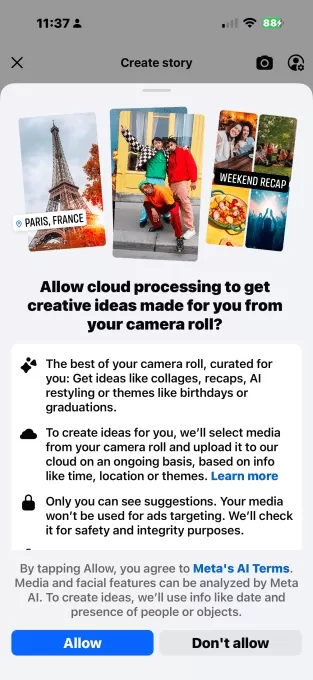
Image Credits: Facebook app screenshot, June 2025 Facebook states that only you can view these suggestions, and the media won't be used for advertising purposes.
However, by tapping "Allow," users agree to Meta's AI Terms, permitting the analysis of media content and facial features by artificial intelligence. The company will also utilize dates and identify people or objects in photos to develop creative concepts.
This tool exemplifies the potential implications of sharing personal media with AI providers. Like other technology giants, Meta has significant ambitions in artificial intelligence. Accessing users' unshared personal photos could provide the company with a competitive edge in the AI landscape.
For consumers, the rapid pace of technological advancement often makes it difficult to fully understand what they're consenting to when such features emerge.
Save $450 on Your TechCrunch All Stage Pass
Build smarter. Scale faster. Connect deeper. Join industry leaders from Precursor Ventures, NEA, Index Ventures, Underscore VC, and other top firms for a day of strategic sessions, workshops, and valuable networking opportunities.
Save $200+ on Your TechCrunch All Stage Pass
Build smarter. Scale faster. Connect deeper. Join industry leaders from Precursor Ventures, NEA, Index Ventures, Underscore VC, and other top firms for a day of strategic sessions, workshops, and valuable networking opportunities.
Boston, MA|July 15REGISTER NOW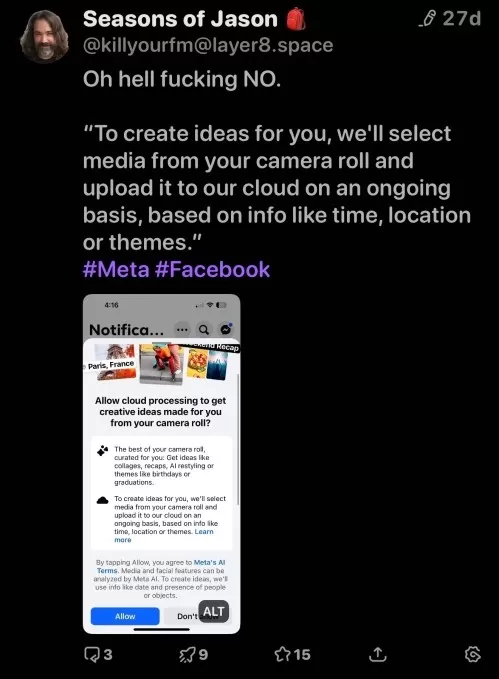
Image Credits: Screenshot from 'Seasons of Jason' on Mastodon (opens in new window) Meta's AI Terms for image processing clarify that "once shared, you agree that Meta will analyze those images, including facial features, using AI. This processing enables us to deliver innovative features, such as summarizing image content, modifying images, and generating new content based on original images."
The same terms grant Meta's AI systems permission to "retain and use" shared personal information to personalize AI outputs. The company acknowledges that it may review user interactions with its AI, including conversations, and these reviews could involve human oversight. The terms don't specifically define what constitutes personal information, beyond encompassing "information you submit as Prompts, Feedback, or other Content."
This raises questions about whether photos submitted for "cloud processing" fall under this category.
Meta has not responded to requests for comment or clarification.
Currently, there has been limited public response to this feature. Some Facebook users have encountered AI-generated photo suggestions while creating stories and expressed concerns online. For example, one Reddit user discovered that Facebook had accessed an older photo (previously shared on the platform) and automatically transformed it into an anime-style image using Meta AI.
When another user in an anti-AI Facebook group sought assistance disabling this feature, they were directed to the "camera roll sharing suggestions" section within the app's Settings.
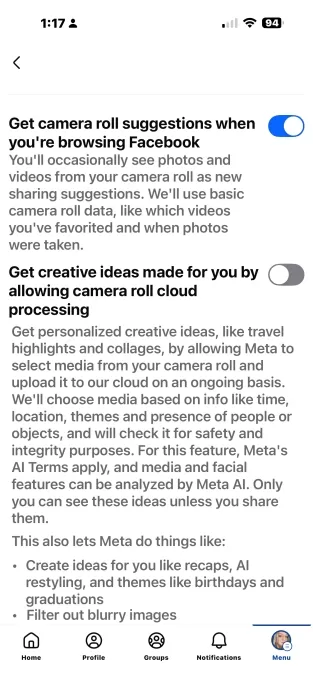
Image Credits: Facebook app screenshot, June 2025 We also located this feature in Facebook's Settings under the Preferences section.
The "Camera roll sharing suggestions" page contains two toggle switches. The first allows Facebook to suggest photos from your camera roll while browsing the app. The second (which should require explicit opt-in based on the Stories permission prompt) enables or disables "cloud processing," permitting Meta to create AI-generated images using your camera roll photos.
This capability to apply AI processing to camera roll photos doesn't appear to be a recent development.
We found earlier discussions this year where confused Facebook users shared screenshots of the prompt appearing in their Stories section. Meta has also published comprehensive Help Documentation about the feature for both iOS and Android users.
Meta's current AI terms took effect on June 23, 2024. Comparing them with previous versions is challenging because Meta doesn't maintain historical records, and earlier terms weren't properly archived by the Internet Archive's Wayback Machine.
By accessing your camera roll, this feature expands beyond Meta's previous announcements about training its AI systems on publicly shared data, including Facebook and Instagram posts and comments. (EU users had until May 27, 2025 to opt out.)
Related article
 Indian Tech Tycoon Invests $30M in AI Rival to Microsoft Office
Serial entrepreneur Bhavin Turakhia is investing $30 million of his own capital, betting that the enterprise AI sector still has room for new players. His latest startup, Neo, operates on a core belief: legacy workplace software cannot simply be patc
Former OpenAI Chief Scientist Ilya’s SSI Unveils First Model
AI has achieved another major milestone. Following his departure from OpenAI, former chief scientist Ilya Sutskever established Safe Superintelligence Inc. (SSI), which has recently unveiled details regarding its inaugural model. Reports from oversea
Lovable Leads Atech's Seed Round as AI Ambient Coding Officially Enters the Hardware Field
On May 14, 2026, AI application development platform Lovable announced its participation in the $800,000 seed funding round for Danish hardware startup Atech. Led by Lovable, the round attracted top-tier venture capital firms including the a16z Scout
Related Special Topic Recommendations
chatbot
Indian Tech Tycoon Invests $30M in AI Rival to Microsoft Office
Serial entrepreneur Bhavin Turakhia is investing $30 million of his own capital, betting that the enterprise AI sector still has room for new players. His latest startup, Neo, operates on a core belief: legacy workplace software cannot simply be patc
Former OpenAI Chief Scientist Ilya’s SSI Unveils First Model
AI has achieved another major milestone. Following his departure from OpenAI, former chief scientist Ilya Sutskever established Safe Superintelligence Inc. (SSI), which has recently unveiled details regarding its inaugural model. Reports from oversea
Lovable Leads Atech's Seed Round as AI Ambient Coding Officially Enters the Hardware Field
On May 14, 2026, AI application development platform Lovable announced its participation in the $800,000 seed funding round for Danish hardware startup Atech. Led by Lovable, the round attracted top-tier venture capital firms including the a16z Scout
Related Special Topic Recommendations
chatbot
 Best AI Conversation Trainer Tools for Interview Practice
2026 Latest Best Top-rated AI Conversation Trainer Tools for Interview Practice are here on XIX.AI! This curated collection features powerful, game-changing tools that go through rigorous real-world tests to deliver accurate feedback. You’ll find a free vs paid comparison and detailed rankings to help you choose the must-try option that boosts your confidence and skills. Explore now to Discover your perfect tool for interview success!
 12 tools
 xix.ai
Design & Art
Best AI Style Transfer Tools for Creative Experiments
xix.ai
Design & Art
Best AI Style Transfer Tools for Creative Experiments
2026 Latest Best Top-rated AI Style Transfer Tools for Creative Experiments! XIX.AI has curated a powerful, game-changing collection of must-try tools that deliver exceptional results through real-world tests and rigorous rankings. These top solutions help creatives boost productivity significantly by accelerating content creation and unlocking endless creative possibilities. Explore now to discover your perfect tool and start creating today!
9 tools
xix.ai
Comic Creation
Best AI Dialogue Bubble Tools for Visual Storytelling
2026 Latest Best Top-Rated AI Dialogue Bubble Tools for Visual Storytelling are here on XIX.AI! This curated collection features powerful, game-changing tools that help creators boost productivity and overcome creative bottlenecks. Get a free vs paid comparison, see real-world tests, and check the latest rankings to find the must-try solutions perfect for crafting engaging visual narratives. Explore now to discover your ideal tool!
10 tools
xix.ai
Meeting Assistant
Top AI Meeting Summary Tools: Track Decisions and Follow-Ups Clearly
2026 Latest Top-Rated Best AI Meeting Summary Tools for Clear Decision Tracking and Effortless Follow-Ups. This curated list showcases powerful, game-changing solutions that boost productivity dramatically by automating meeting notes, identifying key action items, and streamlining team coordination across all projects. Get a free vs paid comparison along with real-world tests and weekly updated rankings to help you find the perfect tool. Explore now to unlock your AI edge!
9 tools
xix.ai
Data Analysis
Best AI Data Cleaning Tools: Fix Missing Values and Duplicates Fast
2026 Latest Best Top-rated AI Data Cleaning Tools for quick fixing of missing values and duplicates. This curated list showcases powerful, game-changing solutions that boost productivity significantly. Each option has undergone rigorous real-world tests to ensure reliability. Get a free vs paid comparison and discover the must-try tool that fits your needs best. Explore now at XIX.AI to Unlock your AI edge.
11 tools
xix.ai
Design & Art
Best AI Creative Ideation Tools for Artists: Break Through Visual Blocks
2026 Latest Best Top-Rated AI Creative Ideation Tools for Artists are curated by XIX.AI to help creators break through visual blocks and boost creativity instantly. These powerful game-changing tools offer real-world tests, detailed free vs paid comparison, and weekly updated rankings. Discover your perfect tool to accelerate content creation and unlock your AI edge today. Explore now!
14 tools
xix.ai

 Comments (2)
0/500
Comments (2)
0/500
![FrankRoberts]()
Also selbst unveröffentlichte Fotos für KI-Analysen? 😅 Hab mich schon gewundert, warum Meta plötzlich die Berechtigung für alle Bilder auf meinem Gerät will. Ehrlich gesagt, die Vorstellung ist irgendwie unangenehm. Wir reden hier von Privatsphäre, nicht nur von Features! Irgendwann wird das bei den Datenschützern sicher Stress geben.
![JasonAnderson]()
Das klingt ja mal wieder total unheimlich! Erst sammeln sie alle Daten, jetzt wollen sie auch noch Fotos sehen, die ich gar nicht mit ihnen teilen wollte? Die KI-Beschleunigung geht echt zu weit. Wo bleibt da die Privatsphäre? Ich werde auf jeden Fall auf 'Nein' klicken und hoffe, dass viele andere das auch tun. Das ist ein gefährlicher Präzedenzfall. 😒
Facebook is now requesting permission to access users' camera rolls to automatically generate AI-enhanced versions of their photos—including images that haven't been uploaded to the platform.
This feature appears when users create a new Story on the Facebook app. A prompt asks users to enable "cloud processing" to receive creative suggestions for their photos.
According to the notification, selecting "Allow" gives Facebook permission to create new content from your camera roll, such as collages, summaries, AI restylings, or themed collections. The platform will continuously upload media from your camera roll to its cloud servers, organizing content based on timing, location, or thematic patterns.
Facebook states that only you can view these suggestions, and the media won't be used for advertising purposes.
However, by tapping "Allow," users agree to Meta's AI Terms, permitting the analysis of media content and facial features by artificial intelligence. The company will also utilize dates and identify people or objects in photos to develop creative concepts.
This tool exemplifies the potential implications of sharing personal media with AI providers. Like other technology giants, Meta has significant ambitions in artificial intelligence. Accessing users' unshared personal photos could provide the company with a competitive edge in the AI landscape.
For consumers, the rapid pace of technological advancement often makes it difficult to fully understand what they're consenting to when such features emerge.
Save $450 on Your TechCrunch All Stage Pass
Build smarter. Scale faster. Connect deeper. Join industry leaders from Precursor Ventures, NEA, Index Ventures, Underscore VC, and other top firms for a day of strategic sessions, workshops, and valuable networking opportunities.
Save $200+ on Your TechCrunch All Stage Pass
Build smarter. Scale faster. Connect deeper. Join industry leaders from Precursor Ventures, NEA, Index Ventures, Underscore VC, and other top firms for a day of strategic sessions, workshops, and valuable networking opportunities.
Boston, MA|July 15REGISTER NOWMeta's AI Terms for image processing clarify that "once shared, you agree that Meta will analyze those images, including facial features, using AI. This processing enables us to deliver innovative features, such as summarizing image content, modifying images, and generating new content based on original images."
The same terms grant Meta's AI systems permission to "retain and use" shared personal information to personalize AI outputs. The company acknowledges that it may review user interactions with its AI, including conversations, and these reviews could involve human oversight. The terms don't specifically define what constitutes personal information, beyond encompassing "information you submit as Prompts, Feedback, or other Content."
This raises questions about whether photos submitted for "cloud processing" fall under this category.
Meta has not responded to requests for comment or clarification.
Currently, there has been limited public response to this feature. Some Facebook users have encountered AI-generated photo suggestions while creating stories and expressed concerns online. For example, one Reddit user discovered that Facebook had accessed an older photo (previously shared on the platform) and automatically transformed it into an anime-style image using Meta AI.
When another user in an anti-AI Facebook group sought assistance disabling this feature, they were directed to the "camera roll sharing suggestions" section within the app's Settings.
We also located this feature in Facebook's Settings under the Preferences section.
The "Camera roll sharing suggestions" page contains two toggle switches. The first allows Facebook to suggest photos from your camera roll while browsing the app. The second (which should require explicit opt-in based on the Stories permission prompt) enables or disables "cloud processing," permitting Meta to create AI-generated images using your camera roll photos.
This capability to apply AI processing to camera roll photos doesn't appear to be a recent development.
We found earlier discussions this year where confused Facebook users shared screenshots of the prompt appearing in their Stories section. Meta has also published comprehensive Help Documentation about the feature for both iOS and Android users.
Meta's current AI terms took effect on June 23, 2024. Comparing them with previous versions is challenging because Meta doesn't maintain historical records, and earlier terms weren't properly archived by the Internet Archive's Wayback Machine.
By accessing your camera roll, this feature expands beyond Meta's previous announcements about training its AI systems on publicly shared data, including Facebook and Instagram posts and comments. (EU users had until May 27, 2025 to opt out.)








 Indian Tech Tycoon Invests $30M in AI Rival to Microsoft Office
Serial entrepreneur Bhavin Turakhia is investing $30 million of his own capital, betting that the enterprise AI sector still has room for new players. His latest startup, Neo, operates on a core belief: legacy workplace software cannot simply be patc
Indian Tech Tycoon Invests $30M in AI Rival to Microsoft Office
Serial entrepreneur Bhavin Turakhia is investing $30 million of his own capital, betting that the enterprise AI sector still has room for new players. His latest startup, Neo, operates on a core belief: legacy workplace software cannot simply be patc
 Former OpenAI Chief Scientist Ilya’s SSI Unveils First Model
AI has achieved another major milestone. Following his departure from OpenAI, former chief scientist Ilya Sutskever established Safe Superintelligence Inc. (SSI), which has recently unveiled details regarding its inaugural model. Reports from oversea
Former OpenAI Chief Scientist Ilya’s SSI Unveils First Model
AI has achieved another major milestone. Following his departure from OpenAI, former chief scientist Ilya Sutskever established Safe Superintelligence Inc. (SSI), which has recently unveiled details regarding its inaugural model. Reports from oversea
 Lovable Leads Atech's Seed Round as AI Ambient Coding Officially Enters the Hardware Field
On May 14, 2026, AI application development platform Lovable announced its participation in the $800,000 seed funding round for Danish hardware startup Atech. Led by Lovable, the round attracted top-tier venture capital firms including the a16z Scout
Lovable Leads Atech's Seed Round as AI Ambient Coding Officially Enters the Hardware Field
On May 14, 2026, AI application development platform Lovable announced its participation in the $800,000 seed funding round for Danish hardware startup Atech. Led by Lovable, the round attracted top-tier venture capital firms including the a16z Scout

2026 Latest Best Top-rated AI Conversation Trainer Tools for Interview Practice are here on XIX.AI! This curated collection features powerful, game-changing tools that go through rigorous real-world tests to deliver accurate feedback. You’ll find a free vs paid comparison and detailed rankings to help you choose the must-try option that boosts your confidence and skills. Explore now to Discover your perfect tool for interview success!
12 tools
xix.ai

2026 Latest Best Top-rated AI Style Transfer Tools for Creative Experiments! XIX.AI has curated a powerful, game-changing collection of must-try tools that deliver exceptional results through real-world tests and rigorous rankings. These top solutions help creatives boost productivity significantly by accelerating content creation and unlocking endless creative possibilities. Explore now to discover your perfect tool and start creating today!
9 tools
xix.ai

2026 Latest Best Top-Rated AI Dialogue Bubble Tools for Visual Storytelling are here on XIX.AI! This curated collection features powerful, game-changing tools that help creators boost productivity and overcome creative bottlenecks. Get a free vs paid comparison, see real-world tests, and check the latest rankings to find the must-try solutions perfect for crafting engaging visual narratives. Explore now to discover your ideal tool!
10 tools
xix.ai

2026 Latest Top-Rated Best AI Meeting Summary Tools for Clear Decision Tracking and Effortless Follow-Ups. This curated list showcases powerful, game-changing solutions that boost productivity dramatically by automating meeting notes, identifying key action items, and streamlining team coordination across all projects. Get a free vs paid comparison along with real-world tests and weekly updated rankings to help you find the perfect tool. Explore now to unlock your AI edge!
9 tools
xix.ai

2026 Latest Best Top-rated AI Data Cleaning Tools for quick fixing of missing values and duplicates. This curated list showcases powerful, game-changing solutions that boost productivity significantly. Each option has undergone rigorous real-world tests to ensure reliability. Get a free vs paid comparison and discover the must-try tool that fits your needs best. Explore now at XIX.AI to Unlock your AI edge.
11 tools
xix.ai

2026 Latest Best Top-Rated AI Creative Ideation Tools for Artists are curated by XIX.AI to help creators break through visual blocks and boost creativity instantly. These powerful game-changing tools offer real-world tests, detailed free vs paid comparison, and weekly updated rankings. Discover your perfect tool to accelerate content creation and unlock your AI edge today. Explore now!
14 tools
xix.ai

Also selbst unveröffentlichte Fotos für KI-Analysen? 😅 Hab mich schon gewundert, warum Meta plötzlich die Berechtigung für alle Bilder auf meinem Gerät will. Ehrlich gesagt, die Vorstellung ist irgendwie unangenehm. Wir reden hier von Privatsphäre, nicht nur von Features! Irgendwann wird das bei den Datenschützern sicher Stress geben.
Das klingt ja mal wieder total unheimlich! Erst sammeln sie alle Daten, jetzt wollen sie auch noch Fotos sehen, die ich gar nicht mit ihnen teilen wollte? Die KI-Beschleunigung geht echt zu weit. Wo bleibt da die Privatsphäre? Ich werde auf jeden Fall auf 'Nein' klicken und hoffe, dass viele andere das auch tun. Das ist ein gefährlicher Präzedenzfall. 😒












