


 Home
HomeWhat is Pachelbels Canon in D? Composition analysis and history.
Johann Pachelbel's Canon in D is arguably one of the most recognizable and beloved pieces of classical music. Its elegant yet simple structure has cemented its place at weddings, in films, and on casual playlists. This article delves into the history of this timeless composition, explores a distinct performance by the ensemble Voices of Music, and examines the reasons for its lasting popularity.
Key Points
Pachelbel's Canon in D is a cornerstone of Baroque music, celebrated for its beautiful simplicity.
The Voices of Music ensemble presents a historically informed interpretation of the Canon.
The piece features a repeating ground bass overlaid with a three-violin canon.
Its enduring charm lies in its power to evoke feelings of peace, joy, and contemplation.
The Enduring Legacy of Pachelbel's Canon in D
What is Pachelbel's Canon in D?
Composed around 1680, Johann Pachelbel's Canon in D is a masterclass in musical simplicity.
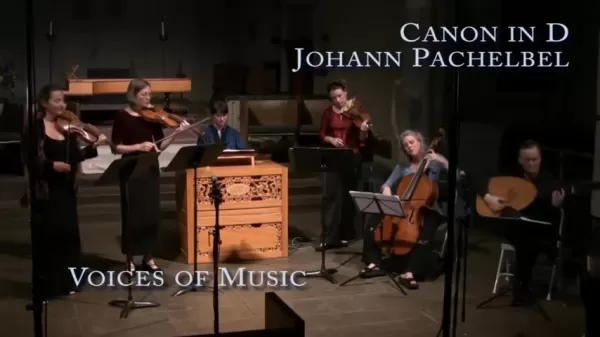
A canon is a compositional technique where a single melody is played by multiple voices in succession, creating a layered, echoing texture. In this piece, three violins perform a canon over a repeating eight-chord sequence known as a ground bass or basso ostinato.
This ground bass provides a stable harmonic foundation. The violins enter one after another, each playing the same melody at a staggered interval, weaving a rich and harmonious tapestry of sound.
The magic of Pachelbel’s Canon lies in its perfect blend of mathematical precision and emotional depth. The predictable bass offers comfort and stability, while the evolving violin lines introduce complexity and interest. This balance makes the piece widely accessible.
Pachelbel's Canon is built on a clear structure:
- Repeating bass line: Establishes a steady harmonic foundation.
- Three violins: Perform a melodic canon above the bass, entering in turn.
- Resulting effect: Creates an interwoven, harmonious texture that is both intricate and pleasing.
This structural clarity contributes to its remarkable versatility, explaining its centuries-long appeal across cultures. A defining work of the Baroque era, its graceful form suits weddings, film scores, and everyday listening alike.
Voices of Music: A Historically Informed Performance
Voices of Music is a celebrated early music ensemble committed to performing Baroque works with historical accuracy and heartfelt passion. Their rendition of Pachelbel's Canon provides a unique window into the piece, prioritizing the instruments and stylistic practices of Pachelbel's time.
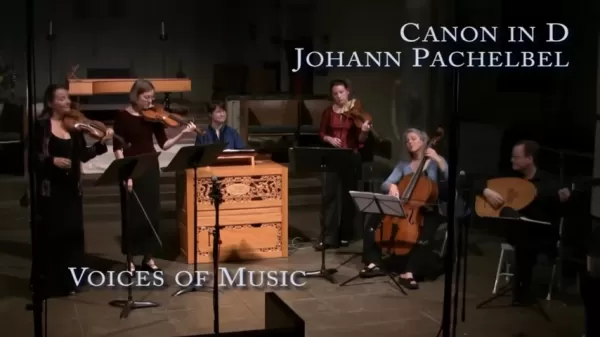
The group's dedication to authenticity goes beyond the notes. They research historical performance practices, ornamentation, and the specific instruments used during the Baroque period.
By employing period instruments like the baroque violin, baroque cello, theorbo, and baroque organ, Voices of Music reconstructs the sonic landscape Pachelbel knew. These instruments possess distinct tones compared to modern ones, delivering a more authentic listening experience.
Their performance demonstrates deep expertise and artistry, offering a fresh perspective on this familiar work that highlights its inherent beauty through historical lens. They play with a passion that underscores the piece's elegance.
Voices of Music utilizes the following period instruments:
- Baroque Violin: Produces a warmer, gentler tone than modern violins.
- Baroque Cello: Delivers a rich, resonant bass line.
- Theorbo: A large lute with extended bass strings that adds harmonic depth.
- Baroque Organ: A versatile keyboard offering a range of timbres.
Voices of Music members include:
- Katherine Kyme (Baroque Violin)
- Carla Moore (Baroque Violin)
- Cynthia Miller Freivogel (Baroque Violin)
- Tanya Tomkins (Baroque Cello)
- Hanneke van Proosdij (Baroque Organ)
- David Tayler (Theorbo)
The Canon's Enduring Appeal: Why We Still Love It
Centuries after its creation, Pachelbel's Canon in D continues to captivate global audiences. Its lasting popularity can be attributed to several key qualities:
- Simplicity: Its clear structure and repeating patterns make it immediately engaging and easy to appreciate.
- Elegance: The interplay of the violins creates a sophisticated and beautiful sonic texture.
- Emotional Depth: It evokes a spectrum of feelings, from serene tranquility to uplifting joy.
- Versatility: Its adaptable nature makes it fitting for diverse settings, from ceremonial to cinematic.
The Canon has been widely adopted in:
- Wedding Ceremonies
- Film and Television Scores
- Background Music
- Adaptations in Popular Music
Its presence in contemporary media has introduced the piece to new generations. The composition's straightforward beauty and emotional resonance make it a rewarding piece to study, listen to, and cherish. From its Baroque origins to the present day, its success is assured for years to come.
Exploring the Musical Structure
Analyzing the Ground Bass
The ground bass in Pachelbel's Canon is the fundamental bedrock of the piece—more than a simple loop, it is the harmonic anchor. This sequence of eight chords repeats throughout, providing a stable foundation for the violins' melodies. Its importance is multifaceted:
- Harmonic Stability: The repetition creates a comforting sense of predictability that listeners easily connect with.
- Foundation for Melody: It allows the violins to explore harmonies and variations without losing structural coherence.
- Counterpoint: A beautiful dialogue emerges between the constant bass and the weaving violin lines.
- Performance Flexibility: Its simplicity permits varied interpretations in instrumentation and arrangement while preserving the work's core identity.
Performances of Pachelbel's Canon often showcase different approaches to the ground bass. Some emphasize rhythm for a more driving energy, while others highlight harmonic subtleties.
The basic chord progression of the ground bass is as follows:
Chord 1 Chord 2 Chord 3 Chord 4 Chord 5 Chord 6 Chord 7 Chord 8 DABmF#mGDGAThis chart illustrates the common harmonic sequence that provides the stable core of Pachelbel's Canon in D.
The Melodic Canon: A Dialogue Between Violins
Sounding above the steadfast ground bass, the three violins engage in the melodic canon that forms the soul of the work. Each violin enters in turn, playing the same melody at an offset, crafting a rich, interwoven tapestry. The qualities of this canon are distinctive:
- Layered Texture: The staggered entries build an intricate, harmonious density, enriching the sound with each new voice.
- Interplay and Dialogue: The violins converse musically, echoing and responding to one another, creating a sense of narrative and movement.
- Emotional Resonance: The inherently expressive violin melodies evoke a wide emotional range, amplified by their interplay to create a powerful experience.
- Ornamentation: Skilled performers may add period-appropriate embellishments, lending further depth and personality to the rendition.
The captivating interplay between the violins draws listeners into a world of harmonic beauty. The piece's enduring connection with audiences stems from its ability to create a profound sense of beauty that invites repeated listening.
The Merits of Pachelbel's Canon in D
Pros
Universally appealing due to its simple beauty.
Evokes a wide spectrum of emotions, fitting for many occasions.
Instills a sense of peace and tranquility.
Highly adaptable for weddings, films, and casual listening.
Cons
Overexposure can lessen its impact for some audiences.
Some listeners may find its repetitive structure predictable.
Can be viewed as overly simplistic by certain classical purists.
Frequently Asked Questions
What is a canon in music?
A canon is a contrapuntal composition where a single melody is performed by multiple voices entering successively. Each voice imitates the melody, creating a layered and echoing effect.
Who was Johann Pachelbel?
Johann Pachelbel (1653-1706) was a German Baroque composer, organist, and teacher. He is most famous for his Canon in D but also composed a substantial body of organ, chamber, and vocal music.
What is Voices of Music?
Voices of Music is an early music ensemble dedicated to performing Baroque works with historical accuracy and passion. They use period instruments and performance practices to recreate the authentic sound of the era.
Where can I find more information about Voices of Music?
Visit their official website at www.voicesofmusic.org for details on their concerts, recordings, and educational resources.
Related Questions
What other pieces of music are similar to Pachelbel's Canon in D?
Other Baroque works share the elegant and emotive qualities of Pachelbel's Canon, including: Bach's Air on the G String: Renowned for its serene melody. Handel's Water Music: Celebrated for its festive spirit. Albinoni's Adagio in G Minor: Noted for its somber, dramatic character. These pieces exemplify the beauty and sophistication of Baroque music.
What is the historical significance of Baroque instruments?
Baroque instruments are significant for their unique timbres and construction, which differ from modern instruments. They offer a more authentic listening experience, allowing audiences to hear the music as originally conceived, often featuring gut strings on bowed instruments and wooden bodies on wind instruments.
Related article
 Stripe to Acquire OpenRouter as AI Model Routing Gains Momentum
Stripe has agreed to acquire OpenRouter, an AI model-routing platform that gives developers access to hundreds of models through a single interface. The deal adds model selection and routing to Stripe’s existing work around AI usage and token-based b
Former OpenAI Researcher Barrett Zoph Returns to Google to Support Gemini Development
Barret Zoph, who previously abruptly left and joined OpenAI due to a disagreement with Thinking Machines Lab CEO Miriam Mularati, has once again changed employers. Alphabet's Google announced that Zoph will return as Vice President of Research, bring
How Recursive Intelligence Raised $335M at $4B Valuation in 4 Months
The co-founders of startup Ricursive Intelligence seemed destined to be co-founders.Anna Goldie, CEO, and Azalia Mirhoseini, CTO, are so well-known in the AI community that they were among those AI engineers who “got those weird emails from Zuckerber
Related Special Topic Recommendations
Design & Art
Stripe to Acquire OpenRouter as AI Model Routing Gains Momentum
Stripe has agreed to acquire OpenRouter, an AI model-routing platform that gives developers access to hundreds of models through a single interface. The deal adds model selection and routing to Stripe’s existing work around AI usage and token-based b
Former OpenAI Researcher Barrett Zoph Returns to Google to Support Gemini Development
Barret Zoph, who previously abruptly left and joined OpenAI due to a disagreement with Thinking Machines Lab CEO Miriam Mularati, has once again changed employers. Alphabet's Google announced that Zoph will return as Vice President of Research, bring
How Recursive Intelligence Raised $335M at $4B Valuation in 4 Months
The co-founders of startup Ricursive Intelligence seemed destined to be co-founders.Anna Goldie, CEO, and Azalia Mirhoseini, CTO, are so well-known in the AI community that they were among those AI engineers who “got those weird emails from Zuckerber
Related Special Topic Recommendations
Design & Art
 Top AI Illustration Tools: Create Editorial Scenes and Cover Art Faster
2026 Latest Top-rated AI Illustration Tools: Our curated list features the best powerfully designed tools for creating stunning editorial scenes and eye-catching cover art quickly. Each option has gone through rigorous real-world tests, offering a free vs paid comparison to help you find the perfect match for your workflow. Try these must-try solutions today to unlock your AI edge and boost your creative productivity. Explore now at XIX.AI.
 10 tools
 xix.ai
Education and Learning
Top AI Tutors for Exam Prep: Practice Math, Science, and English
xix.ai
Education and Learning
Top AI Tutors for Exam Prep: Practice Math, Science, and English
2026 Latest Top-Rated Best AI Tutors for Exam Prep are here on XIX.AI! Our curated list features powerful game-changing tools that offer free vs paid comparison, real-world tests, and weekly updated rankings. They help boost your writing efficiency, simplify complex topic learning, and unlock your academic potential. Explore now to Discover your perfect exam prep tool and Start creating today to Unlock your AI edge!
10 tools
xix.ai
Finance
AI Budget Planning Tools for Personal Money Management
2026 Latest Best Top-Rated AI Budget Planning Tools for Personal Money Management are here on XIX.AI! This curated collection features powerful, game-changing solutions that help you conduct real-world tests, understand spending habits, and create personalized plans to boost productivity. Enjoy a free vs paid comparison along with detailed rankings. Must-try tools designed to simplify money management and unlock your AI edge. Explore now!
11 tools
xix.ai
Health & Wellness
AI Sleep Tracking Assistants: Improve Recovery with Better Bedtime Habits
2026 Latest Best Top-Rated AI Sleep Tracking Assistants curated for ultimate recovery. This fully updated weekly guide features powerful tools that deliver real-world tests, free vs paid comparison, and detailed rankings to help you find the must-try solution that boosts sleep quality and supports better bedtime habits. Explore now at XIX.AI to Unlock your AI edge.
10 tools
xix.ai
Data Analysis
AI SQL Copilots for Product and Revenue Analytics
2026 Latest Best Top-Rated AI SQL Copilots for Product and Revenue Analytics! XIX.AI has curated a powerful, game-changing collection of must-try tools that undergo real-world tests through weekly updated rankings. These tools help users boost productivity significantly by accelerating data analysis, streamlining complex queries, and generating accurate insights to drive smarter business decisions. Explore now to Discover your perfect tool for unlocking your AI edge!
14 tools
xix.ai
Education and Learning
Best AI Homework Helpers That Teach: Learn Concepts, Not Just Answers
2026 Latest Best Top-Rated AI Homework Helpers That Teach Core Concepts Not Just Answers Powerful Tools for Students Must-Try Curated List Weekly Updated Free vs Paid Comparison Real-World Tests Accurate Rankings to Help You Unlock Your Full Learning Potential Explore now to Discover your perfect tool for smarter studying.
10 tools
xix.ai

 Comments (1)
0/500
Comments (1)
0/500
![RalphJohnson]()
パッヘルベルの『カノン ニ長調』、この曲は本当にどこでも聞こえますよね。結婚式であれば定番で、最近のCMでもよく使われている気がします。しかし、これだけ有名なのに、ヨハン・パッヘルベル自身はこの曲の成功を目の当たりにできなかったのは、少し考えさせられますね。音楽の未来や遺産について考えちゃいます。🎵
Johann Pachelbel's Canon in D is arguably one of the most recognizable and beloved pieces of classical music. Its elegant yet simple structure has cemented its place at weddings, in films, and on casual playlists. This article delves into the history of this timeless composition, explores a distinct performance by the ensemble Voices of Music, and examines the reasons for its lasting popularity.
Key Points
Pachelbel's Canon in D is a cornerstone of Baroque music, celebrated for its beautiful simplicity.
The Voices of Music ensemble presents a historically informed interpretation of the Canon.
The piece features a repeating ground bass overlaid with a three-violin canon.
Its enduring charm lies in its power to evoke feelings of peace, joy, and contemplation.
The Enduring Legacy of Pachelbel's Canon in D
What is Pachelbel's Canon in D?
Composed around 1680, Johann Pachelbel's Canon in D is a masterclass in musical simplicity.
A canon is a compositional technique where a single melody is played by multiple voices in succession, creating a layered, echoing texture. In this piece, three violins perform a canon over a repeating eight-chord sequence known as a ground bass or basso ostinato.
This ground bass provides a stable harmonic foundation. The violins enter one after another, each playing the same melody at a staggered interval, weaving a rich and harmonious tapestry of sound.
The magic of Pachelbel’s Canon lies in its perfect blend of mathematical precision and emotional depth. The predictable bass offers comfort and stability, while the evolving violin lines introduce complexity and interest. This balance makes the piece widely accessible.
Pachelbel's Canon is built on a clear structure:
- Repeating bass line: Establishes a steady harmonic foundation.
- Three violins: Perform a melodic canon above the bass, entering in turn.
- Resulting effect: Creates an interwoven, harmonious texture that is both intricate and pleasing.
This structural clarity contributes to its remarkable versatility, explaining its centuries-long appeal across cultures. A defining work of the Baroque era, its graceful form suits weddings, film scores, and everyday listening alike.
Voices of Music: A Historically Informed Performance
Voices of Music is a celebrated early music ensemble committed to performing Baroque works with historical accuracy and heartfelt passion. Their rendition of Pachelbel's Canon provides a unique window into the piece, prioritizing the instruments and stylistic practices of Pachelbel's time.
The group's dedication to authenticity goes beyond the notes. They research historical performance practices, ornamentation, and the specific instruments used during the Baroque period.
By employing period instruments like the baroque violin, baroque cello, theorbo, and baroque organ, Voices of Music reconstructs the sonic landscape Pachelbel knew. These instruments possess distinct tones compared to modern ones, delivering a more authentic listening experience.
Their performance demonstrates deep expertise and artistry, offering a fresh perspective on this familiar work that highlights its inherent beauty through historical lens. They play with a passion that underscores the piece's elegance.
Voices of Music utilizes the following period instruments:
- Baroque Violin: Produces a warmer, gentler tone than modern violins.
- Baroque Cello: Delivers a rich, resonant bass line.
- Theorbo: A large lute with extended bass strings that adds harmonic depth.
- Baroque Organ: A versatile keyboard offering a range of timbres.
Voices of Music members include:
- Katherine Kyme (Baroque Violin)
- Carla Moore (Baroque Violin)
- Cynthia Miller Freivogel (Baroque Violin)
- Tanya Tomkins (Baroque Cello)
- Hanneke van Proosdij (Baroque Organ)
- David Tayler (Theorbo)
The Canon's Enduring Appeal: Why We Still Love It
Centuries after its creation, Pachelbel's Canon in D continues to captivate global audiences. Its lasting popularity can be attributed to several key qualities:
- Simplicity: Its clear structure and repeating patterns make it immediately engaging and easy to appreciate.
- Elegance: The interplay of the violins creates a sophisticated and beautiful sonic texture.
- Emotional Depth: It evokes a spectrum of feelings, from serene tranquility to uplifting joy.
- Versatility: Its adaptable nature makes it fitting for diverse settings, from ceremonial to cinematic.
The Canon has been widely adopted in:
- Wedding Ceremonies
- Film and Television Scores
- Background Music
- Adaptations in Popular Music
Its presence in contemporary media has introduced the piece to new generations. The composition's straightforward beauty and emotional resonance make it a rewarding piece to study, listen to, and cherish. From its Baroque origins to the present day, its success is assured for years to come.
Exploring the Musical Structure
Analyzing the Ground Bass
The ground bass in Pachelbel's Canon is the fundamental bedrock of the piece—more than a simple loop, it is the harmonic anchor. This sequence of eight chords repeats throughout, providing a stable foundation for the violins' melodies. Its importance is multifaceted:
- Harmonic Stability: The repetition creates a comforting sense of predictability that listeners easily connect with.
- Foundation for Melody: It allows the violins to explore harmonies and variations without losing structural coherence.
- Counterpoint: A beautiful dialogue emerges between the constant bass and the weaving violin lines.
- Performance Flexibility: Its simplicity permits varied interpretations in instrumentation and arrangement while preserving the work's core identity.
Performances of Pachelbel's Canon often showcase different approaches to the ground bass. Some emphasize rhythm for a more driving energy, while others highlight harmonic subtleties.
The basic chord progression of the ground bass is as follows:
This chart illustrates the common harmonic sequence that provides the stable core of Pachelbel's Canon in D.
The Melodic Canon: A Dialogue Between Violins
Sounding above the steadfast ground bass, the three violins engage in the melodic canon that forms the soul of the work. Each violin enters in turn, playing the same melody at an offset, crafting a rich, interwoven tapestry. The qualities of this canon are distinctive:
- Layered Texture: The staggered entries build an intricate, harmonious density, enriching the sound with each new voice.
- Interplay and Dialogue: The violins converse musically, echoing and responding to one another, creating a sense of narrative and movement.
- Emotional Resonance: The inherently expressive violin melodies evoke a wide emotional range, amplified by their interplay to create a powerful experience.
- Ornamentation: Skilled performers may add period-appropriate embellishments, lending further depth and personality to the rendition.
The captivating interplay between the violins draws listeners into a world of harmonic beauty. The piece's enduring connection with audiences stems from its ability to create a profound sense of beauty that invites repeated listening.
The Merits of Pachelbel's Canon in D
Pros
Universally appealing due to its simple beauty.
Evokes a wide spectrum of emotions, fitting for many occasions.
Instills a sense of peace and tranquility.
Highly adaptable for weddings, films, and casual listening.
Cons
Overexposure can lessen its impact for some audiences.
Some listeners may find its repetitive structure predictable.
Can be viewed as overly simplistic by certain classical purists.
Frequently Asked Questions
What is a canon in music?
A canon is a contrapuntal composition where a single melody is performed by multiple voices entering successively. Each voice imitates the melody, creating a layered and echoing effect.
Who was Johann Pachelbel?
Johann Pachelbel (1653-1706) was a German Baroque composer, organist, and teacher. He is most famous for his Canon in D but also composed a substantial body of organ, chamber, and vocal music.
What is Voices of Music?
Voices of Music is an early music ensemble dedicated to performing Baroque works with historical accuracy and passion. They use period instruments and performance practices to recreate the authentic sound of the era.
Where can I find more information about Voices of Music?
Visit their official website at www.voicesofmusic.org for details on their concerts, recordings, and educational resources.
Related Questions
What other pieces of music are similar to Pachelbel's Canon in D?
Other Baroque works share the elegant and emotive qualities of Pachelbel's Canon, including: Bach's Air on the G String: Renowned for its serene melody. Handel's Water Music: Celebrated for its festive spirit. Albinoni's Adagio in G Minor: Noted for its somber, dramatic character. These pieces exemplify the beauty and sophistication of Baroque music.
What is the historical significance of Baroque instruments?
Baroque instruments are significant for their unique timbres and construction, which differ from modern instruments. They offer a more authentic listening experience, allowing audiences to hear the music as originally conceived, often featuring gut strings on bowed instruments and wooden bodies on wind instruments.








 Stripe to Acquire OpenRouter as AI Model Routing Gains Momentum
Stripe has agreed to acquire OpenRouter, an AI model-routing platform that gives developers access to hundreds of models through a single interface. The deal adds model selection and routing to Stripe’s existing work around AI usage and token-based b
Stripe to Acquire OpenRouter as AI Model Routing Gains Momentum
Stripe has agreed to acquire OpenRouter, an AI model-routing platform that gives developers access to hundreds of models through a single interface. The deal adds model selection and routing to Stripe’s existing work around AI usage and token-based b
 Former OpenAI Researcher Barrett Zoph Returns to Google to Support Gemini Development
Barret Zoph, who previously abruptly left and joined OpenAI due to a disagreement with Thinking Machines Lab CEO Miriam Mularati, has once again changed employers. Alphabet's Google announced that Zoph will return as Vice President of Research, bring
Former OpenAI Researcher Barrett Zoph Returns to Google to Support Gemini Development
Barret Zoph, who previously abruptly left and joined OpenAI due to a disagreement with Thinking Machines Lab CEO Miriam Mularati, has once again changed employers. Alphabet's Google announced that Zoph will return as Vice President of Research, bring
 How Recursive Intelligence Raised $335M at $4B Valuation in 4 Months
The co-founders of startup Ricursive Intelligence seemed destined to be co-founders.Anna Goldie, CEO, and Azalia Mirhoseini, CTO, are so well-known in the AI community that they were among those AI engineers who “got those weird emails from Zuckerber
How Recursive Intelligence Raised $335M at $4B Valuation in 4 Months
The co-founders of startup Ricursive Intelligence seemed destined to be co-founders.Anna Goldie, CEO, and Azalia Mirhoseini, CTO, are so well-known in the AI community that they were among those AI engineers who “got those weird emails from Zuckerber

2026 Latest Top-rated AI Illustration Tools: Our curated list features the best powerfully designed tools for creating stunning editorial scenes and eye-catching cover art quickly. Each option has gone through rigorous real-world tests, offering a free vs paid comparison to help you find the perfect match for your workflow. Try these must-try solutions today to unlock your AI edge and boost your creative productivity. Explore now at XIX.AI.
10 tools
xix.ai

2026 Latest Top-Rated Best AI Tutors for Exam Prep are here on XIX.AI! Our curated list features powerful game-changing tools that offer free vs paid comparison, real-world tests, and weekly updated rankings. They help boost your writing efficiency, simplify complex topic learning, and unlock your academic potential. Explore now to Discover your perfect exam prep tool and Start creating today to Unlock your AI edge!
10 tools
xix.ai

2026 Latest Best Top-Rated AI Budget Planning Tools for Personal Money Management are here on XIX.AI! This curated collection features powerful, game-changing solutions that help you conduct real-world tests, understand spending habits, and create personalized plans to boost productivity. Enjoy a free vs paid comparison along with detailed rankings. Must-try tools designed to simplify money management and unlock your AI edge. Explore now!
11 tools
xix.ai

2026 Latest Best Top-Rated AI Sleep Tracking Assistants curated for ultimate recovery. This fully updated weekly guide features powerful tools that deliver real-world tests, free vs paid comparison, and detailed rankings to help you find the must-try solution that boosts sleep quality and supports better bedtime habits. Explore now at XIX.AI to Unlock your AI edge.
10 tools
xix.ai

2026 Latest Best Top-Rated AI SQL Copilots for Product and Revenue Analytics! XIX.AI has curated a powerful, game-changing collection of must-try tools that undergo real-world tests through weekly updated rankings. These tools help users boost productivity significantly by accelerating data analysis, streamlining complex queries, and generating accurate insights to drive smarter business decisions. Explore now to Discover your perfect tool for unlocking your AI edge!
14 tools
xix.ai

2026 Latest Best Top-Rated AI Homework Helpers That Teach Core Concepts Not Just Answers Powerful Tools for Students Must-Try Curated List Weekly Updated Free vs Paid Comparison Real-World Tests Accurate Rankings to Help You Unlock Your Full Learning Potential Explore now to Discover your perfect tool for smarter studying.
10 tools
xix.ai

パッヘルベルの『カノン ニ長調』、この曲は本当にどこでも聞こえますよね。結婚式であれば定番で、最近のCMでもよく使われている気がします。しかし、これだけ有名なのに、ヨハン・パッヘルベル自身はこの曲の成功を目の当たりにできなかったのは、少し考えさせられますね。音楽の未来や遺産について考えちゃいます。🎵












