


 Home
HomeCyberRealistic: Crafting Lifelike AI-Generated Artworks
In the rapidly advancing realm of AI-driven art, CyberRealistic stands out as a top-tier model, empowering users to produce remarkably lifelike images. This sophisticated tool, rigorously tested and refined, merges multiple AI frameworks to yield outstanding results. This article delves into CyberRealistic’s core features, testing insights, and optimal configurations, catering to both novice and seasoned AI artists.
Highlights
CyberRealistic excels in generating highly lifelike visuals.
It employs textual inversions and LoRAs for intricate outputs.
Minimal input prompts yield impressive outcomes.
Negative embeddings significantly boost image quality.
Optimal sampling steps, samplers, and CFG scales ensure peak performance.
Testing confirms strong results in creating realistic portraits and landscapes.
CyberRealistic: Mastering Photorealistic AI Art
What is CyberRealistic?
CyberRealistic, developed by Cyberdelia, is a checkpoint model crafted to produce strikingly photorealistic images through AI.
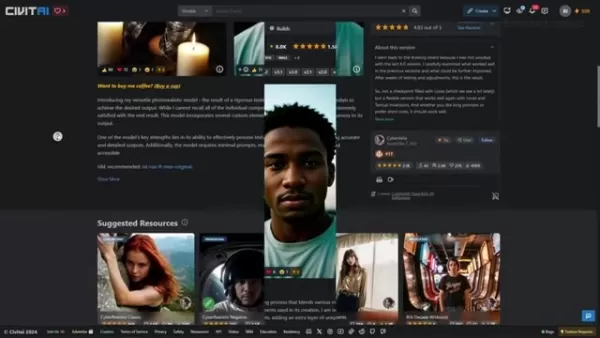
This model shines as a versatile photorealistic solution, meticulously developed through extensive testing and the integration of multiple AI models for superior output. Its strength lies in efficiently handling textual inversions and LoRAs, delivering precise and detailed visuals. Designed for ease of use, CyberRealistic requires minimal prompting, making it accessible to users of all skill levels. Custom elements add a unique touch to its outputs.
It’s an ideal tool for digital artists, hobbyists, and professionals aiming to create high-quality, realistic visuals effortlessly. From detailed portraits to breathtaking landscapes or intricate object renderings, CyberRealistic brings creative visions to life. Its consistent testing and model integration ensure reliable, high-quality results with vivid realism.
The model’s lifelike outputs stem from its fusion of various AI frameworks, rigorously tested to deliver optimal results. Its minimal prompting requirement makes it approachable for both beginners and advanced Stable Diffusion users.
Key Features of CyberRealistic
CyberRealistic offers a suite of features that drive its exceptional performance:
- Photorealism: Its core strength is generating images that mirror real-world photographs, achieved through advanced rendering and meticulous detail.
- Versatility: The model handles diverse subjects, from human portraits to landscapes and still life compositions.
- Textual Inversion and LoRA Support: CyberRealistic processes textual inversions and LoRAs effectively, enabling precise image customization.
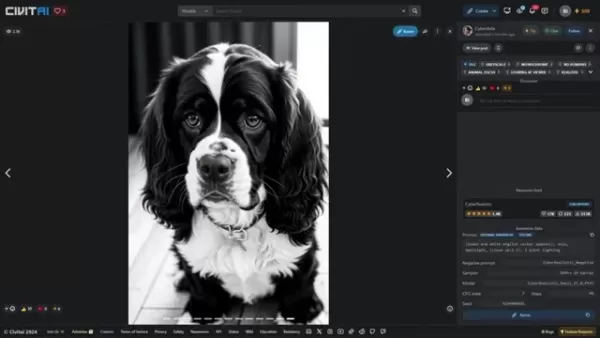
This allows artists to tailor details and aesthetics to their specific needs.
- Minimal Prompting: Its user-friendly design enables even novice Stable Diffusion users to create photorealistic images with simple prompts.
CyberRealistic is perfect for various applications. Digital artists can craft stunning visuals for projects, advertisers can create realistic campaign mockups, architects and designers can visualize designs with precision, and hobbyists can explore creative ideas. Its advanced features ensure versatility while remaining accessible across different prompt types.
Testing and Initial Insights
Understanding CyberRealistic’s capabilities requires hands-on testing. The model emphasizes the use of negative embeddings, which must be downloaded separately. Initial tests replicated example image data to verify the checkpoint’s performance, comparing results to the author’s outputs to spot any differences.
Results were impressive, producing images closely aligned with the originals, with minor variations in posture and color tones.
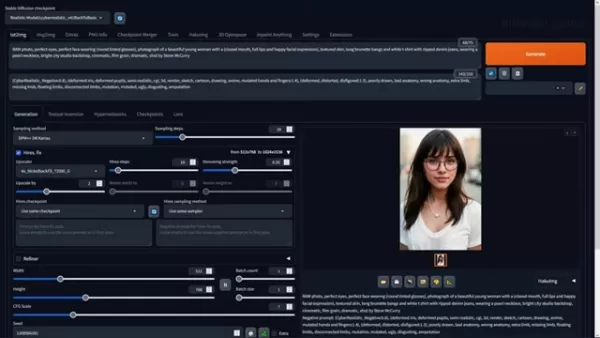
These slight differences didn’t compromise quality, confirming the model’s reliability. Further tests without negative embeddings revealed their critical role in enhancing image quality, lighting, and consistency, particularly for details like candle positioning.
Optimizing for Best Results
Achieving top-tier results with CyberRealistic demands careful tuning of settings. Tests explored optimal values for sampling steps, samplers, CFG Scale, and clip skip.
- Sampling Steps: Testing steps from 10 to 50 showed no significant improvement beyond 20 steps.
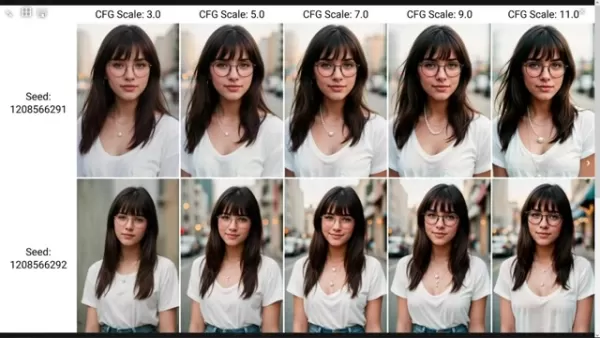
Images at 20 steps matched the quality of higher counts, making it an efficient choice.
Samplers: Tests compared DPM++ 2M Karras, DPM++ SDE Karras, Euler a, and DDIM samplers. DPM++ 2M Karras, as recommended, performed best, though DDIM also delivered strong results. SDE Karras added unprompted elements like a denim jacket, while Euler a produced a plain background.
Sampler analysis summary:
Sampler Results DPM++ 2M Karras Recommended, delivers outstanding results DPM++ SDE Karras Introduced unprompted elements Euler a Produced subpar output compared to others DDIM Excellent results, comparable to DPM++ 2M Karras
- CFG Scale: Testing CFG scales from 3.0 to 11.0 showed values between 5 and 9 offered the best balance of detail and smoothness. Lower values outperformed higher ones.
- Clip Skip: A clip skip value of 1 yielded optimal results, while higher values caused distortions in facial features and lighting.
These settings provide a foundation for optimizing CyberRealistic workflows, balancing performance and visual quality.
Enhancing Image Creation
Skin Tones, Objects, Animals, & Landmarks
Beyond basic testing, CyberRealistic’s ability to handle varied prompts was explored, including skin tones, object rendering, animal depictions, and ethnic diversity, with generally accurate results.
Skin tone prompts distinguished between light and dark tones effectively.
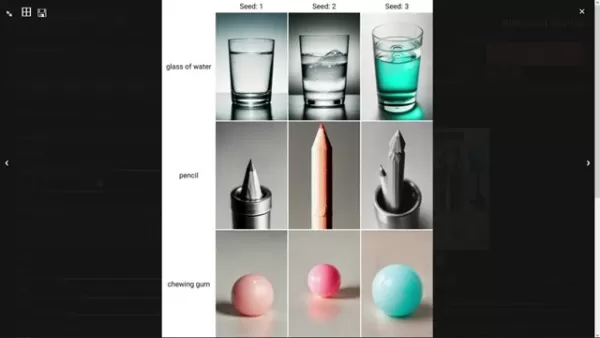
Non-standard tones, like purple, were less accurate. Ethnicity prompts, such as African, produced noticeably darker skin tones.
Object rendering showed variability, requiring detailed prompts for higher accuracy. Quality remained high, though results varied based on prompt specificity.
Animal prompts prioritized quality over accuracy. For instance, a “scorpion” prompt resembled a grasshopper, suggesting more descriptive prompts for precise outcomes.
CyberRealistic: Strengths and Limitations
Strengths
Produces photorealistic images nearly indistinguishable from real photos.
User-friendly, especially with minimal prompting requirements.
Handles textual inversions and LoRAs effectively for detailed customization.
Versatile across portraits, landscapes, and objects.
Limitations
Requires separate negative embedding downloads.
Struggles with abstract image generation.
Optimal output demands parameter adjustments.
Frequently Asked Questions (FAQ)
What is a realistic style checkpoint in AI art?
A realistic style checkpoint is an AI model trained to create images mimicking real-world photographs, capturing fine details and textures for high-fidelity visuals.
What types of images benefit from CyberRealistic?
CyberRealistic excels in portraits, environmental scenes, and various objects, offering accurate and detailed outputs for diverse prompts.
Why are negative embeddings critical for CyberRealistic?
Negative embeddings refine image generation by minimizing artifacts, enhancing lighting, and improving overall quality.
What are the optimal sampling steps for CyberRealistic?
Tests indicate 20 sampling steps suffice for excellent results, with no significant gains beyond this point.
Which samplers perform best with CyberRealistic?
DPM++ 2M Karras is the top choice, with DDIM also delivering strong results. Other samplers may introduce unwanted elements.
What is the ideal CFG scale for CyberRealistic?
CFG scales between 5 and 9 balance detail and smoothness, with lower values generally performing better.
How does clip skip impact CyberRealistic?
A clip skip value of 1 ensures optimal results, while higher values may distort facial features and lighting.
Related Questions
How does CyberRealistic compare to other AI art models?
CyberRealistic stands out with its focus on photorealism, support for textual inversions and LoRAs, and minimal prompting needs. Unlike models favoring stylized or abstract art, it produces images nearly identical to real photographs, ideal for realism-driven applications. Its fine-tuned control and accessibility make it a compelling choice for both new and experienced artists, though it may lack flexibility for abstract outputs.
How can I enhance CyberRealistic’s performance?
Boost CyberRealistic’s output with these strategies: Use negative embeddings to reduce artifacts and improve quality. Set sampling steps to 20 for efficient, high-quality results. Choose DPM++ 2M Karras or DDIM samplers for optimal performance. Adjust CFG scales between 5 and 9 for balanced visuals. Set clip skip to 1 to avoid distortions. Experimenting with these settings can tailor the model to your desired aesthetic.
What ethical considerations arise with AI art models like CyberRealistic?
AI art models like CyberRealistic pose ethical challenges, including potential copyright infringement from training on existing image datasets. Users must ensure outputs don’t violate intellectual property rights. Questions of authorship—whether the artist, model developers, or AI itself—remain complex. Misuse risks, such as creating deepfakes or misleading content, highlight the need for ethical guidelines to ensure responsible use and innovation.
Related article
 Meta Removes AI Photo Editing Feature Following User Backlash
Meta, the social media giant, is once again embroiled in a public debate regarding the delicate balance between artificial intelligence and user privacy. According to TechCrunch, Meta’s Superintelligence Labs introduced a new AI image generator, Muse
DeepMind CEO Hassabis: I sleep six hours a day, usually feel energetic around 1 a.m.
Fortune recently featured an interview with Demis Hassabis, CEO of Google DeepMind, revealing his unconventional approach to rest and productivity. Hassabis disclosed that he sleeps very little, structuring his waking hours into two distinct work blo
OpenAI, Anthropic Vie for Market Share Despite Revenue Shortfalls
Despite recent reports suggesting OpenAI missed revenue targets, creating pressure on tech stocks this Tuesday, private AI lab investors remain resilient. Seasoned backers have confirmed they will not reduce investment despite negative media coverage
Related Special Topic Recommendations
Video creation
Meta Removes AI Photo Editing Feature Following User Backlash
Meta, the social media giant, is once again embroiled in a public debate regarding the delicate balance between artificial intelligence and user privacy. According to TechCrunch, Meta’s Superintelligence Labs introduced a new AI image generator, Muse
DeepMind CEO Hassabis: I sleep six hours a day, usually feel energetic around 1 a.m.
Fortune recently featured an interview with Demis Hassabis, CEO of Google DeepMind, revealing his unconventional approach to rest and productivity. Hassabis disclosed that he sleeps very little, structuring his waking hours into two distinct work blo
OpenAI, Anthropic Vie for Market Share Despite Revenue Shortfalls
Despite recent reports suggesting OpenAI missed revenue targets, creating pressure on tech stocks this Tuesday, private AI lab investors remain resilient. Seasoned backers have confirmed they will not reduce investment despite negative media coverage
Related Special Topic Recommendations
Video creation
 AI Short-Form Video Hook Generators for Reels, Shorts, and Product Launch Campaigns
2026 Latest Best AI Short-Form Video Hook Generators for Reels Shorts and Product Launch Campaigns! XIX.AI curates top-rated powerful game-changing tools that deliver must-try results through real-world tests. This weekly updated page offers free vs paid comparison rankings to help you find the perfect solution for boosting content creativity and productivity. Explore now to Unlock your AI edge!
 11 tools
 xix.ai
writing
AI Article Outline Tools for Long Form Writing
xix.ai
writing
AI Article Outline Tools for Long Form Writing
2026 Latest Best Top-Rated AI Article Outline Tools for Long Form Writing! This curated collection features powerful, game-changing tools that deliver accurate, structured outlines with real-world tests to boost writing efficiency significantly. XIX.AI is part of this elite selection. Get a free vs paid comparison to help you choose the perfect tool. Explore now and Unlock your AI edge!
9 tools
xix.ai
chatbot
Best AI Roleplay Chat Apps for Language Practice, Interview Prep, and Daily Fluency
2026 Latest Best Top-rated AI Roleplay Chat Apps for Language Practice, Interview Prep, and Daily Fluency! XIX.AI curates a powerful game-changing collection that offers free vs paid comparison, real-world tests, and updated rankings weekly. These must-try tools help you boost writing skills, overcome fluency challenges, and improve communication efficiency across all daily scenarios. Explore now to discover your perfect tool for language growth!
10 tools
xix.ai
Music composition
AI Stem Separation Tools for Remix Production, Sampling Prep, and Karaoke Masters
2026 Latest Best Top-rated AI Stem Separation Tools Curated for Remix Production, Sampling Prep, and Karaoke Masters. These powerful game-changing tools offer real-world tests to deliver precise audio isolation, boosting productivity significantly. XIX.AI provides a weekly updated free vs paid comparison guide to help you find the must-try solution that suits your needs. Explore now to unlock your AI edge.
8 tools
xix.ai
Data Analysis
AI SQL Copilots for Revenue Dashboards, Funnel Analysis, and Product Metrics
2026 Latest Best AI SQL Copilots Ranked Top-Rated! XIX.AI curates a powerful game-changing collection for weekly updated real-world tests. These must-try tools help you generate accurate revenue dashboards, analyze sales funnels, and track product metrics swiftly, boosting productivity massively. Explore now to Discover your perfect tool for data-driven decision making! 238 characters
9 tools
xix.ai
Music composition
Best AI Melody Writing Tools for Song Drafts
2026 Latest Best Top-Rated AI Melody Writing Tools for Song Drafts! XIX.AI has curated a highly powerful game-changing collection that goes through rigorous real-world tests to deliver the best writing experience. You can find detailed free vs paid comparisons, accurate rankings, and must-try options designed to help you create stunning song drafts effortlessly and boost your creative productivity significantly. Explore now to discover your perfect tool!
8 tools
xix.ai

 Comments (2)
0/500
Comments (2)
0/500
![NoahSmith]()
I've been tinkering with AI art generators for a while, and CyberRealistic sounds like a game-changer. The level of detail in those sample images is almost creepy—like, are we sure this isn't just a fancy camera? 😅 But honestly, I'm more worried about deepfakes than impressed. How do we even trust photos anymore?
![GregoryWilson]()
超現実的な画像がこんなに簡単に作れるなんて。ただ、技術の急速な進歩はわくわくする反面、芸術家の仕事が奪われる可能性も気になってしまう。生成AIがクリエイターの市場に与える影響は、これからどうなっていくのだろう?🎨
In the rapidly advancing realm of AI-driven art, CyberRealistic stands out as a top-tier model, empowering users to produce remarkably lifelike images. This sophisticated tool, rigorously tested and refined, merges multiple AI frameworks to yield outstanding results. This article delves into CyberRealistic’s core features, testing insights, and optimal configurations, catering to both novice and seasoned AI artists.
Highlights
CyberRealistic excels in generating highly lifelike visuals.
It employs textual inversions and LoRAs for intricate outputs.
Minimal input prompts yield impressive outcomes.
Negative embeddings significantly boost image quality.
Optimal sampling steps, samplers, and CFG scales ensure peak performance.
Testing confirms strong results in creating realistic portraits and landscapes.
CyberRealistic: Mastering Photorealistic AI Art
What is CyberRealistic?
CyberRealistic, developed by Cyberdelia, is a checkpoint model crafted to produce strikingly photorealistic images through AI.
This model shines as a versatile photorealistic solution, meticulously developed through extensive testing and the integration of multiple AI models for superior output. Its strength lies in efficiently handling textual inversions and LoRAs, delivering precise and detailed visuals. Designed for ease of use, CyberRealistic requires minimal prompting, making it accessible to users of all skill levels. Custom elements add a unique touch to its outputs.
It’s an ideal tool for digital artists, hobbyists, and professionals aiming to create high-quality, realistic visuals effortlessly. From detailed portraits to breathtaking landscapes or intricate object renderings, CyberRealistic brings creative visions to life. Its consistent testing and model integration ensure reliable, high-quality results with vivid realism.
The model’s lifelike outputs stem from its fusion of various AI frameworks, rigorously tested to deliver optimal results. Its minimal prompting requirement makes it approachable for both beginners and advanced Stable Diffusion users.
Key Features of CyberRealistic
CyberRealistic offers a suite of features that drive its exceptional performance:
- Photorealism: Its core strength is generating images that mirror real-world photographs, achieved through advanced rendering and meticulous detail.
- Versatility: The model handles diverse subjects, from human portraits to landscapes and still life compositions.
- Textual Inversion and LoRA Support: CyberRealistic processes textual inversions and LoRAs effectively, enabling precise image customization.
This allows artists to tailor details and aesthetics to their specific needs.
- Minimal Prompting: Its user-friendly design enables even novice Stable Diffusion users to create photorealistic images with simple prompts.
CyberRealistic is perfect for various applications. Digital artists can craft stunning visuals for projects, advertisers can create realistic campaign mockups, architects and designers can visualize designs with precision, and hobbyists can explore creative ideas. Its advanced features ensure versatility while remaining accessible across different prompt types.
Testing and Initial Insights
Understanding CyberRealistic’s capabilities requires hands-on testing. The model emphasizes the use of negative embeddings, which must be downloaded separately. Initial tests replicated example image data to verify the checkpoint’s performance, comparing results to the author’s outputs to spot any differences.
Results were impressive, producing images closely aligned with the originals, with minor variations in posture and color tones.
These slight differences didn’t compromise quality, confirming the model’s reliability. Further tests without negative embeddings revealed their critical role in enhancing image quality, lighting, and consistency, particularly for details like candle positioning.
Optimizing for Best Results
Achieving top-tier results with CyberRealistic demands careful tuning of settings. Tests explored optimal values for sampling steps, samplers, CFG Scale, and clip skip.
- Sampling Steps: Testing steps from 10 to 50 showed no significant improvement beyond 20 steps.
Images at 20 steps matched the quality of higher counts, making it an efficient choice.
Samplers: Tests compared DPM++ 2M Karras, DPM++ SDE Karras, Euler a, and DDIM samplers. DPM++ 2M Karras, as recommended, performed best, though DDIM also delivered strong results. SDE Karras added unprompted elements like a denim jacket, while Euler a produced a plain background.
Sampler analysis summary:
| Sampler | Results |
|---|---|
| DPM++ 2M Karras | Recommended, delivers outstanding results |
| DPM++ SDE Karras | Introduced unprompted elements |
| Euler a | Produced subpar output compared to others |
| DDIM | Excellent results, comparable to DPM++ 2M Karras |
- CFG Scale: Testing CFG scales from 3.0 to 11.0 showed values between 5 and 9 offered the best balance of detail and smoothness. Lower values outperformed higher ones.
- Clip Skip: A clip skip value of 1 yielded optimal results, while higher values caused distortions in facial features and lighting.
These settings provide a foundation for optimizing CyberRealistic workflows, balancing performance and visual quality.
Enhancing Image Creation
Skin Tones, Objects, Animals, & Landmarks
Beyond basic testing, CyberRealistic’s ability to handle varied prompts was explored, including skin tones, object rendering, animal depictions, and ethnic diversity, with generally accurate results.
Skin tone prompts distinguished between light and dark tones effectively.
Non-standard tones, like purple, were less accurate. Ethnicity prompts, such as African, produced noticeably darker skin tones.
Object rendering showed variability, requiring detailed prompts for higher accuracy. Quality remained high, though results varied based on prompt specificity.
Animal prompts prioritized quality over accuracy. For instance, a “scorpion” prompt resembled a grasshopper, suggesting more descriptive prompts for precise outcomes.
CyberRealistic: Strengths and Limitations
Strengths
Produces photorealistic images nearly indistinguishable from real photos.
User-friendly, especially with minimal prompting requirements.
Handles textual inversions and LoRAs effectively for detailed customization.
Versatile across portraits, landscapes, and objects.
Limitations
Requires separate negative embedding downloads.
Struggles with abstract image generation.
Optimal output demands parameter adjustments.
Frequently Asked Questions (FAQ)
What is a realistic style checkpoint in AI art?
A realistic style checkpoint is an AI model trained to create images mimicking real-world photographs, capturing fine details and textures for high-fidelity visuals.
What types of images benefit from CyberRealistic?
CyberRealistic excels in portraits, environmental scenes, and various objects, offering accurate and detailed outputs for diverse prompts.
Why are negative embeddings critical for CyberRealistic?
Negative embeddings refine image generation by minimizing artifacts, enhancing lighting, and improving overall quality.
What are the optimal sampling steps for CyberRealistic?
Tests indicate 20 sampling steps suffice for excellent results, with no significant gains beyond this point.
Which samplers perform best with CyberRealistic?
DPM++ 2M Karras is the top choice, with DDIM also delivering strong results. Other samplers may introduce unwanted elements.
What is the ideal CFG scale for CyberRealistic?
CFG scales between 5 and 9 balance detail and smoothness, with lower values generally performing better.
How does clip skip impact CyberRealistic?
A clip skip value of 1 ensures optimal results, while higher values may distort facial features and lighting.
Related Questions
How does CyberRealistic compare to other AI art models?
CyberRealistic stands out with its focus on photorealism, support for textual inversions and LoRAs, and minimal prompting needs. Unlike models favoring stylized or abstract art, it produces images nearly identical to real photographs, ideal for realism-driven applications. Its fine-tuned control and accessibility make it a compelling choice for both new and experienced artists, though it may lack flexibility for abstract outputs.
How can I enhance CyberRealistic’s performance?
Boost CyberRealistic’s output with these strategies: Use negative embeddings to reduce artifacts and improve quality. Set sampling steps to 20 for efficient, high-quality results. Choose DPM++ 2M Karras or DDIM samplers for optimal performance. Adjust CFG scales between 5 and 9 for balanced visuals. Set clip skip to 1 to avoid distortions. Experimenting with these settings can tailor the model to your desired aesthetic.
What ethical considerations arise with AI art models like CyberRealistic?
AI art models like CyberRealistic pose ethical challenges, including potential copyright infringement from training on existing image datasets. Users must ensure outputs don’t violate intellectual property rights. Questions of authorship—whether the artist, model developers, or AI itself—remain complex. Misuse risks, such as creating deepfakes or misleading content, highlight the need for ethical guidelines to ensure responsible use and innovation.








 Meta Removes AI Photo Editing Feature Following User Backlash
Meta, the social media giant, is once again embroiled in a public debate regarding the delicate balance between artificial intelligence and user privacy. According to TechCrunch, Meta’s Superintelligence Labs introduced a new AI image generator, Muse
Meta Removes AI Photo Editing Feature Following User Backlash
Meta, the social media giant, is once again embroiled in a public debate regarding the delicate balance between artificial intelligence and user privacy. According to TechCrunch, Meta’s Superintelligence Labs introduced a new AI image generator, Muse
 DeepMind CEO Hassabis: I sleep six hours a day, usually feel energetic around 1 a.m.
Fortune recently featured an interview with Demis Hassabis, CEO of Google DeepMind, revealing his unconventional approach to rest and productivity. Hassabis disclosed that he sleeps very little, structuring his waking hours into two distinct work blo
DeepMind CEO Hassabis: I sleep six hours a day, usually feel energetic around 1 a.m.
Fortune recently featured an interview with Demis Hassabis, CEO of Google DeepMind, revealing his unconventional approach to rest and productivity. Hassabis disclosed that he sleeps very little, structuring his waking hours into two distinct work blo
 OpenAI, Anthropic Vie for Market Share Despite Revenue Shortfalls
Despite recent reports suggesting OpenAI missed revenue targets, creating pressure on tech stocks this Tuesday, private AI lab investors remain resilient. Seasoned backers have confirmed they will not reduce investment despite negative media coverage
OpenAI, Anthropic Vie for Market Share Despite Revenue Shortfalls
Despite recent reports suggesting OpenAI missed revenue targets, creating pressure on tech stocks this Tuesday, private AI lab investors remain resilient. Seasoned backers have confirmed they will not reduce investment despite negative media coverage

2026 Latest Best AI Short-Form Video Hook Generators for Reels Shorts and Product Launch Campaigns! XIX.AI curates top-rated powerful game-changing tools that deliver must-try results through real-world tests. This weekly updated page offers free vs paid comparison rankings to help you find the perfect solution for boosting content creativity and productivity. Explore now to Unlock your AI edge!
11 tools
xix.ai

2026 Latest Best Top-Rated AI Article Outline Tools for Long Form Writing! This curated collection features powerful, game-changing tools that deliver accurate, structured outlines with real-world tests to boost writing efficiency significantly. XIX.AI is part of this elite selection. Get a free vs paid comparison to help you choose the perfect tool. Explore now and Unlock your AI edge!
9 tools
xix.ai

2026 Latest Best Top-rated AI Roleplay Chat Apps for Language Practice, Interview Prep, and Daily Fluency! XIX.AI curates a powerful game-changing collection that offers free vs paid comparison, real-world tests, and updated rankings weekly. These must-try tools help you boost writing skills, overcome fluency challenges, and improve communication efficiency across all daily scenarios. Explore now to discover your perfect tool for language growth!
10 tools
xix.ai

2026 Latest Best Top-rated AI Stem Separation Tools Curated for Remix Production, Sampling Prep, and Karaoke Masters. These powerful game-changing tools offer real-world tests to deliver precise audio isolation, boosting productivity significantly. XIX.AI provides a weekly updated free vs paid comparison guide to help you find the must-try solution that suits your needs. Explore now to unlock your AI edge.
8 tools
xix.ai

2026 Latest Best AI SQL Copilots Ranked Top-Rated! XIX.AI curates a powerful game-changing collection for weekly updated real-world tests. These must-try tools help you generate accurate revenue dashboards, analyze sales funnels, and track product metrics swiftly, boosting productivity massively. Explore now to Discover your perfect tool for data-driven decision making! 238 characters
9 tools
xix.ai

2026 Latest Best Top-Rated AI Melody Writing Tools for Song Drafts! XIX.AI has curated a highly powerful game-changing collection that goes through rigorous real-world tests to deliver the best writing experience. You can find detailed free vs paid comparisons, accurate rankings, and must-try options designed to help you create stunning song drafts effortlessly and boost your creative productivity significantly. Explore now to discover your perfect tool!
8 tools
xix.ai

I've been tinkering with AI art generators for a while, and CyberRealistic sounds like a game-changer. The level of detail in those sample images is almost creepy—like, are we sure this isn't just a fancy camera? 😅 But honestly, I'm more worried about deepfakes than impressed. How do we even trust photos anymore?
超現実的な画像がこんなに簡単に作れるなんて。ただ、技術の急速な進歩はわくわくする反面、芸術家の仕事が奪われる可能性も気になってしまう。生成AIがクリエイターの市場に与える影響は、これからどうなっていくのだろう?🎨












