


 Home
HomeCoGrader's AI Rubric Generator Aims to Ease Grading Burden for Educators
In today's dynamic educational environment, educators continually search for innovative tools to boost productivity and optimize grading workflows. CoGrader's AI Rubric Generator stands out as a transformative solution, empowering teachers with efficient rubric creation capabilities. This guide demonstrates how educators can leverage AI technology to develop assessment tools that reduce workload while maintaining grading consistency.
Key Features
CoGrader's AI Rubric Generator simplifies assessment design through intelligent automation.
Educators can build custom rubrics or select pre-designed templates from an extensive library.
The platform enables customization based on detailed assignment requirements and learning objectives.
Rubrics adapt to various assessment formats, including proficiency levels and numeric scoring systems.
Teachers can align assessments with Common Core Standards for curriculum-based evaluations.
Automatically generated rubrics contain comprehensive descriptors and sample responses for each achievement level.
The system supports CSV file imports for seamless rubric integration.
CoGrader facilitates comprehensive evaluation with built-in feedback mechanisms.
The tool ensures objective, standardized assessment across all student work.
Educators maintain full control with manual editing capabilities for personalized feedback.
Discovering CoGrader's AI Rubric Generator
Understanding CoGrader's Core Functionality
CoGrader represents an advanced educational platform supporting diverse grading and evaluation needs. The AI Rubric Generator serves as its cornerstone feature, allowing teachers to rapidly construct tailored assessment frameworks.

This intelligent tool processes assignment parameters to generate adaptive grading criteria, preserving instructional time while ensuring evaluation reliability. By automating rubric development, CoGrader allows educators to concentrate on pedagogical strategies and student interaction.
Why do effective rubrics matter? They establish transparent benchmarks for student performance, creating an accountable learning ecosystem. Well-structured rubrics define concrete expectations and evaluation standards, helping students comprehend assessment parameters. This transparency encourages learner autonomy and academic responsibility. Rubrics also deliver multiple instructional advantages:
- Efficiency Gains: Manual rubric development demands significant time investment. AI-enhanced tools like CoGrader dramatically streamline this process.
- Assessment Reliability: Standardized rubrics minimize grading inconsistencies and evaluator bias.
- Expectation Clarity: Organized rubric structures explicitly communicate project requirements.
- Targeted Evaluation: Rubrics enable focused, constructive feedback that guides student improvement.
Accessing CoGrader's Platform Interface
Begin your CoGrader experience by accessing the platform through secure login credentials.

Upon authentication, navigate to your designated class to initiate rubric generation. The intuitive dashboard provides comprehensive assignment oversight and content management capabilities. Complete course information ensures precise rubric customization, allowing the AI to align with specific curricular needs.
Platform Navigation Essentials:
- Account Access: Enter your credentials on CoGrader's authentication portal.
- Course Selection: Identify the relevant class from your active course listings.
- Assignment Management: Review existing assessments or establish new ones through the dashboard interface. Detailed assignment specifications yield optimal rubric quality.
Supplementary Instructional Resources
Professional Development Platforms
These educational websites enhance assessment methodologies and feedback practices:
- Cult of Pedagogy: Features practical teaching resources including grading strategies and feedback models.
- Edutopia: Shares research-based educational innovations including assessment best practices.
- ASCD: Offers professional learning materials focused on teaching excellence and evaluation techniques.
- Faculty Focus: Provides higher education resources including grading optimization strategies.
- University Teaching Centers: Numerous institutions maintain pedagogical support centers with assessment workshops.
Instructional Technology Tools
- Turnitin: Academic integrity platform with writing evaluation features.
- Grammarly: Writing enhancement tool for grammatical improvement.
- Google Classroom: Digital learning environment for assignment distribution.
Comprehensive Rubric Creation Process
Initiating Rubric Development
Commence by selecting your target assignment within the course interface.
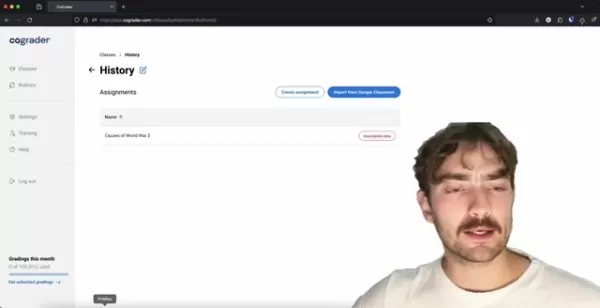
The assessment management section contains rubric configuration options, including template selection and AI generation capabilities. Choosing 'Generate New Rubric' activates CoGrader's artificial intelligence framework.
Implementation Steps:
- Assignment Selection: Identify the specific assessment requiring rubric development.
- Rubric Interface: Locate the rubric management section within assessment settings.
- Creation Initiation: Select the option for new rubric generation.
Optimizing Rubric Parameters
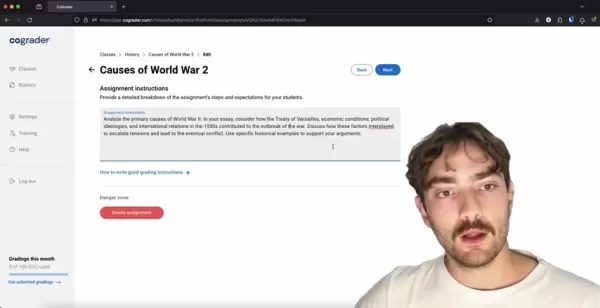
The rubric development process requires comprehensive assignment details.
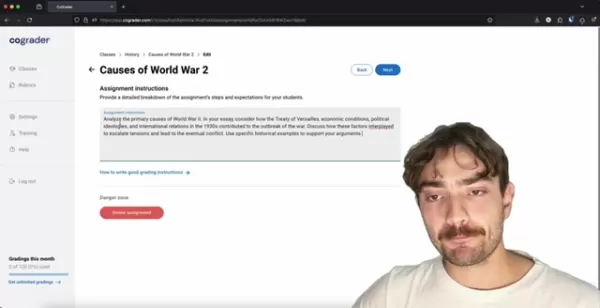
These specifications guide the AI in producing relevant evaluation criteria. Precise assignment descriptions yield higher quality rubrics. Incorporate detailed expectations and conceptual frameworks to enhance rubric accuracy.
Assignment Description Best Practices:
- Specific Objectives: Define measurable learning outcomes.
- Component Requirements: Outline essential evaluation elements.
- Terminology Precision: Include discipline-specific vocabulary.
Selecting Assessment Frameworks
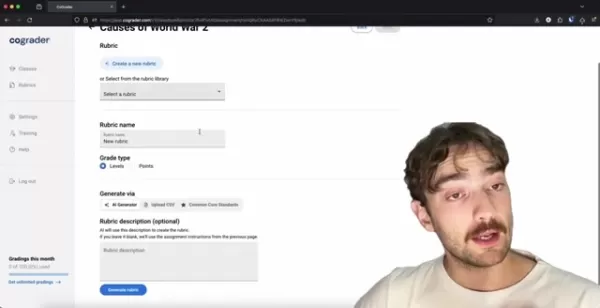
CoGrader supports multiple rubric architectures.
Choose between descriptive proficiency scales or quantitative scoring models based on assessment goals. The selection depends on instructional objectives and evaluation preferences.
Descriptive Rubric Applications:
- Subjective Evaluation Scenarios
- Holistic Performance Assessment
- Creative Expression Projects
Quantitative Rubric Applications:
- Objective Measurement Requirements
- Criterion-Specific Evaluation
- Knowledge-Based Assessments
Enhancing Rubric Specifications
Detailed context improves rubric quality.
Include instructional context, subject-specific requirements, and relevant academic standards. Comprehensive descriptions ensure rubric-alignment with pedagogical objectives.
Essential Contextual Elements:
- Disciplinary Focus
- Developmental Level
- Curricular Standards
- Assessment Purpose
Reviewing and Refining Generated Rubrics
Execute rubric generation and conduct comprehensive review.
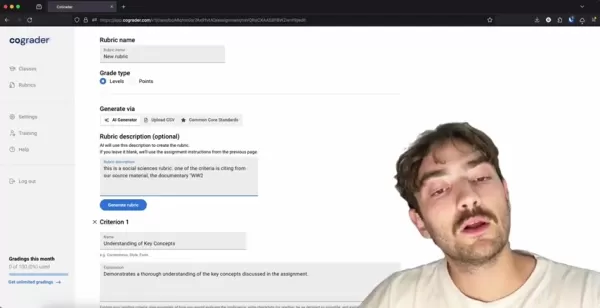
The AI produces detailed evaluation frameworks with criterion explanations and performance exemplars. Manual adjustments ensure perfect alignment with instructional goals.
Rubric Review Components:
- Evaluation Dimensions
- Performance Level Descriptors
- Criterion Explanations
- Positive/Negative Exemplars
Precision Rubric Customization
AI-generated rubrics require educator refinement.
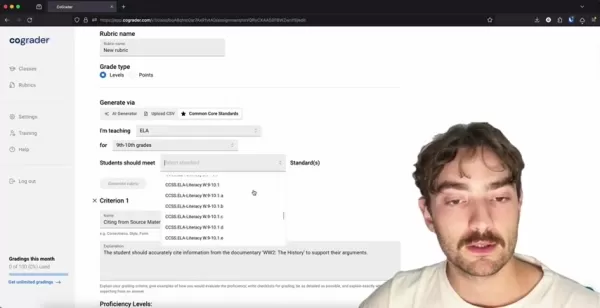
Adjust evaluation dimensions, modify performance descriptors, and enhance criterion explanations. Continuous rubric maintenance preserves assessment validity.
Customization Process:
- Criteria Validation
- Descriptor Refinement
- Explanation Enhancement
- Resource Integration
- Citation Verification
Subscription Options
Flexible Licensing Structure
CoGrader offers tiered subscription models accommodating diverse institutional needs.
Key Selection Considerations:
- Feature Accessibility
- Usage Parameters
- Scalability Options
- Trial Availability
Platform Evaluation
Advantages
Dramatically reduces assessment workload
Ensures evaluation uniformity
Delivers substantive student feedback
Supports adaptive rubric design
Integrates with common LMS platforms
Provides performance analytics
Facilitates differentiated instruction
Considerations
Initial configuration requires time investment
Potential reduction in direct student interaction
Algorithmic bias mitigation necessary
Subscription costs vary
Dependent on technology infrastructure
Data security protocols essential
Core Platform Capabilities
Automated Evaluation System
CoGrader's AI analyzes student submissions, generating targeted feedback and preserving educator time.
Adaptive Rubric Framework
The platform supports custom assessment design with configurable evaluation parameters.
LMS Compatibility
Seamless integration with major learning management systems streamlines grading workflows.
Analytical Reporting
Comprehensive performance tracking enables data-informed instructional decisions.
Instructional Applications
Language Arts Implementation
CoGrader effectively assesses composition quality, grammatical precision, and analytical writing.
Social Studies Utilization
The platform evaluates research quality, argument development, and historical analysis.
Mathematical Assessment
CoGrader analyzes problem-solving approaches, computational accuracy, and proof construction.
Common Inquiries
Grading Consistency Assurance
Standardized rubrics, automated feedback, and analytical tracking maintain assessment reliability.
LMS Compatibility Verification
Full integration with Canvas, Blackboard, and Moodle ensures operational continuity.
Disciplinary Adaptability
The platform's customizable framework supports diverse academic subjects.
Related Considerations
AI-Enabled Differentiation
Adaptive learning systems personalize content delivery and instructional pacing.
Implementation Challenges
Privacy concerns, algorithmic bias, and technological equity present adoption barriers.
Related article
 Stripe to Acquire OpenRouter as AI Model Routing Gains Momentum
Stripe has agreed to acquire OpenRouter, an AI model-routing platform that gives developers access to hundreds of models through a single interface. The deal adds model selection and routing to Stripe’s existing work around AI usage and token-based b
Former OpenAI Researcher Barrett Zoph Returns to Google to Support Gemini Development
Barret Zoph, who previously abruptly left and joined OpenAI due to a disagreement with Thinking Machines Lab CEO Miriam Mularati, has once again changed employers. Alphabet's Google announced that Zoph will return as Vice President of Research, bring
How Recursive Intelligence Raised $335M at $4B Valuation in 4 Months
The co-founders of startup Ricursive Intelligence seemed destined to be co-founders.Anna Goldie, CEO, and Azalia Mirhoseini, CTO, are so well-known in the AI community that they were among those AI engineers who “got those weird emails from Zuckerber
Related Special Topic Recommendations
Design & Art
Stripe to Acquire OpenRouter as AI Model Routing Gains Momentum
Stripe has agreed to acquire OpenRouter, an AI model-routing platform that gives developers access to hundreds of models through a single interface. The deal adds model selection and routing to Stripe’s existing work around AI usage and token-based b
Former OpenAI Researcher Barrett Zoph Returns to Google to Support Gemini Development
Barret Zoph, who previously abruptly left and joined OpenAI due to a disagreement with Thinking Machines Lab CEO Miriam Mularati, has once again changed employers. Alphabet's Google announced that Zoph will return as Vice President of Research, bring
How Recursive Intelligence Raised $335M at $4B Valuation in 4 Months
The co-founders of startup Ricursive Intelligence seemed destined to be co-founders.Anna Goldie, CEO, and Azalia Mirhoseini, CTO, are so well-known in the AI community that they were among those AI engineers who “got those weird emails from Zuckerber
Related Special Topic Recommendations
Design & Art
 Top AI Illustration Tools: Create Editorial Scenes and Cover Art Faster
2026 Latest Top-rated AI Illustration Tools: Our curated list features the best powerfully designed tools for creating stunning editorial scenes and eye-catching cover art quickly. Each option has gone through rigorous real-world tests, offering a free vs paid comparison to help you find the perfect match for your workflow. Try these must-try solutions today to unlock your AI edge and boost your creative productivity. Explore now at XIX.AI.
 10 tools
 xix.ai
Education and Learning
Top AI Tutors for Exam Prep: Practice Math, Science, and English
xix.ai
Education and Learning
Top AI Tutors for Exam Prep: Practice Math, Science, and English
2026 Latest Top-Rated Best AI Tutors for Exam Prep are here on XIX.AI! Our curated list features powerful game-changing tools that offer free vs paid comparison, real-world tests, and weekly updated rankings. They help boost your writing efficiency, simplify complex topic learning, and unlock your academic potential. Explore now to Discover your perfect exam prep tool and Start creating today to Unlock your AI edge!
10 tools
xix.ai
Finance
AI Budget Planning Tools for Personal Money Management
2026 Latest Best Top-Rated AI Budget Planning Tools for Personal Money Management are here on XIX.AI! This curated collection features powerful, game-changing solutions that help you conduct real-world tests, understand spending habits, and create personalized plans to boost productivity. Enjoy a free vs paid comparison along with detailed rankings. Must-try tools designed to simplify money management and unlock your AI edge. Explore now!
11 tools
xix.ai
Health & Wellness
AI Sleep Tracking Assistants: Improve Recovery with Better Bedtime Habits
2026 Latest Best Top-Rated AI Sleep Tracking Assistants curated for ultimate recovery. This fully updated weekly guide features powerful tools that deliver real-world tests, free vs paid comparison, and detailed rankings to help you find the must-try solution that boosts sleep quality and supports better bedtime habits. Explore now at XIX.AI to Unlock your AI edge.
10 tools
xix.ai
Data Analysis
AI SQL Copilots for Product and Revenue Analytics
2026 Latest Best Top-Rated AI SQL Copilots for Product and Revenue Analytics! XIX.AI has curated a powerful, game-changing collection of must-try tools that undergo real-world tests through weekly updated rankings. These tools help users boost productivity significantly by accelerating data analysis, streamlining complex queries, and generating accurate insights to drive smarter business decisions. Explore now to Discover your perfect tool for unlocking your AI edge!
14 tools
xix.ai
Education and Learning
Best AI Homework Helpers That Teach: Learn Concepts, Not Just Answers
2026 Latest Best Top-Rated AI Homework Helpers That Teach Core Concepts Not Just Answers Powerful Tools for Students Must-Try Curated List Weekly Updated Free vs Paid Comparison Real-World Tests Accurate Rankings to Help You Unlock Your Full Learning Potential Explore now to Discover your perfect tool for smarter studying.
10 tools
xix.ai

 Comments (2)
0/500
Comments (2)
0/500
![RalphThomas]()
Honestly, as a student, I'm a bit torn. On one hand, anything that speeds up grading so teachers can focus more on actual teaching sounds fantastic. On the other, I hope it doesn't just standardize feedback into bland, generic comments. The human touch in grading matters, you know? 🤔 Let's see how this plays out in real classrooms.
![GeorgeTaylor]()
Quem dera isso existisse quando eu era aluno! 😅 Mas falando sério, automatizar rubricas parece uma ótima ideia pra dar feedback mais rápido. Ainda acho que a avaliação humana é importante pra certas coisas, como criatividade, mas pra corrigir tarefas mais mecânicas deve ser um alívio pros professores. Será que as escolas públicas conseguirão adotar?
In today's dynamic educational environment, educators continually search for innovative tools to boost productivity and optimize grading workflows. CoGrader's AI Rubric Generator stands out as a transformative solution, empowering teachers with efficient rubric creation capabilities. This guide demonstrates how educators can leverage AI technology to develop assessment tools that reduce workload while maintaining grading consistency.
Key Features
CoGrader's AI Rubric Generator simplifies assessment design through intelligent automation.
Educators can build custom rubrics or select pre-designed templates from an extensive library.
The platform enables customization based on detailed assignment requirements and learning objectives.
Rubrics adapt to various assessment formats, including proficiency levels and numeric scoring systems.
Teachers can align assessments with Common Core Standards for curriculum-based evaluations.
Automatically generated rubrics contain comprehensive descriptors and sample responses for each achievement level.
The system supports CSV file imports for seamless rubric integration.
CoGrader facilitates comprehensive evaluation with built-in feedback mechanisms.
The tool ensures objective, standardized assessment across all student work.
Educators maintain full control with manual editing capabilities for personalized feedback.
Discovering CoGrader's AI Rubric Generator
Understanding CoGrader's Core Functionality
CoGrader represents an advanced educational platform supporting diverse grading and evaluation needs. The AI Rubric Generator serves as its cornerstone feature, allowing teachers to rapidly construct tailored assessment frameworks.
This intelligent tool processes assignment parameters to generate adaptive grading criteria, preserving instructional time while ensuring evaluation reliability. By automating rubric development, CoGrader allows educators to concentrate on pedagogical strategies and student interaction.
Why do effective rubrics matter? They establish transparent benchmarks for student performance, creating an accountable learning ecosystem. Well-structured rubrics define concrete expectations and evaluation standards, helping students comprehend assessment parameters. This transparency encourages learner autonomy and academic responsibility. Rubrics also deliver multiple instructional advantages:
- Efficiency Gains: Manual rubric development demands significant time investment. AI-enhanced tools like CoGrader dramatically streamline this process.
- Assessment Reliability: Standardized rubrics minimize grading inconsistencies and evaluator bias.
- Expectation Clarity: Organized rubric structures explicitly communicate project requirements.
- Targeted Evaluation: Rubrics enable focused, constructive feedback that guides student improvement.
Accessing CoGrader's Platform Interface
Begin your CoGrader experience by accessing the platform through secure login credentials.
Upon authentication, navigate to your designated class to initiate rubric generation. The intuitive dashboard provides comprehensive assignment oversight and content management capabilities. Complete course information ensures precise rubric customization, allowing the AI to align with specific curricular needs.
Platform Navigation Essentials:
- Account Access: Enter your credentials on CoGrader's authentication portal.
- Course Selection: Identify the relevant class from your active course listings.
- Assignment Management: Review existing assessments or establish new ones through the dashboard interface. Detailed assignment specifications yield optimal rubric quality.
Supplementary Instructional Resources
Professional Development Platforms
These educational websites enhance assessment methodologies and feedback practices:
- Cult of Pedagogy: Features practical teaching resources including grading strategies and feedback models.
- Edutopia: Shares research-based educational innovations including assessment best practices.
- ASCD: Offers professional learning materials focused on teaching excellence and evaluation techniques.
- Faculty Focus: Provides higher education resources including grading optimization strategies.
- University Teaching Centers: Numerous institutions maintain pedagogical support centers with assessment workshops.
Instructional Technology Tools
- Turnitin: Academic integrity platform with writing evaluation features.
- Grammarly: Writing enhancement tool for grammatical improvement.
- Google Classroom: Digital learning environment for assignment distribution.
Comprehensive Rubric Creation Process
Initiating Rubric Development
Commence by selecting your target assignment within the course interface.
The assessment management section contains rubric configuration options, including template selection and AI generation capabilities. Choosing 'Generate New Rubric' activates CoGrader's artificial intelligence framework.
Implementation Steps:
- Assignment Selection: Identify the specific assessment requiring rubric development.
- Rubric Interface: Locate the rubric management section within assessment settings.
- Creation Initiation: Select the option for new rubric generation.
Optimizing Rubric Parameters
The rubric development process requires comprehensive assignment details.
These specifications guide the AI in producing relevant evaluation criteria. Precise assignment descriptions yield higher quality rubrics. Incorporate detailed expectations and conceptual frameworks to enhance rubric accuracy.
Assignment Description Best Practices:
- Specific Objectives: Define measurable learning outcomes.
- Component Requirements: Outline essential evaluation elements.
- Terminology Precision: Include discipline-specific vocabulary.
Selecting Assessment Frameworks
CoGrader supports multiple rubric architectures.
Choose between descriptive proficiency scales or quantitative scoring models based on assessment goals. The selection depends on instructional objectives and evaluation preferences.
Descriptive Rubric Applications:
- Subjective Evaluation Scenarios
- Holistic Performance Assessment
- Creative Expression Projects
Quantitative Rubric Applications:
- Objective Measurement Requirements
- Criterion-Specific Evaluation
- Knowledge-Based Assessments
Enhancing Rubric Specifications
Detailed context improves rubric quality.
Include instructional context, subject-specific requirements, and relevant academic standards. Comprehensive descriptions ensure rubric-alignment with pedagogical objectives.
Essential Contextual Elements:
- Disciplinary Focus
- Developmental Level
- Curricular Standards
- Assessment Purpose
Reviewing and Refining Generated Rubrics
Execute rubric generation and conduct comprehensive review.
The AI produces detailed evaluation frameworks with criterion explanations and performance exemplars. Manual adjustments ensure perfect alignment with instructional goals.
Rubric Review Components:
- Evaluation Dimensions
- Performance Level Descriptors
- Criterion Explanations
- Positive/Negative Exemplars
Precision Rubric Customization
AI-generated rubrics require educator refinement.
Adjust evaluation dimensions, modify performance descriptors, and enhance criterion explanations. Continuous rubric maintenance preserves assessment validity.
Customization Process:
- Criteria Validation
- Descriptor Refinement
- Explanation Enhancement
- Resource Integration
- Citation Verification
Subscription Options
Flexible Licensing Structure
CoGrader offers tiered subscription models accommodating diverse institutional needs.
Key Selection Considerations:
- Feature Accessibility
- Usage Parameters
- Scalability Options
- Trial Availability
Platform Evaluation
Advantages
Dramatically reduces assessment workload
Ensures evaluation uniformity
Delivers substantive student feedback
Supports adaptive rubric design
Integrates with common LMS platforms
Provides performance analytics
Facilitates differentiated instruction
Considerations
Initial configuration requires time investment
Potential reduction in direct student interaction
Algorithmic bias mitigation necessary
Subscription costs vary
Dependent on technology infrastructure
Data security protocols essential
Core Platform Capabilities
Automated Evaluation System
CoGrader's AI analyzes student submissions, generating targeted feedback and preserving educator time.
Adaptive Rubric Framework
The platform supports custom assessment design with configurable evaluation parameters.
LMS Compatibility
Seamless integration with major learning management systems streamlines grading workflows.
Analytical Reporting
Comprehensive performance tracking enables data-informed instructional decisions.
Instructional Applications
Language Arts Implementation
CoGrader effectively assesses composition quality, grammatical precision, and analytical writing.
Social Studies Utilization
The platform evaluates research quality, argument development, and historical analysis.
Mathematical Assessment
CoGrader analyzes problem-solving approaches, computational accuracy, and proof construction.
Common Inquiries
Grading Consistency Assurance
Standardized rubrics, automated feedback, and analytical tracking maintain assessment reliability.
LMS Compatibility Verification
Full integration with Canvas, Blackboard, and Moodle ensures operational continuity.
Disciplinary Adaptability
The platform's customizable framework supports diverse academic subjects.
Related Considerations
AI-Enabled Differentiation
Adaptive learning systems personalize content delivery and instructional pacing.
Implementation Challenges
Privacy concerns, algorithmic bias, and technological equity present adoption barriers.








 Stripe to Acquire OpenRouter as AI Model Routing Gains Momentum
Stripe has agreed to acquire OpenRouter, an AI model-routing platform that gives developers access to hundreds of models through a single interface. The deal adds model selection and routing to Stripe’s existing work around AI usage and token-based b
Stripe to Acquire OpenRouter as AI Model Routing Gains Momentum
Stripe has agreed to acquire OpenRouter, an AI model-routing platform that gives developers access to hundreds of models through a single interface. The deal adds model selection and routing to Stripe’s existing work around AI usage and token-based b
 Former OpenAI Researcher Barrett Zoph Returns to Google to Support Gemini Development
Barret Zoph, who previously abruptly left and joined OpenAI due to a disagreement with Thinking Machines Lab CEO Miriam Mularati, has once again changed employers. Alphabet's Google announced that Zoph will return as Vice President of Research, bring
Former OpenAI Researcher Barrett Zoph Returns to Google to Support Gemini Development
Barret Zoph, who previously abruptly left and joined OpenAI due to a disagreement with Thinking Machines Lab CEO Miriam Mularati, has once again changed employers. Alphabet's Google announced that Zoph will return as Vice President of Research, bring
 How Recursive Intelligence Raised $335M at $4B Valuation in 4 Months
The co-founders of startup Ricursive Intelligence seemed destined to be co-founders.Anna Goldie, CEO, and Azalia Mirhoseini, CTO, are so well-known in the AI community that they were among those AI engineers who “got those weird emails from Zuckerber
How Recursive Intelligence Raised $335M at $4B Valuation in 4 Months
The co-founders of startup Ricursive Intelligence seemed destined to be co-founders.Anna Goldie, CEO, and Azalia Mirhoseini, CTO, are so well-known in the AI community that they were among those AI engineers who “got those weird emails from Zuckerber

2026 Latest Top-rated AI Illustration Tools: Our curated list features the best powerfully designed tools for creating stunning editorial scenes and eye-catching cover art quickly. Each option has gone through rigorous real-world tests, offering a free vs paid comparison to help you find the perfect match for your workflow. Try these must-try solutions today to unlock your AI edge and boost your creative productivity. Explore now at XIX.AI.
10 tools
xix.ai

2026 Latest Top-Rated Best AI Tutors for Exam Prep are here on XIX.AI! Our curated list features powerful game-changing tools that offer free vs paid comparison, real-world tests, and weekly updated rankings. They help boost your writing efficiency, simplify complex topic learning, and unlock your academic potential. Explore now to Discover your perfect exam prep tool and Start creating today to Unlock your AI edge!
10 tools
xix.ai

2026 Latest Best Top-Rated AI Budget Planning Tools for Personal Money Management are here on XIX.AI! This curated collection features powerful, game-changing solutions that help you conduct real-world tests, understand spending habits, and create personalized plans to boost productivity. Enjoy a free vs paid comparison along with detailed rankings. Must-try tools designed to simplify money management and unlock your AI edge. Explore now!
11 tools
xix.ai

2026 Latest Best Top-Rated AI Sleep Tracking Assistants curated for ultimate recovery. This fully updated weekly guide features powerful tools that deliver real-world tests, free vs paid comparison, and detailed rankings to help you find the must-try solution that boosts sleep quality and supports better bedtime habits. Explore now at XIX.AI to Unlock your AI edge.
10 tools
xix.ai
2026 Latest Best Top-Rated AI SQL Copilots for Product and Revenue Analytics! XIX.AI has curated a powerful, game-changing collection of must-try tools that undergo real-world tests through weekly updated rankings. These tools help users boost productivity significantly by accelerating data analysis, streamlining complex queries, and generating accurate insights to drive smarter business decisions. Explore now to Discover your perfect tool for unlocking your AI edge!
14 tools
xix.ai

2026 Latest Best Top-Rated AI Homework Helpers That Teach Core Concepts Not Just Answers Powerful Tools for Students Must-Try Curated List Weekly Updated Free vs Paid Comparison Real-World Tests Accurate Rankings to Help You Unlock Your Full Learning Potential Explore now to Discover your perfect tool for smarter studying.
10 tools
xix.ai

Honestly, as a student, I'm a bit torn. On one hand, anything that speeds up grading so teachers can focus more on actual teaching sounds fantastic. On the other, I hope it doesn't just standardize feedback into bland, generic comments. The human touch in grading matters, you know? 🤔 Let's see how this plays out in real classrooms.
Quem dera isso existisse quando eu era aluno! 😅 Mas falando sério, automatizar rubricas parece uma ótima ideia pra dar feedback mais rápido. Ainda acho que a avaliação humana é importante pra certas coisas, como criatividade, mas pra corrigir tarefas mais mecânicas deve ser um alívio pros professores. Será que as escolas públicas conseguirão adotar?












