


 Home
HomeDeezer reports over half of daily music uploads are AI-generated
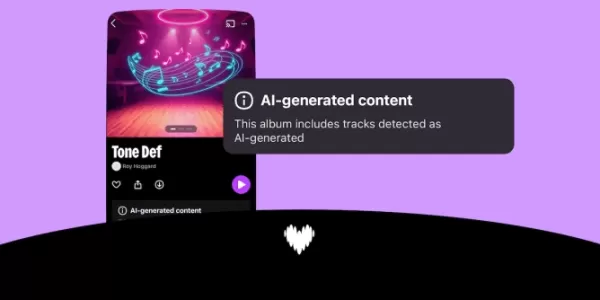
Deezer, a major music streaming service, has monitored the surge in AI-generated uploads since last year, with figures climbing steadily. The platform now reports that AI-produced content accounts for over half of all downloads.
According to Deezer, AI track submissions peaked in June 2026, averaging 90,000 new uploads daily.
This rapid expansion of AI music has compelled streaming services to determine how much such content they are willing to host. Industry standards remain inconsistent: Bandcamp prohibits these tracks entirely, while Tidal has removed monetization options for them. Conversely, Apple Music offers a voluntary tagging system for AI content, and Spotify has established specific guidelines regarding the extent of AI involvement in music production.
Deezer’s latest strategy involves removing AI-generated tracks that have not been streamed in the last six months or are linked to fraudulent activity designed to artificially inflate revenue.
“Deezer has been at the forefront of combating fraud and mitigating payment dilution caused by AI music for nearly two years. With half of all daily uploads now being AI-generated, we are implementing further measures to protect the rights of artists and songwriters while continuing to prioritize music that listeners truly enjoy,” stated Deezer CEO Alexis Lanternier.
The platform initially shared AI upload statistics in January 2025, when daily submissions hovered around 10,000 tracks, or 10% of total uploads. By April 2025, this figure rose to 20,000 tracks, representing 18% of daily uploads. In September 2025, it climbed to 30,000 tracks (28% of daily uploads), followed by 50,000 daily uploads (34% of total) in November 2025.
The trend continued into this year, reaching 60,000 tracks (39% of daily uploads) in January 2026. By April 2026, the number hit 75,000 tracks, accounting for 44% of daily uploads.
Deezer began labeling AI music on its platform last year, noting that its detection technology can also identify tracks created using models from Suno and Udio, AI music startups currently involved in copyright disputes. Earlier this year, Deezer made its detection technology available to other platforms, though it remains unclear if any major competitors have adopted the tool. Last month, the company also launched a tool capable of scanning Apple Music and Spotify playlists for AI-generated content.
Related article
 Instinct launches AI agent in group chats, including those with non-users
Instinct, the AI agent now valued at $10 billion following its latest funding round, is expanding into group chats. The startup announced on Monday that users can add the agent to conversations with friends, offering assistance in scenarios such as t
Amazon Launches AI Shopping Assistant for Retailers Including Kate Spade
Amazon is extending its AI shopping capabilities to external retailers via a new Agentic Shopping Assistant built on AWS, with Kate Spade among the initial brands to adopt it.This service enables retailers to create AI shopping assistants for their o
Bain & Co: Inside the US$4.7tn AI Profit Shift
Dunigan O’Keeffe, Partner in Bain & Company’s Strategy & Transformation practice and lead author of the report. Credit: Bain & CompanyBain & Company Partner Dunigan O’Keeffe explores the US$4.7tn AI profit shift across four sector clusters and explai
Related Special Topic Recommendations
Design & Art
Instinct launches AI agent in group chats, including those with non-users
Instinct, the AI agent now valued at $10 billion following its latest funding round, is expanding into group chats. The startup announced on Monday that users can add the agent to conversations with friends, offering assistance in scenarios such as t
Amazon Launches AI Shopping Assistant for Retailers Including Kate Spade
Amazon is extending its AI shopping capabilities to external retailers via a new Agentic Shopping Assistant built on AWS, with Kate Spade among the initial brands to adopt it.This service enables retailers to create AI shopping assistants for their o
Bain & Co: Inside the US$4.7tn AI Profit Shift
Dunigan O’Keeffe, Partner in Bain & Company’s Strategy & Transformation practice and lead author of the report. Credit: Bain & CompanyBain & Company Partner Dunigan O’Keeffe explores the US$4.7tn AI profit shift across four sector clusters and explai
Related Special Topic Recommendations
Design & Art
 Top AI Illustration Tools: Create Editorial Scenes and Cover Art Faster
2026 Latest Top-rated AI Illustration Tools: Our curated list features the best powerfully designed tools for creating stunning editorial scenes and eye-catching cover art quickly. Each option has gone through rigorous real-world tests, offering a free vs paid comparison to help you find the perfect match for your workflow. Try these must-try solutions today to unlock your AI edge and boost your creative productivity. Explore now at XIX.AI.
 10 tools
 xix.ai
Education and Learning
Top AI Tutors for Exam Prep: Practice Math, Science, and English
xix.ai
Education and Learning
Top AI Tutors for Exam Prep: Practice Math, Science, and English
2026 Latest Top-Rated Best AI Tutors for Exam Prep are here on XIX.AI! Our curated list features powerful game-changing tools that offer free vs paid comparison, real-world tests, and weekly updated rankings. They help boost your writing efficiency, simplify complex topic learning, and unlock your academic potential. Explore now to Discover your perfect exam prep tool and Start creating today to Unlock your AI edge!
10 tools
xix.ai
Finance
AI Budget Planning Tools for Personal Money Management
2026 Latest Best Top-Rated AI Budget Planning Tools for Personal Money Management are here on XIX.AI! This curated collection features powerful, game-changing solutions that help you conduct real-world tests, understand spending habits, and create personalized plans to boost productivity. Enjoy a free vs paid comparison along with detailed rankings. Must-try tools designed to simplify money management and unlock your AI edge. Explore now!
11 tools
xix.ai
Health & Wellness
AI Sleep Tracking Assistants: Improve Recovery with Better Bedtime Habits
2026 Latest Best Top-Rated AI Sleep Tracking Assistants curated for ultimate recovery. This fully updated weekly guide features powerful tools that deliver real-world tests, free vs paid comparison, and detailed rankings to help you find the must-try solution that boosts sleep quality and supports better bedtime habits. Explore now at XIX.AI to Unlock your AI edge.
10 tools
xix.ai
Data Analysis
AI SQL Copilots for Product and Revenue Analytics
2026 Latest Best Top-Rated AI SQL Copilots for Product and Revenue Analytics! XIX.AI has curated a powerful, game-changing collection of must-try tools that undergo real-world tests through weekly updated rankings. These tools help users boost productivity significantly by accelerating data analysis, streamlining complex queries, and generating accurate insights to drive smarter business decisions. Explore now to Discover your perfect tool for unlocking your AI edge!
14 tools
xix.ai
Education and Learning
Best AI Homework Helpers That Teach: Learn Concepts, Not Just Answers
2026 Latest Best Top-Rated AI Homework Helpers That Teach Core Concepts Not Just Answers Powerful Tools for Students Must-Try Curated List Weekly Updated Free vs Paid Comparison Real-World Tests Accurate Rankings to Help You Unlock Your Full Learning Potential Explore now to Discover your perfect tool for smarter studying.
10 tools
xix.ai

 Comments (0)
0/500
Comments (0)
0/500
Deezer, a major music streaming service, has monitored the surge in AI-generated uploads since last year, with figures climbing steadily. The platform now reports that AI-produced content accounts for over half of all downloads.
According to Deezer, AI track submissions peaked in June 2026, averaging 90,000 new uploads daily.
This rapid expansion of AI music has compelled streaming services to determine how much such content they are willing to host. Industry standards remain inconsistent: Bandcamp prohibits these tracks entirely, while Tidal has removed monetization options for them. Conversely, Apple Music offers a voluntary tagging system for AI content, and Spotify has established specific guidelines regarding the extent of AI involvement in music production.
Deezer’s latest strategy involves removing AI-generated tracks that have not been streamed in the last six months or are linked to fraudulent activity designed to artificially inflate revenue.
“Deezer has been at the forefront of combating fraud and mitigating payment dilution caused by AI music for nearly two years. With half of all daily uploads now being AI-generated, we are implementing further measures to protect the rights of artists and songwriters while continuing to prioritize music that listeners truly enjoy,” stated Deezer CEO Alexis Lanternier.
The platform initially shared AI upload statistics in January 2025, when daily submissions hovered around 10,000 tracks, or 10% of total uploads. By April 2025, this figure rose to 20,000 tracks, representing 18% of daily uploads. In September 2025, it climbed to 30,000 tracks (28% of daily uploads), followed by 50,000 daily uploads (34% of total) in November 2025.
The trend continued into this year, reaching 60,000 tracks (39% of daily uploads) in January 2026. By April 2026, the number hit 75,000 tracks, accounting for 44% of daily uploads.
Deezer began labeling AI music on its platform last year, noting that its detection technology can also identify tracks created using models from Suno and Udio, AI music startups currently involved in copyright disputes. Earlier this year, Deezer made its detection technology available to other platforms, though it remains unclear if any major competitors have adopted the tool. Last month, the company also launched a tool capable of scanning Apple Music and Spotify playlists for AI-generated content.








 Instinct launches AI agent in group chats, including those with non-users
Instinct, the AI agent now valued at $10 billion following its latest funding round, is expanding into group chats. The startup announced on Monday that users can add the agent to conversations with friends, offering assistance in scenarios such as t
Instinct launches AI agent in group chats, including those with non-users
Instinct, the AI agent now valued at $10 billion following its latest funding round, is expanding into group chats. The startup announced on Monday that users can add the agent to conversations with friends, offering assistance in scenarios such as t
 Amazon Launches AI Shopping Assistant for Retailers Including Kate Spade
Amazon is extending its AI shopping capabilities to external retailers via a new Agentic Shopping Assistant built on AWS, with Kate Spade among the initial brands to adopt it.This service enables retailers to create AI shopping assistants for their o
Amazon Launches AI Shopping Assistant for Retailers Including Kate Spade
Amazon is extending its AI shopping capabilities to external retailers via a new Agentic Shopping Assistant built on AWS, with Kate Spade among the initial brands to adopt it.This service enables retailers to create AI shopping assistants for their o
 Bain & Co: Inside the US$4.7tn AI Profit Shift
Dunigan O’Keeffe, Partner in Bain & Company’s Strategy & Transformation practice and lead author of the report. Credit: Bain & CompanyBain & Company Partner Dunigan O’Keeffe explores the US$4.7tn AI profit shift across four sector clusters and explai
Bain & Co: Inside the US$4.7tn AI Profit Shift
Dunigan O’Keeffe, Partner in Bain & Company’s Strategy & Transformation practice and lead author of the report. Credit: Bain & CompanyBain & Company Partner Dunigan O’Keeffe explores the US$4.7tn AI profit shift across four sector clusters and explai

2026 Latest Top-rated AI Illustration Tools: Our curated list features the best powerfully designed tools for creating stunning editorial scenes and eye-catching cover art quickly. Each option has gone through rigorous real-world tests, offering a free vs paid comparison to help you find the perfect match for your workflow. Try these must-try solutions today to unlock your AI edge and boost your creative productivity. Explore now at XIX.AI.
10 tools
xix.ai

2026 Latest Top-Rated Best AI Tutors for Exam Prep are here on XIX.AI! Our curated list features powerful game-changing tools that offer free vs paid comparison, real-world tests, and weekly updated rankings. They help boost your writing efficiency, simplify complex topic learning, and unlock your academic potential. Explore now to Discover your perfect exam prep tool and Start creating today to Unlock your AI edge!
10 tools
xix.ai

2026 Latest Best Top-Rated AI Budget Planning Tools for Personal Money Management are here on XIX.AI! This curated collection features powerful, game-changing solutions that help you conduct real-world tests, understand spending habits, and create personalized plans to boost productivity. Enjoy a free vs paid comparison along with detailed rankings. Must-try tools designed to simplify money management and unlock your AI edge. Explore now!
11 tools
xix.ai

2026 Latest Best Top-Rated AI Sleep Tracking Assistants curated for ultimate recovery. This fully updated weekly guide features powerful tools that deliver real-world tests, free vs paid comparison, and detailed rankings to help you find the must-try solution that boosts sleep quality and supports better bedtime habits. Explore now at XIX.AI to Unlock your AI edge.
10 tools
xix.ai

2026 Latest Best Top-Rated AI SQL Copilots for Product and Revenue Analytics! XIX.AI has curated a powerful, game-changing collection of must-try tools that undergo real-world tests through weekly updated rankings. These tools help users boost productivity significantly by accelerating data analysis, streamlining complex queries, and generating accurate insights to drive smarter business decisions. Explore now to Discover your perfect tool for unlocking your AI edge!
14 tools
xix.ai

2026 Latest Best Top-Rated AI Homework Helpers That Teach Core Concepts Not Just Answers Powerful Tools for Students Must-Try Curated List Weekly Updated Free vs Paid Comparison Real-World Tests Accurate Rankings to Help You Unlock Your Full Learning Potential Explore now to Discover your perfect tool for smarter studying.
10 tools
xix.ai












