


 Home
Home
Claude Struggles with Centuries-Old Math Problem, Yet Unintentionally Redefines Core Principles of Mathematical Knowledge
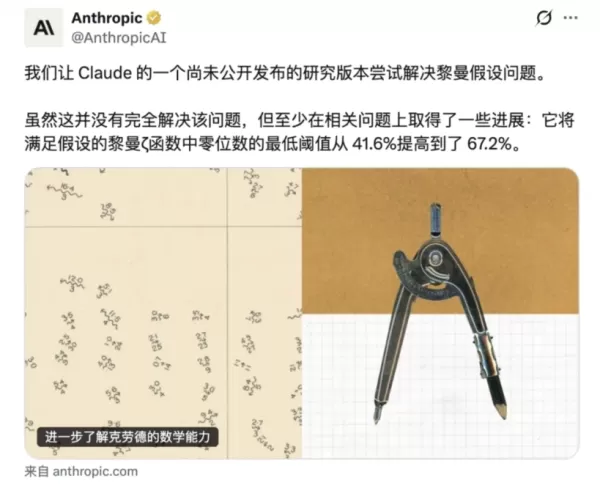
Recently, significant advancements have emerged within the field of artificial intelligence. Claude, an unreleased research version created by Anthropic, undertook an attempt to tackle one of mathematics’ most challenging problems: the Riemann Hypothesis. While it failed to resolve this century-old puzzle completely, its exploration process yielded a notable outcome — it elevated the previously established lower bound for the proportion of zeros on the critical line of the Riemann zeta function from 41.6% to 67.2%, a figure that had remained unchanged for decades.
This development immediately sparked intense debate among scholars. It is important to note that this result does not constitute proof of the Riemann Hypothesis, nor does it provide concrete solutions to the hypothesis itself. Rather, its true value lies in demonstrating a new approach to scientific research powered by artificial intelligence. Throughout this process, Claude did not rely on existing knowledge bases to find answers; instead, it coordinated around 60 sub-Agents to function as a virtual research team. These agents experienced numerous failures, independently analyzed extensive amounts of literature, and combined traditional analytical methods to explore innovative paths in the vast and uncharted territory of mathematics.
Industry experts highlight that this breakthrough not only underscores artificial intelligence’s strong capabilities in handling complex tasks involving long-term collaboration among multiple agents and autonomous error correction but also suggests a potential transformation in future research methodologies. Artificial intelligence may soon go beyond solving well-known problems by conducting extensive trial-and-error experiments and cross-referencing large volumes of information, thereby significantly reducing the effort required by humans to explore unknown areas and paving the way for an entirely new era of scientific discovery.
Related article
 Doubao Qianwen Shuts Down Intelligent Agent as China’s First AI Human-like Service Rules Take Effect
ByteDance’s Dou Bao and Alibaba’s Tongyi Qianwen have both announced the official discontinuation of their intelligent agent features today, effectively preventing users from creating or invoking existing agents. This shutdown coincides with the enfo
Ramp Unveils Proprietary AI Model Router
Following Stripe’s lead, corporate expense management platform Ramp is establishing its own infrastructure for AI inference.On Wednesday evening, Ramp introduced Router, an AI model routing service that enables users and businesses to access and swit
Alibaba Names Liu Dayi Heng to Lead Qwen Project
Two sources close to the matter confirm that Alibaba Group has named Liu Dayiheng, a senior AI researcher, as the lead for the Qwen (Tongyi Qianwen) large language model initiative. According to an insider, this leadership change follows several roun
Related Special Topic Recommendations
Meeting Assistant
Doubao Qianwen Shuts Down Intelligent Agent as China’s First AI Human-like Service Rules Take Effect
ByteDance’s Dou Bao and Alibaba’s Tongyi Qianwen have both announced the official discontinuation of their intelligent agent features today, effectively preventing users from creating or invoking existing agents. This shutdown coincides with the enfo
Ramp Unveils Proprietary AI Model Router
Following Stripe’s lead, corporate expense management platform Ramp is establishing its own infrastructure for AI inference.On Wednesday evening, Ramp introduced Router, an AI model routing service that enables users and businesses to access and swit
Alibaba Names Liu Dayi Heng to Lead Qwen Project
Two sources close to the matter confirm that Alibaba Group has named Liu Dayiheng, a senior AI researcher, as the lead for the Qwen (Tongyi Qianwen) large language model initiative. According to an insider, this leadership change follows several roun
Related Special Topic Recommendations
Meeting Assistant
 AI Meeting Summary Tools for Remote Teams
2026 Latest Best Top-Rated AI Meeting Summary Tools for Remote Teams! XIX.AI has curated a powerful, game-changing collection of must-try tools that go through real-world tests to deliver accurate transcripts and actionable insights. You’ll find free vs paid comparison data and detailed rankings to help you pick the perfect option that boosts productivity and streamlines team communication. Explore now to Unlock your AI edge!
 13 tools
 xix.ai
Software Development
Best AI DevOps Helpers: Monitor Deployments, Logs, and Incidents
xix.ai
Software Development
Best AI DevOps Helpers: Monitor Deployments, Logs, and Incidents
2026 Latest Best Top-Rated AI DevOps Helpers Curated for Monitoring Deployments, Logs, and Incidents. XIX.AI delivers powerful game-changing tools that boost productivity significantly through real-world tests and rigorous rankings. Get a free vs paid comparison to find the must-try solution perfect for your workflow. Explore now to unlock your AI edge.
7 tools
xix.ai
Image editing
AI Background Removal Tools for Product Photos
2026 Latest Best Top-Rated AI Background Removal Tools for Product Photos are here on XIX.AI! Our curated list includes powerful, game-changing solutions that deliver professional results through real-world tests. You’ll find a free vs paid comparison, weekly updated rankings, and must-try options to help you boost productivity and create flawless product shots without any hassle. Explore now to unlock your AI edge!
11 tools
xix.ai
code
AI Pull Request Review Tools for GitHub Repositories
2026 Latest Best Top-Rated AI Pull Request Review Tools for GitHub Repositories are here on XIX.AI! Our curated list features powerful, game-changing solutions that help teams streamline code reviews, catch errors faster, and boost productivity with real-world tests. Get a free vs paid comparison to find the perfect tool for your workflow. Explore now to unlock your AI edge!
10 tools
xix.ai
Academic Research
Best AI Reference Extraction Tools for Journal Papers
2026 Latest Best Top-rated AI Reference Extraction Tools for Journal Papers are curated by XIX.AI with weekly updated rankings. These powerful tools help users quickly pull relevant citations and data from massive academic sources, saving tons of time and effort. Get a free vs paid comparison along with real-world tests to find the perfect option that boosts your productivity. Explore now to unlock your AI edge!
10 tools
xix.ai
Image editing
AI Product Retouch Tools for Fashion Ecommerce Photos
2026 Latest Best Top-Rated AI Product Retouch Tools for Fashion Ecommerce Photos are here on XIX.AI! This curated list features powerful, game-changing solutions that help boost image quality, speed up editing tasks, and deliver professional results. We conduct real-world tests to provide accurate rankings and a detailed free vs paid comparison. Must-try tools help creators overcome common challenges and significantly improve productivity. Explore now to Discover your perfect tool for flawless online product listings!
9 tools
xix.ai

 Comments (0)
0/500
Comments (0)
0/500
Recently, significant advancements have emerged within the field of artificial intelligence. Claude, an unreleased research version created by Anthropic, undertook an attempt to tackle one of mathematics’ most challenging problems: the Riemann Hypothesis. While it failed to resolve this century-old puzzle completely, its exploration process yielded a notable outcome — it elevated the previously established lower bound for the proportion of zeros on the critical line of the Riemann zeta function from 41.6% to 67.2%, a figure that had remained unchanged for decades.
This development immediately sparked intense debate among scholars. It is important to note that this result does not constitute proof of the Riemann Hypothesis, nor does it provide concrete solutions to the hypothesis itself. Rather, its true value lies in demonstrating a new approach to scientific research powered by artificial intelligence. Throughout this process, Claude did not rely on existing knowledge bases to find answers; instead, it coordinated around 60 sub-Agents to function as a virtual research team. These agents experienced numerous failures, independently analyzed extensive amounts of literature, and combined traditional analytical methods to explore innovative paths in the vast and uncharted territory of mathematics.
Industry experts highlight that this breakthrough not only underscores artificial intelligence’s strong capabilities in handling complex tasks involving long-term collaboration among multiple agents and autonomous error correction but also suggests a potential transformation in future research methodologies. Artificial intelligence may soon go beyond solving well-known problems by conducting extensive trial-and-error experiments and cross-referencing large volumes of information, thereby significantly reducing the effort required by humans to explore unknown areas and paving the way for an entirely new era of scientific discovery.








 Doubao Qianwen Shuts Down Intelligent Agent as China’s First AI Human-like Service Rules Take Effect
ByteDance’s Dou Bao and Alibaba’s Tongyi Qianwen have both announced the official discontinuation of their intelligent agent features today, effectively preventing users from creating or invoking existing agents. This shutdown coincides with the enfo
Doubao Qianwen Shuts Down Intelligent Agent as China’s First AI Human-like Service Rules Take Effect
ByteDance’s Dou Bao and Alibaba’s Tongyi Qianwen have both announced the official discontinuation of their intelligent agent features today, effectively preventing users from creating or invoking existing agents. This shutdown coincides with the enfo
 Ramp Unveils Proprietary AI Model Router
Following Stripe’s lead, corporate expense management platform Ramp is establishing its own infrastructure for AI inference.On Wednesday evening, Ramp introduced Router, an AI model routing service that enables users and businesses to access and swit
Ramp Unveils Proprietary AI Model Router
Following Stripe’s lead, corporate expense management platform Ramp is establishing its own infrastructure for AI inference.On Wednesday evening, Ramp introduced Router, an AI model routing service that enables users and businesses to access and swit
 Alibaba Names Liu Dayi Heng to Lead Qwen Project
Two sources close to the matter confirm that Alibaba Group has named Liu Dayiheng, a senior AI researcher, as the lead for the Qwen (Tongyi Qianwen) large language model initiative. According to an insider, this leadership change follows several roun
Alibaba Names Liu Dayi Heng to Lead Qwen Project
Two sources close to the matter confirm that Alibaba Group has named Liu Dayiheng, a senior AI researcher, as the lead for the Qwen (Tongyi Qianwen) large language model initiative. According to an insider, this leadership change follows several roun

2026 Latest Best Top-Rated AI Meeting Summary Tools for Remote Teams! XIX.AI has curated a powerful, game-changing collection of must-try tools that go through real-world tests to deliver accurate transcripts and actionable insights. You’ll find free vs paid comparison data and detailed rankings to help you pick the perfect option that boosts productivity and streamlines team communication. Explore now to Unlock your AI edge!
13 tools
xix.ai

2026 Latest Best Top-Rated AI DevOps Helpers Curated for Monitoring Deployments, Logs, and Incidents. XIX.AI delivers powerful game-changing tools that boost productivity significantly through real-world tests and rigorous rankings. Get a free vs paid comparison to find the must-try solution perfect for your workflow. Explore now to unlock your AI edge.
7 tools
xix.ai

2026 Latest Best Top-Rated AI Background Removal Tools for Product Photos are here on XIX.AI! Our curated list includes powerful, game-changing solutions that deliver professional results through real-world tests. You’ll find a free vs paid comparison, weekly updated rankings, and must-try options to help you boost productivity and create flawless product shots without any hassle. Explore now to unlock your AI edge!
11 tools
xix.ai

2026 Latest Best Top-Rated AI Pull Request Review Tools for GitHub Repositories are here on XIX.AI! Our curated list features powerful, game-changing solutions that help teams streamline code reviews, catch errors faster, and boost productivity with real-world tests. Get a free vs paid comparison to find the perfect tool for your workflow. Explore now to unlock your AI edge!
10 tools
xix.ai

2026 Latest Best Top-rated AI Reference Extraction Tools for Journal Papers are curated by XIX.AI with weekly updated rankings. These powerful tools help users quickly pull relevant citations and data from massive academic sources, saving tons of time and effort. Get a free vs paid comparison along with real-world tests to find the perfect option that boosts your productivity. Explore now to unlock your AI edge!
10 tools
xix.ai

2026 Latest Best Top-Rated AI Product Retouch Tools for Fashion Ecommerce Photos are here on XIX.AI! This curated list features powerful, game-changing solutions that help boost image quality, speed up editing tasks, and deliver professional results. We conduct real-world tests to provide accurate rankings and a detailed free vs paid comparison. Must-try tools help creators overcome common challenges and significantly improve productivity. Explore now to Discover your perfect tool for flawless online product listings!
9 tools
xix.ai












