


 Home
HomeChatGPT-5.2 Independently Proves Mathematical Conjecture, Pioneering Contextual Proof Era
Recent research from the Free University of Brussels (VUB) marks a potential milestone in AI history: commercial large language models can now autonomously generate original mathematical proofs. In an experiment, OpenAI's ChatGPT-5.2 (Thinking) successfully resolved a long-standing mathematical conjecture proposed by mathematicians Ran and Teng in 2024.
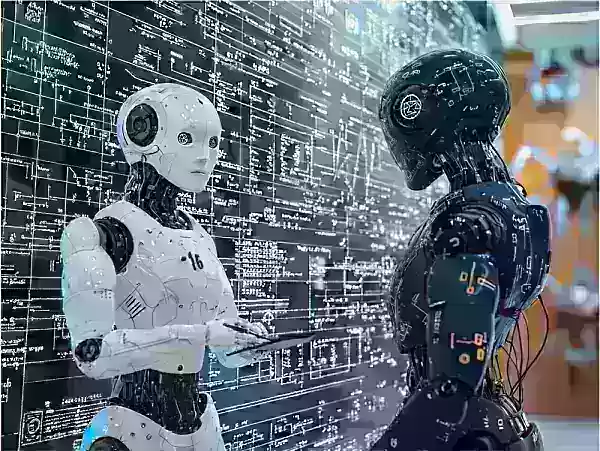
Image source note: This image is AI-generated, courtesy of the Midjourney AI service.
This achievement signifies a major expansion of large language model (LLM) capabilities, moving beyond code and text generation into the logically rigorous domain of theoretical mathematics. The mathematical community has reacted with significant interest, viewing it as a potential paradigm shift in scientific discovery.
The Rise of "Vibe-Proving": A Theorem Forged Through Dialogue
The research team termed this new approach "vibe-proving," inspired by the recent trend of "vibe programming." Throughout the proof process, ChatGPT autonomously explored solution paths and constructed the core logical framework, demonstrating genuine reasoning ability beyond simple data recombination.
The complete proof involved 7 rounds of conversational interaction and 4 iterations of self-refinement, culminating in a rigorous logical argument. While human researchers performed the final verification, the AI's deductive efficiency far surpassed the expectations of mathematicians.
Industry Shift: From Human "Producers" to "Verifiers"
VUB Professor Vincent Ginis noted this breakthrough challenges the persistent notion that "AI possesses only inductive, not creative, capabilities." As the barrier for AI to generate mathematical proofs lowers, the pace of discovery in theoretical mathematics is anticipated to accelerate exponentially.
Related article
 Ctrip Business Travel Unveils AI Ecosystem with 7 Industry Agents and 17 Core Capabilities
Ctrip Business Travel has officially unveiled the "Ctrip Business Travel AI Ecosystem," leveraging large language models to fundamentally restructure corporate travel management. This comprehensive ecosystem addresses four core scenarios: travel arra
Stripe to Acquire OpenRouter as AI Model Routing Gains Momentum
Stripe has agreed to acquire OpenRouter, an AI model-routing platform that gives developers access to hundreds of models through a single interface. The deal adds model selection and routing to Stripe’s existing work around AI usage and token-based b
Former OpenAI Researcher Barrett Zoph Returns to Google to Support Gemini Development
Barret Zoph, who previously abruptly left and joined OpenAI due to a disagreement with Thinking Machines Lab CEO Miriam Mularati, has once again changed employers. Alphabet's Google announced that Zoph will return as Vice President of Research, bring
Related Special Topic Recommendations
Design & Art
Ctrip Business Travel Unveils AI Ecosystem with 7 Industry Agents and 17 Core Capabilities
Ctrip Business Travel has officially unveiled the "Ctrip Business Travel AI Ecosystem," leveraging large language models to fundamentally restructure corporate travel management. This comprehensive ecosystem addresses four core scenarios: travel arra
Stripe to Acquire OpenRouter as AI Model Routing Gains Momentum
Stripe has agreed to acquire OpenRouter, an AI model-routing platform that gives developers access to hundreds of models through a single interface. The deal adds model selection and routing to Stripe’s existing work around AI usage and token-based b
Former OpenAI Researcher Barrett Zoph Returns to Google to Support Gemini Development
Barret Zoph, who previously abruptly left and joined OpenAI due to a disagreement with Thinking Machines Lab CEO Miriam Mularati, has once again changed employers. Alphabet's Google announced that Zoph will return as Vice President of Research, bring
Related Special Topic Recommendations
Design & Art
 Top AI Illustration Tools: Create Editorial Scenes and Cover Art Faster
2026 Latest Top-rated AI Illustration Tools: Our curated list features the best powerfully designed tools for creating stunning editorial scenes and eye-catching cover art quickly. Each option has gone through rigorous real-world tests, offering a free vs paid comparison to help you find the perfect match for your workflow. Try these must-try solutions today to unlock your AI edge and boost your creative productivity. Explore now at XIX.AI.
 10 tools
 xix.ai
Education and Learning
Top AI Tutors for Exam Prep: Practice Math, Science, and English
xix.ai
Education and Learning
Top AI Tutors for Exam Prep: Practice Math, Science, and English
2026 Latest Top-Rated Best AI Tutors for Exam Prep are here on XIX.AI! Our curated list features powerful game-changing tools that offer free vs paid comparison, real-world tests, and weekly updated rankings. They help boost your writing efficiency, simplify complex topic learning, and unlock your academic potential. Explore now to Discover your perfect exam prep tool and Start creating today to Unlock your AI edge!
10 tools
xix.ai
Finance
AI Budget Planning Tools for Personal Money Management
2026 Latest Best Top-Rated AI Budget Planning Tools for Personal Money Management are here on XIX.AI! This curated collection features powerful, game-changing solutions that help you conduct real-world tests, understand spending habits, and create personalized plans to boost productivity. Enjoy a free vs paid comparison along with detailed rankings. Must-try tools designed to simplify money management and unlock your AI edge. Explore now!
11 tools
xix.ai
Health & Wellness
AI Sleep Tracking Assistants: Improve Recovery with Better Bedtime Habits
2026 Latest Best Top-Rated AI Sleep Tracking Assistants curated for ultimate recovery. This fully updated weekly guide features powerful tools that deliver real-world tests, free vs paid comparison, and detailed rankings to help you find the must-try solution that boosts sleep quality and supports better bedtime habits. Explore now at XIX.AI to Unlock your AI edge.
10 tools
xix.ai
Data Analysis
AI SQL Copilots for Product and Revenue Analytics
2026 Latest Best Top-Rated AI SQL Copilots for Product and Revenue Analytics! XIX.AI has curated a powerful, game-changing collection of must-try tools that undergo real-world tests through weekly updated rankings. These tools help users boost productivity significantly by accelerating data analysis, streamlining complex queries, and generating accurate insights to drive smarter business decisions. Explore now to Discover your perfect tool for unlocking your AI edge!
14 tools
xix.ai
Education and Learning
Best AI Homework Helpers That Teach: Learn Concepts, Not Just Answers
2026 Latest Best Top-Rated AI Homework Helpers That Teach Core Concepts Not Just Answers Powerful Tools for Students Must-Try Curated List Weekly Updated Free vs Paid Comparison Real-World Tests Accurate Rankings to Help You Unlock Your Full Learning Potential Explore now to Discover your perfect tool for smarter studying.
10 tools
xix.ai

 Comments (2)
0/500
Comments (2)
0/500
![PeterYoung]()
Wait, so ChatGPT can now prove math theorems? I barely passed calculus... 😅 But seriously, this is both exciting and a little scary. What happens when AI starts proving things humans can't even understand? 🤯
![LawrenceGarcía]()
Wait, so ChatGPT-5.2 actually proved a math conjecture on its own? That's either super exciting or kinda terrifying — I mean, are we heading towards a future where AI writes proofs and we just nod along? 😅 Also, the whole "contextual proof era" sounds like something from a sci-fi novel. But honestly, I'd love to see the actual proof steps, because knowing how the model "thinks" could be huge for education.
Recent research from the Free University of Brussels (VUB) marks a potential milestone in AI history: commercial large language models can now autonomously generate original mathematical proofs. In an experiment, OpenAI's ChatGPT-5.2 (Thinking) successfully resolved a long-standing mathematical conjecture proposed by mathematicians Ran and Teng in 2024.
Image source note: This image is AI-generated, courtesy of the Midjourney AI service.
This achievement signifies a major expansion of large language model (LLM) capabilities, moving beyond code and text generation into the logically rigorous domain of theoretical mathematics. The mathematical community has reacted with significant interest, viewing it as a potential paradigm shift in scientific discovery.
The Rise of "Vibe-Proving": A Theorem Forged Through Dialogue
The research team termed this new approach "vibe-proving," inspired by the recent trend of "vibe programming." Throughout the proof process, ChatGPT autonomously explored solution paths and constructed the core logical framework, demonstrating genuine reasoning ability beyond simple data recombination.
The complete proof involved 7 rounds of conversational interaction and 4 iterations of self-refinement, culminating in a rigorous logical argument. While human researchers performed the final verification, the AI's deductive efficiency far surpassed the expectations of mathematicians.
Industry Shift: From Human "Producers" to "Verifiers"
VUB Professor Vincent Ginis noted this breakthrough challenges the persistent notion that "AI possesses only inductive, not creative, capabilities." As the barrier for AI to generate mathematical proofs lowers, the pace of discovery in theoretical mathematics is anticipated to accelerate exponentially.








 Ctrip Business Travel Unveils AI Ecosystem with 7 Industry Agents and 17 Core Capabilities
Ctrip Business Travel has officially unveiled the "Ctrip Business Travel AI Ecosystem," leveraging large language models to fundamentally restructure corporate travel management. This comprehensive ecosystem addresses four core scenarios: travel arra
Ctrip Business Travel Unveils AI Ecosystem with 7 Industry Agents and 17 Core Capabilities
Ctrip Business Travel has officially unveiled the "Ctrip Business Travel AI Ecosystem," leveraging large language models to fundamentally restructure corporate travel management. This comprehensive ecosystem addresses four core scenarios: travel arra
 Stripe to Acquire OpenRouter as AI Model Routing Gains Momentum
Stripe has agreed to acquire OpenRouter, an AI model-routing platform that gives developers access to hundreds of models through a single interface. The deal adds model selection and routing to Stripe’s existing work around AI usage and token-based b
Stripe to Acquire OpenRouter as AI Model Routing Gains Momentum
Stripe has agreed to acquire OpenRouter, an AI model-routing platform that gives developers access to hundreds of models through a single interface. The deal adds model selection and routing to Stripe’s existing work around AI usage and token-based b
 Former OpenAI Researcher Barrett Zoph Returns to Google to Support Gemini Development
Barret Zoph, who previously abruptly left and joined OpenAI due to a disagreement with Thinking Machines Lab CEO Miriam Mularati, has once again changed employers. Alphabet's Google announced that Zoph will return as Vice President of Research, bring
Former OpenAI Researcher Barrett Zoph Returns to Google to Support Gemini Development
Barret Zoph, who previously abruptly left and joined OpenAI due to a disagreement with Thinking Machines Lab CEO Miriam Mularati, has once again changed employers. Alphabet's Google announced that Zoph will return as Vice President of Research, bring
2026 Latest Top-rated AI Illustration Tools: Our curated list features the best powerfully designed tools for creating stunning editorial scenes and eye-catching cover art quickly. Each option has gone through rigorous real-world tests, offering a free vs paid comparison to help you find the perfect match for your workflow. Try these must-try solutions today to unlock your AI edge and boost your creative productivity. Explore now at XIX.AI.
10 tools
xix.ai
2026 Latest Top-Rated Best AI Tutors for Exam Prep are here on XIX.AI! Our curated list features powerful game-changing tools that offer free vs paid comparison, real-world tests, and weekly updated rankings. They help boost your writing efficiency, simplify complex topic learning, and unlock your academic potential. Explore now to Discover your perfect exam prep tool and Start creating today to Unlock your AI edge!
10 tools
xix.ai

2026 Latest Best Top-Rated AI Budget Planning Tools for Personal Money Management are here on XIX.AI! This curated collection features powerful, game-changing solutions that help you conduct real-world tests, understand spending habits, and create personalized plans to boost productivity. Enjoy a free vs paid comparison along with detailed rankings. Must-try tools designed to simplify money management and unlock your AI edge. Explore now!
11 tools
xix.ai

2026 Latest Best Top-Rated AI Sleep Tracking Assistants curated for ultimate recovery. This fully updated weekly guide features powerful tools that deliver real-world tests, free vs paid comparison, and detailed rankings to help you find the must-try solution that boosts sleep quality and supports better bedtime habits. Explore now at XIX.AI to Unlock your AI edge.
10 tools
xix.ai

2026 Latest Best Top-Rated AI SQL Copilots for Product and Revenue Analytics! XIX.AI has curated a powerful, game-changing collection of must-try tools that undergo real-world tests through weekly updated rankings. These tools help users boost productivity significantly by accelerating data analysis, streamlining complex queries, and generating accurate insights to drive smarter business decisions. Explore now to Discover your perfect tool for unlocking your AI edge!
14 tools
xix.ai

2026 Latest Best Top-Rated AI Homework Helpers That Teach Core Concepts Not Just Answers Powerful Tools for Students Must-Try Curated List Weekly Updated Free vs Paid Comparison Real-World Tests Accurate Rankings to Help You Unlock Your Full Learning Potential Explore now to Discover your perfect tool for smarter studying.
10 tools
xix.ai

Wait, so ChatGPT can now prove math theorems? I barely passed calculus... 😅 But seriously, this is both exciting and a little scary. What happens when AI starts proving things humans can't even understand? 🤯
Wait, so ChatGPT-5.2 actually proved a math conjecture on its own? That's either super exciting or kinda terrifying — I mean, are we heading towards a future where AI writes proofs and we just nod along? 😅 Also, the whole "contextual proof era" sounds like something from a sci-fi novel. But honestly, I'd love to see the actual proof steps, because knowing how the model "thinks" could be huge for education.












