


 Home
HomeAI Models' Memorized Data Exposed in CAMIA Privacy Breach
A groundbreaking new privacy attack exposes vulnerabilities by detecting whether personal data was used to train AI systems.
Developed jointly by Brave and National University of Singapore researchers, CAMIA (Context-Aware Membership Inference Attack) significantly outperforms previous methods for analyzing AI model memory.
The AI industry faces mounting concerns about "data memorization," where models unintentionally retain sensitive training information. Healthcare AI might disclose patient records, while corporate-trained models could regurgitate confidential emails.
Recent developments like LinkedIn's plans to utilize user data for AI training have intensified privacy debates, highlighting potential risks of sensitive information appearing in generated content.
Security professionals employ Membership Inference Attacks (MIAs) to detect data leaks. These tests essentially ask models: "Was this specific example part of your training?" Successful attacks confirm dangerous privacy breaches.
The principle stems from models processing familiar training data differently than new information - MIAs exploit these behavioral differences systematically.
Traditional MIAs proved ineffective against modern generative AI because they were designed for simpler classification models. Large language models generate text sequentially, making holistic evaluations inadequate for spotting leaks.
CAMIA's innovation recognizes that AI memorization depends on context. Models rely on memorized content most when uncertain about subsequent responses.
Consider the phrase "Harry Potter is...written by... The world of Harry..." - models easily predict "Potter" through contextual clues rather than memorization.
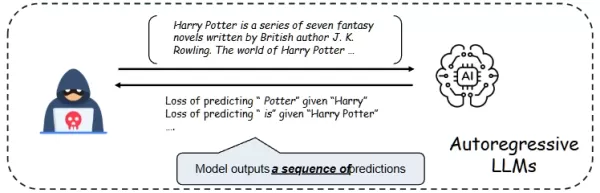
However, given just "Harry," predicting "Potter" requires actual memorization of training data. High-confidence predictions in ambiguous contexts strongly indicate memorized content.
CAMIA represents the first privacy attack designed specifically for generative AI. It tracks uncertainty fluctuations during text generation, distinguishing between contextual guessing and genuine recall.
Testing on MIMIR benchmarks with Pythia and GPT-Neo models yielded impressive results. Against a 2.8B parameter Pythia model, CAMIA nearly doubled detection accuracy while maintaining a minimal 1% false positive rate.
The attack operates efficiently - processing 1,000 samples takes roughly 38 minutes on an A100 GPU, making it viable for practical model auditing.
This research underscores the privacy risks inherent in training massive models on unvetted datasets. The team aims to promote privacy-preserving techniques that balance AI utility with user protection.
See also: Samsung benchmarks real productivity of enterprise AI models

Explore AI and big data advancements at the AI & Big Data Expo in Amsterdam, California, and London. This TechEx-affiliated event offers comprehensive insights alongside leading technology conferences.
AI News is brought to you by TechForge Media. Discover upcoming enterprise technology events and webinars.
Related article
 Meta Faces Lawsuit Over AI Glasses Privacy as Staff Reportedly Viewed Explicit Content
Meta is confronting a new lawsuit regarding privacy issues with its AI smart glasses. According to an investigation by Swedish newspapers, workers at a Kenya-based subcontractor have been reviewing customer footage. This footage reportedly included s
OpenAI's Sam Altman Declares Dawn of the Superintelligence Era
OpenAI CEO Sam Altman has announced that humanity has entered the age of artificial superintelligence, and there is no going back."We have passed the point of no return; the ascent has begun," Altman says. "We are on the brink of creating digital sup
AI Boom Echoes Dot-Com Era Bubble Concerns
The influx of multi-billion dollar investments into AI has fueled a heated debate: is the industry headed for a dot-com style bubble?Investors are vigilant for any cooling of enthusiasm or signs that massive spending on chips and infrastructure isn't
Related Special Topic Recommendations
Data Analysis
Meta Faces Lawsuit Over AI Glasses Privacy as Staff Reportedly Viewed Explicit Content
Meta is confronting a new lawsuit regarding privacy issues with its AI smart glasses. According to an investigation by Swedish newspapers, workers at a Kenya-based subcontractor have been reviewing customer footage. This footage reportedly included s
OpenAI's Sam Altman Declares Dawn of the Superintelligence Era
OpenAI CEO Sam Altman has announced that humanity has entered the age of artificial superintelligence, and there is no going back."We have passed the point of no return; the ascent has begun," Altman says. "We are on the brink of creating digital sup
AI Boom Echoes Dot-Com Era Bubble Concerns
The influx of multi-billion dollar investments into AI has fueled a heated debate: is the industry headed for a dot-com style bubble?Investors are vigilant for any cooling of enthusiasm or signs that massive spending on chips and infrastructure isn't
Related Special Topic Recommendations
Data Analysis
 AI SQL Copilots for Revenue Dashboards, Funnel Analysis, and Product Metrics
2026 Latest Best AI SQL Copilots Ranked Top-Rated! XIX.AI curates a powerful game-changing collection for weekly updated real-world tests. These must-try tools help you generate accurate revenue dashboards, analyze sales funnels, and track product metrics swiftly, boosting productivity massively. Explore now to Discover your perfect tool for data-driven decision making! 238 characters
 9 tools
 xix.ai
Music composition
Best AI Melody Writing Tools for Song Drafts
xix.ai
Music composition
Best AI Melody Writing Tools for Song Drafts
2026 Latest Best Top-Rated AI Melody Writing Tools for Song Drafts! XIX.AI has curated a highly powerful game-changing collection that goes through rigorous real-world tests to deliver the best writing experience. You can find detailed free vs paid comparisons, accurate rankings, and must-try options designed to help you create stunning song drafts effortlessly and boost your creative productivity significantly. Explore now to discover your perfect tool!
8 tools
xix.ai
chatbot
Best AI Conversation Trainer Tools for Interview Practice
2026 Latest Best Top-rated AI Conversation Trainer Tools for Interview Practice are here on XIX.AI! This curated collection features powerful, game-changing tools that go through rigorous real-world tests to deliver accurate feedback. You’ll find a free vs paid comparison and detailed rankings to help you choose the must-try option that boosts your confidence and skills. Explore now to Discover your perfect tool for interview success!
12 tools
xix.ai
Design & Art
Best AI Style Transfer Tools for Creative Experiments
2026 Latest Best Top-rated AI Style Transfer Tools for Creative Experiments! XIX.AI has curated a powerful, game-changing collection of must-try tools that deliver exceptional results through real-world tests and rigorous rankings. These top solutions help creatives boost productivity significantly by accelerating content creation and unlocking endless creative possibilities. Explore now to discover your perfect tool and start creating today!
9 tools
xix.ai
Comic Creation
Best AI Dialogue Bubble Tools for Visual Storytelling
2026 Latest Best Top-Rated AI Dialogue Bubble Tools for Visual Storytelling are here on XIX.AI! This curated collection features powerful, game-changing tools that help creators boost productivity and overcome creative bottlenecks. Get a free vs paid comparison, see real-world tests, and check the latest rankings to find the must-try solutions perfect for crafting engaging visual narratives. Explore now to discover your ideal tool!
10 tools
xix.ai
Meeting Assistant
Top AI Meeting Summary Tools: Track Decisions and Follow-Ups Clearly
2026 Latest Top-Rated Best AI Meeting Summary Tools for Clear Decision Tracking and Effortless Follow-Ups. This curated list showcases powerful, game-changing solutions that boost productivity dramatically by automating meeting notes, identifying key action items, and streamlining team coordination across all projects. Get a free vs paid comparison along with real-world tests and weekly updated rankings to help you find the perfect tool. Explore now to unlock your AI edge!
9 tools
xix.ai

 Comments (4)
0/500
Comments (4)
0/500
![JoeWalker]()
Is my data in there? 🤔 This CAMIA attack by Brave and NUS is pretty scary. It feels like we're just training material for these models without even knowing it. Makes me wonder about the real cost of 'free' AI services.
![BenGarcía]()
This is wild! 🤯 So basically they can tell if my personal data was used to train an AI? That's both cool and terrifying. What if companies get sued over this? Privacy laws need to catch up fast, because memorization is a real issue.
![MarkHarris]()
Also das mit dem CAMIA-Angriff klingt echt nicht gut. KI-Modelle sollen doch keine persönlichen Daten speichern, oder? Wenn jetzt jeder prüfen kann, ob seine eigenen Daten im Training waren, wo soll das hinführen? Da müssen dringend strengere Datenschutzregeln für KI-Entwicklung her. Ist ja fast schon beängstigend, was da alles rauskommen könnte... 🤔
![RalphSmith]()
Слышали про CAMIA? Это кошмар для приватности! Теперь любой может узнать, использовались ли их данные для обучения ИИ. Время удалять свои фото из интернета 📸 А вы как думаете - стоит ли запретить сбор личных данных для ИИ?
A groundbreaking new privacy attack exposes vulnerabilities by detecting whether personal data was used to train AI systems.
Developed jointly by Brave and National University of Singapore researchers, CAMIA (Context-Aware Membership Inference Attack) significantly outperforms previous methods for analyzing AI model memory.
The AI industry faces mounting concerns about "data memorization," where models unintentionally retain sensitive training information. Healthcare AI might disclose patient records, while corporate-trained models could regurgitate confidential emails.
Recent developments like LinkedIn's plans to utilize user data for AI training have intensified privacy debates, highlighting potential risks of sensitive information appearing in generated content.
Security professionals employ Membership Inference Attacks (MIAs) to detect data leaks. These tests essentially ask models: "Was this specific example part of your training?" Successful attacks confirm dangerous privacy breaches.
The principle stems from models processing familiar training data differently than new information - MIAs exploit these behavioral differences systematically.
Traditional MIAs proved ineffective against modern generative AI because they were designed for simpler classification models. Large language models generate text sequentially, making holistic evaluations inadequate for spotting leaks.
CAMIA's innovation recognizes that AI memorization depends on context. Models rely on memorized content most when uncertain about subsequent responses.
Consider the phrase "Harry Potter is...written by... The world of Harry..." - models easily predict "Potter" through contextual clues rather than memorization.
However, given just "Harry," predicting "Potter" requires actual memorization of training data. High-confidence predictions in ambiguous contexts strongly indicate memorized content.
CAMIA represents the first privacy attack designed specifically for generative AI. It tracks uncertainty fluctuations during text generation, distinguishing between contextual guessing and genuine recall.
Testing on MIMIR benchmarks with Pythia and GPT-Neo models yielded impressive results. Against a 2.8B parameter Pythia model, CAMIA nearly doubled detection accuracy while maintaining a minimal 1% false positive rate.
The attack operates efficiently - processing 1,000 samples takes roughly 38 minutes on an A100 GPU, making it viable for practical model auditing.
This research underscores the privacy risks inherent in training massive models on unvetted datasets. The team aims to promote privacy-preserving techniques that balance AI utility with user protection.
See also: Samsung benchmarks real productivity of enterprise AI models
Explore AI and big data advancements at the AI & Big Data Expo in Amsterdam, California, and London. This TechEx-affiliated event offers comprehensive insights alongside leading technology conferences.
AI News is brought to you by TechForge Media. Discover upcoming enterprise technology events and webinars.








 Meta Faces Lawsuit Over AI Glasses Privacy as Staff Reportedly Viewed Explicit Content
Meta is confronting a new lawsuit regarding privacy issues with its AI smart glasses. According to an investigation by Swedish newspapers, workers at a Kenya-based subcontractor have been reviewing customer footage. This footage reportedly included s
OpenAI's Sam Altman Declares Dawn of the Superintelligence Era
OpenAI CEO Sam Altman has announced that humanity has entered the age of artificial superintelligence, and there is no going back."We have passed the point of no return; the ascent has begun," Altman says. "We are on the brink of creating digital sup
Meta Faces Lawsuit Over AI Glasses Privacy as Staff Reportedly Viewed Explicit Content
Meta is confronting a new lawsuit regarding privacy issues with its AI smart glasses. According to an investigation by Swedish newspapers, workers at a Kenya-based subcontractor have been reviewing customer footage. This footage reportedly included s
OpenAI's Sam Altman Declares Dawn of the Superintelligence Era
OpenAI CEO Sam Altman has announced that humanity has entered the age of artificial superintelligence, and there is no going back."We have passed the point of no return; the ascent has begun," Altman says. "We are on the brink of creating digital sup
 AI Boom Echoes Dot-Com Era Bubble Concerns
The influx of multi-billion dollar investments into AI has fueled a heated debate: is the industry headed for a dot-com style bubble?Investors are vigilant for any cooling of enthusiasm or signs that massive spending on chips and infrastructure isn't
AI Boom Echoes Dot-Com Era Bubble Concerns
The influx of multi-billion dollar investments into AI has fueled a heated debate: is the industry headed for a dot-com style bubble?Investors are vigilant for any cooling of enthusiasm or signs that massive spending on chips and infrastructure isn't

2026 Latest Best AI SQL Copilots Ranked Top-Rated! XIX.AI curates a powerful game-changing collection for weekly updated real-world tests. These must-try tools help you generate accurate revenue dashboards, analyze sales funnels, and track product metrics swiftly, boosting productivity massively. Explore now to Discover your perfect tool for data-driven decision making! 238 characters
9 tools
xix.ai

2026 Latest Best Top-Rated AI Melody Writing Tools for Song Drafts! XIX.AI has curated a highly powerful game-changing collection that goes through rigorous real-world tests to deliver the best writing experience. You can find detailed free vs paid comparisons, accurate rankings, and must-try options designed to help you create stunning song drafts effortlessly and boost your creative productivity significantly. Explore now to discover your perfect tool!
8 tools
xix.ai

2026 Latest Best Top-rated AI Conversation Trainer Tools for Interview Practice are here on XIX.AI! This curated collection features powerful, game-changing tools that go through rigorous real-world tests to deliver accurate feedback. You’ll find a free vs paid comparison and detailed rankings to help you choose the must-try option that boosts your confidence and skills. Explore now to Discover your perfect tool for interview success!
12 tools
xix.ai

2026 Latest Best Top-rated AI Style Transfer Tools for Creative Experiments! XIX.AI has curated a powerful, game-changing collection of must-try tools that deliver exceptional results through real-world tests and rigorous rankings. These top solutions help creatives boost productivity significantly by accelerating content creation and unlocking endless creative possibilities. Explore now to discover your perfect tool and start creating today!
9 tools
xix.ai

2026 Latest Best Top-Rated AI Dialogue Bubble Tools for Visual Storytelling are here on XIX.AI! This curated collection features powerful, game-changing tools that help creators boost productivity and overcome creative bottlenecks. Get a free vs paid comparison, see real-world tests, and check the latest rankings to find the must-try solutions perfect for crafting engaging visual narratives. Explore now to discover your ideal tool!
10 tools
xix.ai
2026 Latest Top-Rated Best AI Meeting Summary Tools for Clear Decision Tracking and Effortless Follow-Ups. This curated list showcases powerful, game-changing solutions that boost productivity dramatically by automating meeting notes, identifying key action items, and streamlining team coordination across all projects. Get a free vs paid comparison along with real-world tests and weekly updated rankings to help you find the perfect tool. Explore now to unlock your AI edge!
9 tools
xix.ai

Is my data in there? 🤔 This CAMIA attack by Brave and NUS is pretty scary. It feels like we're just training material for these models without even knowing it. Makes me wonder about the real cost of 'free' AI services.
This is wild! 🤯 So basically they can tell if my personal data was used to train an AI? That's both cool and terrifying. What if companies get sued over this? Privacy laws need to catch up fast, because memorization is a real issue.
Also das mit dem CAMIA-Angriff klingt echt nicht gut. KI-Modelle sollen doch keine persönlichen Daten speichern, oder? Wenn jetzt jeder prüfen kann, ob seine eigenen Daten im Training waren, wo soll das hinführen? Da müssen dringend strengere Datenschutzregeln für KI-Entwicklung her. Ist ja fast schon beängstigend, was da alles rauskommen könnte... 🤔
Слышали про CAMIA? Это кошмар для приватности! Теперь любой может узнать, использовались ли их данные для обучения ИИ. Время удалять свои фото из интернета 📸 А вы как думаете - стоит ли запретить сбор личных данных для ИИ?












