


 Home
HomeBoost Confidence: AI-Powered English Conversation Practice for Social Anxiety
Overcoming Social Anxiety in English: A Practical AI-Powered Guide
Feeling nervous in English conversations? You're not alone. Many learners struggle with social anxiety when speaking a second language—fear of mistakes, difficulty understanding fast speech, or simply not feeling "fluent enough." But what if you could practice real-world conversations in a safe, judgment-free space?
That’s where AI comes in. With tools like ChatGPT, you can simulate realistic dialogues, refine your responses, and build confidence—before stepping into actual social situations. This guide will show you how to use AI effectively to transform anxiety into assurance.
Why Social Anxiety Happens (And How AI Can Help)
The Root of the Problem
For many English learners, social anxiety stems from:
- Fear of mistakes ("What if I say something wrong?")
- Difficulty keeping up ("Native speakers talk too fast!")
- Lack of practice ("I don’t have anyone to speak with regularly.")
How AI Bridges the Gap
AI-powered conversation practice offers:
✅ A safe space – No judgment, no embarrassment.
✅ Personalized scenarios – Practice exactly what you need (job interviews, small talk, presentations).
✅ Instant feedback – Get corrections on grammar, vocabulary, and pronunciation.
✅ 24/7 availability – No need to wait for a language partner.
Step-by-Step: Using AI for Realistic English Practice
1. Identify Your "Trigger" Situations
What makes you most nervous? Common scenarios include:
- Networking events ("How do I introduce myself naturally?")
- Job interviews ("What if I freeze when asked a question?")
- Casual conversations ("How do I keep small talk going?")
2. Set Up a Role-Play in ChatGPT
Example prompt:
"Act as a friendly coworker at a networking event. Ask me questions about my job, hobbies, and opinions. Keep the conversation casual but professional. Correct me if I make mistakes."
📌 Pro Tip: Use voice chat (if available) to practice real-time speaking.
3. Focus on Active Listening & Natural Responses
- Don’t just reply—engage. Ask follow-up questions.
- Mimic real speech patterns (e.g., "Oh, really?" "That’s interesting!")
- Record yourself to catch pronunciation issues.
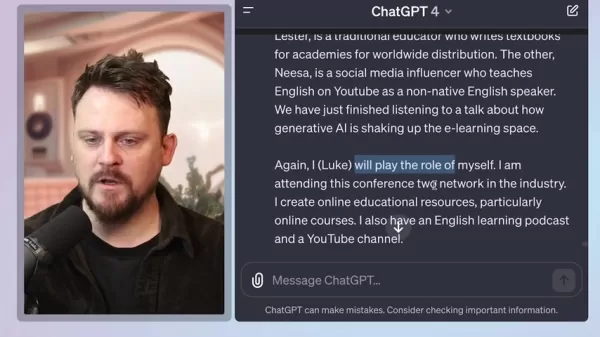
4. Refine with AI Feedback
After each session, ask ChatGPT:
- "Did I make any grammar mistakes?"
- "Were my responses natural?"
- "How could I sound more fluent?"
5. Take It to the Real World
Start small:
- Chat with a language exchange partner.
- Join an English-speaking club (online or in person).
- Gradually increase difficulty (e.g., from casual chats to debates).
Pros & Cons of AI Conversation Practice
Pros Cons ✔ Practice anytime, anywhere ❌ Can miss cultural nuances ✔ Zero pressure ❌ AI may give incorrect corrections ✔ Customizable scenarios ❌ No real emotional feedback
Best used alongside real conversations!
FAQs: AI-Powered English Practice
Q: How do I make AI conversations feel more real?
A: Add details! Example:
"Pretend we’re at a café in London. You’re a barista asking about my trip."
Q: What if the AI gives wrong corrections?
A: Double-check with grammar tools (Grammarly, DeepL) or native speakers.
Q: Can AI help with pronunciation?
A: Yes! Use voice recognition features or apps like Elsa Speak.
Final Tip: Embrace Mistakes!
Even native speakers slip up. The key is practice, not perfection. AI lets you fail safely—so when real conversations happen, you’ll feel ready.
🚀 Start today: Open ChatGPT, pick a scenario, and just talk. Your confidence will grow faster than you think!
Related Questions:
- How to improve English pronunciation fast?
- Best free apps for English conversation practice?
- How to sound more natural in English?
Now it’s your turn! What social situation makes you most nervous in English? Drop a comment—we might feature your question in the next guide! 🎤💬
Related article
 Ctrip Business Travel Unveils AI Ecosystem with 7 Industry Agents and 17 Core Capabilities
Ctrip Business Travel has officially unveiled the "Ctrip Business Travel AI Ecosystem," leveraging large language models to fundamentally restructure corporate travel management. This comprehensive ecosystem addresses four core scenarios: travel arra
Stripe to Acquire OpenRouter as AI Model Routing Gains Momentum
Stripe has agreed to acquire OpenRouter, an AI model-routing platform that gives developers access to hundreds of models through a single interface. The deal adds model selection and routing to Stripe’s existing work around AI usage and token-based b
Former OpenAI Researcher Barrett Zoph Returns to Google to Support Gemini Development
Barret Zoph, who previously abruptly left and joined OpenAI due to a disagreement with Thinking Machines Lab CEO Miriam Mularati, has once again changed employers. Alphabet's Google announced that Zoph will return as Vice President of Research, bring
Related Special Topic Recommendations
Design & Art
Ctrip Business Travel Unveils AI Ecosystem with 7 Industry Agents and 17 Core Capabilities
Ctrip Business Travel has officially unveiled the "Ctrip Business Travel AI Ecosystem," leveraging large language models to fundamentally restructure corporate travel management. This comprehensive ecosystem addresses four core scenarios: travel arra
Stripe to Acquire OpenRouter as AI Model Routing Gains Momentum
Stripe has agreed to acquire OpenRouter, an AI model-routing platform that gives developers access to hundreds of models through a single interface. The deal adds model selection and routing to Stripe’s existing work around AI usage and token-based b
Former OpenAI Researcher Barrett Zoph Returns to Google to Support Gemini Development
Barret Zoph, who previously abruptly left and joined OpenAI due to a disagreement with Thinking Machines Lab CEO Miriam Mularati, has once again changed employers. Alphabet's Google announced that Zoph will return as Vice President of Research, bring
Related Special Topic Recommendations
Design & Art
 Top AI Illustration Tools: Create Editorial Scenes and Cover Art Faster
2026 Latest Top-rated AI Illustration Tools: Our curated list features the best powerfully designed tools for creating stunning editorial scenes and eye-catching cover art quickly. Each option has gone through rigorous real-world tests, offering a free vs paid comparison to help you find the perfect match for your workflow. Try these must-try solutions today to unlock your AI edge and boost your creative productivity. Explore now at XIX.AI.
 10 tools
 xix.ai
Education and Learning
Top AI Tutors for Exam Prep: Practice Math, Science, and English
xix.ai
Education and Learning
Top AI Tutors for Exam Prep: Practice Math, Science, and English
2026 Latest Top-Rated Best AI Tutors for Exam Prep are here on XIX.AI! Our curated list features powerful game-changing tools that offer free vs paid comparison, real-world tests, and weekly updated rankings. They help boost your writing efficiency, simplify complex topic learning, and unlock your academic potential. Explore now to Discover your perfect exam prep tool and Start creating today to Unlock your AI edge!
10 tools
xix.ai
Finance
AI Budget Planning Tools for Personal Money Management
2026 Latest Best Top-Rated AI Budget Planning Tools for Personal Money Management are here on XIX.AI! This curated collection features powerful, game-changing solutions that help you conduct real-world tests, understand spending habits, and create personalized plans to boost productivity. Enjoy a free vs paid comparison along with detailed rankings. Must-try tools designed to simplify money management and unlock your AI edge. Explore now!
11 tools
xix.ai
Health & Wellness
AI Sleep Tracking Assistants: Improve Recovery with Better Bedtime Habits
2026 Latest Best Top-Rated AI Sleep Tracking Assistants curated for ultimate recovery. This fully updated weekly guide features powerful tools that deliver real-world tests, free vs paid comparison, and detailed rankings to help you find the must-try solution that boosts sleep quality and supports better bedtime habits. Explore now at XIX.AI to Unlock your AI edge.
10 tools
xix.ai
Data Analysis
AI SQL Copilots for Product and Revenue Analytics
2026 Latest Best Top-Rated AI SQL Copilots for Product and Revenue Analytics! XIX.AI has curated a powerful, game-changing collection of must-try tools that undergo real-world tests through weekly updated rankings. These tools help users boost productivity significantly by accelerating data analysis, streamlining complex queries, and generating accurate insights to drive smarter business decisions. Explore now to Discover your perfect tool for unlocking your AI edge!
14 tools
xix.ai
Education and Learning
Best AI Homework Helpers That Teach: Learn Concepts, Not Just Answers
2026 Latest Best Top-Rated AI Homework Helpers That Teach Core Concepts Not Just Answers Powerful Tools for Students Must-Try Curated List Weekly Updated Free vs Paid Comparison Real-World Tests Accurate Rankings to Help You Unlock Your Full Learning Potential Explore now to Discover your perfect tool for smarter studying.
10 tools
xix.ai

 Comments (4)
0/500
Comments (4)
0/500
![WilliamYoung]()
Also ich finde den Ansatz echt clever! Die Idee, dass KI einem beim Englischlernen helfen kann, ohne dass man sich vor anderen blamiert, ist super. Ich frage mich nur, ob das wirklich die gleiche Wirkung hat wie ein echtes Gespräch mit einem Menschen. Die Körpersprache und die spontanen Reaktionen fehlen ja doch. Aber für den Einstieg bestimmt hilfreich! 🤔
![DanielPerez]()
This guide is a game-changer for anyone who's ever felt their heart race before speaking English! The AI-powered approach seems like a low-pressure way to build skills without the fear of real-time judgment. I wonder how it compares to traditional language exchange apps in terms of building genuine conversational confidence, not just vocabulary. 🤔
![MarkScott]()
Как по мне, нейросети реально круты для таких целей — общаться без стресса с ботами и набираться уверенности. Но вот что немного настораживает: если все ученики станут практиковаться только с ИИ, не утратят ли они способность адаптироваться к живым эмоциям, непредсказуемости настоящего диалога? Есть над чем подумать 💭
![WillieRodriguez]()
C'est génial ! J'aimerais tellement avoir eu ça quand j'apprenais l'anglais 😅 Ça pourrait marcher pour d'autres langues aussi ? L'anxiété sociale c'est vraiment un vrai problème pour plein d'apprenants...
Overcoming Social Anxiety in English: A Practical AI-Powered Guide
Feeling nervous in English conversations? You're not alone. Many learners struggle with social anxiety when speaking a second language—fear of mistakes, difficulty understanding fast speech, or simply not feeling "fluent enough." But what if you could practice real-world conversations in a safe, judgment-free space?
That’s where AI comes in. With tools like ChatGPT, you can simulate realistic dialogues, refine your responses, and build confidence—before stepping into actual social situations. This guide will show you how to use AI effectively to transform anxiety into assurance.
Why Social Anxiety Happens (And How AI Can Help)
The Root of the Problem
For many English learners, social anxiety stems from:
- Fear of mistakes ("What if I say something wrong?")
- Difficulty keeping up ("Native speakers talk too fast!")
- Lack of practice ("I don’t have anyone to speak with regularly.")
How AI Bridges the Gap
AI-powered conversation practice offers:
✅ A safe space – No judgment, no embarrassment.
✅ Personalized scenarios – Practice exactly what you need (job interviews, small talk, presentations).
✅ Instant feedback – Get corrections on grammar, vocabulary, and pronunciation.
✅ 24/7 availability – No need to wait for a language partner.
Step-by-Step: Using AI for Realistic English Practice
1. Identify Your "Trigger" Situations
What makes you most nervous? Common scenarios include:
- Networking events ("How do I introduce myself naturally?")
- Job interviews ("What if I freeze when asked a question?")
- Casual conversations ("How do I keep small talk going?")
2. Set Up a Role-Play in ChatGPT
Example prompt:
"Act as a friendly coworker at a networking event. Ask me questions about my job, hobbies, and opinions. Keep the conversation casual but professional. Correct me if I make mistakes."
📌 Pro Tip: Use voice chat (if available) to practice real-time speaking.
3. Focus on Active Listening & Natural Responses
- Don’t just reply—engage. Ask follow-up questions.
- Mimic real speech patterns (e.g., "Oh, really?" "That’s interesting!")
- Record yourself to catch pronunciation issues.
4. Refine with AI Feedback
After each session, ask ChatGPT:
- "Did I make any grammar mistakes?"
- "Were my responses natural?"
- "How could I sound more fluent?"
5. Take It to the Real World
Start small:
- Chat with a language exchange partner.
- Join an English-speaking club (online or in person).
- Gradually increase difficulty (e.g., from casual chats to debates).
Pros & Cons of AI Conversation Practice
| Pros | Cons |
|---|---|
| ✔ Practice anytime, anywhere | ❌ Can miss cultural nuances |
| ✔ Zero pressure | ❌ AI may give incorrect corrections |
| ✔ Customizable scenarios | ❌ No real emotional feedback |
Best used alongside real conversations!
FAQs: AI-Powered English Practice
Q: How do I make AI conversations feel more real?
A: Add details! Example:
"Pretend we’re at a café in London. You’re a barista asking about my trip."
Q: What if the AI gives wrong corrections?
A: Double-check with grammar tools (Grammarly, DeepL) or native speakers.
Q: Can AI help with pronunciation?
A: Yes! Use voice recognition features or apps like Elsa Speak.
Final Tip: Embrace Mistakes!
Even native speakers slip up. The key is practice, not perfection. AI lets you fail safely—so when real conversations happen, you’ll feel ready.
🚀 Start today: Open ChatGPT, pick a scenario, and just talk. Your confidence will grow faster than you think!
Related Questions:
- How to improve English pronunciation fast?
- Best free apps for English conversation practice?
- How to sound more natural in English?
Now it’s your turn! What social situation makes you most nervous in English? Drop a comment—we might feature your question in the next guide! 🎤💬








 Ctrip Business Travel Unveils AI Ecosystem with 7 Industry Agents and 17 Core Capabilities
Ctrip Business Travel has officially unveiled the "Ctrip Business Travel AI Ecosystem," leveraging large language models to fundamentally restructure corporate travel management. This comprehensive ecosystem addresses four core scenarios: travel arra
Ctrip Business Travel Unveils AI Ecosystem with 7 Industry Agents and 17 Core Capabilities
Ctrip Business Travel has officially unveiled the "Ctrip Business Travel AI Ecosystem," leveraging large language models to fundamentally restructure corporate travel management. This comprehensive ecosystem addresses four core scenarios: travel arra
 Stripe to Acquire OpenRouter as AI Model Routing Gains Momentum
Stripe has agreed to acquire OpenRouter, an AI model-routing platform that gives developers access to hundreds of models through a single interface. The deal adds model selection and routing to Stripe’s existing work around AI usage and token-based b
Stripe to Acquire OpenRouter as AI Model Routing Gains Momentum
Stripe has agreed to acquire OpenRouter, an AI model-routing platform that gives developers access to hundreds of models through a single interface. The deal adds model selection and routing to Stripe’s existing work around AI usage and token-based b
 Former OpenAI Researcher Barrett Zoph Returns to Google to Support Gemini Development
Barret Zoph, who previously abruptly left and joined OpenAI due to a disagreement with Thinking Machines Lab CEO Miriam Mularati, has once again changed employers. Alphabet's Google announced that Zoph will return as Vice President of Research, bring
Former OpenAI Researcher Barrett Zoph Returns to Google to Support Gemini Development
Barret Zoph, who previously abruptly left and joined OpenAI due to a disagreement with Thinking Machines Lab CEO Miriam Mularati, has once again changed employers. Alphabet's Google announced that Zoph will return as Vice President of Research, bring

2026 Latest Top-rated AI Illustration Tools: Our curated list features the best powerfully designed tools for creating stunning editorial scenes and eye-catching cover art quickly. Each option has gone through rigorous real-world tests, offering a free vs paid comparison to help you find the perfect match for your workflow. Try these must-try solutions today to unlock your AI edge and boost your creative productivity. Explore now at XIX.AI.
10 tools
xix.ai
2026 Latest Top-Rated Best AI Tutors for Exam Prep are here on XIX.AI! Our curated list features powerful game-changing tools that offer free vs paid comparison, real-world tests, and weekly updated rankings. They help boost your writing efficiency, simplify complex topic learning, and unlock your academic potential. Explore now to Discover your perfect exam prep tool and Start creating today to Unlock your AI edge!
10 tools
xix.ai

2026 Latest Best Top-Rated AI Budget Planning Tools for Personal Money Management are here on XIX.AI! This curated collection features powerful, game-changing solutions that help you conduct real-world tests, understand spending habits, and create personalized plans to boost productivity. Enjoy a free vs paid comparison along with detailed rankings. Must-try tools designed to simplify money management and unlock your AI edge. Explore now!
11 tools
xix.ai

2026 Latest Best Top-Rated AI Sleep Tracking Assistants curated for ultimate recovery. This fully updated weekly guide features powerful tools that deliver real-world tests, free vs paid comparison, and detailed rankings to help you find the must-try solution that boosts sleep quality and supports better bedtime habits. Explore now at XIX.AI to Unlock your AI edge.
10 tools
xix.ai

2026 Latest Best Top-Rated AI SQL Copilots for Product and Revenue Analytics! XIX.AI has curated a powerful, game-changing collection of must-try tools that undergo real-world tests through weekly updated rankings. These tools help users boost productivity significantly by accelerating data analysis, streamlining complex queries, and generating accurate insights to drive smarter business decisions. Explore now to Discover your perfect tool for unlocking your AI edge!
14 tools
xix.ai
2026 Latest Best Top-Rated AI Homework Helpers That Teach Core Concepts Not Just Answers Powerful Tools for Students Must-Try Curated List Weekly Updated Free vs Paid Comparison Real-World Tests Accurate Rankings to Help You Unlock Your Full Learning Potential Explore now to Discover your perfect tool for smarter studying.
10 tools
xix.ai

Also ich finde den Ansatz echt clever! Die Idee, dass KI einem beim Englischlernen helfen kann, ohne dass man sich vor anderen blamiert, ist super. Ich frage mich nur, ob das wirklich die gleiche Wirkung hat wie ein echtes Gespräch mit einem Menschen. Die Körpersprache und die spontanen Reaktionen fehlen ja doch. Aber für den Einstieg bestimmt hilfreich! 🤔
This guide is a game-changer for anyone who's ever felt their heart race before speaking English! The AI-powered approach seems like a low-pressure way to build skills without the fear of real-time judgment. I wonder how it compares to traditional language exchange apps in terms of building genuine conversational confidence, not just vocabulary. 🤔
Как по мне, нейросети реально круты для таких целей — общаться без стресса с ботами и набираться уверенности. Но вот что немного настораживает: если все ученики станут практиковаться только с ИИ, не утратят ли они способность адаптироваться к живым эмоциям, непредсказуемости настоящего диалога? Есть над чем подумать 💭
C'est génial ! J'aimerais tellement avoir eu ça quand j'apprenais l'anglais 😅 Ça pourrait marcher pour d'autres langues aussi ? L'anxiété sociale c'est vraiment un vrai problème pour plein d'apprenants...












