


 Home
HomeAnthropic Unveils AI Consultant Tool with Specialized Model Roles
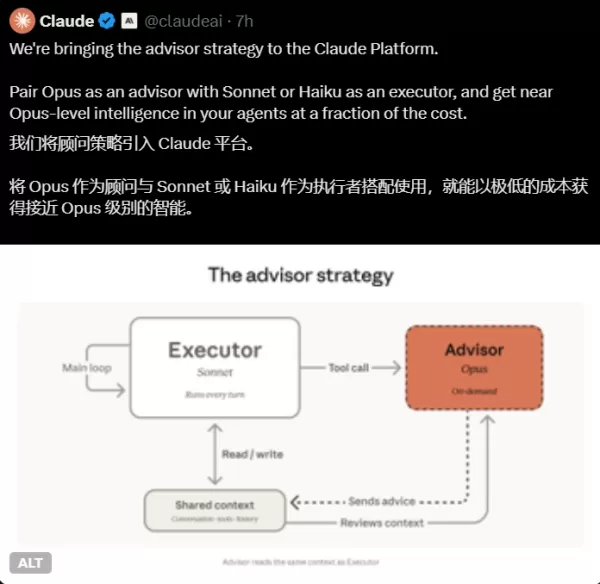
Anthropic has officially launched the Advisor Tool within the Claude Platform API, introducing developers to a novel hybrid intelligence model. In this setup, a more affordable and faster model handles the bulk of the workload, automatically consulting the most powerful model for strategic advice only when complex decisions arise. This design fundamentally rethinks the traditional Agent development approach of "large model plans, small model acts," delivering a truly optimal cost-to-performance solution.
Innovative Mechanism: Small Model Executes, Large Model Advises
This new feature positions Claude Sonnet or Haiku as the "executor," responsible for calling tools, processing tasks, and integrating results. The executor only passes the current context to Claude Opus for advisory input when it encounters a difficult problem it cannot solve independently.
Opus provides high-level solutions, course corrections, or strategic guidance before immediately returning control to the executor. Crucially, Opus does not directly call tools or output final results to users, acting instead as an invisible "strategist." This inverted design ensures the majority of token consumption occurs on the lower-cost model, reserving high-end computing power for critical junctures.
Performance and Cost: A Win-Win in Testing
Official test data reveals significant benefits:
The Sonnet + Opus Advisor combination showed a 2.7 percentage point improvement on the multi-language SWE-bench compared to Sonnet alone, while the overall cost per task decreased by 11.9%.
The Haiku + Opus Advisor pairing delivered even more striking results. Its score in the BrowseComp test jumped from 19.7% to 41.2%, effectively doubling performance. While it still trails Sonnet's solo performance by about 29%, its cost is only 15% of Sonnet's, making it ideal for high-concurrency, batch-processing scenarios with higher tolerance for error.
These results demonstrate that by intelligently routing key decisions, developers can move beyond the difficult choice between "Opus is too expensive for full-time use" and "Sonnet alone isn't powerful enough."
Simple to Use: Enable with a Single Line of Configuration
Developers can activate this feature simply by adding a tool definition of type advisor_20260301 to the tools array in the Messages API. Complex operations like model switching and context passing are managed automatically within a single API request, eliminating the need to manually orchestrate multiple calls or manage extra context.
The max_uses parameter allows flexible control over the maximum number of advisor consultations per request. For billing, token usage for the executor and the advisor are charged separately, ensuring transparency and control. Currently in Beta, using the feature requires adding `anthropic-beta: advisor-tool-2026-03-01` to the request header.
Industry Impact: Opening New Doors for Cost-Effective Agent Development
The launch of the Advisor Tool signifies an important evolution in AI Agent development paradigms. It enables developers to enjoy Sonnet's execution efficiency and near-Sonnet pricing for roughly 95% of tasks, while gaining Opus-level judgment at the 5% of critical decision points. This "executor + advisor" hybrid strategy not only slashes the cost of large-scale deployment but also dramatically enhances the viability of smaller models in complex workflows.
Whether building coding agents, browser automation tools, or high-volume data processing systems, the Advisor Tool offers an efficient, flexible, and economical option. Anthropic once again proves that breakthroughs in model capability stem not just from parameter scale, but from architectural and usage-pattern innovation.
As the Beta phase continues, this feature is poised to quickly become a standard tool for developers building performant, cost-conscious AI Agents. Its subsequent updates and further benchmark performances are certainly worth watching closely.
Related article
 Ctrip Business Travel Unveils AI Ecosystem with 7 Industry Agents and 17 Core Capabilities
Ctrip Business Travel has officially unveiled the "Ctrip Business Travel AI Ecosystem," leveraging large language models to fundamentally restructure corporate travel management. This comprehensive ecosystem addresses four core scenarios: travel arra
Stripe to Acquire OpenRouter as AI Model Routing Gains Momentum
Stripe has agreed to acquire OpenRouter, an AI model-routing platform that gives developers access to hundreds of models through a single interface. The deal adds model selection and routing to Stripe’s existing work around AI usage and token-based b
Former OpenAI Researcher Barrett Zoph Returns to Google to Support Gemini Development
Barret Zoph, who previously abruptly left and joined OpenAI due to a disagreement with Thinking Machines Lab CEO Miriam Mularati, has once again changed employers. Alphabet's Google announced that Zoph will return as Vice President of Research, bring
Related Special Topic Recommendations
Design & Art
Ctrip Business Travel Unveils AI Ecosystem with 7 Industry Agents and 17 Core Capabilities
Ctrip Business Travel has officially unveiled the "Ctrip Business Travel AI Ecosystem," leveraging large language models to fundamentally restructure corporate travel management. This comprehensive ecosystem addresses four core scenarios: travel arra
Stripe to Acquire OpenRouter as AI Model Routing Gains Momentum
Stripe has agreed to acquire OpenRouter, an AI model-routing platform that gives developers access to hundreds of models through a single interface. The deal adds model selection and routing to Stripe’s existing work around AI usage and token-based b
Former OpenAI Researcher Barrett Zoph Returns to Google to Support Gemini Development
Barret Zoph, who previously abruptly left and joined OpenAI due to a disagreement with Thinking Machines Lab CEO Miriam Mularati, has once again changed employers. Alphabet's Google announced that Zoph will return as Vice President of Research, bring
Related Special Topic Recommendations
Design & Art
 Top AI Illustration Tools: Create Editorial Scenes and Cover Art Faster
2026 Latest Top-rated AI Illustration Tools: Our curated list features the best powerfully designed tools for creating stunning editorial scenes and eye-catching cover art quickly. Each option has gone through rigorous real-world tests, offering a free vs paid comparison to help you find the perfect match for your workflow. Try these must-try solutions today to unlock your AI edge and boost your creative productivity. Explore now at XIX.AI.
 10 tools
 xix.ai
Education and Learning
Top AI Tutors for Exam Prep: Practice Math, Science, and English
xix.ai
Education and Learning
Top AI Tutors for Exam Prep: Practice Math, Science, and English
2026 Latest Top-Rated Best AI Tutors for Exam Prep are here on XIX.AI! Our curated list features powerful game-changing tools that offer free vs paid comparison, real-world tests, and weekly updated rankings. They help boost your writing efficiency, simplify complex topic learning, and unlock your academic potential. Explore now to Discover your perfect exam prep tool and Start creating today to Unlock your AI edge!
10 tools
xix.ai
Finance
AI Budget Planning Tools for Personal Money Management
2026 Latest Best Top-Rated AI Budget Planning Tools for Personal Money Management are here on XIX.AI! This curated collection features powerful, game-changing solutions that help you conduct real-world tests, understand spending habits, and create personalized plans to boost productivity. Enjoy a free vs paid comparison along with detailed rankings. Must-try tools designed to simplify money management and unlock your AI edge. Explore now!
11 tools
xix.ai
Health & Wellness
AI Sleep Tracking Assistants: Improve Recovery with Better Bedtime Habits
2026 Latest Best Top-Rated AI Sleep Tracking Assistants curated for ultimate recovery. This fully updated weekly guide features powerful tools that deliver real-world tests, free vs paid comparison, and detailed rankings to help you find the must-try solution that boosts sleep quality and supports better bedtime habits. Explore now at XIX.AI to Unlock your AI edge.
10 tools
xix.ai
Data Analysis
AI SQL Copilots for Product and Revenue Analytics
2026 Latest Best Top-Rated AI SQL Copilots for Product and Revenue Analytics! XIX.AI has curated a powerful, game-changing collection of must-try tools that undergo real-world tests through weekly updated rankings. These tools help users boost productivity significantly by accelerating data analysis, streamlining complex queries, and generating accurate insights to drive smarter business decisions. Explore now to Discover your perfect tool for unlocking your AI edge!
14 tools
xix.ai
Education and Learning
Best AI Homework Helpers That Teach: Learn Concepts, Not Just Answers
2026 Latest Best Top-Rated AI Homework Helpers That Teach Core Concepts Not Just Answers Powerful Tools for Students Must-Try Curated List Weekly Updated Free vs Paid Comparison Real-World Tests Accurate Rankings to Help You Unlock Your Full Learning Potential Explore now to Discover your perfect tool for smarter studying.
10 tools
xix.ai

 Comments (1)
0/500
Comments (1)
0/500
![MarkGonzalez]()
So they're basically using a cheap intern to do the grunt work and only calling in the senior dev when things get messy? That's actually a smart way to cut costs, but I wonder if the hand-off between models will cause any weird logic gaps. 🤔
Anthropic has officially launched the Advisor Tool within the Claude Platform API, introducing developers to a novel hybrid intelligence model. In this setup, a more affordable and faster model handles the bulk of the workload, automatically consulting the most powerful model for strategic advice only when complex decisions arise. This design fundamentally rethinks the traditional Agent development approach of "large model plans, small model acts," delivering a truly optimal cost-to-performance solution.
Innovative Mechanism: Small Model Executes, Large Model Advises
This new feature positions Claude Sonnet or Haiku as the "executor," responsible for calling tools, processing tasks, and integrating results. The executor only passes the current context to Claude Opus for advisory input when it encounters a difficult problem it cannot solve independently.
Opus provides high-level solutions, course corrections, or strategic guidance before immediately returning control to the executor. Crucially, Opus does not directly call tools or output final results to users, acting instead as an invisible "strategist." This inverted design ensures the majority of token consumption occurs on the lower-cost model, reserving high-end computing power for critical junctures.
Performance and Cost: A Win-Win in Testing
Official test data reveals significant benefits:
The Sonnet + Opus Advisor combination showed a 2.7 percentage point improvement on the multi-language SWE-bench compared to Sonnet alone, while the overall cost per task decreased by 11.9%.
The Haiku + Opus Advisor pairing delivered even more striking results. Its score in the BrowseComp test jumped from 19.7% to 41.2%, effectively doubling performance. While it still trails Sonnet's solo performance by about 29%, its cost is only 15% of Sonnet's, making it ideal for high-concurrency, batch-processing scenarios with higher tolerance for error.
These results demonstrate that by intelligently routing key decisions, developers can move beyond the difficult choice between "Opus is too expensive for full-time use" and "Sonnet alone isn't powerful enough."
Simple to Use: Enable with a Single Line of Configuration
Developers can activate this feature simply by adding a tool definition of type advisor_20260301 to the tools array in the Messages API. Complex operations like model switching and context passing are managed automatically within a single API request, eliminating the need to manually orchestrate multiple calls or manage extra context.
The max_uses parameter allows flexible control over the maximum number of advisor consultations per request. For billing, token usage for the executor and the advisor are charged separately, ensuring transparency and control. Currently in Beta, using the feature requires adding `anthropic-beta: advisor-tool-2026-03-01` to the request header.
Industry Impact: Opening New Doors for Cost-Effective Agent Development
The launch of the Advisor Tool signifies an important evolution in AI Agent development paradigms. It enables developers to enjoy Sonnet's execution efficiency and near-Sonnet pricing for roughly 95% of tasks, while gaining Opus-level judgment at the 5% of critical decision points. This "executor + advisor" hybrid strategy not only slashes the cost of large-scale deployment but also dramatically enhances the viability of smaller models in complex workflows.
Whether building coding agents, browser automation tools, or high-volume data processing systems, the Advisor Tool offers an efficient, flexible, and economical option. Anthropic once again proves that breakthroughs in model capability stem not just from parameter scale, but from architectural and usage-pattern innovation.
As the Beta phase continues, this feature is poised to quickly become a standard tool for developers building performant, cost-conscious AI Agents. Its subsequent updates and further benchmark performances are certainly worth watching closely.








 Ctrip Business Travel Unveils AI Ecosystem with 7 Industry Agents and 17 Core Capabilities
Ctrip Business Travel has officially unveiled the "Ctrip Business Travel AI Ecosystem," leveraging large language models to fundamentally restructure corporate travel management. This comprehensive ecosystem addresses four core scenarios: travel arra
Ctrip Business Travel Unveils AI Ecosystem with 7 Industry Agents and 17 Core Capabilities
Ctrip Business Travel has officially unveiled the "Ctrip Business Travel AI Ecosystem," leveraging large language models to fundamentally restructure corporate travel management. This comprehensive ecosystem addresses four core scenarios: travel arra
 Stripe to Acquire OpenRouter as AI Model Routing Gains Momentum
Stripe has agreed to acquire OpenRouter, an AI model-routing platform that gives developers access to hundreds of models through a single interface. The deal adds model selection and routing to Stripe’s existing work around AI usage and token-based b
Stripe to Acquire OpenRouter as AI Model Routing Gains Momentum
Stripe has agreed to acquire OpenRouter, an AI model-routing platform that gives developers access to hundreds of models through a single interface. The deal adds model selection and routing to Stripe’s existing work around AI usage and token-based b
 Former OpenAI Researcher Barrett Zoph Returns to Google to Support Gemini Development
Barret Zoph, who previously abruptly left and joined OpenAI due to a disagreement with Thinking Machines Lab CEO Miriam Mularati, has once again changed employers. Alphabet's Google announced that Zoph will return as Vice President of Research, bring
Former OpenAI Researcher Barrett Zoph Returns to Google to Support Gemini Development
Barret Zoph, who previously abruptly left and joined OpenAI due to a disagreement with Thinking Machines Lab CEO Miriam Mularati, has once again changed employers. Alphabet's Google announced that Zoph will return as Vice President of Research, bring

2026 Latest Top-rated AI Illustration Tools: Our curated list features the best powerfully designed tools for creating stunning editorial scenes and eye-catching cover art quickly. Each option has gone through rigorous real-world tests, offering a free vs paid comparison to help you find the perfect match for your workflow. Try these must-try solutions today to unlock your AI edge and boost your creative productivity. Explore now at XIX.AI.
10 tools
xix.ai

2026 Latest Top-Rated Best AI Tutors for Exam Prep are here on XIX.AI! Our curated list features powerful game-changing tools that offer free vs paid comparison, real-world tests, and weekly updated rankings. They help boost your writing efficiency, simplify complex topic learning, and unlock your academic potential. Explore now to Discover your perfect exam prep tool and Start creating today to Unlock your AI edge!
10 tools
xix.ai

2026 Latest Best Top-Rated AI Budget Planning Tools for Personal Money Management are here on XIX.AI! This curated collection features powerful, game-changing solutions that help you conduct real-world tests, understand spending habits, and create personalized plans to boost productivity. Enjoy a free vs paid comparison along with detailed rankings. Must-try tools designed to simplify money management and unlock your AI edge. Explore now!
11 tools
xix.ai

2026 Latest Best Top-Rated AI Sleep Tracking Assistants curated for ultimate recovery. This fully updated weekly guide features powerful tools that deliver real-world tests, free vs paid comparison, and detailed rankings to help you find the must-try solution that boosts sleep quality and supports better bedtime habits. Explore now at XIX.AI to Unlock your AI edge.
10 tools
xix.ai

2026 Latest Best Top-Rated AI SQL Copilots for Product and Revenue Analytics! XIX.AI has curated a powerful, game-changing collection of must-try tools that undergo real-world tests through weekly updated rankings. These tools help users boost productivity significantly by accelerating data analysis, streamlining complex queries, and generating accurate insights to drive smarter business decisions. Explore now to Discover your perfect tool for unlocking your AI edge!
14 tools
xix.ai

2026 Latest Best Top-Rated AI Homework Helpers That Teach Core Concepts Not Just Answers Powerful Tools for Students Must-Try Curated List Weekly Updated Free vs Paid Comparison Real-World Tests Accurate Rankings to Help You Unlock Your Full Learning Potential Explore now to Discover your perfect tool for smarter studying.
10 tools
xix.ai

So they're basically using a cheap intern to do the grunt work and only calling in the senior dev when things get messy? That's actually a smart way to cut costs, but I wonder if the hand-off between models will cause any weird logic gaps. 🤔












