


 Home
HomeAlibaba's Wan2.7-Image AI Generates Custom Faces and Writes Essays
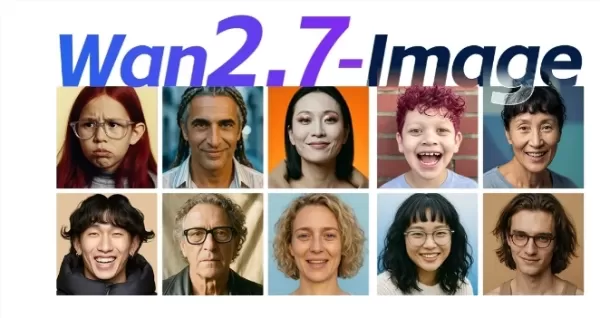
Today, Alibaba officially launched its unified large model for image generation and editing, Wan2.7-Image. This model not only achieves a qualitative leap in visual quality but also overcomes traditional AI image generation limitations, such as "generic faces" and "prompt misalignment," through comprehensive capability upgrades.
Farewell to AI-Generated Faces: Entering the Era of "One Person, One Face"
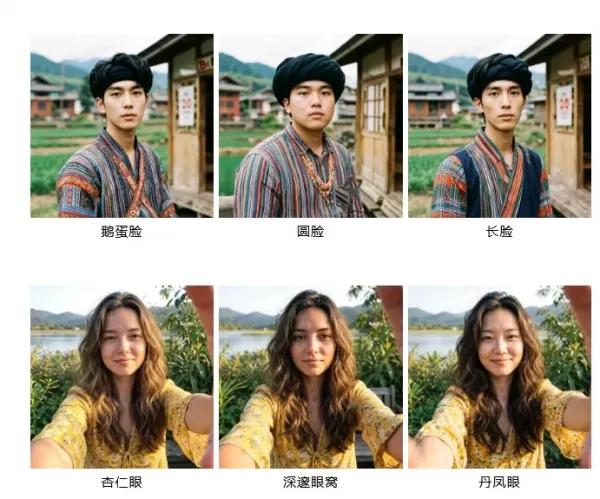
Wan2.7-Image significantly enhances its virtual character customization function. Users can customize everything from bone structure and eyes to subtle facial features, precisely controlling specific traits like an oval face, phoenix eyes, or deep-set eye sockets. This advancement moves beyond the mechanical uniformity of past AI portraits, enabling true personal expression.
"Color Palette" Feature and "Print-Quality" Text Rendering
In artistic expression, the model now supports a "Color Palette" feature. This allows users to extract the color composition from a reference image—such as Matisse's red series or Van Gogh's yellow series—with a single click and accurately apply it to new creations. Furthermore, Wan2.7-Image excels at long-text rendering, supporting inputs of up to 3K tokens. It can stably output an entire A4 page of content containing complex formulas and tables, meeting print-quality standards across 12 supported languages.
Interactive Editing and Multi-Subject Consistency
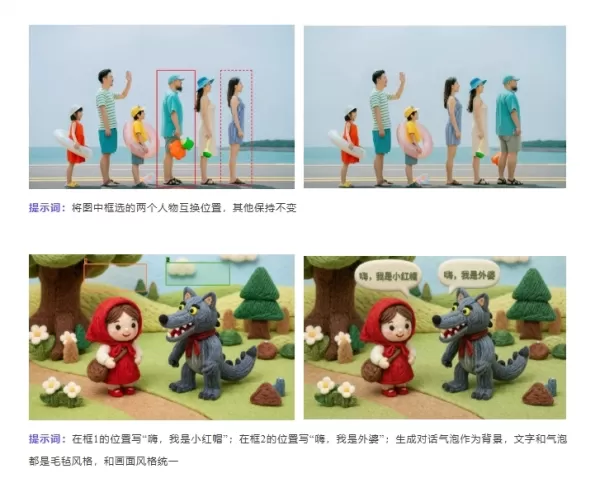
The model boasts powerful interactive editing capabilities, supporting the alignment, movement, or replacement of elements via precise selection. For instance, users can select characters in an image to swap their positions or replace ice cubes with fruit, achieving pixel-level control. Simultaneously, the model supports multi-subject consistency across up to 9 images, maintaining a uniform style and characteristics when generating AI girl groups or furniture sets.
Core Technological Breakthroughs and Industry Applications
Wan2.7-Image employs a leading unified architecture for both generation and understanding, achieving semantic mapping within a shared latent space. This means the model no longer merely guesses text to match pixels but possesses a foundational semantic understanding. The model has launched alongside the Wan2.7-Image-pro version, which offers more stable composition and precise comprehension.
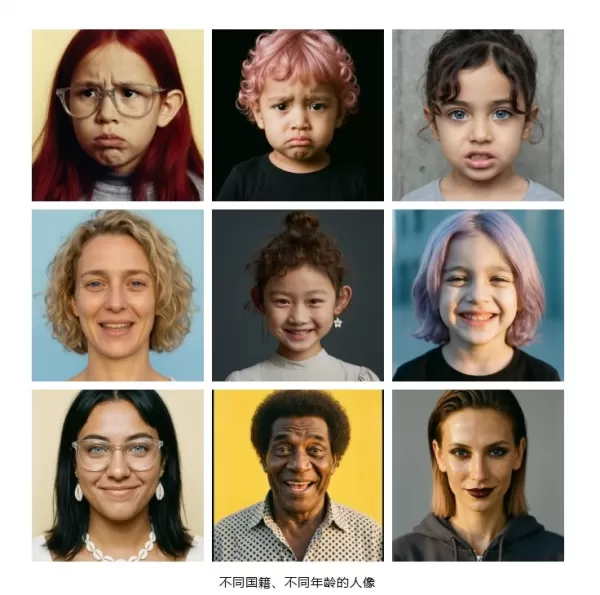
This model is now widely applied in short-form video production (one actor playing multiple roles), e-commerce advertising (one model image for multiple uses), education, research, and social entertainment. Users can access the API via the Alibaba Cloud BaiLian Platform or experience it directly on the Wanxiang Official Website .
Related article
 Stripe to Acquire OpenRouter as AI Model Routing Gains Momentum
Stripe has agreed to acquire OpenRouter, an AI model-routing platform that gives developers access to hundreds of models through a single interface. The deal adds model selection and routing to Stripe’s existing work around AI usage and token-based b
Former OpenAI Researcher Barrett Zoph Returns to Google to Support Gemini Development
Barret Zoph, who previously abruptly left and joined OpenAI due to a disagreement with Thinking Machines Lab CEO Miriam Mularati, has once again changed employers. Alphabet's Google announced that Zoph will return as Vice President of Research, bring
How Recursive Intelligence Raised $335M at $4B Valuation in 4 Months
The co-founders of startup Ricursive Intelligence seemed destined to be co-founders.Anna Goldie, CEO, and Azalia Mirhoseini, CTO, are so well-known in the AI community that they were among those AI engineers who “got those weird emails from Zuckerber
Related Special Topic Recommendations
Design & Art
Stripe to Acquire OpenRouter as AI Model Routing Gains Momentum
Stripe has agreed to acquire OpenRouter, an AI model-routing platform that gives developers access to hundreds of models through a single interface. The deal adds model selection and routing to Stripe’s existing work around AI usage and token-based b
Former OpenAI Researcher Barrett Zoph Returns to Google to Support Gemini Development
Barret Zoph, who previously abruptly left and joined OpenAI due to a disagreement with Thinking Machines Lab CEO Miriam Mularati, has once again changed employers. Alphabet's Google announced that Zoph will return as Vice President of Research, bring
How Recursive Intelligence Raised $335M at $4B Valuation in 4 Months
The co-founders of startup Ricursive Intelligence seemed destined to be co-founders.Anna Goldie, CEO, and Azalia Mirhoseini, CTO, are so well-known in the AI community that they were among those AI engineers who “got those weird emails from Zuckerber
Related Special Topic Recommendations
Design & Art
 Top AI Illustration Tools: Create Editorial Scenes and Cover Art Faster
2026 Latest Top-rated AI Illustration Tools: Our curated list features the best powerfully designed tools for creating stunning editorial scenes and eye-catching cover art quickly. Each option has gone through rigorous real-world tests, offering a free vs paid comparison to help you find the perfect match for your workflow. Try these must-try solutions today to unlock your AI edge and boost your creative productivity. Explore now at XIX.AI.
 10 tools
 xix.ai
Education and Learning
Top AI Tutors for Exam Prep: Practice Math, Science, and English
xix.ai
Education and Learning
Top AI Tutors for Exam Prep: Practice Math, Science, and English
2026 Latest Top-Rated Best AI Tutors for Exam Prep are here on XIX.AI! Our curated list features powerful game-changing tools that offer free vs paid comparison, real-world tests, and weekly updated rankings. They help boost your writing efficiency, simplify complex topic learning, and unlock your academic potential. Explore now to Discover your perfect exam prep tool and Start creating today to Unlock your AI edge!
10 tools
xix.ai
Finance
AI Budget Planning Tools for Personal Money Management
2026 Latest Best Top-Rated AI Budget Planning Tools for Personal Money Management are here on XIX.AI! This curated collection features powerful, game-changing solutions that help you conduct real-world tests, understand spending habits, and create personalized plans to boost productivity. Enjoy a free vs paid comparison along with detailed rankings. Must-try tools designed to simplify money management and unlock your AI edge. Explore now!
11 tools
xix.ai
Health & Wellness
AI Sleep Tracking Assistants: Improve Recovery with Better Bedtime Habits
2026 Latest Best Top-Rated AI Sleep Tracking Assistants curated for ultimate recovery. This fully updated weekly guide features powerful tools that deliver real-world tests, free vs paid comparison, and detailed rankings to help you find the must-try solution that boosts sleep quality and supports better bedtime habits. Explore now at XIX.AI to Unlock your AI edge.
10 tools
xix.ai
Data Analysis
AI SQL Copilots for Product and Revenue Analytics
2026 Latest Best Top-Rated AI SQL Copilots for Product and Revenue Analytics! XIX.AI has curated a powerful, game-changing collection of must-try tools that undergo real-world tests through weekly updated rankings. These tools help users boost productivity significantly by accelerating data analysis, streamlining complex queries, and generating accurate insights to drive smarter business decisions. Explore now to Discover your perfect tool for unlocking your AI edge!
14 tools
xix.ai
Education and Learning
Best AI Homework Helpers That Teach: Learn Concepts, Not Just Answers
2026 Latest Best Top-Rated AI Homework Helpers That Teach Core Concepts Not Just Answers Powerful Tools for Students Must-Try Curated List Weekly Updated Free vs Paid Comparison Real-World Tests Accurate Rankings to Help You Unlock Your Full Learning Potential Explore now to Discover your perfect tool for smarter studying.
10 tools
xix.ai

 Comments (0)
0/500
Comments (0)
0/500
Today, Alibaba officially launched its unified large model for image generation and editing, Wan2.7-Image. This model not only achieves a qualitative leap in visual quality but also overcomes traditional AI image generation limitations, such as "generic faces" and "prompt misalignment," through comprehensive capability upgrades.
Farewell to AI-Generated Faces: Entering the Era of "One Person, One Face"
Wan2.7-Image significantly enhances its virtual character customization function. Users can customize everything from bone structure and eyes to subtle facial features, precisely controlling specific traits like an oval face, phoenix eyes, or deep-set eye sockets. This advancement moves beyond the mechanical uniformity of past AI portraits, enabling true personal expression.
"Color Palette" Feature and "Print-Quality" Text Rendering
In artistic expression, the model now supports a "Color Palette" feature. This allows users to extract the color composition from a reference image—such as Matisse's red series or Van Gogh's yellow series—with a single click and accurately apply it to new creations. Furthermore, Wan2.7-Image excels at long-text rendering, supporting inputs of up to 3K tokens. It can stably output an entire A4 page of content containing complex formulas and tables, meeting print-quality standards across 12 supported languages.
Interactive Editing and Multi-Subject Consistency
The model boasts powerful interactive editing capabilities, supporting the alignment, movement, or replacement of elements via precise selection. For instance, users can select characters in an image to swap their positions or replace ice cubes with fruit, achieving pixel-level control. Simultaneously, the model supports multi-subject consistency across up to 9 images, maintaining a uniform style and characteristics when generating AI girl groups or furniture sets.
Core Technological Breakthroughs and Industry Applications
Wan2.7-Image employs a leading unified architecture for both generation and understanding, achieving semantic mapping within a shared latent space. This means the model no longer merely guesses text to match pixels but possesses a foundational semantic understanding. The model has launched alongside the Wan2.7-Image-pro version, which offers more stable composition and precise comprehension.
This model is now widely applied in short-form video production (one actor playing multiple roles), e-commerce advertising (one model image for multiple uses), education, research, and social entertainment. Users can access the API via the








 Stripe to Acquire OpenRouter as AI Model Routing Gains Momentum
Stripe has agreed to acquire OpenRouter, an AI model-routing platform that gives developers access to hundreds of models through a single interface. The deal adds model selection and routing to Stripe’s existing work around AI usage and token-based b
Stripe to Acquire OpenRouter as AI Model Routing Gains Momentum
Stripe has agreed to acquire OpenRouter, an AI model-routing platform that gives developers access to hundreds of models through a single interface. The deal adds model selection and routing to Stripe’s existing work around AI usage and token-based b
 Former OpenAI Researcher Barrett Zoph Returns to Google to Support Gemini Development
Barret Zoph, who previously abruptly left and joined OpenAI due to a disagreement with Thinking Machines Lab CEO Miriam Mularati, has once again changed employers. Alphabet's Google announced that Zoph will return as Vice President of Research, bring
Former OpenAI Researcher Barrett Zoph Returns to Google to Support Gemini Development
Barret Zoph, who previously abruptly left and joined OpenAI due to a disagreement with Thinking Machines Lab CEO Miriam Mularati, has once again changed employers. Alphabet's Google announced that Zoph will return as Vice President of Research, bring
 How Recursive Intelligence Raised $335M at $4B Valuation in 4 Months
The co-founders of startup Ricursive Intelligence seemed destined to be co-founders.Anna Goldie, CEO, and Azalia Mirhoseini, CTO, are so well-known in the AI community that they were among those AI engineers who “got those weird emails from Zuckerber
How Recursive Intelligence Raised $335M at $4B Valuation in 4 Months
The co-founders of startup Ricursive Intelligence seemed destined to be co-founders.Anna Goldie, CEO, and Azalia Mirhoseini, CTO, are so well-known in the AI community that they were among those AI engineers who “got those weird emails from Zuckerber
2026 Latest Top-rated AI Illustration Tools: Our curated list features the best powerfully designed tools for creating stunning editorial scenes and eye-catching cover art quickly. Each option has gone through rigorous real-world tests, offering a free vs paid comparison to help you find the perfect match for your workflow. Try these must-try solutions today to unlock your AI edge and boost your creative productivity. Explore now at XIX.AI.
10 tools
xix.ai

2026 Latest Top-Rated Best AI Tutors for Exam Prep are here on XIX.AI! Our curated list features powerful game-changing tools that offer free vs paid comparison, real-world tests, and weekly updated rankings. They help boost your writing efficiency, simplify complex topic learning, and unlock your academic potential. Explore now to Discover your perfect exam prep tool and Start creating today to Unlock your AI edge!
10 tools
xix.ai

2026 Latest Best Top-Rated AI Budget Planning Tools for Personal Money Management are here on XIX.AI! This curated collection features powerful, game-changing solutions that help you conduct real-world tests, understand spending habits, and create personalized plans to boost productivity. Enjoy a free vs paid comparison along with detailed rankings. Must-try tools designed to simplify money management and unlock your AI edge. Explore now!
11 tools
xix.ai

2026 Latest Best Top-Rated AI Sleep Tracking Assistants curated for ultimate recovery. This fully updated weekly guide features powerful tools that deliver real-world tests, free vs paid comparison, and detailed rankings to help you find the must-try solution that boosts sleep quality and supports better bedtime habits. Explore now at XIX.AI to Unlock your AI edge.
10 tools
xix.ai

2026 Latest Best Top-Rated AI SQL Copilots for Product and Revenue Analytics! XIX.AI has curated a powerful, game-changing collection of must-try tools that undergo real-world tests through weekly updated rankings. These tools help users boost productivity significantly by accelerating data analysis, streamlining complex queries, and generating accurate insights to drive smarter business decisions. Explore now to Discover your perfect tool for unlocking your AI edge!
14 tools
xix.ai

2026 Latest Best Top-Rated AI Homework Helpers That Teach Core Concepts Not Just Answers Powerful Tools for Students Must-Try Curated List Weekly Updated Free vs Paid Comparison Real-World Tests Accurate Rankings to Help You Unlock Your Full Learning Potential Explore now to Discover your perfect tool for smarter studying.
10 tools
xix.ai












