


 Home
HomeCan AI Resurrect Extinct Languages or Obliterate Them for Good?
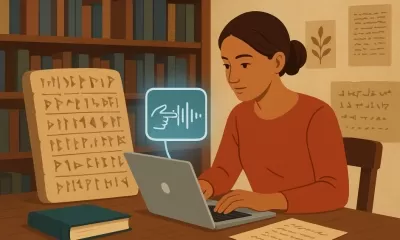
Many languages that once shaped entire cultures survive today only in fragmented written records or in the fading memories of their last speakers. Some vanished through conquest, colonization, and deliberate cultural suppression. Others faded as younger generations shifted to more dominant tongues. With each loss, we lose not just a means of communication, but an entire body of knowledge and a unique cultural identity.
Today, Artificial Intelligence (AI) is entering this space, analyzing manuscripts, audio archives, and inscriptions to reconstruct lost grammar, vocabulary, and pronunciation. Proponents see this as a potential path to revival, offering communities a bridge to reconnect with their linguistic past.
Yet, significant risks exist. Reconstructions that lack deep cultural context, historical nuance, and active community engagement may produce languages that are technically accurate yet functionally hollow. In such cases, preservation remains confined to static records, effectively confirming a language's extinction rather than reversing it.
Language Loss in the Age of Globalization
The decline of global linguistic diversity is accelerating at an unprecedented rate. UNESCO estimates that nearly 40% of the world's roughly 7,000 languages are endangered, with one disappearing approximately every two weeks. This represents a loss far greater than communication systems; it erases unique worldviews, historical narratives, and specialized environmental knowledge.
Traditional documentation methods—recording native speech, mapping grammatical structures, and archiving oral histories—are vital but often painstakingly slow. Many languages slip into silence before they can be fully captured.
AI is beginning to alter this dynamic. Advanced algorithms can process scarce audio data, identify linguistic patterns, and reconstruct incomplete language systems much faster than conventional approaches. While this acceleration creates new preservation opportunities, it also presents a key challenge: if efforts focus solely on data extraction without involving the language community, the result may be a precise but culturally disconnected digital archive.
Sustaining linguistic heritage in the modern era therefore requires a collaborative model, uniting researchers, technologists, and community members to ensure preservation is both accurate and culturally resonant.
AI in Linguistic Reconstruction and Language Revival
AI has rapidly evolved from a supplementary research tool to a central force in linguistic reconstruction. Machine learning models, particularly deep neural networks, now perform tasks that once demanded decades of scholarly labor. These systems can analyze enormous collections of manuscripts, inscriptions, and audio recordings in a fraction of the time, uncovering subtle patterns that may elude even expert linguists.
Technologically reconstructing a lost language typically involves two complementary AI approaches. The first uses pattern recognition models to identify recurring structures in grammar, syntax, and vocabulary from surviving fragments. The second employs generative systems, like Large Language Models (LLMs), to fill in the gaps. Insights from the initial analysis guide the generative stage, allowing AI to propose plausible missing words, phrases, and phonetic elements. By training on related languages and partial documentation, these systems can generate educated hypotheses about how the language may have sounded and been structured.
Several pioneering projects demonstrate this potential. AI has helped model Proto-Indo-European roots with greater statistical confidence, reconstruct ancient Greek phonetics from damaged texts, and create realistic speech synthesis for critically endangered languages, allowing communities to hear pronunciations silent for generations.
However, significant hurdles remain, both technical and cultural. Limited or low-quality data can lead models to generate convincing but historically inaccurate patterns. High statistical accuracy does not automatically equate to cultural authenticity. Consequently, leading projects integrate algorithmic outputs with the critical review of linguists, anthropologists, and, most importantly, descendant community speakers.
Emerging techniques like self-supervised learning offer further promise. These models can deduce grammatical rules from data in a single language without needing parallel translations, making them ideal for languages with very few resources. When deployed collaboratively, they provide scale and speed while preserving essential cultural context.
Ultimately, AI-driven reconstruction only succeeds when technology serves human expertise. The most meaningful revivals occur when AI assists community leaders and scholars, helping transform silent records back into living, spoken languages.
The Evolution of Digital Language Preservation from Static Archives to Interactive Revival
Before the rise of AI, preserving endangered and extinct languages primarily relied on static digital archives. Initiatives like the Rosetta Project and the Endangered Languages Archive amassed dictionaries, texts, audio recordings, and cultural artifacts. These repositories provided invaluable access to linguistic heritage for scholars and communities alike. Yet, these resources were largely passive. Learners could consult a dictionary or listen to a recording but had few ways to actively use or practice the language, limiting its potential revival as a living medium.
AI is transforming this landscape by introducing interactivity and dynamic engagement. Modern AI tools now include chatbots, voice assistants, and translation apps capable of conversing, listening, and responding in endangered or historically lost languages. This shift allows languages to move beyond reference materials and become part of daily life, education, and cultural practice through interactive experiences.
A key strength of AI lies in intelligently filling gaps. When complete dictionaries or texts are missing, AI models can analyze related languages to suggest probable vocabulary. For instance, if 30% of a language's lexicon is lost, AI can propose likely words by drawing on linguistic patterns from sister languages or historical contexts. AI is also reconstructing the sounds of lost languages. By synthesizing phonetic clues from ancient texts with modern linguistic knowledge, AI-generated voices can now speak languages like Sumerian, Sanskrit, and Old Norse, allowing learners and researchers to hear tongues silent for centuries.
Challenges and Ethical Considerations in AI-Driven Language Revival
While AI opens new pathways for reviving languages, significant challenges and ethical questions must be navigated. Without living native speakers for verification, AI outputs remain educated approximations. At times, models may generate pronunciations or usages that seem plausible but are not historically or culturally faithful. This underscores the necessity of close partnerships between technologists, linguists, and community members to ensure revival efforts honor both cultural heritage and historical integrity.
A major risk is the creation of a purely digital language. A language is more than vocabulary and grammar; it lives through daily use, social rituals, humor, and shared cultural expression. If a language is reconstructed by AI but not spoken and woven into community life, it risks becoming a static museum piece—technically preserved but socially inert.
Bias in training data is another critical concern. Data often comes from colonial-era archives or outsider documentation, which may reflect perspectives at odds with the community's own. If AI learns from such biased sources, it may perpetuate a distorted version of the language, misrepresenting the community's true heritage and identity.
Over-reliance on AI tools also poses a threat. If communities depend solely on AI for language teaching and maintenance, the vital motivation for intergenerational, person-to-person transmission may weaken. Oral tradition and community engagement are the lifeblood of a living language; AI should support these processes, not supplant them.
Ethical issues of ownership and control are paramount. For many Indigenous and minority groups, language is a core element of cultural sovereignty. There is legitimate concern that large technology corporations could claim rights over AI-generated language content, especially if derived from recordings made by community elders. To safeguard community rights, revival projects must involve local stakeholders from the outset, prioritizing informed consent, data sovereignty, and cultural sensitivity. AI should act as a supportive tool, aiding but never overriding community agency.
Promising models of this collaborative approach are emerging. In New Zealand, AI helps develop resources for the Māori language, with all content reviewed and approved by Māori linguists and educators. In Canada, AI supports Indigenous languages like Inuktitut and Cree, empowering communities to build their own digital learning tools. In these cases, AI accelerates resource creation while the heart of the revival—human teaching and cultural practice—remains central.
This integrated approach leverages AI's analytical power alongside the deep cultural knowledge of native speakers. It helps ensure languages remain vibrant both online and in daily life. AI can significantly accelerate revival, but it must work in harmony with people, culture, and community usage to genuinely restore these languages to living practice.
The Bottom Line
Reviving extinct and endangered languages is a profoundly complex endeavor. AI provides powerful new tools to accelerate reconstruction and create engaging, interactive resources. However, technology alone cannot breathe life back into a language. True revival is fundamentally a human and social process, dependent on native speakers, community buy-in, and the cultural practices that embed a language in daily life.
AI must serve as a supportive partner, not a replacement, ensuring that revived languages carry authentic meaning and cultural weight. This requires ongoing collaboration between technologists, linguists, and communities to balance technical accuracy with cultural authenticity and deep respect for heritage. Only through this partnership can we move beyond preserving words in an archive to restoring living, spoken languages that connect us to our past and enrich our shared human future.
Related article
 DeepMind CEO Hassabis: I sleep six hours a day, usually feel energetic around 1 a.m.
Fortune recently featured an interview with Demis Hassabis, CEO of Google DeepMind, revealing his unconventional approach to rest and productivity. Hassabis disclosed that he sleeps very little, structuring his waking hours into two distinct work blo
OpenAI, Anthropic Vie for Market Share Despite Revenue Shortfalls
Despite recent reports suggesting OpenAI missed revenue targets, creating pressure on tech stocks this Tuesday, private AI lab investors remain resilient. Seasoned backers have confirmed they will not reduce investment despite negative media coverage
California AV Compliance: A New Era of Tickets, Geofences, and 1M Miles
Guident operates an AuveTech shuttle in South Florida, managing a four-mile route in West Palm Beach and a one-mile route in Boca Raton using its remote monitoring technology. | Credit: GuidentCalifornia is redefining the regulatory landscape for dri
Related Special Topic Recommendations
Music composition
DeepMind CEO Hassabis: I sleep six hours a day, usually feel energetic around 1 a.m.
Fortune recently featured an interview with Demis Hassabis, CEO of Google DeepMind, revealing his unconventional approach to rest and productivity. Hassabis disclosed that he sleeps very little, structuring his waking hours into two distinct work blo
OpenAI, Anthropic Vie for Market Share Despite Revenue Shortfalls
Despite recent reports suggesting OpenAI missed revenue targets, creating pressure on tech stocks this Tuesday, private AI lab investors remain resilient. Seasoned backers have confirmed they will not reduce investment despite negative media coverage
California AV Compliance: A New Era of Tickets, Geofences, and 1M Miles
Guident operates an AuveTech shuttle in South Florida, managing a four-mile route in West Palm Beach and a one-mile route in Boca Raton using its remote monitoring technology. | Credit: GuidentCalifornia is redefining the regulatory landscape for dri
Related Special Topic Recommendations
Music composition
 AI Stem Separation Tools for Remix Production, Sampling Prep, and Karaoke Masters
2026 Latest Best Top-rated AI Stem Separation Tools Curated for Remix Production, Sampling Prep, and Karaoke Masters. These powerful game-changing tools offer real-world tests to deliver precise audio isolation, boosting productivity significantly. XIX.AI provides a weekly updated free vs paid comparison guide to help you find the must-try solution that suits your needs. Explore now to unlock your AI edge.
 8 tools
 xix.ai
Data Analysis
AI SQL Copilots for Revenue Dashboards, Funnel Analysis, and Product Metrics
xix.ai
Data Analysis
AI SQL Copilots for Revenue Dashboards, Funnel Analysis, and Product Metrics
2026 Latest Best AI SQL Copilots Ranked Top-Rated! XIX.AI curates a powerful game-changing collection for weekly updated real-world tests. These must-try tools help you generate accurate revenue dashboards, analyze sales funnels, and track product metrics swiftly, boosting productivity massively. Explore now to Discover your perfect tool for data-driven decision making! 238 characters
9 tools
xix.ai
Music composition
Best AI Melody Writing Tools for Song Drafts
2026 Latest Best Top-Rated AI Melody Writing Tools for Song Drafts! XIX.AI has curated a highly powerful game-changing collection that goes through rigorous real-world tests to deliver the best writing experience. You can find detailed free vs paid comparisons, accurate rankings, and must-try options designed to help you create stunning song drafts effortlessly and boost your creative productivity significantly. Explore now to discover your perfect tool!
8 tools
xix.ai
chatbot
Best AI Conversation Trainer Tools for Interview Practice
2026 Latest Best Top-rated AI Conversation Trainer Tools for Interview Practice are here on XIX.AI! This curated collection features powerful, game-changing tools that go through rigorous real-world tests to deliver accurate feedback. You’ll find a free vs paid comparison and detailed rankings to help you choose the must-try option that boosts your confidence and skills. Explore now to Discover your perfect tool for interview success!
12 tools
xix.ai
Design & Art
Best AI Style Transfer Tools for Creative Experiments
2026 Latest Best Top-rated AI Style Transfer Tools for Creative Experiments! XIX.AI has curated a powerful, game-changing collection of must-try tools that deliver exceptional results through real-world tests and rigorous rankings. These top solutions help creatives boost productivity significantly by accelerating content creation and unlocking endless creative possibilities. Explore now to discover your perfect tool and start creating today!
9 tools
xix.ai
Comic Creation
Best AI Dialogue Bubble Tools for Visual Storytelling
2026 Latest Best Top-Rated AI Dialogue Bubble Tools for Visual Storytelling are here on XIX.AI! This curated collection features powerful, game-changing tools that help creators boost productivity and overcome creative bottlenecks. Get a free vs paid comparison, see real-world tests, and check the latest rankings to find the must-try solutions perfect for crafting engaging visual narratives. Explore now to discover your ideal tool!
10 tools
xix.ai

 Comments (1)
0/500
Comments (1)
0/500
![NicholasSanchez]()
看完這篇文章,真的很震撼⋯⋯把已經消失的語言透過 AI 重現,聽起來像科幻小說的情節。但我也會想,要是 AI 最後讓語言變得更單一怎麼辦?就像我們現在很多人只講英語或幾種主流語言,會不會反而加速那些脆弱語言的消亡?這個技術到底會是救贖還是另一種形式的抹殺呢?有點擔心 😅
Many languages that once shaped entire cultures survive today only in fragmented written records or in the fading memories of their last speakers. Some vanished through conquest, colonization, and deliberate cultural suppression. Others faded as younger generations shifted to more dominant tongues. With each loss, we lose not just a means of communication, but an entire body of knowledge and a unique cultural identity.
Today, Artificial Intelligence (AI) is entering this space, analyzing manuscripts, audio archives, and inscriptions to reconstruct lost grammar, vocabulary, and pronunciation. Proponents see this as a potential path to revival, offering communities a bridge to reconnect with their linguistic past.
Yet, significant risks exist. Reconstructions that lack deep cultural context, historical nuance, and active community engagement may produce languages that are technically accurate yet functionally hollow. In such cases, preservation remains confined to static records, effectively confirming a language's extinction rather than reversing it.
Language Loss in the Age of Globalization
The decline of global linguistic diversity is accelerating at an unprecedented rate. UNESCO estimates that nearly 40% of the world's roughly 7,000 languages are endangered, with one disappearing approximately every two weeks. This represents a loss far greater than communication systems; it erases unique worldviews, historical narratives, and specialized environmental knowledge.
Traditional documentation methods—recording native speech, mapping grammatical structures, and archiving oral histories—are vital but often painstakingly slow. Many languages slip into silence before they can be fully captured.
AI is beginning to alter this dynamic. Advanced algorithms can process scarce audio data, identify linguistic patterns, and reconstruct incomplete language systems much faster than conventional approaches. While this acceleration creates new preservation opportunities, it also presents a key challenge: if efforts focus solely on data extraction without involving the language community, the result may be a precise but culturally disconnected digital archive.
Sustaining linguistic heritage in the modern era therefore requires a collaborative model, uniting researchers, technologists, and community members to ensure preservation is both accurate and culturally resonant.
AI in Linguistic Reconstruction and Language Revival
AI has rapidly evolved from a supplementary research tool to a central force in linguistic reconstruction. Machine learning models, particularly deep neural networks, now perform tasks that once demanded decades of scholarly labor. These systems can analyze enormous collections of manuscripts, inscriptions, and audio recordings in a fraction of the time, uncovering subtle patterns that may elude even expert linguists.
Technologically reconstructing a lost language typically involves two complementary AI approaches. The first uses pattern recognition models to identify recurring structures in grammar, syntax, and vocabulary from surviving fragments. The second employs generative systems, like Large Language Models (LLMs), to fill in the gaps. Insights from the initial analysis guide the generative stage, allowing AI to propose plausible missing words, phrases, and phonetic elements. By training on related languages and partial documentation, these systems can generate educated hypotheses about how the language may have sounded and been structured.
Several pioneering projects demonstrate this potential. AI has helped model Proto-Indo-European roots with greater statistical confidence, reconstruct ancient Greek phonetics from damaged texts, and create realistic speech synthesis for critically endangered languages, allowing communities to hear pronunciations silent for generations.
However, significant hurdles remain, both technical and cultural. Limited or low-quality data can lead models to generate convincing but historically inaccurate patterns. High statistical accuracy does not automatically equate to cultural authenticity. Consequently, leading projects integrate algorithmic outputs with the critical review of linguists, anthropologists, and, most importantly, descendant community speakers.
Emerging techniques like self-supervised learning offer further promise. These models can deduce grammatical rules from data in a single language without needing parallel translations, making them ideal for languages with very few resources. When deployed collaboratively, they provide scale and speed while preserving essential cultural context.
Ultimately, AI-driven reconstruction only succeeds when technology serves human expertise. The most meaningful revivals occur when AI assists community leaders and scholars, helping transform silent records back into living, spoken languages.
The Evolution of Digital Language Preservation from Static Archives to Interactive Revival
Before the rise of AI, preserving endangered and extinct languages primarily relied on static digital archives. Initiatives like the Rosetta Project and the Endangered Languages Archive amassed dictionaries, texts, audio recordings, and cultural artifacts. These repositories provided invaluable access to linguistic heritage for scholars and communities alike. Yet, these resources were largely passive. Learners could consult a dictionary or listen to a recording but had few ways to actively use or practice the language, limiting its potential revival as a living medium.
AI is transforming this landscape by introducing interactivity and dynamic engagement. Modern AI tools now include chatbots, voice assistants, and translation apps capable of conversing, listening, and responding in endangered or historically lost languages. This shift allows languages to move beyond reference materials and become part of daily life, education, and cultural practice through interactive experiences.
A key strength of AI lies in intelligently filling gaps. When complete dictionaries or texts are missing, AI models can analyze related languages to suggest probable vocabulary. For instance, if 30% of a language's lexicon is lost, AI can propose likely words by drawing on linguistic patterns from sister languages or historical contexts. AI is also reconstructing the sounds of lost languages. By synthesizing phonetic clues from ancient texts with modern linguistic knowledge, AI-generated voices can now speak languages like Sumerian, Sanskrit, and Old Norse, allowing learners and researchers to hear tongues silent for centuries.
Challenges and Ethical Considerations in AI-Driven Language Revival
While AI opens new pathways for reviving languages, significant challenges and ethical questions must be navigated. Without living native speakers for verification, AI outputs remain educated approximations. At times, models may generate pronunciations or usages that seem plausible but are not historically or culturally faithful. This underscores the necessity of close partnerships between technologists, linguists, and community members to ensure revival efforts honor both cultural heritage and historical integrity.
A major risk is the creation of a purely digital language. A language is more than vocabulary and grammar; it lives through daily use, social rituals, humor, and shared cultural expression. If a language is reconstructed by AI but not spoken and woven into community life, it risks becoming a static museum piece—technically preserved but socially inert.
Bias in training data is another critical concern. Data often comes from colonial-era archives or outsider documentation, which may reflect perspectives at odds with the community's own. If AI learns from such biased sources, it may perpetuate a distorted version of the language, misrepresenting the community's true heritage and identity.
Over-reliance on AI tools also poses a threat. If communities depend solely on AI for language teaching and maintenance, the vital motivation for intergenerational, person-to-person transmission may weaken. Oral tradition and community engagement are the lifeblood of a living language; AI should support these processes, not supplant them.
Ethical issues of ownership and control are paramount. For many Indigenous and minority groups, language is a core element of cultural sovereignty. There is legitimate concern that large technology corporations could claim rights over AI-generated language content, especially if derived from recordings made by community elders. To safeguard community rights, revival projects must involve local stakeholders from the outset, prioritizing informed consent, data sovereignty, and cultural sensitivity. AI should act as a supportive tool, aiding but never overriding community agency.
Promising models of this collaborative approach are emerging. In New Zealand, AI helps develop resources for the Māori language, with all content reviewed and approved by Māori linguists and educators. In Canada, AI supports Indigenous languages like Inuktitut and Cree, empowering communities to build their own digital learning tools. In these cases, AI accelerates resource creation while the heart of the revival—human teaching and cultural practice—remains central.
This integrated approach leverages AI's analytical power alongside the deep cultural knowledge of native speakers. It helps ensure languages remain vibrant both online and in daily life. AI can significantly accelerate revival, but it must work in harmony with people, culture, and community usage to genuinely restore these languages to living practice.
The Bottom Line
Reviving extinct and endangered languages is a profoundly complex endeavor. AI provides powerful new tools to accelerate reconstruction and create engaging, interactive resources. However, technology alone cannot breathe life back into a language. True revival is fundamentally a human and social process, dependent on native speakers, community buy-in, and the cultural practices that embed a language in daily life.
AI must serve as a supportive partner, not a replacement, ensuring that revived languages carry authentic meaning and cultural weight. This requires ongoing collaboration between technologists, linguists, and communities to balance technical accuracy with cultural authenticity and deep respect for heritage. Only through this partnership can we move beyond preserving words in an archive to restoring living, spoken languages that connect us to our past and enrich our shared human future.








 DeepMind CEO Hassabis: I sleep six hours a day, usually feel energetic around 1 a.m.
Fortune recently featured an interview with Demis Hassabis, CEO of Google DeepMind, revealing his unconventional approach to rest and productivity. Hassabis disclosed that he sleeps very little, structuring his waking hours into two distinct work blo
DeepMind CEO Hassabis: I sleep six hours a day, usually feel energetic around 1 a.m.
Fortune recently featured an interview with Demis Hassabis, CEO of Google DeepMind, revealing his unconventional approach to rest and productivity. Hassabis disclosed that he sleeps very little, structuring his waking hours into two distinct work blo
 OpenAI, Anthropic Vie for Market Share Despite Revenue Shortfalls
Despite recent reports suggesting OpenAI missed revenue targets, creating pressure on tech stocks this Tuesday, private AI lab investors remain resilient. Seasoned backers have confirmed they will not reduce investment despite negative media coverage
California AV Compliance: A New Era of Tickets, Geofences, and 1M Miles
Guident operates an AuveTech shuttle in South Florida, managing a four-mile route in West Palm Beach and a one-mile route in Boca Raton using its remote monitoring technology. | Credit: GuidentCalifornia is redefining the regulatory landscape for dri
OpenAI, Anthropic Vie for Market Share Despite Revenue Shortfalls
Despite recent reports suggesting OpenAI missed revenue targets, creating pressure on tech stocks this Tuesday, private AI lab investors remain resilient. Seasoned backers have confirmed they will not reduce investment despite negative media coverage
California AV Compliance: A New Era of Tickets, Geofences, and 1M Miles
Guident operates an AuveTech shuttle in South Florida, managing a four-mile route in West Palm Beach and a one-mile route in Boca Raton using its remote monitoring technology. | Credit: GuidentCalifornia is redefining the regulatory landscape for dri

2026 Latest Best Top-rated AI Stem Separation Tools Curated for Remix Production, Sampling Prep, and Karaoke Masters. These powerful game-changing tools offer real-world tests to deliver precise audio isolation, boosting productivity significantly. XIX.AI provides a weekly updated free vs paid comparison guide to help you find the must-try solution that suits your needs. Explore now to unlock your AI edge.
8 tools
xix.ai

2026 Latest Best AI SQL Copilots Ranked Top-Rated! XIX.AI curates a powerful game-changing collection for weekly updated real-world tests. These must-try tools help you generate accurate revenue dashboards, analyze sales funnels, and track product metrics swiftly, boosting productivity massively. Explore now to Discover your perfect tool for data-driven decision making! 238 characters
9 tools
xix.ai

2026 Latest Best Top-Rated AI Melody Writing Tools for Song Drafts! XIX.AI has curated a highly powerful game-changing collection that goes through rigorous real-world tests to deliver the best writing experience. You can find detailed free vs paid comparisons, accurate rankings, and must-try options designed to help you create stunning song drafts effortlessly and boost your creative productivity significantly. Explore now to discover your perfect tool!
8 tools
xix.ai

2026 Latest Best Top-rated AI Conversation Trainer Tools for Interview Practice are here on XIX.AI! This curated collection features powerful, game-changing tools that go through rigorous real-world tests to deliver accurate feedback. You’ll find a free vs paid comparison and detailed rankings to help you choose the must-try option that boosts your confidence and skills. Explore now to Discover your perfect tool for interview success!
12 tools
xix.ai

2026 Latest Best Top-rated AI Style Transfer Tools for Creative Experiments! XIX.AI has curated a powerful, game-changing collection of must-try tools that deliver exceptional results through real-world tests and rigorous rankings. These top solutions help creatives boost productivity significantly by accelerating content creation and unlocking endless creative possibilities. Explore now to discover your perfect tool and start creating today!
9 tools
xix.ai

2026 Latest Best Top-Rated AI Dialogue Bubble Tools for Visual Storytelling are here on XIX.AI! This curated collection features powerful, game-changing tools that help creators boost productivity and overcome creative bottlenecks. Get a free vs paid comparison, see real-world tests, and check the latest rankings to find the must-try solutions perfect for crafting engaging visual narratives. Explore now to discover your ideal tool!
10 tools
xix.ai

看完這篇文章,真的很震撼⋯⋯把已經消失的語言透過 AI 重現,聽起來像科幻小說的情節。但我也會想,要是 AI 最後讓語言變得更單一怎麼辦?就像我們現在很多人只講英語或幾種主流語言,會不會反而加速那些脆弱語言的消亡?這個技術到底會是救贖還是另一種形式的抹殺呢?有點擔心 😅












