


 Home
HomeAI Streamlines News Article Summarization in Comprehensive Guide
In an era of information saturation, AI-powered text summarization provides an essential tool for efficiently processing a vast number of news articles. This detailed guide explores the approaches behind extractive and abstractive summarization, showcasing their use in improving data-driven decision-making. Learn how businesses and individuals can use these technologies to stay informed and make strategic decisions.
Key Points
Text summarization uses AI to condense large volumes of text into concise summaries.
Extractive summarization picks out and copies key phrases directly from the source text.
Abstractive summarization rephrases and rewrites the content to produce original summaries.
73 Strings is an AI-focused startup offering insights based on data analysis.
Data-driven decision-making relies on analyzed information to guide choices.
Natural Language Processing (NLP) is essential for producing accurate and coherent text summaries.
Understanding Text Summarization
What is Text Summarization?
Text summarization is the technique of shortening a lengthy document into a brief version while keeping the most critical information. This is an essential function in today's information-heavy world, where people and organizations are continually faced with massive amounts of data. The objective is to distill key insights without needing to read entire documents.
This technique is especially beneficial in areas like journalism, research, and business intelligence, where staying updated is vital but time is scarce. AI-driven text summarization provides a powerful solution for efficiently analyzing and comprehending large texts, leading to better decisions and increased productivity.
The demand for effective text summarization is driven by several factors:
- Information Overload: The enormous quantity of data available online makes it impossible for people to manually review everything.
- Time Limitations: Professionals often need to quickly understand a document's main ideas to make informed choices.
- Enhanced Understanding: A well-written summary can improve comprehension and retention of key points.
Many methods have been created to address text summarization, each with unique advantages and drawbacks. These techniques range from straightforward keyword extraction to advanced natural language processing (NLP) algorithms.
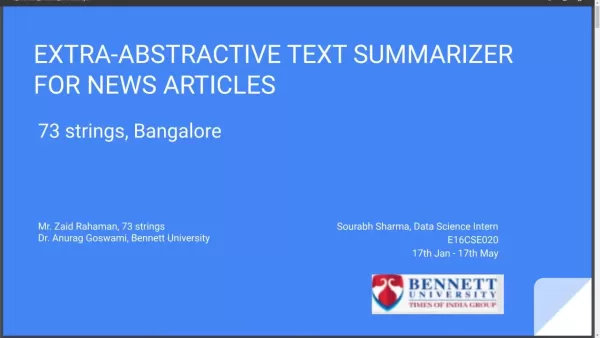
For instance, 73 Strings uses AI to deliver critical insights for financial advisory, illustrating how text summarization and AI work together to support informed decision-making.
The Importance of Data-Driven Decision Making
Data-driven decision making is the practice of basing choices on data analysis. Instead of relying on gut feeling or isolated examples, this method uses factual data to guide decisions. It is especially useful in complex situations where many variables can affect results.
Data-driven decision making offers several key advantages:
- Greater Accuracy: Data analysis can uncover patterns and trends that are not immediately obvious.
- Enhanced Efficiency: By focusing on what the data shows, organizations can improve their processes and use of resources.
- Lower Risk: Decisions backed by data are less likely to be influenced by errors or biases.
To successfully adopt data-driven decision making, organizations must build strong data collection and analysis capabilities. This involves investing in appropriate tools, training staff, and setting up clear data management procedures.
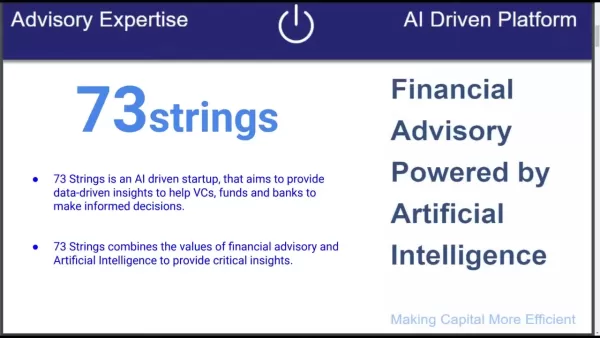
As mentioned in the video, objective decision-making verifies assumptions based on current market activity.
In the current digital environment, the volume of data is enormous, which requires the creation of efficient algorithms that can compress large amounts of information into smaller, digestible pieces without losing critical details. This is where AI and machine learning (ML) are instrumental.
The Role of NLP in Text Mining
Advancements in NLP Techniques
Natural Language Processing (NLP) is fundamental to text mining, connecting human language with machine comprehension. NLP includes various methods such as sentiment analysis, named entity recognition, and topic modeling, allowing computers to extract meaning from text. Recent progress in NLP has greatly improved the precision and speed of these processes, enabling deeper insights and more informed decisions.
- Sentiment Analysis: NLP algorithms can assess the emotional tone of text, determining if it is positive, negative, or neutral. This is useful for analyzing customer feedback and managing brand reputation.
- Named Entity Recognition (NER): NER detects and categorizes named entities in text, like people, organizations, locations, and dates. It is key for pulling structured information from unstructured text, aiding knowledge discovery and data integration.
- Topic Modeling: Topic modeling algorithms find hidden themes in document collections, grouping them by shared subjects. This is helpful for exploring large datasets, spotting emerging trends, and organizing information efficiently.
How to Use AI Text Summarization Tools
Step-by-Step Guide to Using AI Text Summarizers
Using AI text summarization tools generally involves these steps:
- Select a Tool: Choose an AI text summarization tool that fits your requirements and budget. Options range from free online summarizers to paid services and custom solutions.
- Input Text: Paste the text you wish to summarize into the tool's input area. Some tools also allow document uploads or URLs.
- Adjust Settings: Modify settings to define the summary's length and format. Certain tools let you specify the number of sentences or words.
- Generate Summary: Click the "Summarize" button to create the summary. The tool will analyze the text and produce a condensed version.
- Review and Edit: Check the summary to ensure it accurately represents the original text's main points. Make any necessary edits for clarity and flow.
Here is an example table for choosing your tool and what text input is best for it:
AI Text Summarizer Text Input Method Cost Best For Free Online Summarizer Copy and Paste Free Quick Overviews Paid Subscription Service Upload Documents, URL Paid Professional Use Custom-Built Solution API Integration Custom Specific Business Needs
Pricing of AI Text Summarization Tools
Cost Considerations for Different Tools
The cost of AI text summarization tools varies significantly based on features, capabilities, and usage limits. Some tools provide free plans with basic functions, while others require a monthly or annual subscription. Custom solutions usually involve an initial development cost plus ongoing maintenance fees.
Here is a general overview of pricing models for different AI text summarization tools:
- Free Online Summarizers: Usually offer basic summarization with limited features and usage caps. These are suitable for occasional use or short texts.
- Paid Subscription Services: Include advanced features like document uploads, customizable settings, and longer summaries. Pricing is often based on the number of summaries or amount of text processed.
- Custom-Built Solutions: Involve a one-time development cost and ongoing maintenance. These are designed for specific organizational needs and can be integrated into existing systems.
When selecting an AI text summarization tool, consider your budget, required features, and the volume of text you plan to summarize.
Advantages and Disadvantages of AI Text Summarization
Pros
Greater Efficiency: Rapidly analyze large amounts of text.
Improved Accuracy: Minimize errors and biases in decision-making.
Better Comprehension: Enhance understanding and retention of information.
Time Savings: Automate the summarization process.
Enhanced Decision Making: Facilitate data-driven choices.
Cons
Risk of Bias: Algorithms may perpetuate biases found in the training data.
Loss of Subtlety: Summaries might miss nuances from the original text.
Dependence on Data Quality: Summary quality depends on the input text's quality.
Ethical Issues: The technology could be used to distort or misrepresent information.
Complexity: Implementing AI-based summarization requires expertise in data science and NLP.
Core Features of AI-Based Text Summarization
Extractive Summarization Techniques
Extractive summarization involves selecting and copying key phrases or sentences directly from the source text. These excerpts are combined to form a summary. This method is relatively straightforward and efficient since it doesn't generate new text. However, it can sometimes produce summaries that lack smooth flow, as the selected sentences may not connect seamlessly.
The process typically includes these steps:
- Text Preprocessing: Cleaning and preparing the text by removing noise, tokenizing, and stemming.
- Feature Extraction: Identifying important elements like term frequency, sentence length, and position in the document.
- Sentence Scoring: Assigning scores to sentences based on their features.
- Summary Generation: Choosing the highest-scoring sentences to create the summary.
Common techniques in extractive summarization include:
- Term Frequency-Inverse Document Frequency (TF-IDF): Evaluates word importance within a document relative to a larger collection.
- TextRank: A graph-based algorithm that identifies important sentences based on their connections to others.
- LexRank: Similar to TextRank but uses cosine similarity to measure sentence similarity.
Extractive summarization is ideal when speed and simplicity are priorities, and the original text is well-structured.
Abstractive Summarization Techniques
Abstractive summarization goes beyond copying text. It involves interpreting and rewriting the original content to create new summaries. This method requires a deeper comprehension of the material and the ability to generate fluent and coherent text. Although more complex than extractive summarization, it can produce summaries that are more readable and informative.
The process typically involves these steps:
- Text Understanding: Analyzing the original text to grasp its meaning and context.
- Information Extraction: Identifying the most important information to include.
- Text Generation: Rephrasing the information concisely and coherently.
Common techniques in abstractive summarization include:
- Sequence-to-Sequence Models: Using neural networks to convert the original text into a summary.
- Attention Mechanisms: Allowing the model to focus on the most relevant parts of the input during summarization.
- Transformer Networks: An advanced neural network architecture that has achieved leading results in various NLP tasks, including text summarization.
Abstractive summarization is particularly useful for complex or poorly written texts where high readability and coherence are needed.
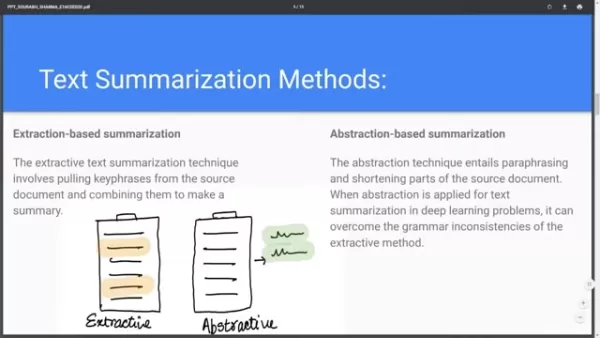
The aim is to produce a grammatically correct and logically connected summary.
Use Cases for AI Text Summarization
Financial Analysis and Advisory
In finance, AI-powered text summarization can quickly analyze large quantities of financial news, reports, and research papers. This helps financial analysts and advisors stay current with market trends and make data-driven investment decisions. Companies like 73 Strings lead this innovation, providing AI-driven insights to assist venture capital firms, funds, and banks in making informed choices.
Key applications in financial analysis include:
- Analyzing Earnings Calls: Summarizing earnings call transcripts to quickly identify key points and potential investment opportunities.
- Monitoring Market News: Tracking news articles and spotting relevant events that could influence market performance.
- Assessing Investment Risks: Evaluating risks associated with investments by analyzing relevant reports and studies.
By automating text summarization, financial professionals save time and enhance the accuracy of their analyses.
News Aggregation and Reporting
AI text summarization is invaluable for news aggregators and reporting agencies. It enables them to quickly process numerous news articles from various sources and create concise summaries for readers. This ensures users stay informed about major events without reading multiple articles.
Key applications in news aggregation and reporting include:
- Creating News Digests: Producing daily or weekly news digests that highlight the most important stories.
- Offering Personalized News Feeds: Customizing news feeds based on individual user interests and preferences.
- Detecting Breaking News: Identifying and summarizing breaking news as it happens.
This technology allows news organizations to deliver more relevant and timely information to their audience.
Academic Research
In academic research, AI-driven text summarization helps researchers quickly review and synthesize large volumes of scientific literature. This allows them to identify relevant studies and extract key findings without reading countless papers. The process becomes more efficient, accelerating research.
Key applications in academic research include:
- Literature Reviews: Summarizing and combining findings from multiple studies in a specific field.
- Identifying Research Gaps: Finding areas needing further research by analyzing existing literature.
- Staying Updated on New Research: Tracking new publications and summarizing their main conclusions.
Automating text summarization saves researchers time and improves research quality.
Frequently Asked Questions
What are the main methods for text summarization?
The primary methods for text summarization are extractive and abstractive. Extractive summarization selects and copies key phrases from the original text to form a summary. Abstractive summarization rephrases and rewrites the content to create a new summary. Both methods utilize NLP and AI to understand and condense text, delivering concise and informative summaries.
How does AI improve text summarization?
AI enhances text summarization by enabling more accurate and efficient analysis of large text volumes. AI algorithms can identify key information, understand context, and generate coherent summaries that capture the main points. Techniques like NLP and machine learning refine the summarization process.
What is the role of NLP in text summarization?
Natural Language Processing (NLP) is vital for text summarization, enabling machines to understand and process human language. NLP techniques analyze text structure, meaning, and context, allowing algorithms to identify important information and produce accurate summaries. NLP is essential for both extractive and abstractive methods.
Related Questions
How can businesses use AI for data analysis?
Businesses can use AI for data analysis in many ways to enhance decision-making and gain a competitive advantage. AI algorithms can examine large datasets to detect patterns, trends, and insights that are difficult for humans to find. This helps businesses make more informed decisions about product development, marketing, sales, and operations. A common application is predictive analytics, where AI forecasts future outcomes based on historical data. For example, a business can predict customer churn, sales trends, or market demand, allowing proactive problem-solving and strategy optimization. Another use is customer segmentation, where AI divides customers into groups based on characteristics, behaviors, and preferences. This enables tailored marketing and product offerings for specific segments, increasing effectiveness. Additionally, AI can help businesses understand the services a startup provides. Beyond these specific uses, AI can automate data analysis tasks like data cleaning, integration, and report generation, freeing human analysts for more strategic work.
What are the ethical considerations of using AI?
Using AI involves several ethical considerations that must be addressed to ensure responsible deployment. A major concern is bias, as AI algorithms can reflect biases in the training data, leading to discriminatory outcomes in hiring, lending, and criminal justice. Another issue is transparency, as AI algorithms can be complex and hard to interpret. This opacity makes it challenging to identify and fix biases or errors and raises accountability questions when mistakes occur. Privacy is also a significant concern, as AI systems often need large amounts of data, which may include sensitive personal information at risk of misuse or unauthorized disclosure. Finally, there are ethical questions about AI's impact on employment. As AI advances, it may automate jobs currently done by humans, resulting in job losses and economic disruption.
Related article
 OpenAI, Anthropic Vie for Market Share Despite Revenue Shortfalls
Despite recent reports suggesting OpenAI missed revenue targets, creating pressure on tech stocks this Tuesday, private AI lab investors remain resilient. Seasoned backers have confirmed they will not reduce investment despite negative media coverage
California AV Compliance: A New Era of Tickets, Geofences, and 1M Miles
Guident operates an AuveTech shuttle in South Florida, managing a four-mile route in West Palm Beach and a one-mile route in Boca Raton using its remote monitoring technology. | Credit: GuidentCalifornia is redefining the regulatory landscape for dri
Apple Smart Glasses Could Debut at WWDC27, Highlighting Privacy Protection
Bloomberg’s Mark Gurman reports that Apple’s smart glasses, codenamed N50, are slated for a WWDC27 debut in June 2027, with a retail launch expected in autumn 2027. Originally targeted for late this year and early 2027, the device’s release has been
Related Special Topic Recommendations
Music composition
OpenAI, Anthropic Vie for Market Share Despite Revenue Shortfalls
Despite recent reports suggesting OpenAI missed revenue targets, creating pressure on tech stocks this Tuesday, private AI lab investors remain resilient. Seasoned backers have confirmed they will not reduce investment despite negative media coverage
California AV Compliance: A New Era of Tickets, Geofences, and 1M Miles
Guident operates an AuveTech shuttle in South Florida, managing a four-mile route in West Palm Beach and a one-mile route in Boca Raton using its remote monitoring technology. | Credit: GuidentCalifornia is redefining the regulatory landscape for dri
Apple Smart Glasses Could Debut at WWDC27, Highlighting Privacy Protection
Bloomberg’s Mark Gurman reports that Apple’s smart glasses, codenamed N50, are slated for a WWDC27 debut in June 2027, with a retail launch expected in autumn 2027. Originally targeted for late this year and early 2027, the device’s release has been
Related Special Topic Recommendations
Music composition
 AI Stem Separation Tools for Remix Production, Sampling Prep, and Karaoke Masters
2026 Latest Best Top-rated AI Stem Separation Tools Curated for Remix Production, Sampling Prep, and Karaoke Masters. These powerful game-changing tools offer real-world tests to deliver precise audio isolation, boosting productivity significantly. XIX.AI provides a weekly updated free vs paid comparison guide to help you find the must-try solution that suits your needs. Explore now to unlock your AI edge.
 8 tools
 xix.ai
Data Analysis
AI SQL Copilots for Revenue Dashboards, Funnel Analysis, and Product Metrics
xix.ai
Data Analysis
AI SQL Copilots for Revenue Dashboards, Funnel Analysis, and Product Metrics
2026 Latest Best AI SQL Copilots Ranked Top-Rated! XIX.AI curates a powerful game-changing collection for weekly updated real-world tests. These must-try tools help you generate accurate revenue dashboards, analyze sales funnels, and track product metrics swiftly, boosting productivity massively. Explore now to Discover your perfect tool for data-driven decision making! 238 characters
9 tools
xix.ai
Music composition
Best AI Melody Writing Tools for Song Drafts
2026 Latest Best Top-Rated AI Melody Writing Tools for Song Drafts! XIX.AI has curated a highly powerful game-changing collection that goes through rigorous real-world tests to deliver the best writing experience. You can find detailed free vs paid comparisons, accurate rankings, and must-try options designed to help you create stunning song drafts effortlessly and boost your creative productivity significantly. Explore now to discover your perfect tool!
8 tools
xix.ai
chatbot
Best AI Conversation Trainer Tools for Interview Practice
2026 Latest Best Top-rated AI Conversation Trainer Tools for Interview Practice are here on XIX.AI! This curated collection features powerful, game-changing tools that go through rigorous real-world tests to deliver accurate feedback. You’ll find a free vs paid comparison and detailed rankings to help you choose the must-try option that boosts your confidence and skills. Explore now to Discover your perfect tool for interview success!
12 tools
xix.ai
Design & Art
Best AI Style Transfer Tools for Creative Experiments
2026 Latest Best Top-rated AI Style Transfer Tools for Creative Experiments! XIX.AI has curated a powerful, game-changing collection of must-try tools that deliver exceptional results through real-world tests and rigorous rankings. These top solutions help creatives boost productivity significantly by accelerating content creation and unlocking endless creative possibilities. Explore now to discover your perfect tool and start creating today!
9 tools
xix.ai
Comic Creation
Best AI Dialogue Bubble Tools for Visual Storytelling
2026 Latest Best Top-Rated AI Dialogue Bubble Tools for Visual Storytelling are here on XIX.AI! This curated collection features powerful, game-changing tools that help creators boost productivity and overcome creative bottlenecks. Get a free vs paid comparison, see real-world tests, and check the latest rankings to find the must-try solutions perfect for crafting engaging visual narratives. Explore now to discover your ideal tool!
10 tools
xix.ai

 Comments (2)
0/500
Comments (2)
0/500
![KevinRoberts]()
Die Erklärung zu extraktiver vs. abstraktiver Zusammenfassung war echt hilfreich! Ich frage mich, ob solche Tools irgendwann die Art, wie wir Nachrichten konsumieren, so sehr verändern, dass wir nur noch die Zusammenfassungen lesen und den Kontext verlieren. Spannend, aber auch ein bisschen beängstigend. 😅
![WillieRodriguez]()
Die KI-Zusammenfassung ist echt praktisch, aber manchmal gehen wichtige Nuancen verloren. Hoffentlich bleibt der menschliche Journalismus trotzdem relevant. 🤔
In an era of information saturation, AI-powered text summarization provides an essential tool for efficiently processing a vast number of news articles. This detailed guide explores the approaches behind extractive and abstractive summarization, showcasing their use in improving data-driven decision-making. Learn how businesses and individuals can use these technologies to stay informed and make strategic decisions.
Key Points
Text summarization uses AI to condense large volumes of text into concise summaries.
Extractive summarization picks out and copies key phrases directly from the source text.
Abstractive summarization rephrases and rewrites the content to produce original summaries.
73 Strings is an AI-focused startup offering insights based on data analysis.
Data-driven decision-making relies on analyzed information to guide choices.
Natural Language Processing (NLP) is essential for producing accurate and coherent text summaries.
Understanding Text Summarization
What is Text Summarization?
Text summarization is the technique of shortening a lengthy document into a brief version while keeping the most critical information. This is an essential function in today's information-heavy world, where people and organizations are continually faced with massive amounts of data. The objective is to distill key insights without needing to read entire documents.
This technique is especially beneficial in areas like journalism, research, and business intelligence, where staying updated is vital but time is scarce. AI-driven text summarization provides a powerful solution for efficiently analyzing and comprehending large texts, leading to better decisions and increased productivity.
The demand for effective text summarization is driven by several factors:
- Information Overload: The enormous quantity of data available online makes it impossible for people to manually review everything.
- Time Limitations: Professionals often need to quickly understand a document's main ideas to make informed choices.
- Enhanced Understanding: A well-written summary can improve comprehension and retention of key points.
Many methods have been created to address text summarization, each with unique advantages and drawbacks. These techniques range from straightforward keyword extraction to advanced natural language processing (NLP) algorithms.
For instance, 73 Strings uses AI to deliver critical insights for financial advisory, illustrating how text summarization and AI work together to support informed decision-making.
The Importance of Data-Driven Decision Making
Data-driven decision making is the practice of basing choices on data analysis. Instead of relying on gut feeling or isolated examples, this method uses factual data to guide decisions. It is especially useful in complex situations where many variables can affect results.
Data-driven decision making offers several key advantages:
- Greater Accuracy: Data analysis can uncover patterns and trends that are not immediately obvious.
- Enhanced Efficiency: By focusing on what the data shows, organizations can improve their processes and use of resources.
- Lower Risk: Decisions backed by data are less likely to be influenced by errors or biases.
To successfully adopt data-driven decision making, organizations must build strong data collection and analysis capabilities. This involves investing in appropriate tools, training staff, and setting up clear data management procedures.
As mentioned in the video, objective decision-making verifies assumptions based on current market activity.
In the current digital environment, the volume of data is enormous, which requires the creation of efficient algorithms that can compress large amounts of information into smaller, digestible pieces without losing critical details. This is where AI and machine learning (ML) are instrumental.
The Role of NLP in Text Mining
Advancements in NLP Techniques
Natural Language Processing (NLP) is fundamental to text mining, connecting human language with machine comprehension. NLP includes various methods such as sentiment analysis, named entity recognition, and topic modeling, allowing computers to extract meaning from text. Recent progress in NLP has greatly improved the precision and speed of these processes, enabling deeper insights and more informed decisions.
- Sentiment Analysis: NLP algorithms can assess the emotional tone of text, determining if it is positive, negative, or neutral. This is useful for analyzing customer feedback and managing brand reputation.
- Named Entity Recognition (NER): NER detects and categorizes named entities in text, like people, organizations, locations, and dates. It is key for pulling structured information from unstructured text, aiding knowledge discovery and data integration.
- Topic Modeling: Topic modeling algorithms find hidden themes in document collections, grouping them by shared subjects. This is helpful for exploring large datasets, spotting emerging trends, and organizing information efficiently.
How to Use AI Text Summarization Tools
Step-by-Step Guide to Using AI Text Summarizers
Using AI text summarization tools generally involves these steps:
- Select a Tool: Choose an AI text summarization tool that fits your requirements and budget. Options range from free online summarizers to paid services and custom solutions.
- Input Text: Paste the text you wish to summarize into the tool's input area. Some tools also allow document uploads or URLs.
- Adjust Settings: Modify settings to define the summary's length and format. Certain tools let you specify the number of sentences or words.
- Generate Summary: Click the "Summarize" button to create the summary. The tool will analyze the text and produce a condensed version.
- Review and Edit: Check the summary to ensure it accurately represents the original text's main points. Make any necessary edits for clarity and flow.
Here is an example table for choosing your tool and what text input is best for it:
| AI Text Summarizer | Text Input Method | Cost | Best For |
|---|---|---|---|
| Free Online Summarizer | Copy and Paste | Free | Quick Overviews |
| Paid Subscription Service | Upload Documents, URL | Paid | Professional Use |
| Custom-Built Solution | API Integration | Custom | Specific Business Needs |
Pricing of AI Text Summarization Tools
Cost Considerations for Different Tools
The cost of AI text summarization tools varies significantly based on features, capabilities, and usage limits. Some tools provide free plans with basic functions, while others require a monthly or annual subscription. Custom solutions usually involve an initial development cost plus ongoing maintenance fees.
Here is a general overview of pricing models for different AI text summarization tools:
- Free Online Summarizers: Usually offer basic summarization with limited features and usage caps. These are suitable for occasional use or short texts.
- Paid Subscription Services: Include advanced features like document uploads, customizable settings, and longer summaries. Pricing is often based on the number of summaries or amount of text processed.
- Custom-Built Solutions: Involve a one-time development cost and ongoing maintenance. These are designed for specific organizational needs and can be integrated into existing systems.
When selecting an AI text summarization tool, consider your budget, required features, and the volume of text you plan to summarize.
Advantages and Disadvantages of AI Text Summarization
Pros
Greater Efficiency: Rapidly analyze large amounts of text.
Improved Accuracy: Minimize errors and biases in decision-making.
Better Comprehension: Enhance understanding and retention of information.
Time Savings: Automate the summarization process.
Enhanced Decision Making: Facilitate data-driven choices.
Cons
Risk of Bias: Algorithms may perpetuate biases found in the training data.
Loss of Subtlety: Summaries might miss nuances from the original text.
Dependence on Data Quality: Summary quality depends on the input text's quality.
Ethical Issues: The technology could be used to distort or misrepresent information.
Complexity: Implementing AI-based summarization requires expertise in data science and NLP.
Core Features of AI-Based Text Summarization
Extractive Summarization Techniques
Extractive summarization involves selecting and copying key phrases or sentences directly from the source text. These excerpts are combined to form a summary. This method is relatively straightforward and efficient since it doesn't generate new text. However, it can sometimes produce summaries that lack smooth flow, as the selected sentences may not connect seamlessly.
The process typically includes these steps:
- Text Preprocessing: Cleaning and preparing the text by removing noise, tokenizing, and stemming.
- Feature Extraction: Identifying important elements like term frequency, sentence length, and position in the document.
- Sentence Scoring: Assigning scores to sentences based on their features.
- Summary Generation: Choosing the highest-scoring sentences to create the summary.
Common techniques in extractive summarization include:
- Term Frequency-Inverse Document Frequency (TF-IDF): Evaluates word importance within a document relative to a larger collection.
- TextRank: A graph-based algorithm that identifies important sentences based on their connections to others.
- LexRank: Similar to TextRank but uses cosine similarity to measure sentence similarity.
Extractive summarization is ideal when speed and simplicity are priorities, and the original text is well-structured.
Abstractive Summarization Techniques
Abstractive summarization goes beyond copying text. It involves interpreting and rewriting the original content to create new summaries. This method requires a deeper comprehension of the material and the ability to generate fluent and coherent text. Although more complex than extractive summarization, it can produce summaries that are more readable and informative.
The process typically involves these steps:
- Text Understanding: Analyzing the original text to grasp its meaning and context.
- Information Extraction: Identifying the most important information to include.
- Text Generation: Rephrasing the information concisely and coherently.
Common techniques in abstractive summarization include:
- Sequence-to-Sequence Models: Using neural networks to convert the original text into a summary.
- Attention Mechanisms: Allowing the model to focus on the most relevant parts of the input during summarization.
- Transformer Networks: An advanced neural network architecture that has achieved leading results in various NLP tasks, including text summarization.
Abstractive summarization is particularly useful for complex or poorly written texts where high readability and coherence are needed.
The aim is to produce a grammatically correct and logically connected summary.
Use Cases for AI Text Summarization
Financial Analysis and Advisory
In finance, AI-powered text summarization can quickly analyze large quantities of financial news, reports, and research papers. This helps financial analysts and advisors stay current with market trends and make data-driven investment decisions. Companies like 73 Strings lead this innovation, providing AI-driven insights to assist venture capital firms, funds, and banks in making informed choices.
Key applications in financial analysis include:
- Analyzing Earnings Calls: Summarizing earnings call transcripts to quickly identify key points and potential investment opportunities.
- Monitoring Market News: Tracking news articles and spotting relevant events that could influence market performance.
- Assessing Investment Risks: Evaluating risks associated with investments by analyzing relevant reports and studies.
By automating text summarization, financial professionals save time and enhance the accuracy of their analyses.
News Aggregation and Reporting
AI text summarization is invaluable for news aggregators and reporting agencies. It enables them to quickly process numerous news articles from various sources and create concise summaries for readers. This ensures users stay informed about major events without reading multiple articles.
Key applications in news aggregation and reporting include:
- Creating News Digests: Producing daily or weekly news digests that highlight the most important stories.
- Offering Personalized News Feeds: Customizing news feeds based on individual user interests and preferences.
- Detecting Breaking News: Identifying and summarizing breaking news as it happens.
This technology allows news organizations to deliver more relevant and timely information to their audience.
Academic Research
In academic research, AI-driven text summarization helps researchers quickly review and synthesize large volumes of scientific literature. This allows them to identify relevant studies and extract key findings without reading countless papers. The process becomes more efficient, accelerating research.
Key applications in academic research include:
- Literature Reviews: Summarizing and combining findings from multiple studies in a specific field.
- Identifying Research Gaps: Finding areas needing further research by analyzing existing literature.
- Staying Updated on New Research: Tracking new publications and summarizing their main conclusions.
Automating text summarization saves researchers time and improves research quality.
Frequently Asked Questions
What are the main methods for text summarization?
The primary methods for text summarization are extractive and abstractive. Extractive summarization selects and copies key phrases from the original text to form a summary. Abstractive summarization rephrases and rewrites the content to create a new summary. Both methods utilize NLP and AI to understand and condense text, delivering concise and informative summaries.
How does AI improve text summarization?
AI enhances text summarization by enabling more accurate and efficient analysis of large text volumes. AI algorithms can identify key information, understand context, and generate coherent summaries that capture the main points. Techniques like NLP and machine learning refine the summarization process.
What is the role of NLP in text summarization?
Natural Language Processing (NLP) is vital for text summarization, enabling machines to understand and process human language. NLP techniques analyze text structure, meaning, and context, allowing algorithms to identify important information and produce accurate summaries. NLP is essential for both extractive and abstractive methods.
Related Questions
How can businesses use AI for data analysis?
Businesses can use AI for data analysis in many ways to enhance decision-making and gain a competitive advantage. AI algorithms can examine large datasets to detect patterns, trends, and insights that are difficult for humans to find. This helps businesses make more informed decisions about product development, marketing, sales, and operations. A common application is predictive analytics, where AI forecasts future outcomes based on historical data. For example, a business can predict customer churn, sales trends, or market demand, allowing proactive problem-solving and strategy optimization. Another use is customer segmentation, where AI divides customers into groups based on characteristics, behaviors, and preferences. This enables tailored marketing and product offerings for specific segments, increasing effectiveness. Additionally, AI can help businesses understand the services a startup provides. Beyond these specific uses, AI can automate data analysis tasks like data cleaning, integration, and report generation, freeing human analysts for more strategic work.
What are the ethical considerations of using AI?
Using AI involves several ethical considerations that must be addressed to ensure responsible deployment. A major concern is bias, as AI algorithms can reflect biases in the training data, leading to discriminatory outcomes in hiring, lending, and criminal justice. Another issue is transparency, as AI algorithms can be complex and hard to interpret. This opacity makes it challenging to identify and fix biases or errors and raises accountability questions when mistakes occur. Privacy is also a significant concern, as AI systems often need large amounts of data, which may include sensitive personal information at risk of misuse or unauthorized disclosure. Finally, there are ethical questions about AI's impact on employment. As AI advances, it may automate jobs currently done by humans, resulting in job losses and economic disruption.








 OpenAI, Anthropic Vie for Market Share Despite Revenue Shortfalls
Despite recent reports suggesting OpenAI missed revenue targets, creating pressure on tech stocks this Tuesday, private AI lab investors remain resilient. Seasoned backers have confirmed they will not reduce investment despite negative media coverage
California AV Compliance: A New Era of Tickets, Geofences, and 1M Miles
Guident operates an AuveTech shuttle in South Florida, managing a four-mile route in West Palm Beach and a one-mile route in Boca Raton using its remote monitoring technology. | Credit: GuidentCalifornia is redefining the regulatory landscape for dri
OpenAI, Anthropic Vie for Market Share Despite Revenue Shortfalls
Despite recent reports suggesting OpenAI missed revenue targets, creating pressure on tech stocks this Tuesday, private AI lab investors remain resilient. Seasoned backers have confirmed they will not reduce investment despite negative media coverage
California AV Compliance: A New Era of Tickets, Geofences, and 1M Miles
Guident operates an AuveTech shuttle in South Florida, managing a four-mile route in West Palm Beach and a one-mile route in Boca Raton using its remote monitoring technology. | Credit: GuidentCalifornia is redefining the regulatory landscape for dri
 Apple Smart Glasses Could Debut at WWDC27, Highlighting Privacy Protection
Bloomberg’s Mark Gurman reports that Apple’s smart glasses, codenamed N50, are slated for a WWDC27 debut in June 2027, with a retail launch expected in autumn 2027. Originally targeted for late this year and early 2027, the device’s release has been
Apple Smart Glasses Could Debut at WWDC27, Highlighting Privacy Protection
Bloomberg’s Mark Gurman reports that Apple’s smart glasses, codenamed N50, are slated for a WWDC27 debut in June 2027, with a retail launch expected in autumn 2027. Originally targeted for late this year and early 2027, the device’s release has been

2026 Latest Best Top-rated AI Stem Separation Tools Curated for Remix Production, Sampling Prep, and Karaoke Masters. These powerful game-changing tools offer real-world tests to deliver precise audio isolation, boosting productivity significantly. XIX.AI provides a weekly updated free vs paid comparison guide to help you find the must-try solution that suits your needs. Explore now to unlock your AI edge.
8 tools
xix.ai

2026 Latest Best AI SQL Copilots Ranked Top-Rated! XIX.AI curates a powerful game-changing collection for weekly updated real-world tests. These must-try tools help you generate accurate revenue dashboards, analyze sales funnels, and track product metrics swiftly, boosting productivity massively. Explore now to Discover your perfect tool for data-driven decision making! 238 characters
9 tools
xix.ai

2026 Latest Best Top-Rated AI Melody Writing Tools for Song Drafts! XIX.AI has curated a highly powerful game-changing collection that goes through rigorous real-world tests to deliver the best writing experience. You can find detailed free vs paid comparisons, accurate rankings, and must-try options designed to help you create stunning song drafts effortlessly and boost your creative productivity significantly. Explore now to discover your perfect tool!
8 tools
xix.ai

2026 Latest Best Top-rated AI Conversation Trainer Tools for Interview Practice are here on XIX.AI! This curated collection features powerful, game-changing tools that go through rigorous real-world tests to deliver accurate feedback. You’ll find a free vs paid comparison and detailed rankings to help you choose the must-try option that boosts your confidence and skills. Explore now to Discover your perfect tool for interview success!
12 tools
xix.ai

2026 Latest Best Top-rated AI Style Transfer Tools for Creative Experiments! XIX.AI has curated a powerful, game-changing collection of must-try tools that deliver exceptional results through real-world tests and rigorous rankings. These top solutions help creatives boost productivity significantly by accelerating content creation and unlocking endless creative possibilities. Explore now to discover your perfect tool and start creating today!
9 tools
xix.ai

2026 Latest Best Top-Rated AI Dialogue Bubble Tools for Visual Storytelling are here on XIX.AI! This curated collection features powerful, game-changing tools that help creators boost productivity and overcome creative bottlenecks. Get a free vs paid comparison, see real-world tests, and check the latest rankings to find the must-try solutions perfect for crafting engaging visual narratives. Explore now to discover your ideal tool!
10 tools
xix.ai

Die Erklärung zu extraktiver vs. abstraktiver Zusammenfassung war echt hilfreich! Ich frage mich, ob solche Tools irgendwann die Art, wie wir Nachrichten konsumieren, so sehr verändern, dass wir nur noch die Zusammenfassungen lesen und den Kontext verlieren. Spannend, aber auch ein bisschen beängstigend. 😅
Die KI-Zusammenfassung ist echt praktisch, aber manchmal gehen wichtige Nuancen verloren. Hoffentlich bleibt der menschliche Journalismus trotzdem relevant. 🤔












