


 Home
Home
AI Giants Report Robust Revenue Growth, Strategic Expansion, and Strong Customer Retention
Artificial intelligence is reshaping the technology sector, fueling remarkable revenue increases, expanding market opportunities, and boosting customer retention. This article examines the performance of leading AI companies—Nvidia, Microsoft, Google, Amazon, and Meta—analyzing how their strategic focus and technological advancements are driving financial success and strengthening their competitive edge. We explore the methods and metrics behind their dominance in the AI landscape.
Key Points
Leading technology firms are achieving substantial revenue growth through AI adoption.
Nvidia recorded the highest net profit in Q3 2024, far exceeding its rivals.
Microsoft's cloud services, enhanced by AI, have significantly increased operating income.
Amazon and Meta are also reporting higher operating income, powered by AI innovations.
High customer retention rates among AI-focused companies reflect strong satisfaction and loyalty.
The Giants of AI
Thesis: AI as a Revenue Driver
Artificial intelligence is not just a source of innovation but a major revenue generator for top firms. Profit margins indicate strong demand for AI-integrated solutions across diverse industries and customer segments. By strategically embedding AI into their offerings, these companies can justify premium pricing and build deeper customer loyalty through enhanced value.
Revenue Growth in Artificial Intelligence
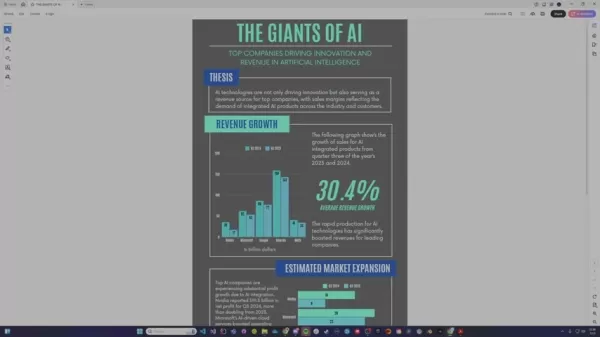
The chart below illustrates the sales growth of AI-integrated products in the third quarters of 2023 and 2024. Rapid development in AI technology has led to significant revenue increases for industry leaders, with an average growth rate of 30.4%.
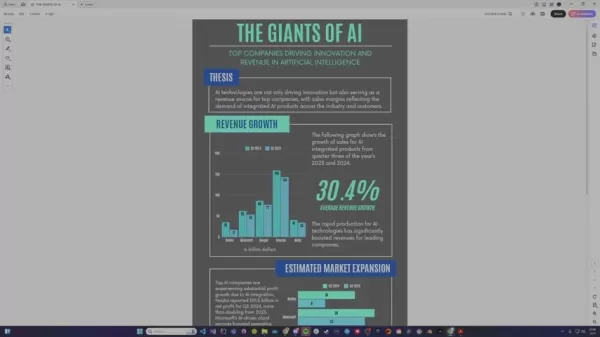
Revenue figures are shown below in billion U.S. dollars:
Company-Specific Revenue Analysis
Nvidia's Dominance
Nvidia leads in profit growth driven by AI integration. The company reported a net profit of $9.2 billion for Q3 2024, more than double its 2023 result. This extraordinary performance highlights Nvidia's central role in the AI revolution, powered by soaring demand for its high-performance GPUs used in AI applications. Its commitment to innovation and cutting-edge technology solidifies its position as a key enabler and beneficiary of the AI boom.
Nvidia's success stems from early and sustained investment in AI technologies, along with strong partnerships with leading AI research bodies and corporations. By focusing on providing the essential hardware infrastructure for AI, the company has established a profitable and defensible market position.
Microsoft's AI-Driven Cloud Services
Microsoft's AI-enhanced cloud services helped drive operating income to $20 billion. This growth demonstrates how AI adds value to existing products, attracting more customers and improving service offerings. The integration of AI capabilities into the Azure platform makes it a vital tool for businesses adopting AI, underscoring the growing reliance on cloud infrastructure for AI applications and strengthening Microsoft's standing in the cloud market.
Microsoft's strategy involves embedding AI across its product suite, from Azure to Office 365, making AI accessible and practical for a broad customer base. This comprehensive approach—combining cloud infrastructure, AI tools, and application integration—creates a powerful ecosystem that encourages adoption and fuels revenue growth.
Amazon's AI Advancements
Amazon's advancements in AI contributed to an operating income of $17.4 billion. This increase reflects AI's role in streamlining operations, enhancing customer experiences, and opening new revenue channels. Amazon Web Services (AWS), augmented by AI, remains a top cloud provider, offering a wide range of AI-powered services. Amazon's diverse application of AI impacts both its e-commerce and cloud divisions.
Amazon leverages AI to improve customer experiences, optimize logistics, and develop new AI-driven products and services. Its investments in AI research and development, supported by vast data resources, enable the creation of innovative solutions that boost efficiency and satisfaction.
Meta's Net Income Fueled by AI-Enhanced Advertising
Meta reported net income of $15.7 billion, driven largely by AI-enhanced advertising. This surge underscores AI's effectiveness in improving ad targeting and return on investment. As AI algorithms become more sophisticated, Meta delivers more relevant ads to users, increasing engagement and ad revenue. AI's central role in advertising highlights its importance to Meta's business model.
Meta's AI strategy focuses on enhancing its advertising platform, personalizing user experiences, and developing new AI-powered features. Investments in AI research—particularly in natural language processing and computer vision—enable the company to build engaging, revenue-generating solutions.
Alphabet's Net Income Increase
Alphabet achieved a net income of $23.03 billion, aided by advancements in AI among other factors. AI contributes to rising operating income, with Google applying AI across search algorithms, cloud services, and more. This diversified approach demonstrates how spreading AI applications across multiple business units can drive broad-based growth and profitability.
How to Analyze AI Company Performance
Key Metrics for Performance Analysis
To effectively evaluate an AI company's performance, consider these key metrics:
1. Revenue Growth: Assess the rate of revenue increase to gauge market traction and sales effectiveness. 2. Net Profit: Examine bottom-line profitability to understand cost management and income generation. 3. Operating Income: Analyze profitability from core business operations, apart from financial activities. 4. Customer Retention Rate: Evaluate how well the company retains customers, indicating satisfaction and loyalty.
Pricing Models of AI Products
Subscription-Based AI Services
Many AI services, especially in cloud computing, operate on subscription models. Pricing depends on usage levels, features selected, and scalability needs. This approach is common with platforms like Microsoft Azure and Amazon Web Services (AWS).
- Basic Tier: Provides essential AI capabilities for small businesses or individual projects.
- Standard Tier: Offers more advanced features and greater scalability for mid-sized companies.
- Premium Tier: Designed for large enterprises, including custom solutions, dedicated support, and comprehensive AI tools.
One-Time Purchase Licenses
Certain AI software, particularly for on-premise use, is sold through perpetual licenses. This model involves a single upfront payment for indefinite software ownership.
- Standard License: Covers basic features and includes updates for a limited period.
- Enterprise License: Provides broader functionality, extended support, and customization options.
- Developer License: Supplies tools and resources for integrating AI into custom applications.
Pay-as-You-Go (Usage-Based Pricing)
This model charges customers based on actual consumption of AI resources, such as computing power, data storage, and API calls. It is frequently used in cloud-based AI platforms.
- Compute Usage: Billing per hour or minute of computation time used.
- Data Storage: Charged per gigabyte or terabyte of data stored.
- API Calls: Pricing based on the number and complexity of API calls made.
Pros and Cons: Investing in AI Technologies
Pros
Improved Efficiency: Automating tasks and streamlining operations reduces costs and increases productivity.
Enhanced Decision-Making: AI analytics delivers insights for data-driven strategies, improving planning and outcomes.
Better Customer Experiences: Personalizing products and services boosts satisfaction and encourages loyalty.
Cons
High Implementation Costs: Initial investment in AI technology—including hardware, software, and talent—can be significant.
Data Privacy Concerns: AI applications often require large datasets, raising issues around data security and regulatory compliance.
Ethical Considerations: Risks of bias and lack of transparency in AI systems can lead to ethical dilemmas and legal challenges.
Core Features Driving AI Company Success
Cutting-Edge Hardware
Advanced GPUs, such as those from Nvidia, are essential for demanding AI tasks like deep learning and neural network training. These processors enable faster, more efficient AI operations.
High-performance CPUs with multiple cores and high clock speeds support complex AI algorithms, ensuring quick computations and accurate outcomes. They are vital for machine learning and data analytics.
Robust Cloud Infrastructure
Scalable cloud platforms like Microsoft Azure and AWS supply the resources needed for AI development, deployment, and management. They offer computing power, storage, and specialized AI services.
Data storage solutions allow companies to manage the large volumes of data required for AI applications. Secure, scalable storage is critical for training AI models and maintaining data privacy.
Comprehensive AI Services
Machine Learning APIs give developers access to pre-trained AI models and tools for integrating AI into applications. These APIs support tasks like natural language processing, image recognition, and predictive analytics.
AI development frameworks such as TensorFlow and PyTorch enable researchers and developers to build and train custom AI models. They offer flexibility, scalability, and support for multiple programming languages.
AI Use Cases in Leading Companies
Nvidia: GPU-Powered AI Applications
- Deep Learning: Nvidia's GPUs accelerate the training of deep learning models, enabling rapid progress in AI capabilities.
- Autonomous Vehicles: AI algorithms trained on Nvidia hardware improve perception and decision-making in self-driving cars.
- Gaming AI: Enhances gaming through realistic simulations, intelligent characters, and immersive environments.
Microsoft: AI-Driven Cloud Integration
- Azure AI Services: Provides pre-trained AI models for tasks like image recognition, natural language processing, and speech recognition.
- Cognitive Services: Offers tools for building intelligent applications, automating workflows, and enhancing decision-making.
- AI-Enhanced Productivity Tools: Integrates AI into applications like Microsoft Office 365 to boost user efficiency.
Amazon: AI-Powered E-commerce and Cloud
- Personalized Recommendations: AI analyzes customer behavior to suggest relevant products, increasing sales and satisfaction.
- Automated Logistics: AI optimizes supply chain management, improving logistics and reducing costs.
- AWS AI Services: Delivers AI tools and services for developers and businesses to build applications and improve operations.
Meta: AI-Enhanced Advertising and User Experience
- Targeted Advertising: AI analyzes user data to deliver relevant ads, boosting ad revenue and ROI.
- Content Moderation: AI automates the detection and removal of harmful content, ensuring a safer user experience.
- Virtual Assistants: AI-powered assistants offer users personalized help and information.
FAQ
What are the key factors driving revenue growth in AI companies?
Key drivers include continuous innovation in AI technology, strategic market positioning, growing demand for AI-integrated products, and effective customer retention strategies.
How does AI integration improve operating income for tech giants?
AI integration boosts operating income by optimizing operational efficiency, enhancing customer experiences, enabling personalized services, and creating new revenue streams through AI-powered offerings.
What is the significance of customer retention in the AI sector?
High customer retention indicates strong satisfaction and loyalty, which are essential for sustained revenue stability and growth in the competitive AI industry.
Related Questions
What are the current trends in AI technology and business?
Current AI technology trends include progress in deep learning, natural language processing, and computer vision. From a business standpoint, AI is being integrated across sectors to drive innovation, efficiency, and personalized experiences. Key trends include: 1. Explainable AI (XAI): Efforts to make AI decision-making more transparent and understandable. 2. Edge AI: Deploying AI on local devices to reduce latency and enhance data privacy. 3. AI Ethics: Addressing concerns related to bias, fairness, and accountability. 4. Generative AI: Developing models capable of creating new content, such as images, text, and code.
What strategies do AI companies use to maintain high customer retention rates?
AI companies maintain high retention through strategies like: 1. Continuous Innovation: Regularly updating products with the latest AI capabilities. 2. Personalized Experiences: Tailoring solutions to individual customer needs. 3. Responsive Support: Providing timely and effective customer service. 4. Value-Added Services: Offering training, consulting, and integration support. 5. Strong Relationships: Engaging customers through feedback, community interaction, and direct communication to build loyalty.
How can businesses leverage AI to drive profitablity?
Businesses can use AI to improve profitability by: Automating processes to lower operational costs. Personalizing offerings to increase customer satisfaction and loyalty. Using AI analytics for data-driven decision-making. Reference examples include:StrategyAI ApplicationImpactProcess AutomationAI-powered robotic process automation (RPA)Reduced operational costs, increased efficiencyPersonalized Customer ServiceAI chatbots and virtual assistantsImproved customer satisfaction, increased sales and loyaltyData-Driven Decision MakingAI analytics and predictive modelingEnhanced strategic planning, improved resource allocationProduct DevelopmentAI algorithms for product design and optimizationFaster time to market, improved product performance and customer satisfactionTargeted MarketingAI-driven ad targeting and personalizationHigher conversion rates, increased ad revenue
Related article
 Former OpenAI Chief Scientist Ilya’s SSI Unveils First Model
AI has achieved another major milestone. Following his departure from OpenAI, former chief scientist Ilya Sutskever established Safe Superintelligence Inc. (SSI), which has recently unveiled details regarding its inaugural model. Reports from oversea
Lovable Leads Atech's Seed Round as AI Ambient Coding Officially Enters the Hardware Field
On May 14, 2026, AI application development platform Lovable announced its participation in the $800,000 seed funding round for Danish hardware startup Atech. Led by Lovable, the round attracted top-tier venture capital firms including the a16z Scout
Anthropic Expands Claude AI Coding Tools to Japan in Push for Overseas Growth
Anthropic, a prominent U.S. artificial intelligence firm, is intensifying its global outreach. On Wednesday, the company hosted a major developer gathering, "Code with Claude," in Tokyo, drawing close to 500 software engineers. This initiative seeks
Related Special Topic Recommendations
chatbot
Former OpenAI Chief Scientist Ilya’s SSI Unveils First Model
AI has achieved another major milestone. Following his departure from OpenAI, former chief scientist Ilya Sutskever established Safe Superintelligence Inc. (SSI), which has recently unveiled details regarding its inaugural model. Reports from oversea
Lovable Leads Atech's Seed Round as AI Ambient Coding Officially Enters the Hardware Field
On May 14, 2026, AI application development platform Lovable announced its participation in the $800,000 seed funding round for Danish hardware startup Atech. Led by Lovable, the round attracted top-tier venture capital firms including the a16z Scout
Anthropic Expands Claude AI Coding Tools to Japan in Push for Overseas Growth
Anthropic, a prominent U.S. artificial intelligence firm, is intensifying its global outreach. On Wednesday, the company hosted a major developer gathering, "Code with Claude," in Tokyo, drawing close to 500 software engineers. This initiative seeks
Related Special Topic Recommendations
chatbot
 Best AI Conversation Trainer Tools for Interview Practice
2026 Latest Best Top-rated AI Conversation Trainer Tools for Interview Practice are here on XIX.AI! This curated collection features powerful, game-changing tools that go through rigorous real-world tests to deliver accurate feedback. You’ll find a free vs paid comparison and detailed rankings to help you choose the must-try option that boosts your confidence and skills. Explore now to Discover your perfect tool for interview success!
 12 tools
 xix.ai
Design & Art
Best AI Style Transfer Tools for Creative Experiments
xix.ai
Design & Art
Best AI Style Transfer Tools for Creative Experiments
2026 Latest Best Top-rated AI Style Transfer Tools for Creative Experiments! XIX.AI has curated a powerful, game-changing collection of must-try tools that deliver exceptional results through real-world tests and rigorous rankings. These top solutions help creatives boost productivity significantly by accelerating content creation and unlocking endless creative possibilities. Explore now to discover your perfect tool and start creating today!
9 tools
xix.ai
Comic Creation
Best AI Dialogue Bubble Tools for Visual Storytelling
2026 Latest Best Top-Rated AI Dialogue Bubble Tools for Visual Storytelling are here on XIX.AI! This curated collection features powerful, game-changing tools that help creators boost productivity and overcome creative bottlenecks. Get a free vs paid comparison, see real-world tests, and check the latest rankings to find the must-try solutions perfect for crafting engaging visual narratives. Explore now to discover your ideal tool!
10 tools
xix.ai
Meeting Assistant
Top AI Meeting Summary Tools: Track Decisions and Follow-Ups Clearly
2026 Latest Top-Rated Best AI Meeting Summary Tools for Clear Decision Tracking and Effortless Follow-Ups. This curated list showcases powerful, game-changing solutions that boost productivity dramatically by automating meeting notes, identifying key action items, and streamlining team coordination across all projects. Get a free vs paid comparison along with real-world tests and weekly updated rankings to help you find the perfect tool. Explore now to unlock your AI edge!
9 tools
xix.ai
Data Analysis
Best AI Data Cleaning Tools: Fix Missing Values and Duplicates Fast
2026 Latest Best Top-rated AI Data Cleaning Tools for quick fixing of missing values and duplicates. This curated list showcases powerful, game-changing solutions that boost productivity significantly. Each option has undergone rigorous real-world tests to ensure reliability. Get a free vs paid comparison and discover the must-try tool that fits your needs best. Explore now at XIX.AI to Unlock your AI edge.
11 tools
xix.ai
Design & Art
Best AI Creative Ideation Tools for Artists: Break Through Visual Blocks
2026 Latest Best Top-Rated AI Creative Ideation Tools for Artists are curated by XIX.AI to help creators break through visual blocks and boost creativity instantly. These powerful game-changing tools offer real-world tests, detailed free vs paid comparison, and weekly updated rankings. Discover your perfect tool to accelerate content creation and unlock your AI edge today. Explore now!
14 tools
xix.ai

 Comments (3)
0/500
Comments (3)
0/500
![JackSanchez]()
這篇文章提到的AI巨頭營收增長確實驚人,但背後是否意味著市場壟斷加劇?作為普通用戶,我既期待AI帶來便利,又擔心小公司失去生存空間。🤔
![ScottRoberts]()
Рост доходов AI-гигантов впечатляет, но не кажется ли вам, что за этим скрывается очередной пузырь? 🤔 NVIDIA и Microsoft доминируют, но как долго это продлится? Интересно, не приведет ли это к монополизации рынка и замедлению инноваций в долгосрочной перспективе.
![WilliamCarter]()
Interesting read, but I'm a bit skeptical about the 'customer retention' part. With AI tools evolving so fast, are users sticking around because of quality or just lack of alternatives? Feels like the market's still a bit of a gold rush. 🤔
Artificial intelligence is reshaping the technology sector, fueling remarkable revenue increases, expanding market opportunities, and boosting customer retention. This article examines the performance of leading AI companies—Nvidia, Microsoft, Google, Amazon, and Meta—analyzing how their strategic focus and technological advancements are driving financial success and strengthening their competitive edge. We explore the methods and metrics behind their dominance in the AI landscape.
Key Points
Leading technology firms are achieving substantial revenue growth through AI adoption.
Nvidia recorded the highest net profit in Q3 2024, far exceeding its rivals.
Microsoft's cloud services, enhanced by AI, have significantly increased operating income.
Amazon and Meta are also reporting higher operating income, powered by AI innovations.
High customer retention rates among AI-focused companies reflect strong satisfaction and loyalty.
The Giants of AI
Thesis: AI as a Revenue Driver
Artificial intelligence is not just a source of innovation but a major revenue generator for top firms. Profit margins indicate strong demand for AI-integrated solutions across diverse industries and customer segments. By strategically embedding AI into their offerings, these companies can justify premium pricing and build deeper customer loyalty through enhanced value.
Revenue Growth in Artificial Intelligence
The chart below illustrates the sales growth of AI-integrated products in the third quarters of 2023 and 2024. Rapid development in AI technology has led to significant revenue increases for industry leaders, with an average growth rate of 30.4%.
Revenue figures are shown below in billion U.S. dollars:
Company-Specific Revenue Analysis
Nvidia's Dominance
Nvidia leads in profit growth driven by AI integration. The company reported a net profit of $9.2 billion for Q3 2024, more than double its 2023 result. This extraordinary performance highlights Nvidia's central role in the AI revolution, powered by soaring demand for its high-performance GPUs used in AI applications. Its commitment to innovation and cutting-edge technology solidifies its position as a key enabler and beneficiary of the AI boom.
Nvidia's success stems from early and sustained investment in AI technologies, along with strong partnerships with leading AI research bodies and corporations. By focusing on providing the essential hardware infrastructure for AI, the company has established a profitable and defensible market position.
Microsoft's AI-Driven Cloud Services
Microsoft's AI-enhanced cloud services helped drive operating income to $20 billion. This growth demonstrates how AI adds value to existing products, attracting more customers and improving service offerings. The integration of AI capabilities into the Azure platform makes it a vital tool for businesses adopting AI, underscoring the growing reliance on cloud infrastructure for AI applications and strengthening Microsoft's standing in the cloud market.
Microsoft's strategy involves embedding AI across its product suite, from Azure to Office 365, making AI accessible and practical for a broad customer base. This comprehensive approach—combining cloud infrastructure, AI tools, and application integration—creates a powerful ecosystem that encourages adoption and fuels revenue growth.
Amazon's AI Advancements
Amazon's advancements in AI contributed to an operating income of $17.4 billion. This increase reflects AI's role in streamlining operations, enhancing customer experiences, and opening new revenue channels. Amazon Web Services (AWS), augmented by AI, remains a top cloud provider, offering a wide range of AI-powered services. Amazon's diverse application of AI impacts both its e-commerce and cloud divisions.
Amazon leverages AI to improve customer experiences, optimize logistics, and develop new AI-driven products and services. Its investments in AI research and development, supported by vast data resources, enable the creation of innovative solutions that boost efficiency and satisfaction.
Meta's Net Income Fueled by AI-Enhanced Advertising
Meta reported net income of $15.7 billion, driven largely by AI-enhanced advertising. This surge underscores AI's effectiveness in improving ad targeting and return on investment. As AI algorithms become more sophisticated, Meta delivers more relevant ads to users, increasing engagement and ad revenue. AI's central role in advertising highlights its importance to Meta's business model.
Meta's AI strategy focuses on enhancing its advertising platform, personalizing user experiences, and developing new AI-powered features. Investments in AI research—particularly in natural language processing and computer vision—enable the company to build engaging, revenue-generating solutions.
Alphabet's Net Income Increase
Alphabet achieved a net income of $23.03 billion, aided by advancements in AI among other factors. AI contributes to rising operating income, with Google applying AI across search algorithms, cloud services, and more. This diversified approach demonstrates how spreading AI applications across multiple business units can drive broad-based growth and profitability.
How to Analyze AI Company Performance
Key Metrics for Performance Analysis
To effectively evaluate an AI company's performance, consider these key metrics:
1. Revenue Growth: Assess the rate of revenue increase to gauge market traction and sales effectiveness. 2. Net Profit: Examine bottom-line profitability to understand cost management and income generation. 3. Operating Income: Analyze profitability from core business operations, apart from financial activities. 4. Customer Retention Rate: Evaluate how well the company retains customers, indicating satisfaction and loyalty.
Pricing Models of AI Products
Subscription-Based AI Services
Many AI services, especially in cloud computing, operate on subscription models. Pricing depends on usage levels, features selected, and scalability needs. This approach is common with platforms like Microsoft Azure and Amazon Web Services (AWS).
- Basic Tier: Provides essential AI capabilities for small businesses or individual projects.
- Standard Tier: Offers more advanced features and greater scalability for mid-sized companies.
- Premium Tier: Designed for large enterprises, including custom solutions, dedicated support, and comprehensive AI tools.
One-Time Purchase Licenses
Certain AI software, particularly for on-premise use, is sold through perpetual licenses. This model involves a single upfront payment for indefinite software ownership.
- Standard License: Covers basic features and includes updates for a limited period.
- Enterprise License: Provides broader functionality, extended support, and customization options.
- Developer License: Supplies tools and resources for integrating AI into custom applications.
Pay-as-You-Go (Usage-Based Pricing)
This model charges customers based on actual consumption of AI resources, such as computing power, data storage, and API calls. It is frequently used in cloud-based AI platforms.
- Compute Usage: Billing per hour or minute of computation time used.
- Data Storage: Charged per gigabyte or terabyte of data stored.
- API Calls: Pricing based on the number and complexity of API calls made.
Pros and Cons: Investing in AI Technologies
Pros
Improved Efficiency: Automating tasks and streamlining operations reduces costs and increases productivity.
Enhanced Decision-Making: AI analytics delivers insights for data-driven strategies, improving planning and outcomes.
Better Customer Experiences: Personalizing products and services boosts satisfaction and encourages loyalty.
Cons
High Implementation Costs: Initial investment in AI technology—including hardware, software, and talent—can be significant.
Data Privacy Concerns: AI applications often require large datasets, raising issues around data security and regulatory compliance.
Ethical Considerations: Risks of bias and lack of transparency in AI systems can lead to ethical dilemmas and legal challenges.
Core Features Driving AI Company Success
Cutting-Edge Hardware
Advanced GPUs, such as those from Nvidia, are essential for demanding AI tasks like deep learning and neural network training. These processors enable faster, more efficient AI operations.
High-performance CPUs with multiple cores and high clock speeds support complex AI algorithms, ensuring quick computations and accurate outcomes. They are vital for machine learning and data analytics.
Robust Cloud Infrastructure
Scalable cloud platforms like Microsoft Azure and AWS supply the resources needed for AI development, deployment, and management. They offer computing power, storage, and specialized AI services.
Data storage solutions allow companies to manage the large volumes of data required for AI applications. Secure, scalable storage is critical for training AI models and maintaining data privacy.
Comprehensive AI Services
Machine Learning APIs give developers access to pre-trained AI models and tools for integrating AI into applications. These APIs support tasks like natural language processing, image recognition, and predictive analytics.
AI development frameworks such as TensorFlow and PyTorch enable researchers and developers to build and train custom AI models. They offer flexibility, scalability, and support for multiple programming languages.
AI Use Cases in Leading Companies
Nvidia: GPU-Powered AI Applications
- Deep Learning: Nvidia's GPUs accelerate the training of deep learning models, enabling rapid progress in AI capabilities.
- Autonomous Vehicles: AI algorithms trained on Nvidia hardware improve perception and decision-making in self-driving cars.
- Gaming AI: Enhances gaming through realistic simulations, intelligent characters, and immersive environments.
Microsoft: AI-Driven Cloud Integration
- Azure AI Services: Provides pre-trained AI models for tasks like image recognition, natural language processing, and speech recognition.
- Cognitive Services: Offers tools for building intelligent applications, automating workflows, and enhancing decision-making.
- AI-Enhanced Productivity Tools: Integrates AI into applications like Microsoft Office 365 to boost user efficiency.
Amazon: AI-Powered E-commerce and Cloud
- Personalized Recommendations: AI analyzes customer behavior to suggest relevant products, increasing sales and satisfaction.
- Automated Logistics: AI optimizes supply chain management, improving logistics and reducing costs.
- AWS AI Services: Delivers AI tools and services for developers and businesses to build applications and improve operations.
Meta: AI-Enhanced Advertising and User Experience
- Targeted Advertising: AI analyzes user data to deliver relevant ads, boosting ad revenue and ROI.
- Content Moderation: AI automates the detection and removal of harmful content, ensuring a safer user experience.
- Virtual Assistants: AI-powered assistants offer users personalized help and information.
FAQ
What are the key factors driving revenue growth in AI companies?
Key drivers include continuous innovation in AI technology, strategic market positioning, growing demand for AI-integrated products, and effective customer retention strategies.
How does AI integration improve operating income for tech giants?
AI integration boosts operating income by optimizing operational efficiency, enhancing customer experiences, enabling personalized services, and creating new revenue streams through AI-powered offerings.
What is the significance of customer retention in the AI sector?
High customer retention indicates strong satisfaction and loyalty, which are essential for sustained revenue stability and growth in the competitive AI industry.
Related Questions
What are the current trends in AI technology and business?
Current AI technology trends include progress in deep learning, natural language processing, and computer vision. From a business standpoint, AI is being integrated across sectors to drive innovation, efficiency, and personalized experiences. Key trends include: 1. Explainable AI (XAI): Efforts to make AI decision-making more transparent and understandable. 2. Edge AI: Deploying AI on local devices to reduce latency and enhance data privacy. 3. AI Ethics: Addressing concerns related to bias, fairness, and accountability. 4. Generative AI: Developing models capable of creating new content, such as images, text, and code.
What strategies do AI companies use to maintain high customer retention rates?
AI companies maintain high retention through strategies like: 1. Continuous Innovation: Regularly updating products with the latest AI capabilities. 2. Personalized Experiences: Tailoring solutions to individual customer needs. 3. Responsive Support: Providing timely and effective customer service. 4. Value-Added Services: Offering training, consulting, and integration support. 5. Strong Relationships: Engaging customers through feedback, community interaction, and direct communication to build loyalty.
How can businesses leverage AI to drive profitablity?
Businesses can use AI to improve profitability by: Automating processes to lower operational costs. Personalizing offerings to increase customer satisfaction and loyalty. Using AI analytics for data-driven decision-making. Reference examples include:StrategyAI ApplicationImpactProcess AutomationAI-powered robotic process automation (RPA)Reduced operational costs, increased efficiencyPersonalized Customer ServiceAI chatbots and virtual assistantsImproved customer satisfaction, increased sales and loyaltyData-Driven Decision MakingAI analytics and predictive modelingEnhanced strategic planning, improved resource allocationProduct DevelopmentAI algorithms for product design and optimizationFaster time to market, improved product performance and customer satisfactionTargeted MarketingAI-driven ad targeting and personalizationHigher conversion rates, increased ad revenue








 Former OpenAI Chief Scientist Ilya’s SSI Unveils First Model
AI has achieved another major milestone. Following his departure from OpenAI, former chief scientist Ilya Sutskever established Safe Superintelligence Inc. (SSI), which has recently unveiled details regarding its inaugural model. Reports from oversea
Former OpenAI Chief Scientist Ilya’s SSI Unveils First Model
AI has achieved another major milestone. Following his departure from OpenAI, former chief scientist Ilya Sutskever established Safe Superintelligence Inc. (SSI), which has recently unveiled details regarding its inaugural model. Reports from oversea
 Lovable Leads Atech's Seed Round as AI Ambient Coding Officially Enters the Hardware Field
On May 14, 2026, AI application development platform Lovable announced its participation in the $800,000 seed funding round for Danish hardware startup Atech. Led by Lovable, the round attracted top-tier venture capital firms including the a16z Scout
Lovable Leads Atech's Seed Round as AI Ambient Coding Officially Enters the Hardware Field
On May 14, 2026, AI application development platform Lovable announced its participation in the $800,000 seed funding round for Danish hardware startup Atech. Led by Lovable, the round attracted top-tier venture capital firms including the a16z Scout
 Anthropic Expands Claude AI Coding Tools to Japan in Push for Overseas Growth
Anthropic, a prominent U.S. artificial intelligence firm, is intensifying its global outreach. On Wednesday, the company hosted a major developer gathering, "Code with Claude," in Tokyo, drawing close to 500 software engineers. This initiative seeks
Anthropic Expands Claude AI Coding Tools to Japan in Push for Overseas Growth
Anthropic, a prominent U.S. artificial intelligence firm, is intensifying its global outreach. On Wednesday, the company hosted a major developer gathering, "Code with Claude," in Tokyo, drawing close to 500 software engineers. This initiative seeks

2026 Latest Best Top-rated AI Conversation Trainer Tools for Interview Practice are here on XIX.AI! This curated collection features powerful, game-changing tools that go through rigorous real-world tests to deliver accurate feedback. You’ll find a free vs paid comparison and detailed rankings to help you choose the must-try option that boosts your confidence and skills. Explore now to Discover your perfect tool for interview success!
12 tools
xix.ai

2026 Latest Best Top-rated AI Style Transfer Tools for Creative Experiments! XIX.AI has curated a powerful, game-changing collection of must-try tools that deliver exceptional results through real-world tests and rigorous rankings. These top solutions help creatives boost productivity significantly by accelerating content creation and unlocking endless creative possibilities. Explore now to discover your perfect tool and start creating today!
9 tools
xix.ai

2026 Latest Best Top-Rated AI Dialogue Bubble Tools for Visual Storytelling are here on XIX.AI! This curated collection features powerful, game-changing tools that help creators boost productivity and overcome creative bottlenecks. Get a free vs paid comparison, see real-world tests, and check the latest rankings to find the must-try solutions perfect for crafting engaging visual narratives. Explore now to discover your ideal tool!
10 tools
xix.ai

2026 Latest Top-Rated Best AI Meeting Summary Tools for Clear Decision Tracking and Effortless Follow-Ups. This curated list showcases powerful, game-changing solutions that boost productivity dramatically by automating meeting notes, identifying key action items, and streamlining team coordination across all projects. Get a free vs paid comparison along with real-world tests and weekly updated rankings to help you find the perfect tool. Explore now to unlock your AI edge!
9 tools
xix.ai

2026 Latest Best Top-rated AI Data Cleaning Tools for quick fixing of missing values and duplicates. This curated list showcases powerful, game-changing solutions that boost productivity significantly. Each option has undergone rigorous real-world tests to ensure reliability. Get a free vs paid comparison and discover the must-try tool that fits your needs best. Explore now at XIX.AI to Unlock your AI edge.
11 tools
xix.ai

2026 Latest Best Top-Rated AI Creative Ideation Tools for Artists are curated by XIX.AI to help creators break through visual blocks and boost creativity instantly. These powerful game-changing tools offer real-world tests, detailed free vs paid comparison, and weekly updated rankings. Discover your perfect tool to accelerate content creation and unlock your AI edge today. Explore now!
14 tools
xix.ai

這篇文章提到的AI巨頭營收增長確實驚人,但背後是否意味著市場壟斷加劇?作為普通用戶,我既期待AI帶來便利,又擔心小公司失去生存空間。🤔
Рост доходов AI-гигантов впечатляет, но не кажется ли вам, что за этим скрывается очередной пузырь? 🤔 NVIDIA и Microsoft доминируют, но как долго это продлится? Интересно, не приведет ли это к монополизации рынка и замедлению инноваций в долгосрочной перспективе.
Interesting read, but I'm a bit skeptical about the 'customer retention' part. With AI tools evolving so fast, are users sticking around because of quality or just lack of alternatives? Feels like the market's still a bit of a gold rush. 🤔












