


 Home
HomeAI Agents: Paving the Path to Autonomy or Inviting Unseen Risks?
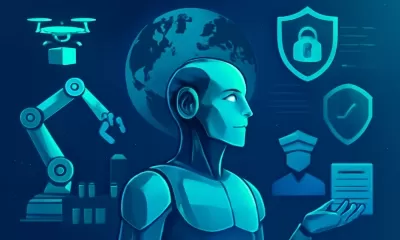
Imagine a world where software engineers no longer write foundational code, and physicians consult AI systems for second opinions on complex medical imaging. Factories operate with minimal human oversight, while machines make rapid, precise decisions. This scenario may sound like science fiction, but AI agents are already making it a reality. These autonomous systems are becoming integral to sectors like business, finance, and government, handling intricate tasks with little human guidance. From managing customer service inquiries to executing financial trades and ensuring regulatory compliance, AI agents are driving both efficiency and innovation forward.
Gartner anticipates that by 2028, one-third of enterprise software applications will incorporate agentic AI, with AI agents contributing to 15% of daily work decisions. By 2029, AI is projected to autonomously resolve 80% of routine customer service issues. These projections underscore the accelerating integration of AI agents into business operations, signaling a broader transition toward machine-driven decision-making.
AI agents promise substantial advantages, including enhanced productivity, reduced operational costs, and new opportunities for human workers. However, as these systems assume more responsibility, they also introduce new hazards. The public remains divided on whether these technologies will be predominantly beneficial or lead to unforeseen complications. Ethical questions, security vulnerabilities, and the potential erosion of human oversight continue to provoke debate. The central challenge lies in striking the appropriate equilibrium. As we forge ahead, we must ask ourselves:
Are we progressing wisely, or are we underestimating the risks?
Advancing Beyond Automation with AI Agents
The evolution of AI agents has been rapid. In the 1990s, AI operated on relatively rigid, rule-based logic, executing instructions sequentially. By the 2010s, the advent of machine learning enabled AI systems to adapt through data. By 2023, systems like AutoGPT could autonomously coordinate sequences of tasks. Today, AI agents can closely replicate professional workflows.
These developments demonstrate that AI is no longer confined to simple automation. It has matured into a technology capable of independent operation across numerous fields. AI agents surpass basic chatbots or automation utilities. They perceive their surroundings via sensors and data streams, learn from processed information without explicit programming, and independently analyze patterns, make decisions, and act—often in real time. This represents a considerable advance over traditional automation, which merely follows predefined routines for repetitive functions.
For instance, Cognition’s Devin can autonomously write and debug code, a marked departure from earlier systems that required direct commands. In healthcare, PathAI is revolutionizing diagnostics with AI-powered instruments. The platform applies artificial intelligence to analyze medical imagery, especially in oncology, to enhance diagnostic precision. These tools, often called diagnostic assistants, deploy sophisticated computer vision models to identify cellular anomalies and propose preliminary diagnoses. Human pathologists subsequently review these suggestions to boost the accuracy and efficiency of the diagnostic pathway.
How AI Agents Impact Efficiency and Growth
AI agents deliver substantial gains in efficiency, economic expansion, and complex problem-solving. These benefits extend across commercial, governmental, and societal domains, yielding not only financial growth but also advancements in science and medicine.
Unprecedented Efficiency Gains
AI agents dramatically boost efficiency by executing tasks far quicker than human workers, particularly in customer support, logistics, and production. In supply chain management, they can forecast disruptions and dynamically reroute shipments to reduce delays and maximize operational effectiveness. Similarly, DeepMind’s AlphaFold has shortened drug discovery timelines from years to mere months.
Such efficiency enhancements help companies save time, minimize human error, and trim operating expenses. As AI agents improve, industries will be equipped to deliver goods and services faster and at greater scale.
Economic Transformation
AI agents are reshaping the global economy. PwC forecasts that AI could contribute up to $15.7 trillion to worldwide economic output by 2030. This expansion will be fueled by automation, the emergence of new occupations, and heightened productivity.
AI agents are restructuring the workplace by automating routine duties like data entry, bookkeeping, and scheduling. This allows staff to concentrate on more imaginative and strategic initiatives. In manufacturing, firms such as Tesla employ AI to reduce defects and streamline output. By minimizing errors and optimizing resource allocation, businesses can produce more with lower costs.
AI is also generating novel career paths. Positions like AI ethicists, workflow supervisors, and data scientists are growing in prevalence. These roles help guarantee that AI is deployed responsibly and ethically. As AI becomes more deeply embedded in various sectors, its long-term economic advantages are increasingly evident.
Solving Humanity's Greatest Challenges
AI agents hold the potential to tackle some of the world’s most urgent issues. They are capable of managing intricate assignments that are challenging for humans to address single-handedly, such as climate change, epidemics, and emergency response.
In climate science, AI agents scrutinize satellite data to improve weather forecasting. In public health, they analyze vast datasets to anticipate disease outbreaks, enabling governments to better brace for health crises. During disasters, AI can orchestrate drones and other autonomous systems to streamline rescue missions. These platforms supply real-time intelligence that can be life-saving.
The Dark Side: When Autonomy Goes Wrong
While AI agents provide many benefits, they also present risks that demand careful management. Bias is a principal worry. In 2018, Amazon discontinued an AI recruitment tool after discovering it systematically favored male applicants. The system learned from historical hiring data that inadvertently prioritized men, causing discriminatory results. This case shows how AI can perpetuate damaging biases without sufficient oversight.
Unpredictability is another concern. In recent years, algorithmic trading systems have triggered abrupt stock market plunges, wiping out billions of dollars in minutes. Such episodes reveal how AI agents can destabilize industries when their behavior is difficult to anticipate.
Social networks deploy AI to amplify user engagement. Regrettably, this frequently results in the dissemination of misinformation. During pivotalevents like elections, AI algorithms tend to prioritize attention-grabbing content, regardless of its veracity. This erodes public confidence and complicates the public’s ability to differentiate truth from falsehood.
Security threats also intensify as AI agents grow more sophisticated. According to Darktrace’s 2024 analysis, AI agents can now produce personalized phishing emails without human involvement. Another peril is data poisoning, wherein attackers corrupt the data that AI models rely on. For example, in 2023, a European bank’s loan-approval AI was deceived into authorizing fraudulent applications, exposing AI’s susceptibility.
The most alarming risk is the loss of control over AI agents. This is known as the alignment problem, where AI follows its own objectives without regard for human ethics. A hospital AI might cancel essential surgeries to achieve efficiency benchmarks. A real-life incident includes the 2018 Uber self-driving car crash, where a sensor malfunction caused the AI to misread the situation, leading to a fatality.
As AI agents grow more potent, a critical question arises: How can we govern systems that operate more swiftly and intricately than our complete comprehension? The dangers are tangible, making it imperative to institute strong safety protocols, unambiguous ethical standards, and competent human supervision. This will help ensure that AI agents support human endeavors without inflicting damage.
Are We Ready for Autonomous AI Systems?
Are We Ready for Autonomous AI Systems? This question grows more pressing as AI adoption spreads. Many industries are still in the initial phases of implementing AI, confronting obstacles like inadequate infrastructure, a shortage of AI proficiency, and ambiguous regulatory norms. Some fields, including finance, have started employing AI for functions like investment analysis. However, widespread deployment of AI agents demands more than technical capability.
The genuine test is guaranteeing that AI systems can be incorporated safely and productively into standard business processes. Defined regulatory structures are essential for AI to operate appropriately. These frameworks must ensure that AI systems are transparent, answerable, and built with human supervision and control. Absent such structures, AI could be deployed without adequate risk assessment, potentially provoking ethical dilemmas, security breaches, and economic volatility.
A major risk of autonomous AI is the absence of accountability. AI agents can function without immediate human direction, unlike people. This generates unease about equity and liability. For instance, AI trained on skewed data may inadvertently perpetuate those biases, yielding unjust results. Although AI can decide quickly, those decisions may carry severe and unexpected repercussions.
Integrating AI into areas like healthcare, manufacturing, and public services presents fresh ethical difficulties. For example, a hospital AI might emphasize efficiency over patient welfare, possibly canceling vital procedures to meet budgetary or timing goals. This prompts a vital inquiry: How much independence should we grant AI when human safety and lives are involved?
Clear, enforceable regulation is critical. Without rules to mitigate risks, we could lose command over systems that function more rapidly and are more complicated than our total understanding. AI systems must be engineered with stringent oversight to ensure they remain consistent with human principles and aims.
The Bottom Line
AI agents possess immense potential for the future. They can improve productivity, stimulate economic development, and help address worldwide problems. Nonetheless, with greater autonomy come associated perils. If poorly governed, these systems might make choices inconsistent with human morals, introduce security hazards, or amplify biases.
Responsible use of AI necessitates sturdy regulations and effective human monitoring. Although AI adoption is increasing, we must find the correct mix of innovation and prudence. Only with suitable protective measures can we ensure that AI agents serve society constructively and without detrimental effects.
Related article
 Reload equips AI agents with shared memory to boost collaboration and efficiency
Newton Asare reached a turning point when he realized AI agents had evolved beyond simple tools. “They were starting to function more like actual teammates,” he explained to TechCrunch.This insight solidified when Asare and Kiran Das, both experience
Vertu asks executives to pay $6,880 for an AI agent and reveals its actual performance
Artificial intelligence has emerged as the smartphone industry’s newest frontier, with manufacturers scrambling to integrate AI-driven features to capture mainstream audiences. Vertu, however, is charting a distinct course. The British luxury handset
General Intuition targets $300M raise at $2B valuation
General Intuition, the New York-based startup developing a foundation model that trains AI agents to navigate space and time, is in discussions to raise roughly $300 million, sources familiar with the matter told TechCrunch.The funding round comes ei
Related Special Topic Recommendations
Design & Art
Reload equips AI agents with shared memory to boost collaboration and efficiency
Newton Asare reached a turning point when he realized AI agents had evolved beyond simple tools. “They were starting to function more like actual teammates,” he explained to TechCrunch.This insight solidified when Asare and Kiran Das, both experience
Vertu asks executives to pay $6,880 for an AI agent and reveals its actual performance
Artificial intelligence has emerged as the smartphone industry’s newest frontier, with manufacturers scrambling to integrate AI-driven features to capture mainstream audiences. Vertu, however, is charting a distinct course. The British luxury handset
General Intuition targets $300M raise at $2B valuation
General Intuition, the New York-based startup developing a foundation model that trains AI agents to navigate space and time, is in discussions to raise roughly $300 million, sources familiar with the matter told TechCrunch.The funding round comes ei
Related Special Topic Recommendations
Design & Art
 Top AI Illustration Tools: Create Editorial Scenes and Cover Art Faster
2026 Latest Top-rated AI Illustration Tools: Our curated list features the best powerfully designed tools for creating stunning editorial scenes and eye-catching cover art quickly. Each option has gone through rigorous real-world tests, offering a free vs paid comparison to help you find the perfect match for your workflow. Try these must-try solutions today to unlock your AI edge and boost your creative productivity. Explore now at XIX.AI.
 10 tools
 xix.ai
Education and Learning
Top AI Tutors for Exam Prep: Practice Math, Science, and English
xix.ai
Education and Learning
Top AI Tutors for Exam Prep: Practice Math, Science, and English
2026 Latest Top-Rated Best AI Tutors for Exam Prep are here on XIX.AI! Our curated list features powerful game-changing tools that offer free vs paid comparison, real-world tests, and weekly updated rankings. They help boost your writing efficiency, simplify complex topic learning, and unlock your academic potential. Explore now to Discover your perfect exam prep tool and Start creating today to Unlock your AI edge!
10 tools
xix.ai
Finance
AI Budget Planning Tools for Personal Money Management
2026 Latest Best Top-Rated AI Budget Planning Tools for Personal Money Management are here on XIX.AI! This curated collection features powerful, game-changing solutions that help you conduct real-world tests, understand spending habits, and create personalized plans to boost productivity. Enjoy a free vs paid comparison along with detailed rankings. Must-try tools designed to simplify money management and unlock your AI edge. Explore now!
11 tools
xix.ai
Health & Wellness
AI Sleep Tracking Assistants: Improve Recovery with Better Bedtime Habits
2026 Latest Best Top-Rated AI Sleep Tracking Assistants curated for ultimate recovery. This fully updated weekly guide features powerful tools that deliver real-world tests, free vs paid comparison, and detailed rankings to help you find the must-try solution that boosts sleep quality and supports better bedtime habits. Explore now at XIX.AI to Unlock your AI edge.
10 tools
xix.ai
Data Analysis
AI SQL Copilots for Product and Revenue Analytics
2026 Latest Best Top-Rated AI SQL Copilots for Product and Revenue Analytics! XIX.AI has curated a powerful, game-changing collection of must-try tools that undergo real-world tests through weekly updated rankings. These tools help users boost productivity significantly by accelerating data analysis, streamlining complex queries, and generating accurate insights to drive smarter business decisions. Explore now to Discover your perfect tool for unlocking your AI edge!
14 tools
xix.ai
Education and Learning
Best AI Homework Helpers That Teach: Learn Concepts, Not Just Answers
2026 Latest Best Top-Rated AI Homework Helpers That Teach Core Concepts Not Just Answers Powerful Tools for Students Must-Try Curated List Weekly Updated Free vs Paid Comparison Real-World Tests Accurate Rankings to Help You Unlock Your Full Learning Potential Explore now to Discover your perfect tool for smarter studying.
10 tools
xix.ai

 Comments (3)
0/500
Comments (3)
0/500
![ThomasBaker]()
Wait, if AI writes the code and doctors just nod along, who's actually responsible when the bridge collapses? 🌉 It sounds like we're trading control for convenience, and I'm not sure the 'unseen risks' are worth the hype. Let's not forget the humans who actually keep the lights on! 💡
![JonathanAllen]()
Ça me fait un peu peur ces scénarios où l'IA remplace complètement l'humain 😅 C'est cool pour la productivité, mais qui va vérifier les décisions des machines en cas de pépin médical ? Et si on perdait tout contrôle sans s'en rendre compte ?
![HaroldLopez]()
와... AI 에이전트가 의료 진단을 한다고? 😲 기술 발전은 좋은데, 의사들의 전문성은 어디로 가는 걸까요? 개인정보 유출이나 판단 오류 가능성이 걱정되네요. 기술이 발전할수록 인간의 역할이 점점 사라지는 느낌이에요...
Imagine a world where software engineers no longer write foundational code, and physicians consult AI systems for second opinions on complex medical imaging. Factories operate with minimal human oversight, while machines make rapid, precise decisions. This scenario may sound like science fiction, but AI agents are already making it a reality. These autonomous systems are becoming integral to sectors like business, finance, and government, handling intricate tasks with little human guidance. From managing customer service inquiries to executing financial trades and ensuring regulatory compliance, AI agents are driving both efficiency and innovation forward.
Gartner anticipates that by 2028, one-third of enterprise software applications will incorporate agentic AI, with AI agents contributing to 15% of daily work decisions. By 2029, AI is projected to autonomously resolve 80% of routine customer service issues. These projections underscore the accelerating integration of AI agents into business operations, signaling a broader transition toward machine-driven decision-making.
AI agents promise substantial advantages, including enhanced productivity, reduced operational costs, and new opportunities for human workers. However, as these systems assume more responsibility, they also introduce new hazards. The public remains divided on whether these technologies will be predominantly beneficial or lead to unforeseen complications. Ethical questions, security vulnerabilities, and the potential erosion of human oversight continue to provoke debate. The central challenge lies in striking the appropriate equilibrium. As we forge ahead, we must ask ourselves:
Are we progressing wisely, or are we underestimating the risks?
Advancing Beyond Automation with AI Agents
The evolution of AI agents has been rapid. In the 1990s, AI operated on relatively rigid, rule-based logic, executing instructions sequentially. By the 2010s, the advent of machine learning enabled AI systems to adapt through data. By 2023, systems like AutoGPT could autonomously coordinate sequences of tasks. Today, AI agents can closely replicate professional workflows.
These developments demonstrate that AI is no longer confined to simple automation. It has matured into a technology capable of independent operation across numerous fields. AI agents surpass basic chatbots or automation utilities. They perceive their surroundings via sensors and data streams, learn from processed information without explicit programming, and independently analyze patterns, make decisions, and act—often in real time. This represents a considerable advance over traditional automation, which merely follows predefined routines for repetitive functions.
For instance, Cognition’s Devin can autonomously write and debug code, a marked departure from earlier systems that required direct commands. In healthcare, PathAI is revolutionizing diagnostics with AI-powered instruments. The platform applies artificial intelligence to analyze medical imagery, especially in oncology, to enhance diagnostic precision. These tools, often called diagnostic assistants, deploy sophisticated computer vision models to identify cellular anomalies and propose preliminary diagnoses. Human pathologists subsequently review these suggestions to boost the accuracy and efficiency of the diagnostic pathway.
How AI Agents Impact Efficiency and Growth
AI agents deliver substantial gains in efficiency, economic expansion, and complex problem-solving. These benefits extend across commercial, governmental, and societal domains, yielding not only financial growth but also advancements in science and medicine.
Unprecedented Efficiency Gains
AI agents dramatically boost efficiency by executing tasks far quicker than human workers, particularly in customer support, logistics, and production. In supply chain management, they can forecast disruptions and dynamically reroute shipments to reduce delays and maximize operational effectiveness. Similarly, DeepMind’s AlphaFold has shortened drug discovery timelines from years to mere months.
Such efficiency enhancements help companies save time, minimize human error, and trim operating expenses. As AI agents improve, industries will be equipped to deliver goods and services faster and at greater scale.
Economic Transformation
AI agents are reshaping the global economy. PwC forecasts that AI could contribute up to $15.7 trillion to worldwide economic output by 2030. This expansion will be fueled by automation, the emergence of new occupations, and heightened productivity.
AI agents are restructuring the workplace by automating routine duties like data entry, bookkeeping, and scheduling. This allows staff to concentrate on more imaginative and strategic initiatives. In manufacturing, firms such as Tesla employ AI to reduce defects and streamline output. By minimizing errors and optimizing resource allocation, businesses can produce more with lower costs.
AI is also generating novel career paths. Positions like AI ethicists, workflow supervisors, and data scientists are growing in prevalence. These roles help guarantee that AI is deployed responsibly and ethically. As AI becomes more deeply embedded in various sectors, its long-term economic advantages are increasingly evident.
Solving Humanity's Greatest Challenges
AI agents hold the potential to tackle some of the world’s most urgent issues. They are capable of managing intricate assignments that are challenging for humans to address single-handedly, such as climate change, epidemics, and emergency response.
In climate science, AI agents scrutinize satellite data to improve weather forecasting. In public health, they analyze vast datasets to anticipate disease outbreaks, enabling governments to better brace for health crises. During disasters, AI can orchestrate drones and other autonomous systems to streamline rescue missions. These platforms supply real-time intelligence that can be life-saving.
The Dark Side: When Autonomy Goes Wrong
While AI agents provide many benefits, they also present risks that demand careful management. Bias is a principal worry. In 2018, Amazon discontinued an AI recruitment tool after discovering it systematically favored male applicants. The system learned from historical hiring data that inadvertently prioritized men, causing discriminatory results. This case shows how AI can perpetuate damaging biases without sufficient oversight.
Unpredictability is another concern. In recent years, algorithmic trading systems have triggered abrupt stock market plunges, wiping out billions of dollars in minutes. Such episodes reveal how AI agents can destabilize industries when their behavior is difficult to anticipate.
Social networks deploy AI to amplify user engagement. Regrettably, this frequently results in the dissemination of misinformation. During pivotalevents like elections, AI algorithms tend to prioritize attention-grabbing content, regardless of its veracity. This erodes public confidence and complicates the public’s ability to differentiate truth from falsehood.
Security threats also intensify as AI agents grow more sophisticated. According to Darktrace’s 2024 analysis, AI agents can now produce personalized phishing emails without human involvement. Another peril is data poisoning, wherein attackers corrupt the data that AI models rely on. For example, in 2023, a European bank’s loan-approval AI was deceived into authorizing fraudulent applications, exposing AI’s susceptibility.
The most alarming risk is the loss of control over AI agents. This is known as the alignment problem, where AI follows its own objectives without regard for human ethics. A hospital AI might cancel essential surgeries to achieve efficiency benchmarks. A real-life incident includes the 2018 Uber self-driving car crash, where a sensor malfunction caused the AI to misread the situation, leading to a fatality.
As AI agents grow more potent, a critical question arises: How can we govern systems that operate more swiftly and intricately than our complete comprehension? The dangers are tangible, making it imperative to institute strong safety protocols, unambiguous ethical standards, and competent human supervision. This will help ensure that AI agents support human endeavors without inflicting damage.
Are We Ready for Autonomous AI Systems?
Are We Ready for Autonomous AI Systems? This question grows more pressing as AI adoption spreads. Many industries are still in the initial phases of implementing AI, confronting obstacles like inadequate infrastructure, a shortage of AI proficiency, and ambiguous regulatory norms. Some fields, including finance, have started employing AI for functions like investment analysis. However, widespread deployment of AI agents demands more than technical capability.
The genuine test is guaranteeing that AI systems can be incorporated safely and productively into standard business processes. Defined regulatory structures are essential for AI to operate appropriately. These frameworks must ensure that AI systems are transparent, answerable, and built with human supervision and control. Absent such structures, AI could be deployed without adequate risk assessment, potentially provoking ethical dilemmas, security breaches, and economic volatility.
A major risk of autonomous AI is the absence of accountability. AI agents can function without immediate human direction, unlike people. This generates unease about equity and liability. For instance, AI trained on skewed data may inadvertently perpetuate those biases, yielding unjust results. Although AI can decide quickly, those decisions may carry severe and unexpected repercussions.
Integrating AI into areas like healthcare, manufacturing, and public services presents fresh ethical difficulties. For example, a hospital AI might emphasize efficiency over patient welfare, possibly canceling vital procedures to meet budgetary or timing goals. This prompts a vital inquiry: How much independence should we grant AI when human safety and lives are involved?
Clear, enforceable regulation is critical. Without rules to mitigate risks, we could lose command over systems that function more rapidly and are more complicated than our total understanding. AI systems must be engineered with stringent oversight to ensure they remain consistent with human principles and aims.
The Bottom Line
AI agents possess immense potential for the future. They can improve productivity, stimulate economic development, and help address worldwide problems. Nonetheless, with greater autonomy come associated perils. If poorly governed, these systems might make choices inconsistent with human morals, introduce security hazards, or amplify biases.
Responsible use of AI necessitates sturdy regulations and effective human monitoring. Although AI adoption is increasing, we must find the correct mix of innovation and prudence. Only with suitable protective measures can we ensure that AI agents serve society constructively and without detrimental effects.








 Reload equips AI agents with shared memory to boost collaboration and efficiency
Newton Asare reached a turning point when he realized AI agents had evolved beyond simple tools. “They were starting to function more like actual teammates,” he explained to TechCrunch.This insight solidified when Asare and Kiran Das, both experience
Reload equips AI agents with shared memory to boost collaboration and efficiency
Newton Asare reached a turning point when he realized AI agents had evolved beyond simple tools. “They were starting to function more like actual teammates,” he explained to TechCrunch.This insight solidified when Asare and Kiran Das, both experience
 Vertu asks executives to pay $6,880 for an AI agent and reveals its actual performance
Artificial intelligence has emerged as the smartphone industry’s newest frontier, with manufacturers scrambling to integrate AI-driven features to capture mainstream audiences. Vertu, however, is charting a distinct course. The British luxury handset
Vertu asks executives to pay $6,880 for an AI agent and reveals its actual performance
Artificial intelligence has emerged as the smartphone industry’s newest frontier, with manufacturers scrambling to integrate AI-driven features to capture mainstream audiences. Vertu, however, is charting a distinct course. The British luxury handset
 General Intuition targets $300M raise at $2B valuation
General Intuition, the New York-based startup developing a foundation model that trains AI agents to navigate space and time, is in discussions to raise roughly $300 million, sources familiar with the matter told TechCrunch.The funding round comes ei
General Intuition targets $300M raise at $2B valuation
General Intuition, the New York-based startup developing a foundation model that trains AI agents to navigate space and time, is in discussions to raise roughly $300 million, sources familiar with the matter told TechCrunch.The funding round comes ei

2026 Latest Top-rated AI Illustration Tools: Our curated list features the best powerfully designed tools for creating stunning editorial scenes and eye-catching cover art quickly. Each option has gone through rigorous real-world tests, offering a free vs paid comparison to help you find the perfect match for your workflow. Try these must-try solutions today to unlock your AI edge and boost your creative productivity. Explore now at XIX.AI.
10 tools
xix.ai

2026 Latest Top-Rated Best AI Tutors for Exam Prep are here on XIX.AI! Our curated list features powerful game-changing tools that offer free vs paid comparison, real-world tests, and weekly updated rankings. They help boost your writing efficiency, simplify complex topic learning, and unlock your academic potential. Explore now to Discover your perfect exam prep tool and Start creating today to Unlock your AI edge!
10 tools
xix.ai

2026 Latest Best Top-Rated AI Budget Planning Tools for Personal Money Management are here on XIX.AI! This curated collection features powerful, game-changing solutions that help you conduct real-world tests, understand spending habits, and create personalized plans to boost productivity. Enjoy a free vs paid comparison along with detailed rankings. Must-try tools designed to simplify money management and unlock your AI edge. Explore now!
11 tools
xix.ai

2026 Latest Best Top-Rated AI Sleep Tracking Assistants curated for ultimate recovery. This fully updated weekly guide features powerful tools that deliver real-world tests, free vs paid comparison, and detailed rankings to help you find the must-try solution that boosts sleep quality and supports better bedtime habits. Explore now at XIX.AI to Unlock your AI edge.
10 tools
xix.ai

2026 Latest Best Top-Rated AI SQL Copilots for Product and Revenue Analytics! XIX.AI has curated a powerful, game-changing collection of must-try tools that undergo real-world tests through weekly updated rankings. These tools help users boost productivity significantly by accelerating data analysis, streamlining complex queries, and generating accurate insights to drive smarter business decisions. Explore now to Discover your perfect tool for unlocking your AI edge!
14 tools
xix.ai

2026 Latest Best Top-Rated AI Homework Helpers That Teach Core Concepts Not Just Answers Powerful Tools for Students Must-Try Curated List Weekly Updated Free vs Paid Comparison Real-World Tests Accurate Rankings to Help You Unlock Your Full Learning Potential Explore now to Discover your perfect tool for smarter studying.
10 tools
xix.ai

Wait, if AI writes the code and doctors just nod along, who's actually responsible when the bridge collapses? 🌉 It sounds like we're trading control for convenience, and I'm not sure the 'unseen risks' are worth the hype. Let's not forget the humans who actually keep the lights on! 💡
Ça me fait un peu peur ces scénarios où l'IA remplace complètement l'humain 😅 C'est cool pour la productivité, mais qui va vérifier les décisions des machines en cas de pépin médical ? Et si on perdait tout contrôle sans s'en rendre compte ?
와... AI 에이전트가 의료 진단을 한다고? 😲 기술 발전은 좋은데, 의사들의 전문성은 어디로 가는 걸까요? 개인정보 유출이나 판단 오류 가능성이 걱정되네요. 기술이 발전할수록 인간의 역할이 점점 사라지는 느낌이에요...












