


 Home
HomeYouTube bolsters AI deepfake protections for politicians, officials, and journalists
YouTube is extending access to its likeness detection technology, designed to identify AI-generated deepfakes, to a pilot program for government officials, political candidates, and journalists, the company announced on Tuesday. Participants in this pilot will be able to use a tool that finds unauthorized AI-generated content featuring their likeness and submit requests for its removal if it violates YouTube's policies.
This technology was initially rolled out last year to approximately 4 million creators in YouTube's Partner Program, building on earlier tests.
Functioning similarly to YouTube's established Content ID system for copyrighted material, this likeness detection feature scans for AI-simulated faces. Such AI tools are occasionally exploited to disseminate misinformation by creating convincing deepfakes of public figures—such as politicians or officials—portraying them saying or doing things that never occurred.
Through this new pilot, YouTube seeks to find a balance between protecting free expression and addressing the risks posed by AI technology that can produce realistic impersonations of individuals in the public eye.
"This expansion is fundamentally about safeguarding the integrity of public discourse," stated Leslie Miller, YouTube's Vice President of Government Affairs and Public Policy, in a press briefing. "We recognize the heightened risks of AI impersonation for those in civic roles. While offering this new protection, we are implementing it with careful consideration," she added.
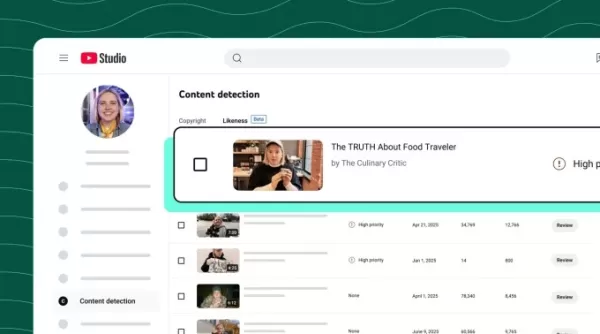
Image Credits:YouTube
Miller clarified that not every detected match will be automatically removed upon request. YouTube will assess each case against its existing privacy policy to determine if the content constitutes protected expression, such as parody or political critique.
The company also stated its support for federal-level protections, endorsing legislation like the proposed NO FAKES Act in Washington, D.C., which aims to regulate the unauthorized AI replication of a person's voice and visual likeness.
Eligible pilot testers must verify their identity by providing a selfie and a government-issued ID to use the tool. They can then set up a profile, review detected matches, and choose to request removals. YouTube plans to eventually allow users to block violating content before it's published or, potentially, to claim monetization rights, mirroring the functionality of its Content ID system.
YouTube did not disclose the specific individuals included in the initial pilot group but indicated the goal is to make the technology widely available in the future.
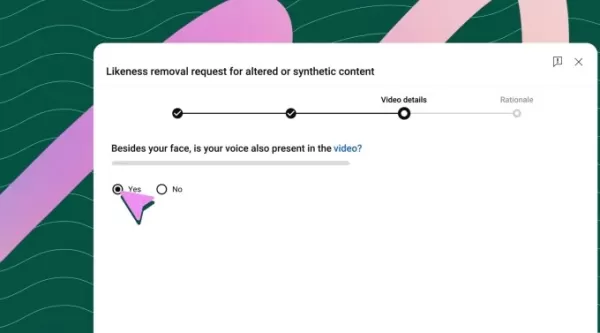
Image Credits:YouTube
Videos identified as AI-generated will carry a label, though its placement will vary. For some content, the label will appear in the video description, while videos on more "sensitive topics" will feature a more prominent label directly on the video player. This approach is consistent with YouTube's labeling for all AI-generated content.
"A significant amount of content is produced with AI, but that fact isn't always central to the content's purpose," explained Amjad Hanif, YouTube's Vice President of Creator Products, regarding label placement. "It could be an AI-generated cartoon, for instance. We use judgment to decide which categories might benefit from a highly visible disclaimer."
YouTube has not disclosed the exact number of AI deepfake removals facilitated by this technology since its release to creators but notes the volume taken down so far has been "minimal."
"For many creators, the primary benefit has been increased awareness of what's being uploaded. The actual number of removal requests remains very low, as most content is fairly benign or even complementary to their channel," Hanif said.
This dynamic may differ for deepfakes targeting government officials, politicians, or journalists.
Looking ahead, YouTube aims to expand its deepfake detection technology to cover other areas, including recognizable voices and intellectual property such as popular fictional characters.
Related article
 Stripe to Acquire OpenRouter as AI Model Routing Gains Momentum
Stripe has agreed to acquire OpenRouter, an AI model-routing platform that gives developers access to hundreds of models through a single interface. The deal adds model selection and routing to Stripe’s existing work around AI usage and token-based b
Google AI Overviews Gain Ground in Search Results
According to Similarweb’s 2026 Generative AI Landscape report, Google’s AI-generated summaries appeared in 43% of US searches, a significant rise from 15% recorded a year prior.While AI Overviews present generated summaries within standard search res
Sequoia-backed Empirik raises $21M to forecast outages before they strike
Before joining Sequoia Capital in 2020 as chief digital and information officer, Avon Puri spent over a decade running infrastructure at Rubrik and VMware. Three years ago, as large language models began showing their true potential, Puri, alongside
Related Special Topic Recommendations
Design & Art
Stripe to Acquire OpenRouter as AI Model Routing Gains Momentum
Stripe has agreed to acquire OpenRouter, an AI model-routing platform that gives developers access to hundreds of models through a single interface. The deal adds model selection and routing to Stripe’s existing work around AI usage and token-based b
Google AI Overviews Gain Ground in Search Results
According to Similarweb’s 2026 Generative AI Landscape report, Google’s AI-generated summaries appeared in 43% of US searches, a significant rise from 15% recorded a year prior.While AI Overviews present generated summaries within standard search res
Sequoia-backed Empirik raises $21M to forecast outages before they strike
Before joining Sequoia Capital in 2020 as chief digital and information officer, Avon Puri spent over a decade running infrastructure at Rubrik and VMware. Three years ago, as large language models began showing their true potential, Puri, alongside
Related Special Topic Recommendations
Design & Art
 Top AI Illustration Tools: Create Editorial Scenes and Cover Art Faster
2026 Latest Top-rated AI Illustration Tools: Our curated list features the best powerfully designed tools for creating stunning editorial scenes and eye-catching cover art quickly. Each option has gone through rigorous real-world tests, offering a free vs paid comparison to help you find the perfect match for your workflow. Try these must-try solutions today to unlock your AI edge and boost your creative productivity. Explore now at XIX.AI.
 10 tools
 xix.ai
Education and Learning
Top AI Tutors for Exam Prep: Practice Math, Science, and English
xix.ai
Education and Learning
Top AI Tutors for Exam Prep: Practice Math, Science, and English
2026 Latest Top-Rated Best AI Tutors for Exam Prep are here on XIX.AI! Our curated list features powerful game-changing tools that offer free vs paid comparison, real-world tests, and weekly updated rankings. They help boost your writing efficiency, simplify complex topic learning, and unlock your academic potential. Explore now to Discover your perfect exam prep tool and Start creating today to Unlock your AI edge!
10 tools
xix.ai
Finance
AI Budget Planning Tools for Personal Money Management
2026 Latest Best Top-Rated AI Budget Planning Tools for Personal Money Management are here on XIX.AI! This curated collection features powerful, game-changing solutions that help you conduct real-world tests, understand spending habits, and create personalized plans to boost productivity. Enjoy a free vs paid comparison along with detailed rankings. Must-try tools designed to simplify money management and unlock your AI edge. Explore now!
11 tools
xix.ai
Health & Wellness
AI Sleep Tracking Assistants: Improve Recovery with Better Bedtime Habits
2026 Latest Best Top-Rated AI Sleep Tracking Assistants curated for ultimate recovery. This fully updated weekly guide features powerful tools that deliver real-world tests, free vs paid comparison, and detailed rankings to help you find the must-try solution that boosts sleep quality and supports better bedtime habits. Explore now at XIX.AI to Unlock your AI edge.
10 tools
xix.ai
Data Analysis
AI SQL Copilots for Product and Revenue Analytics
2026 Latest Best Top-Rated AI SQL Copilots for Product and Revenue Analytics! XIX.AI has curated a powerful, game-changing collection of must-try tools that undergo real-world tests through weekly updated rankings. These tools help users boost productivity significantly by accelerating data analysis, streamlining complex queries, and generating accurate insights to drive smarter business decisions. Explore now to Discover your perfect tool for unlocking your AI edge!
14 tools
xix.ai
Education and Learning
Best AI Homework Helpers That Teach: Learn Concepts, Not Just Answers
2026 Latest Best Top-Rated AI Homework Helpers That Teach Core Concepts Not Just Answers Powerful Tools for Students Must-Try Curated List Weekly Updated Free vs Paid Comparison Real-World Tests Accurate Rankings to Help You Unlock Your Full Learning Potential Explore now to Discover your perfect tool for smarter studying.
10 tools
xix.ai

 Comments (0)
0/500
Comments (0)
0/500
YouTube is extending access to its likeness detection technology, designed to identify AI-generated deepfakes, to a pilot program for government officials, political candidates, and journalists, the company announced on Tuesday. Participants in this pilot will be able to use a tool that finds unauthorized AI-generated content featuring their likeness and submit requests for its removal if it violates YouTube's policies.
This technology was initially rolled out last year to approximately 4 million creators in YouTube's Partner Program, building on earlier tests.
Functioning similarly to YouTube's established Content ID system for copyrighted material, this likeness detection feature scans for AI-simulated faces. Such AI tools are occasionally exploited to disseminate misinformation by creating convincing deepfakes of public figures—such as politicians or officials—portraying them saying or doing things that never occurred.
Through this new pilot, YouTube seeks to find a balance between protecting free expression and addressing the risks posed by AI technology that can produce realistic impersonations of individuals in the public eye.
"This expansion is fundamentally about safeguarding the integrity of public discourse," stated Leslie Miller, YouTube's Vice President of Government Affairs and Public Policy, in a press briefing. "We recognize the heightened risks of AI impersonation for those in civic roles. While offering this new protection, we are implementing it with careful consideration," she added.
Image Credits:YouTube
Miller clarified that not every detected match will be automatically removed upon request. YouTube will assess each case against its existing privacy policy to determine if the content constitutes protected expression, such as parody or political critique.
The company also stated its support for federal-level protections, endorsing legislation like the proposed NO FAKES Act in Washington, D.C., which aims to regulate the unauthorized AI replication of a person's voice and visual likeness.
Eligible pilot testers must verify their identity by providing a selfie and a government-issued ID to use the tool. They can then set up a profile, review detected matches, and choose to request removals. YouTube plans to eventually allow users to block violating content before it's published or, potentially, to claim monetization rights, mirroring the functionality of its Content ID system.
YouTube did not disclose the specific individuals included in the initial pilot group but indicated the goal is to make the technology widely available in the future.
Image Credits:YouTube
Videos identified as AI-generated will carry a label, though its placement will vary. For some content, the label will appear in the video description, while videos on more "sensitive topics" will feature a more prominent label directly on the video player. This approach is consistent with YouTube's labeling for all AI-generated content.
"A significant amount of content is produced with AI, but that fact isn't always central to the content's purpose," explained Amjad Hanif, YouTube's Vice President of Creator Products, regarding label placement. "It could be an AI-generated cartoon, for instance. We use judgment to decide which categories might benefit from a highly visible disclaimer."
YouTube has not disclosed the exact number of AI deepfake removals facilitated by this technology since its release to creators but notes the volume taken down so far has been "minimal."
"For many creators, the primary benefit has been increased awareness of what's being uploaded. The actual number of removal requests remains very low, as most content is fairly benign or even complementary to their channel," Hanif said.
This dynamic may differ for deepfakes targeting government officials, politicians, or journalists.
Looking ahead, YouTube aims to expand its deepfake detection technology to cover other areas, including recognizable voices and intellectual property such as popular fictional characters.








 Stripe to Acquire OpenRouter as AI Model Routing Gains Momentum
Stripe has agreed to acquire OpenRouter, an AI model-routing platform that gives developers access to hundreds of models through a single interface. The deal adds model selection and routing to Stripe’s existing work around AI usage and token-based b
Stripe to Acquire OpenRouter as AI Model Routing Gains Momentum
Stripe has agreed to acquire OpenRouter, an AI model-routing platform that gives developers access to hundreds of models through a single interface. The deal adds model selection and routing to Stripe’s existing work around AI usage and token-based b
 Google AI Overviews Gain Ground in Search Results
According to Similarweb’s 2026 Generative AI Landscape report, Google’s AI-generated summaries appeared in 43% of US searches, a significant rise from 15% recorded a year prior.While AI Overviews present generated summaries within standard search res
Google AI Overviews Gain Ground in Search Results
According to Similarweb’s 2026 Generative AI Landscape report, Google’s AI-generated summaries appeared in 43% of US searches, a significant rise from 15% recorded a year prior.While AI Overviews present generated summaries within standard search res
 Sequoia-backed Empirik raises $21M to forecast outages before they strike
Before joining Sequoia Capital in 2020 as chief digital and information officer, Avon Puri spent over a decade running infrastructure at Rubrik and VMware. Three years ago, as large language models began showing their true potential, Puri, alongside
Sequoia-backed Empirik raises $21M to forecast outages before they strike
Before joining Sequoia Capital in 2020 as chief digital and information officer, Avon Puri spent over a decade running infrastructure at Rubrik and VMware. Three years ago, as large language models began showing their true potential, Puri, alongside

2026 Latest Top-rated AI Illustration Tools: Our curated list features the best powerfully designed tools for creating stunning editorial scenes and eye-catching cover art quickly. Each option has gone through rigorous real-world tests, offering a free vs paid comparison to help you find the perfect match for your workflow. Try these must-try solutions today to unlock your AI edge and boost your creative productivity. Explore now at XIX.AI.
10 tools
xix.ai

2026 Latest Top-Rated Best AI Tutors for Exam Prep are here on XIX.AI! Our curated list features powerful game-changing tools that offer free vs paid comparison, real-world tests, and weekly updated rankings. They help boost your writing efficiency, simplify complex topic learning, and unlock your academic potential. Explore now to Discover your perfect exam prep tool and Start creating today to Unlock your AI edge!
10 tools
xix.ai

2026 Latest Best Top-Rated AI Budget Planning Tools for Personal Money Management are here on XIX.AI! This curated collection features powerful, game-changing solutions that help you conduct real-world tests, understand spending habits, and create personalized plans to boost productivity. Enjoy a free vs paid comparison along with detailed rankings. Must-try tools designed to simplify money management and unlock your AI edge. Explore now!
11 tools
xix.ai

2026 Latest Best Top-Rated AI Sleep Tracking Assistants curated for ultimate recovery. This fully updated weekly guide features powerful tools that deliver real-world tests, free vs paid comparison, and detailed rankings to help you find the must-try solution that boosts sleep quality and supports better bedtime habits. Explore now at XIX.AI to Unlock your AI edge.
10 tools
xix.ai

2026 Latest Best Top-Rated AI SQL Copilots for Product and Revenue Analytics! XIX.AI has curated a powerful, game-changing collection of must-try tools that undergo real-world tests through weekly updated rankings. These tools help users boost productivity significantly by accelerating data analysis, streamlining complex queries, and generating accurate insights to drive smarter business decisions. Explore now to Discover your perfect tool for unlocking your AI edge!
14 tools
xix.ai

2026 Latest Best Top-Rated AI Homework Helpers That Teach Core Concepts Not Just Answers Powerful Tools for Students Must-Try Curated List Weekly Updated Free vs Paid Comparison Real-World Tests Accurate Rankings to Help You Unlock Your Full Learning Potential Explore now to Discover your perfect tool for smarter studying.
10 tools
xix.ai












