


 Home
HomeXREAL Unveils Project Aura, a Sub-90-Gram Android XR Spatial Computing Device
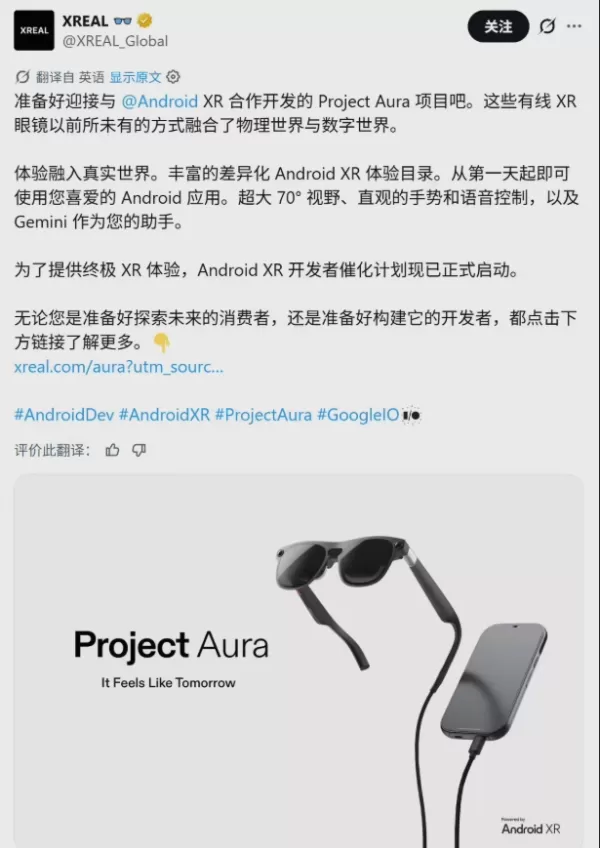
At the recently held 2026 Google I/O Developer Conference, AR leader XREAL unveiled its Project Aura smart glasses and confirmed full shipments by the end of 2026. Built on the Android XR architecture, this device not only achieves breakthroughs in lightweight design but also introduces a "separated computing" approach that sets a new standard for mass-producing AR glasses.
The Ultimate Balance of Lightweight: “Pocket Computing” Under 90 Grams
With current hardware constraints, balancing lightweight wearability, high performance, and long battery life remains a key industry challenge. XREAL's solution is a separated design: shifting the heavy processor, battery, and touch module outside the frame into a compact box that easily fits in a pocket.
This approach keeps the Project Aura glasses under 90 grams, delivering a comfortable wearing experience. The external module not only powers the device but also includes a physical touchpad that complements native gesture controls. To enable precise interaction, the glasses frame features three wide‑angle cameras. On‑site tests showed impressive gesture recognition range and sensitivity, allowing smooth movement and pinch actions even while moving.
Native Android XR Ecosystem: Deep Google AI Integration
As a flagship product for Google’s Android XR platform, Project Aura natively accesses the full suite of spatial applications. At the developer conference, it demonstrated immersive 3D navigation in Google Maps and full‑screen 180‑degree/360‑degree VR video playback on YouTube.
The standout technological feature is deep integration with multimodal Gemini AI. When connecting the glasses to a laptop via DisplayPort, the system automatically initiates "auto spatialization," transforming flat documents, web pages, and mobile apps into 3D environments that appear suspended in your visual space, creating an accessible 3D workspace and entertainment experience.
Powerful Specs and Future Prospects
Project Aura is powered by XREAL’s self‑developed X1S spatial computing chip, working closely with the Qualcomm Snapdragon XR platform to ensure ample performance. Battery life, while still under software optimization, currently supports approximately four hours of continuous use.
Related article
 Indian Tech Tycoon Invests $30M in AI Rival to Microsoft Office
Serial entrepreneur Bhavin Turakhia is investing $30 million of his own capital, betting that the enterprise AI sector still has room for new players. His latest startup, Neo, operates on a core belief: legacy workplace software cannot simply be patc
Former OpenAI Chief Scientist Ilya’s SSI Unveils First Model
AI has achieved another major milestone. Following his departure from OpenAI, former chief scientist Ilya Sutskever established Safe Superintelligence Inc. (SSI), which has recently unveiled details regarding its inaugural model. Reports from oversea
Lovable Leads Atech's Seed Round as AI Ambient Coding Officially Enters the Hardware Field
On May 14, 2026, AI application development platform Lovable announced its participation in the $800,000 seed funding round for Danish hardware startup Atech. Led by Lovable, the round attracted top-tier venture capital firms including the a16z Scout
Related Special Topic Recommendations
chatbot
Indian Tech Tycoon Invests $30M in AI Rival to Microsoft Office
Serial entrepreneur Bhavin Turakhia is investing $30 million of his own capital, betting that the enterprise AI sector still has room for new players. His latest startup, Neo, operates on a core belief: legacy workplace software cannot simply be patc
Former OpenAI Chief Scientist Ilya’s SSI Unveils First Model
AI has achieved another major milestone. Following his departure from OpenAI, former chief scientist Ilya Sutskever established Safe Superintelligence Inc. (SSI), which has recently unveiled details regarding its inaugural model. Reports from oversea
Lovable Leads Atech's Seed Round as AI Ambient Coding Officially Enters the Hardware Field
On May 14, 2026, AI application development platform Lovable announced its participation in the $800,000 seed funding round for Danish hardware startup Atech. Led by Lovable, the round attracted top-tier venture capital firms including the a16z Scout
Related Special Topic Recommendations
chatbot
 Best AI Conversation Trainer Tools for Interview Practice
2026 Latest Best Top-rated AI Conversation Trainer Tools for Interview Practice are here on XIX.AI! This curated collection features powerful, game-changing tools that go through rigorous real-world tests to deliver accurate feedback. You’ll find a free vs paid comparison and detailed rankings to help you choose the must-try option that boosts your confidence and skills. Explore now to Discover your perfect tool for interview success!
 12 tools
 xix.ai
Design & Art
Best AI Style Transfer Tools for Creative Experiments
xix.ai
Design & Art
Best AI Style Transfer Tools for Creative Experiments
2026 Latest Best Top-rated AI Style Transfer Tools for Creative Experiments! XIX.AI has curated a powerful, game-changing collection of must-try tools that deliver exceptional results through real-world tests and rigorous rankings. These top solutions help creatives boost productivity significantly by accelerating content creation and unlocking endless creative possibilities. Explore now to discover your perfect tool and start creating today!
9 tools
xix.ai
Comic Creation
Best AI Dialogue Bubble Tools for Visual Storytelling
2026 Latest Best Top-Rated AI Dialogue Bubble Tools for Visual Storytelling are here on XIX.AI! This curated collection features powerful, game-changing tools that help creators boost productivity and overcome creative bottlenecks. Get a free vs paid comparison, see real-world tests, and check the latest rankings to find the must-try solutions perfect for crafting engaging visual narratives. Explore now to discover your ideal tool!
10 tools
xix.ai
Meeting Assistant
Top AI Meeting Summary Tools: Track Decisions and Follow-Ups Clearly
2026 Latest Top-Rated Best AI Meeting Summary Tools for Clear Decision Tracking and Effortless Follow-Ups. This curated list showcases powerful, game-changing solutions that boost productivity dramatically by automating meeting notes, identifying key action items, and streamlining team coordination across all projects. Get a free vs paid comparison along with real-world tests and weekly updated rankings to help you find the perfect tool. Explore now to unlock your AI edge!
9 tools
xix.ai
Data Analysis
Best AI Data Cleaning Tools: Fix Missing Values and Duplicates Fast
2026 Latest Best Top-rated AI Data Cleaning Tools for quick fixing of missing values and duplicates. This curated list showcases powerful, game-changing solutions that boost productivity significantly. Each option has undergone rigorous real-world tests to ensure reliability. Get a free vs paid comparison and discover the must-try tool that fits your needs best. Explore now at XIX.AI to Unlock your AI edge.
11 tools
xix.ai
Design & Art
Best AI Creative Ideation Tools for Artists: Break Through Visual Blocks
2026 Latest Best Top-Rated AI Creative Ideation Tools for Artists are curated by XIX.AI to help creators break through visual blocks and boost creativity instantly. These powerful game-changing tools offer real-world tests, detailed free vs paid comparison, and weekly updated rankings. Discover your perfect tool to accelerate content creation and unlock your AI edge today. Explore now!
14 tools
xix.ai

 Comments (1)
0/500
Comments (1)
0/500
![StephenScott]()
Sub-90 grams? That's insane! I've been waiting for something that doesn't feel like a brick on my face. Hope the price is reasonable though. 😅
At the recently held 2026 Google I/O Developer Conference, AR leader XREAL unveiled its Project Aura smart glasses and confirmed full shipments by the end of 2026. Built on the Android XR architecture, this device not only achieves breakthroughs in lightweight design but also introduces a "separated computing" approach that sets a new standard for mass-producing AR glasses.
The Ultimate Balance of Lightweight: “Pocket Computing” Under 90 Grams
With current hardware constraints, balancing lightweight wearability, high performance, and long battery life remains a key industry challenge. XREAL's solution is a separated design: shifting the heavy processor, battery, and touch module outside the frame into a compact box that easily fits in a pocket.
This approach keeps the Project Aura glasses under 90 grams, delivering a comfortable wearing experience. The external module not only powers the device but also includes a physical touchpad that complements native gesture controls. To enable precise interaction, the glasses frame features three wide‑angle cameras. On‑site tests showed impressive gesture recognition range and sensitivity, allowing smooth movement and pinch actions even while moving.
Native Android XR Ecosystem: Deep Google AI Integration
As a flagship product for Google’s Android XR platform, Project Aura natively accesses the full suite of spatial applications. At the developer conference, it demonstrated immersive 3D navigation in Google Maps and full‑screen 180‑degree/360‑degree VR video playback on YouTube.
The standout technological feature is deep integration with multimodal Gemini AI. When connecting the glasses to a laptop via DisplayPort, the system automatically initiates "auto spatialization," transforming flat documents, web pages, and mobile apps into 3D environments that appear suspended in your visual space, creating an accessible 3D workspace and entertainment experience.
Powerful Specs and Future Prospects
Project Aura is powered by XREAL’s self‑developed X1S spatial computing chip, working closely with the Qualcomm Snapdragon XR platform to ensure ample performance. Battery life, while still under software optimization, currently supports approximately four hours of continuous use.








 Indian Tech Tycoon Invests $30M in AI Rival to Microsoft Office
Serial entrepreneur Bhavin Turakhia is investing $30 million of his own capital, betting that the enterprise AI sector still has room for new players. His latest startup, Neo, operates on a core belief: legacy workplace software cannot simply be patc
Indian Tech Tycoon Invests $30M in AI Rival to Microsoft Office
Serial entrepreneur Bhavin Turakhia is investing $30 million of his own capital, betting that the enterprise AI sector still has room for new players. His latest startup, Neo, operates on a core belief: legacy workplace software cannot simply be patc
 Former OpenAI Chief Scientist Ilya’s SSI Unveils First Model
AI has achieved another major milestone. Following his departure from OpenAI, former chief scientist Ilya Sutskever established Safe Superintelligence Inc. (SSI), which has recently unveiled details regarding its inaugural model. Reports from oversea
Former OpenAI Chief Scientist Ilya’s SSI Unveils First Model
AI has achieved another major milestone. Following his departure from OpenAI, former chief scientist Ilya Sutskever established Safe Superintelligence Inc. (SSI), which has recently unveiled details regarding its inaugural model. Reports from oversea
 Lovable Leads Atech's Seed Round as AI Ambient Coding Officially Enters the Hardware Field
On May 14, 2026, AI application development platform Lovable announced its participation in the $800,000 seed funding round for Danish hardware startup Atech. Led by Lovable, the round attracted top-tier venture capital firms including the a16z Scout
Lovable Leads Atech's Seed Round as AI Ambient Coding Officially Enters the Hardware Field
On May 14, 2026, AI application development platform Lovable announced its participation in the $800,000 seed funding round for Danish hardware startup Atech. Led by Lovable, the round attracted top-tier venture capital firms including the a16z Scout

2026 Latest Best Top-rated AI Conversation Trainer Tools for Interview Practice are here on XIX.AI! This curated collection features powerful, game-changing tools that go through rigorous real-world tests to deliver accurate feedback. You’ll find a free vs paid comparison and detailed rankings to help you choose the must-try option that boosts your confidence and skills. Explore now to Discover your perfect tool for interview success!
12 tools
xix.ai

2026 Latest Best Top-rated AI Style Transfer Tools for Creative Experiments! XIX.AI has curated a powerful, game-changing collection of must-try tools that deliver exceptional results through real-world tests and rigorous rankings. These top solutions help creatives boost productivity significantly by accelerating content creation and unlocking endless creative possibilities. Explore now to discover your perfect tool and start creating today!
9 tools
xix.ai

2026 Latest Best Top-Rated AI Dialogue Bubble Tools for Visual Storytelling are here on XIX.AI! This curated collection features powerful, game-changing tools that help creators boost productivity and overcome creative bottlenecks. Get a free vs paid comparison, see real-world tests, and check the latest rankings to find the must-try solutions perfect for crafting engaging visual narratives. Explore now to discover your ideal tool!
10 tools
xix.ai

2026 Latest Top-Rated Best AI Meeting Summary Tools for Clear Decision Tracking and Effortless Follow-Ups. This curated list showcases powerful, game-changing solutions that boost productivity dramatically by automating meeting notes, identifying key action items, and streamlining team coordination across all projects. Get a free vs paid comparison along with real-world tests and weekly updated rankings to help you find the perfect tool. Explore now to unlock your AI edge!
9 tools
xix.ai

2026 Latest Best Top-rated AI Data Cleaning Tools for quick fixing of missing values and duplicates. This curated list showcases powerful, game-changing solutions that boost productivity significantly. Each option has undergone rigorous real-world tests to ensure reliability. Get a free vs paid comparison and discover the must-try tool that fits your needs best. Explore now at XIX.AI to Unlock your AI edge.
11 tools
xix.ai

2026 Latest Best Top-Rated AI Creative Ideation Tools for Artists are curated by XIX.AI to help creators break through visual blocks and boost creativity instantly. These powerful game-changing tools offer real-world tests, detailed free vs paid comparison, and weekly updated rankings. Discover your perfect tool to accelerate content creation and unlock your AI edge today. Explore now!
14 tools
xix.ai

Sub-90 grams? That's insane! I've been waiting for something that doesn't feel like a brick on my face. Hope the price is reasonable though. 😅












