


 Home
HomeXiaohongshu Unveils BigMac: Breaking the Memory-Speed Trade-off in Multi-modal Training
Multi-modal large language models are emerging as the cornerstone of next-generation AI, yet their training infrastructure has long been hindered by a persistent trade-off: systems optimized for speed often struggle with memory constraints, while those prioritizing memory efficiency tend to be slow. The Dots Infra team at Xiaohongshu identifies this bottleneck as the Pareto frontier of multi-modal pipeline training and has now broken through it. On July 22, the team open-sourced BigMac, a novel pipeline parallel training paradigm designed specifically for native multi-modal scenarios. The project is now available on GitHub under the Dots-Infra repository.
Unlike standard transformers, multi-modal models are inherently complex. A typical Multi-modal Large Language Model (MLLM) comprises three distinct components: modal encoders that convert images and audio into embeddings, an LLM backbone for inference, and a generator that maps LLM outputs back to target modalities such as images or speech. The significant structural differences between these components create substantial challenges when integrating them into a single training pipeline.
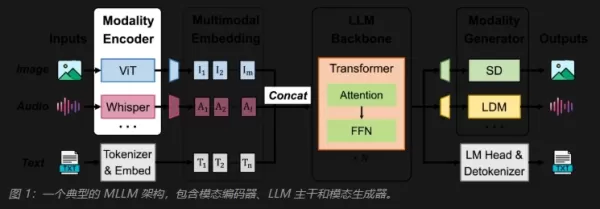
Current industry solutions generally fall into two categories. The first approach prioritizes computational efficiency by decoupling encoders and generators from the LLM pipeline, running them separately. This prevents fluctuations in modal module duration from creating bubbles in the LLM pipeline, but it causes activation memory to scale with the number of microbatches, leading to high costs at scale. The second approach focuses on memory efficiency by keeping all modules within the same pipeline, which shortens activation lifecycles and reduces memory usage. However, if any encoder or generator is slow, the entire LLM pipeline stalls, resulting in tail bubbles. As model scale increases, both designs reveal critical bottlenecks.
BigMac addresses this challenge with a straightforward yet pivotal principle: the core LLM pipeline remains the primary focus. Large-scale LLM training already relies on mature scheduling strategies like 1F1B or interleaved 1F1B, which are deeply integrated into production-grade training stacks. Rather than replacing these established methods, BigMac uses the LLM schedule as its underlying timeline, strategically inserting encoder and generator computations when inputs are ready and without disrupting the LLM execution order. The team refers to this architecture as a "quasi-dependency-safe nested pipeline."
This design delivers two key advantages. First, fluctuations in encoder and generator duration no longer propagate through the LLM pipeline, allowing the LLM to maintain its optimal pace. Second, memory requirements for modal activations are reduced to O(1) at the algorithmic level. Encoders no longer need to retain activations for all microbatches until the pipeline concludes, and generators avoid extending long activation tails. Essentially, BigMac does not trade memory for performance bubbles; instead, it restructures the scheduling logic to make these two objectives compatible rather than mutually exclusive.
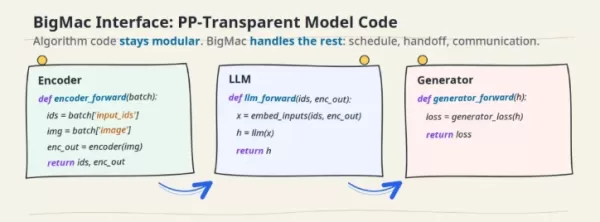
Bridging the gap between schedule design and actual execution involves significant engineering hurdles, including system integration, interface definition, and performance debugging. BigMac is engineered to address these specific challenges by providing three core capabilities. First, it makes the global schedule transparent: the scheduler generates a comprehensive operator table covering all pipeline ranks, microbatches, and module types at runtime. The executor then distributes these into local sequences for each rank, integrating seamlessly with LLM backends like Megatron Core, modal runtimes, and communication layers. This visibility allows for easier checking and backend optimization.
Second, BigMac offers a pipeline parallel interface that remains invisible to algorithm engineers. Users only need to define what each module produces and consumes; the system handles stage division, activation and gradient handoff, and cross-device communication internally. This allows multi-modal experiments verified on a single GPU to scale naturally to pipeline parallelism. Third, it provides a suite of profiling, simulation, and visualization tools. These tools break down training iterations to the operator level, revealing exactly what each rank is doing at every time step, identifying idle periods, and highlighting dependency bottlenecks. The simulator also allows teams to test various PP configurations and microbatch combinations before committing to full-scale training, estimating their impact on bubbles and throughput.
The effectiveness of BigMac has been validated across two representative workloads. In MLLM-Understanding tasks, using Qwen3-30B-A3B as the backbone and a 1.3B ViT encoder, BigMac achieves a 1.08x to 1.1x speedup compared to the computationally efficient baseline Optimus, and a 1.6x to 1.9x speedup over the memory-efficient baseline Megatron-DistTrain. Crucially, memory usage remains stable as the per-GPU batch size increases, whereas Optimus experiences peak memory surges that eventually lead to Out-of-Memory (OOM) errors at larger batches. MLLM-Generation tasks are more complex, involving a 20B MMDiT generator, where the performance gap widens further: Optimus fails across all tested batch sizes due to OOM, while BigMac avoids this by efficiently executing the generator backward and rapidly releasing activations. Compared to Megatron-DistTrain, BigMac still delivers a 1.5x to 1.9x speedup with stable memory usage. This highlights the primary value of nested pipelines: serving both encoder and generator dependencies without excessive activation retention or significant idle time.
BigMac is now a core component of Dots’ multi-modal model training infrastructure and operates within Xiaohongshu’s production environment. The accompanying paper, "BigMac: Breaking the Pareto Frontier of Compute and Memory in Multimodal LLM Training," is available on arXiv, along with interactive PP Profiler trace examples. For researchers and engineers struggling with the memory-speed trade-off in multi-modal training, this production-validated open-source project offers a practical solution that saves significant time and effort.
Related article
 Google Tests Remy AI Agent for Gemini as Focus Shifts to User Control
According to Business Insider, Google is testing Remy, a new AI personal agent for Gemini. This tool aims to execute tasks on behalf of users, streamlining both professional workflows and daily routines.Currently, Remy is undergoing testing in an int
How to fix Core Web Vitals for better SEO rankings
Streamline Report Card Comments with AI ToolsIntroductionAI Tools for Generating Report Card CommentsMagic SchoolAlmanac AIChat GPTUsing Magic School to Generate Report Card CommentsLogging into Magic SchoolSelecting the Report Card Comments ToolCust
Slackbot Becomes an AI Agent
Slackbot, the automated assistant embedded in Salesforce’s corporate messaging platform Slack, is evolving into an AI agent. Salesforce CTO Parker Harris envisions it achieving viral status comparable to OpenAI’s ChatGPT.The cloud software giant laun
Related Special Topic Recommendations
writing
Google Tests Remy AI Agent for Gemini as Focus Shifts to User Control
According to Business Insider, Google is testing Remy, a new AI personal agent for Gemini. This tool aims to execute tasks on behalf of users, streamlining both professional workflows and daily routines.Currently, Remy is undergoing testing in an int
How to fix Core Web Vitals for better SEO rankings
Streamline Report Card Comments with AI ToolsIntroductionAI Tools for Generating Report Card CommentsMagic SchoolAlmanac AIChat GPTUsing Magic School to Generate Report Card CommentsLogging into Magic SchoolSelecting the Report Card Comments ToolCust
Slackbot Becomes an AI Agent
Slackbot, the automated assistant embedded in Salesforce’s corporate messaging platform Slack, is evolving into an AI agent. Salesforce CTO Parker Harris envisions it achieving viral status comparable to OpenAI’s ChatGPT.The cloud software giant laun
Related Special Topic Recommendations
writing
 Best AI Outline Generators for Long-Form SEO Articles
2026 Latest Best Top-Rated AI Outline Generators for Long-Form SEO Articles, meticulously curated by XIX.AI. These powerful tools offer game-changing assistance in creating high-quality content quickly, boosting writing efficiency significantly. Get a free vs paid comparison along with real-world tests and detailed rankings to help you find the must-try option that suits your needs. Explore now to unlock your AI edge.
 8 tools
 xix.ai
Education and Learning
AI Study Tools for Homework and Exam Prep
xix.ai
Education and Learning
AI Study Tools for Homework and Exam Prep
2026 Latest Best AI Study Tools for Homework and Exam Prep! XIX.AI curates a top-rated list of powerful, game-changing tools that help students boost productivity, streamline homework completion, and ace exams through real-world tests. Get a free vs paid comparison, detailed rankings, and must-try options to unlock your AI edge. Explore now!
10 tools
xix.ai
Music composition
AI Vocal Demo Tools for Songwriters, Hooks, Toplines, and Multilingual Draft Sessions
2026 Latest Best AI Vocal Demo Tools for Songwriters, Hook Creators, and Multi-Language Content Teams! XIX.AI has curated a top-rated list of powerful game-changing tools that go through rigorous real-world tests. You’ll find detailed free vs paid comparison data, comprehensive rankings, and must-try options to help you boost writing efficiency and unlock your creative potential. Explore now to discover your perfect tool for all your content needs!
9 tools
xix.ai
Business
Best AI Competitive Research Tools for Small Businesses
2026 Latest Best Top-rated AI Competitive Research Tools for Small Businesses! XIX.AI has curated a highly powerful game-changing collection, updated weekly with rigorous real-world tests and detailed rankings. You can find a comprehensive free vs paid comparison to help you identify the must-try tools that boost your productivity and give you a competitive edge. Explore now to discover your perfect tool!
9 tools
xix.ai
Image editing
Photoshop AI Retouch Tools for Ecommerce Apparel, Skin Cleanup, and Color Consistency
2026 Latest Best Photoshop AI retouch tools for ecommerce apparel, skin cleanup, and color consistency! This top-rated curated list features powerful game-changing solutions that help you boost writing efficiency, streamline content creation, and achieve perfect visual results effortlessly. Each tool has undergone real-world tests through weekly updated rankings, complete with free vs paid comparison details. Backed by XIX.AI, it’s the must-try guide for anyone aiming to unlock your AI edge. Explore now!
10 tools
xix.ai
Prompt
Best AI Prompt Libraries for ChatGPT Workflows
2026 Latest Best Top-Rated AI Prompt Libraries for optimizing all types of ChatGPT workflows. XIX.AI has curated a powerful, game-changing collection that goes through rigorous real-world tests to ensure top performance. You can find detailed free vs paid comparisons and expert rankings to help you choose the must-try tools that boost your productivity and unlock your AI edge. Explore now!
11 tools
xix.ai

 Comments (10)
0/500
Comments (10)
0/500
![JackMartinez]()
¿BigMac? Suena a que viene con mucho contenido. 😂 Resolver la tensión entre memoria y velocidad es clave en IA actual. Si logran mantener la precisión sin consumir tantos recursos, será un hito importante. Ojalá los benchmarks sean sólidos.
![AlbertThomas]()
O nome BigMac é hilário, mas a proposta é séria! Resolver o trade-off entre memória e velocidade é crucial para modelos multimodais. Se funcionar como prometem, facilita muito a vida de quem treina modelos grandes. Aguardando os resultados práticos!
![BillyAnderson]()
Interessanter Ansatz! Die Balance zwischen Speicherbedarf und Trainingsgeschwindigkeit ist oft der Engpass. Wenn BigMac hier wirklich einen Unterschied macht, wäre das ein echter Fortschritt für die Community. Mal sehen, wie sich die Zahlen im Live-Betrieb verhalten.
![WillieAnderson]()
빅맥이라는 이름이 참 신기하네요. 다중 모달 학습에서 메모리와 속도의 균형을 맞추는 건 정말 어려운 과제인데, Xiaohongshu가 해냈다면 큰 의미가 있을 것 같습니다. 성능 테스트 결과가 기대됩니다!
![BillyYoung]()
Наконец-то кто-то решает проблему памяти в мультимодальных моделях. BigMac звучит как мощное решение. Надеюсь, это не просто маркетинг, а реальный прорыв в инфраструктуре обучения. Ждем тестов! 🚀
![JoseAdams]()
C'est une avancée intéressante. Le compromis entre vitesse et mémoire est souvent un frein dans notre domaine. Si BigMac parvient à l'optimiser sans perdre en précision, ça pourrait démocratiser l'entraînement multimodal. À suivre de près !
Multi-modal large language models are emerging as the cornerstone of next-generation AI, yet their training infrastructure has long been hindered by a persistent trade-off: systems optimized for speed often struggle with memory constraints, while those prioritizing memory efficiency tend to be slow. The Dots Infra team at Xiaohongshu identifies this bottleneck as the Pareto frontier of multi-modal pipeline training and has now broken through it. On July 22, the team open-sourced BigMac, a novel pipeline parallel training paradigm designed specifically for native multi-modal scenarios. The project is now available on GitHub under the Dots-Infra repository.
Unlike standard transformers, multi-modal models are inherently complex. A typical Multi-modal Large Language Model (MLLM) comprises three distinct components: modal encoders that convert images and audio into embeddings, an LLM backbone for inference, and a generator that maps LLM outputs back to target modalities such as images or speech. The significant structural differences between these components create substantial challenges when integrating them into a single training pipeline.
Current industry solutions generally fall into two categories. The first approach prioritizes computational efficiency by decoupling encoders and generators from the LLM pipeline, running them separately. This prevents fluctuations in modal module duration from creating bubbles in the LLM pipeline, but it causes activation memory to scale with the number of microbatches, leading to high costs at scale. The second approach focuses on memory efficiency by keeping all modules within the same pipeline, which shortens activation lifecycles and reduces memory usage. However, if any encoder or generator is slow, the entire LLM pipeline stalls, resulting in tail bubbles. As model scale increases, both designs reveal critical bottlenecks.
BigMac addresses this challenge with a straightforward yet pivotal principle: the core LLM pipeline remains the primary focus. Large-scale LLM training already relies on mature scheduling strategies like 1F1B or interleaved 1F1B, which are deeply integrated into production-grade training stacks. Rather than replacing these established methods, BigMac uses the LLM schedule as its underlying timeline, strategically inserting encoder and generator computations when inputs are ready and without disrupting the LLM execution order. The team refers to this architecture as a "quasi-dependency-safe nested pipeline."
This design delivers two key advantages. First, fluctuations in encoder and generator duration no longer propagate through the LLM pipeline, allowing the LLM to maintain its optimal pace. Second, memory requirements for modal activations are reduced to O(1) at the algorithmic level. Encoders no longer need to retain activations for all microbatches until the pipeline concludes, and generators avoid extending long activation tails. Essentially, BigMac does not trade memory for performance bubbles; instead, it restructures the scheduling logic to make these two objectives compatible rather than mutually exclusive.
Bridging the gap between schedule design and actual execution involves significant engineering hurdles, including system integration, interface definition, and performance debugging. BigMac is engineered to address these specific challenges by providing three core capabilities. First, it makes the global schedule transparent: the scheduler generates a comprehensive operator table covering all pipeline ranks, microbatches, and module types at runtime. The executor then distributes these into local sequences for each rank, integrating seamlessly with LLM backends like Megatron Core, modal runtimes, and communication layers. This visibility allows for easier checking and backend optimization.
Second, BigMac offers a pipeline parallel interface that remains invisible to algorithm engineers. Users only need to define what each module produces and consumes; the system handles stage division, activation and gradient handoff, and cross-device communication internally. This allows multi-modal experiments verified on a single GPU to scale naturally to pipeline parallelism. Third, it provides a suite of profiling, simulation, and visualization tools. These tools break down training iterations to the operator level, revealing exactly what each rank is doing at every time step, identifying idle periods, and highlighting dependency bottlenecks. The simulator also allows teams to test various PP configurations and microbatch combinations before committing to full-scale training, estimating their impact on bubbles and throughput.
The effectiveness of BigMac has been validated across two representative workloads. In MLLM-Understanding tasks, using Qwen3-30B-A3B as the backbone and a 1.3B ViT encoder, BigMac achieves a 1.08x to 1.1x speedup compared to the computationally efficient baseline Optimus, and a 1.6x to 1.9x speedup over the memory-efficient baseline Megatron-DistTrain. Crucially, memory usage remains stable as the per-GPU batch size increases, whereas Optimus experiences peak memory surges that eventually lead to Out-of-Memory (OOM) errors at larger batches. MLLM-Generation tasks are more complex, involving a 20B MMDiT generator, where the performance gap widens further: Optimus fails across all tested batch sizes due to OOM, while BigMac avoids this by efficiently executing the generator backward and rapidly releasing activations. Compared to Megatron-DistTrain, BigMac still delivers a 1.5x to 1.9x speedup with stable memory usage. This highlights the primary value of nested pipelines: serving both encoder and generator dependencies without excessive activation retention or significant idle time.
BigMac is now a core component of Dots’ multi-modal model training infrastructure and operates within Xiaohongshu’s production environment. The accompanying paper, "BigMac: Breaking the Pareto Frontier of Compute and Memory in Multimodal LLM Training," is available on arXiv, along with interactive PP Profiler trace examples. For researchers and engineers struggling with the memory-speed trade-off in multi-modal training, this production-validated open-source project offers a practical solution that saves significant time and effort.







 Google Tests Remy AI Agent for Gemini as Focus Shifts to User Control
According to Business Insider, Google is testing Remy, a new AI personal agent for Gemini. This tool aims to execute tasks on behalf of users, streamlining both professional workflows and daily routines.Currently, Remy is undergoing testing in an int
Google Tests Remy AI Agent for Gemini as Focus Shifts to User Control
According to Business Insider, Google is testing Remy, a new AI personal agent for Gemini. This tool aims to execute tasks on behalf of users, streamlining both professional workflows and daily routines.Currently, Remy is undergoing testing in an int
 How to fix Core Web Vitals for better SEO rankings
Streamline Report Card Comments with AI ToolsIntroductionAI Tools for Generating Report Card CommentsMagic SchoolAlmanac AIChat GPTUsing Magic School to Generate Report Card CommentsLogging into Magic SchoolSelecting the Report Card Comments ToolCust
How to fix Core Web Vitals for better SEO rankings
Streamline Report Card Comments with AI ToolsIntroductionAI Tools for Generating Report Card CommentsMagic SchoolAlmanac AIChat GPTUsing Magic School to Generate Report Card CommentsLogging into Magic SchoolSelecting the Report Card Comments ToolCust
 Slackbot Becomes an AI Agent
Slackbot, the automated assistant embedded in Salesforce’s corporate messaging platform Slack, is evolving into an AI agent. Salesforce CTO Parker Harris envisions it achieving viral status comparable to OpenAI’s ChatGPT.The cloud software giant laun
Slackbot Becomes an AI Agent
Slackbot, the automated assistant embedded in Salesforce’s corporate messaging platform Slack, is evolving into an AI agent. Salesforce CTO Parker Harris envisions it achieving viral status comparable to OpenAI’s ChatGPT.The cloud software giant laun

2026 Latest Best Top-Rated AI Outline Generators for Long-Form SEO Articles, meticulously curated by XIX.AI. These powerful tools offer game-changing assistance in creating high-quality content quickly, boosting writing efficiency significantly. Get a free vs paid comparison along with real-world tests and detailed rankings to help you find the must-try option that suits your needs. Explore now to unlock your AI edge.
8 tools
xix.ai

2026 Latest Best AI Study Tools for Homework and Exam Prep! XIX.AI curates a top-rated list of powerful, game-changing tools that help students boost productivity, streamline homework completion, and ace exams through real-world tests. Get a free vs paid comparison, detailed rankings, and must-try options to unlock your AI edge. Explore now!
10 tools
xix.ai

2026 Latest Best AI Vocal Demo Tools for Songwriters, Hook Creators, and Multi-Language Content Teams! XIX.AI has curated a top-rated list of powerful game-changing tools that go through rigorous real-world tests. You’ll find detailed free vs paid comparison data, comprehensive rankings, and must-try options to help you boost writing efficiency and unlock your creative potential. Explore now to discover your perfect tool for all your content needs!
9 tools
xix.ai

2026 Latest Best Top-rated AI Competitive Research Tools for Small Businesses! XIX.AI has curated a highly powerful game-changing collection, updated weekly with rigorous real-world tests and detailed rankings. You can find a comprehensive free vs paid comparison to help you identify the must-try tools that boost your productivity and give you a competitive edge. Explore now to discover your perfect tool!
9 tools
xix.ai

2026 Latest Best Photoshop AI retouch tools for ecommerce apparel, skin cleanup, and color consistency! This top-rated curated list features powerful game-changing solutions that help you boost writing efficiency, streamline content creation, and achieve perfect visual results effortlessly. Each tool has undergone real-world tests through weekly updated rankings, complete with free vs paid comparison details. Backed by XIX.AI, it’s the must-try guide for anyone aiming to unlock your AI edge. Explore now!
10 tools
xix.ai
2026 Latest Best Top-Rated AI Prompt Libraries for optimizing all types of ChatGPT workflows. XIX.AI has curated a powerful, game-changing collection that goes through rigorous real-world tests to ensure top performance. You can find detailed free vs paid comparisons and expert rankings to help you choose the must-try tools that boost your productivity and unlock your AI edge. Explore now!
11 tools
xix.ai

¿BigMac? Suena a que viene con mucho contenido. 😂 Resolver la tensión entre memoria y velocidad es clave en IA actual. Si logran mantener la precisión sin consumir tantos recursos, será un hito importante. Ojalá los benchmarks sean sólidos.
O nome BigMac é hilário, mas a proposta é séria! Resolver o trade-off entre memória e velocidade é crucial para modelos multimodais. Se funcionar como prometem, facilita muito a vida de quem treina modelos grandes. Aguardando os resultados práticos!
Interessanter Ansatz! Die Balance zwischen Speicherbedarf und Trainingsgeschwindigkeit ist oft der Engpass. Wenn BigMac hier wirklich einen Unterschied macht, wäre das ein echter Fortschritt für die Community. Mal sehen, wie sich die Zahlen im Live-Betrieb verhalten.
빅맥이라는 이름이 참 신기하네요. 다중 모달 학습에서 메모리와 속도의 균형을 맞추는 건 정말 어려운 과제인데, Xiaohongshu가 해냈다면 큰 의미가 있을 것 같습니다. 성능 테스트 결과가 기대됩니다!
Наконец-то кто-то решает проблему памяти в мультимодальных моделях. BigMac звучит как мощное решение. Надеюсь, это не просто маркетинг, а реальный прорыв в инфраструктуре обучения. Ждем тестов! 🚀
C'est une avancée intéressante. Le compromis entre vitesse et mémoire est souvent un frein dans notre domaine. Si BigMac parvient à l'optimiser sans perdre en précision, ça pourrait démocratiser l'entraînement multimodal. À suivre de près !












