


 Home
HomeGemini's Nano Banana Editor Sees Surging User Adoption
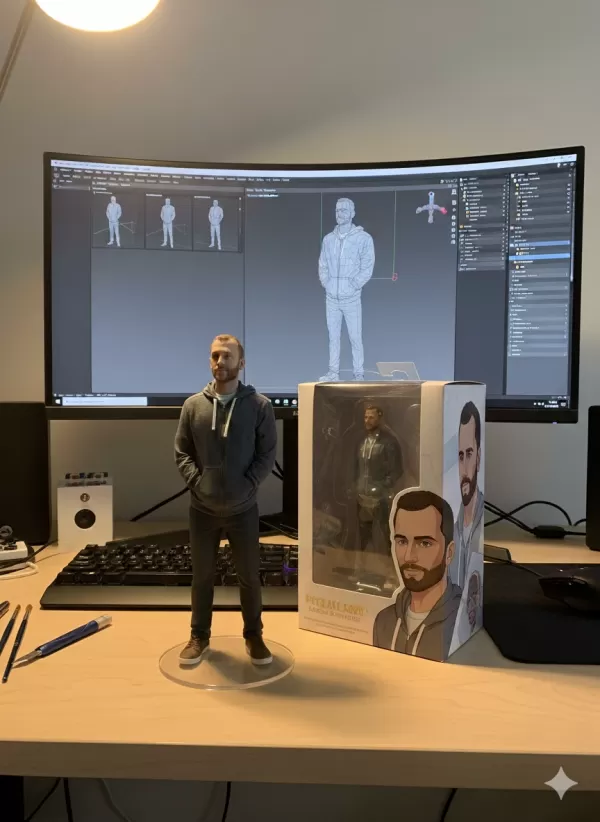
Google Gemini is stepping out from the shadow of ChatGPT, largely thanks to its Nano Banana image editor and the popular trend of creating lifelike AI-generated figurines.
Google introduced Nano Banana at the end of August, promoting it as a tool to “transform images in remarkable new ways” directly inside the Gemini app. To create the “perfect picture,” you simply upload an image into Gemini and “describe what you want to change,” as the company explained. Google’s recommendations include giving your home a makeover, styling your hair in a ‘60s beehive, dressing your chihuahua in a tutu, or previewing how you might look with more wrinkles in a decade. You can even blend different photos and generate a “fun video” of your imagined scenario by re-submitting the edited image to Gemini.
On X, Josh Woodward, Google Labs vice president and head of Gemini, shared that the Gemini app had gained 23 million new users in the two weeks following the editor’s debut. Over the same period, he reported that 500 million images had been transformed using the tool.
This rapid growth has helped Gemini climb to the top of app store rankings worldwide. As of this writing, Gemini is the number one iPhone app on Apple’s App Store in the United States, United Kingdom, Canada, France, Australia, Germany, and Italy. In many of these countries, it overtook OpenAI’s ChatGPT, which is now ranked second.
On September 11, Woodward noted that “India has discovered” the image editor and later announced that Google would need to impose “temporary usage limits” to handle overwhelming demand. He described the response as a “full-on stampede” and credited the Gemini team for performing “heroics” to maintain system stability.
What’s behind the surge in popularity? While a range of editing options have gained traction, the standout feature of Nano Banana lets users turn themselves—or their pets—into 3D figurines. You only need to upload a photo into Gemini and enter a detailed prompt to receive a miniature doll version of yourself, posed on a desktop. The figurine often arrives with a display box and is set against a computer screen showing a wireframe model supposedly used in its creation. Though the required prompt is detailed, copy-and-paste versions have been widely shared online. Google has even supplied its own example prompts to fuel the trend.
After experimenting with Nano Banana, it’s not hard to see why Google is having a viral AI moment. The image editor is straightforward and convenient to use within the Gemini app. It’s also fast, avoiding the long wait times that have made other tools like ChatGPT less appealing. That said, it’s not without its flaws. Similar to other image apps, the output doesn’t always match expectations, and Gemini occasionally disregards instructions entirely, returning the original image unaltered.
Despite these hiccups, one feature of Nano Banana impressed me enough to believe it deserves the attention—and will likely inspire more viral trends until a new model comes along: the images it produces still look like me. While many AI editors tend to alter facial features and produce unsettling replicas, Google’s Nano Banana quickly generated a cute desktop doll that remained unmistakably recognizable as myself.
Related article
 Google AI Overviews Gain Ground in Search Results
According to Similarweb’s 2026 Generative AI Landscape report, Google’s AI-generated summaries appeared in 43% of US searches, a significant rise from 15% recorded a year prior.While AI Overviews present generated summaries within standard search res
Sequoia-backed Empirik raises $21M to forecast outages before they strike
Before joining Sequoia Capital in 2020 as chief digital and information officer, Avon Puri spent over a decade running infrastructure at Rubrik and VMware. Three years ago, as large language models began showing their true potential, Puri, alongside
ElevenLabs brings on BlackRock, Jamie Foxx and Longoria as new investors
ElevenLabs, a leader in Voice AI, has announced new participants in its $500 million Series D funding round, initially revealed in February. The investor roster now features major institutions like BlackRock, Wellington, D.E. Shaw, and Schroders, alo
Related Special Topic Recommendations
Design & Art
Google AI Overviews Gain Ground in Search Results
According to Similarweb’s 2026 Generative AI Landscape report, Google’s AI-generated summaries appeared in 43% of US searches, a significant rise from 15% recorded a year prior.While AI Overviews present generated summaries within standard search res
Sequoia-backed Empirik raises $21M to forecast outages before they strike
Before joining Sequoia Capital in 2020 as chief digital and information officer, Avon Puri spent over a decade running infrastructure at Rubrik and VMware. Three years ago, as large language models began showing their true potential, Puri, alongside
ElevenLabs brings on BlackRock, Jamie Foxx and Longoria as new investors
ElevenLabs, a leader in Voice AI, has announced new participants in its $500 million Series D funding round, initially revealed in February. The investor roster now features major institutions like BlackRock, Wellington, D.E. Shaw, and Schroders, alo
Related Special Topic Recommendations
Design & Art
 Top AI Illustration Tools: Create Editorial Scenes and Cover Art Faster
2026 Latest Top-rated AI Illustration Tools: Our curated list features the best powerfully designed tools for creating stunning editorial scenes and eye-catching cover art quickly. Each option has gone through rigorous real-world tests, offering a free vs paid comparison to help you find the perfect match for your workflow. Try these must-try solutions today to unlock your AI edge and boost your creative productivity. Explore now at XIX.AI.
 10 tools
 xix.ai
Education and Learning
Top AI Tutors for Exam Prep: Practice Math, Science, and English
xix.ai
Education and Learning
Top AI Tutors for Exam Prep: Practice Math, Science, and English
2026 Latest Top-Rated Best AI Tutors for Exam Prep are here on XIX.AI! Our curated list features powerful game-changing tools that offer free vs paid comparison, real-world tests, and weekly updated rankings. They help boost your writing efficiency, simplify complex topic learning, and unlock your academic potential. Explore now to Discover your perfect exam prep tool and Start creating today to Unlock your AI edge!
10 tools
xix.ai
Finance
AI Budget Planning Tools for Personal Money Management
2026 Latest Best Top-Rated AI Budget Planning Tools for Personal Money Management are here on XIX.AI! This curated collection features powerful, game-changing solutions that help you conduct real-world tests, understand spending habits, and create personalized plans to boost productivity. Enjoy a free vs paid comparison along with detailed rankings. Must-try tools designed to simplify money management and unlock your AI edge. Explore now!
11 tools
xix.ai
Health & Wellness
AI Sleep Tracking Assistants: Improve Recovery with Better Bedtime Habits
2026 Latest Best Top-Rated AI Sleep Tracking Assistants curated for ultimate recovery. This fully updated weekly guide features powerful tools that deliver real-world tests, free vs paid comparison, and detailed rankings to help you find the must-try solution that boosts sleep quality and supports better bedtime habits. Explore now at XIX.AI to Unlock your AI edge.
10 tools
xix.ai
Data Analysis
AI SQL Copilots for Product and Revenue Analytics
2026 Latest Best Top-Rated AI SQL Copilots for Product and Revenue Analytics! XIX.AI has curated a powerful, game-changing collection of must-try tools that undergo real-world tests through weekly updated rankings. These tools help users boost productivity significantly by accelerating data analysis, streamlining complex queries, and generating accurate insights to drive smarter business decisions. Explore now to Discover your perfect tool for unlocking your AI edge!
14 tools
xix.ai
Education and Learning
Best AI Homework Helpers That Teach: Learn Concepts, Not Just Answers
2026 Latest Best Top-Rated AI Homework Helpers That Teach Core Concepts Not Just Answers Powerful Tools for Students Must-Try Curated List Weekly Updated Free vs Paid Comparison Real-World Tests Accurate Rankings to Help You Unlock Your Full Learning Potential Explore now to Discover your perfect tool for smarter studying.
10 tools
xix.ai

 Comments (0)
0/500
Comments (0)
0/500
Google Gemini is stepping out from the shadow of ChatGPT, largely thanks to its Nano Banana image editor and the popular trend of creating lifelike AI-generated figurines.
Google introduced Nano Banana at the end of August, promoting it as a tool to “transform images in remarkable new ways” directly inside the Gemini app. To create the “perfect picture,” you simply upload an image into Gemini and “describe what you want to change,” as the company explained. Google’s recommendations include giving your home a makeover, styling your hair in a ‘60s beehive, dressing your chihuahua in a tutu, or previewing how you might look with more wrinkles in a decade. You can even blend different photos and generate a “fun video” of your imagined scenario by re-submitting the edited image to Gemini.
On X, Josh Woodward, Google Labs vice president and head of Gemini, shared that the Gemini app had gained 23 million new users in the two weeks following the editor’s debut. Over the same period, he reported that 500 million images had been transformed using the tool.
This rapid growth has helped Gemini climb to the top of app store rankings worldwide. As of this writing, Gemini is the number one iPhone app on Apple’s App Store in the United States, United Kingdom, Canada, France, Australia, Germany, and Italy. In many of these countries, it overtook OpenAI’s ChatGPT, which is now ranked second.
On September 11, Woodward noted that “India has discovered” the image editor and later announced that Google would need to impose “temporary usage limits” to handle overwhelming demand. He described the response as a “full-on stampede” and credited the Gemini team for performing “heroics” to maintain system stability.
What’s behind the surge in popularity? While a range of editing options have gained traction, the standout feature of Nano Banana lets users turn themselves—or their pets—into 3D figurines. You only need to upload a photo into Gemini and enter a detailed prompt to receive a miniature doll version of yourself, posed on a desktop. The figurine often arrives with a display box and is set against a computer screen showing a wireframe model supposedly used in its creation. Though the required prompt is detailed, copy-and-paste versions have been widely shared online. Google has even supplied its own example prompts to fuel the trend.
After experimenting with Nano Banana, it’s not hard to see why Google is having a viral AI moment. The image editor is straightforward and convenient to use within the Gemini app. It’s also fast, avoiding the long wait times that have made other tools like ChatGPT less appealing. That said, it’s not without its flaws. Similar to other image apps, the output doesn’t always match expectations, and Gemini occasionally disregards instructions entirely, returning the original image unaltered.
Despite these hiccups, one feature of Nano Banana impressed me enough to believe it deserves the attention—and will likely inspire more viral trends until a new model comes along: the images it produces still look like me. While many AI editors tend to alter facial features and produce unsettling replicas, Google’s Nano Banana quickly generated a cute desktop doll that remained unmistakably recognizable as myself.








 Google AI Overviews Gain Ground in Search Results
According to Similarweb’s 2026 Generative AI Landscape report, Google’s AI-generated summaries appeared in 43% of US searches, a significant rise from 15% recorded a year prior.While AI Overviews present generated summaries within standard search res
Google AI Overviews Gain Ground in Search Results
According to Similarweb’s 2026 Generative AI Landscape report, Google’s AI-generated summaries appeared in 43% of US searches, a significant rise from 15% recorded a year prior.While AI Overviews present generated summaries within standard search res
 Sequoia-backed Empirik raises $21M to forecast outages before they strike
Before joining Sequoia Capital in 2020 as chief digital and information officer, Avon Puri spent over a decade running infrastructure at Rubrik and VMware. Three years ago, as large language models began showing their true potential, Puri, alongside
Sequoia-backed Empirik raises $21M to forecast outages before they strike
Before joining Sequoia Capital in 2020 as chief digital and information officer, Avon Puri spent over a decade running infrastructure at Rubrik and VMware. Three years ago, as large language models began showing their true potential, Puri, alongside
 ElevenLabs brings on BlackRock, Jamie Foxx and Longoria as new investors
ElevenLabs, a leader in Voice AI, has announced new participants in its $500 million Series D funding round, initially revealed in February. The investor roster now features major institutions like BlackRock, Wellington, D.E. Shaw, and Schroders, alo
ElevenLabs brings on BlackRock, Jamie Foxx and Longoria as new investors
ElevenLabs, a leader in Voice AI, has announced new participants in its $500 million Series D funding round, initially revealed in February. The investor roster now features major institutions like BlackRock, Wellington, D.E. Shaw, and Schroders, alo

2026 Latest Top-rated AI Illustration Tools: Our curated list features the best powerfully designed tools for creating stunning editorial scenes and eye-catching cover art quickly. Each option has gone through rigorous real-world tests, offering a free vs paid comparison to help you find the perfect match for your workflow. Try these must-try solutions today to unlock your AI edge and boost your creative productivity. Explore now at XIX.AI.
10 tools
xix.ai

2026 Latest Top-Rated Best AI Tutors for Exam Prep are here on XIX.AI! Our curated list features powerful game-changing tools that offer free vs paid comparison, real-world tests, and weekly updated rankings. They help boost your writing efficiency, simplify complex topic learning, and unlock your academic potential. Explore now to Discover your perfect exam prep tool and Start creating today to Unlock your AI edge!
10 tools
xix.ai

2026 Latest Best Top-Rated AI Budget Planning Tools for Personal Money Management are here on XIX.AI! This curated collection features powerful, game-changing solutions that help you conduct real-world tests, understand spending habits, and create personalized plans to boost productivity. Enjoy a free vs paid comparison along with detailed rankings. Must-try tools designed to simplify money management and unlock your AI edge. Explore now!
11 tools
xix.ai

2026 Latest Best Top-Rated AI Sleep Tracking Assistants curated for ultimate recovery. This fully updated weekly guide features powerful tools that deliver real-world tests, free vs paid comparison, and detailed rankings to help you find the must-try solution that boosts sleep quality and supports better bedtime habits. Explore now at XIX.AI to Unlock your AI edge.
10 tools
xix.ai

2026 Latest Best Top-Rated AI SQL Copilots for Product and Revenue Analytics! XIX.AI has curated a powerful, game-changing collection of must-try tools that undergo real-world tests through weekly updated rankings. These tools help users boost productivity significantly by accelerating data analysis, streamlining complex queries, and generating accurate insights to drive smarter business decisions. Explore now to Discover your perfect tool for unlocking your AI edge!
14 tools
xix.ai

2026 Latest Best Top-Rated AI Homework Helpers That Teach Core Concepts Not Just Answers Powerful Tools for Students Must-Try Curated List Weekly Updated Free vs Paid Comparison Real-World Tests Accurate Rankings to Help You Unlock Your Full Learning Potential Explore now to Discover your perfect tool for smarter studying.
10 tools
xix.ai












