


 Home
HomeWhat is AI disruption in 2026? Machine learning & deep learning innovations.
Artificial Intelligence (AI) is fundamentally reshaping our world, with Machine Learning (ML) and Deep Learning (DL) serving as its foundational pillars. These are no longer abstract, futuristic ideas but are actively powering innovation across a multitude of industries. This article explores the profound potential of AI, ML, and DL, examining their advanced applications and the promising career paths available in this fast-paced sector. We will also cover the core concepts of these technologies and provide guidance on how to launch a successful career in AI.
Key Points
The AI Disruption: Artificial Intelligence and its specialized fields, Machine Learning and Deep Learning, are fundamentally changing entire industries.
Machine Learning in Action: ML algorithms allow computers to learn directly from data, eliminating the need for rigid programming and enabling groundbreaking innovation.
The Power of Deep Learning: DL, modeled after the human brain's neural networks, achieves superior performance in complex tasks like image and speech recognition.
Career Pathways: The fields of AI, ML, and Data Science offer a wide array of fulfilling career options, such as data scientist and AI consultant.
Learning by Doing: Gaining hands-on experience through coding exercises and real-world projects is essential for truly mastering these technologies.
Generative AI: Understand the game-changing capabilities of Generative Adversarial Networks (GANs) within the AI landscape.
Optimization with RL: Reinforcement Learning (RL) is used to enhance decision-making processes in areas like robotics, gaming, and autonomous vehicles.
Unlocking Text Data: Text Mining and Natural Language Processing (NLP) are crucial for extracting meaningful insights from vast amounts of text.
Deep Learning Frameworks: Utilize powerful frameworks like TensorFlow to implement deep learning solutions for challenging problems.
Cons
tant Advancement: The AI field is in a state of perpetual evolution, demanding ongoing education and adaptation from professionals.AI: The Disruptive Force
The AI Revolution: Machine Learning and Deep Learning Defined
The AI revolution is well underway.

What was once confined to science fiction is now a tangible force, revolutionizing industries and creating opportunities that were previously unimaginable. Central to this transformation are Machine Learning (ML) and Deep Learning (DL), two powerful branches of AI.
Machine learning gives computers the ability to learn from data without relying on explicit, step-by-step instructions. Using sophisticated algorithms, systems can identify patterns, make predictions, and continuously improve their performance. This data-driven approach has unlocked countless applications. Consider algorithms that can forecast customer attrition, tailor product recommendations, or identify fraudulent financial activity—all by learning from historical data.
Deep learning, inspired by the complex structure of the human brain, elevates machine learning to a new level. It employs artificial neural networks with many layers to analyze highly complex data. This architecture allows deep learning models to excel at demanding tasks like image recognition, natural language processing, and speech recognition, achieving levels of accuracy and efficiency previously thought impossible. It is a specialized form of machine learning that uses networks of computational units, or neurons, to process information. The design of these models is directly inspired by the neural networks found in the human brain.
Introduction to CellStrat: Pioneers in AI Education and Innovation
CellStrat is a driving force in India's AI landscape.

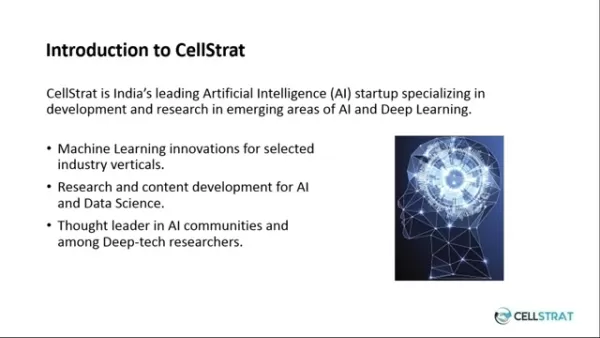
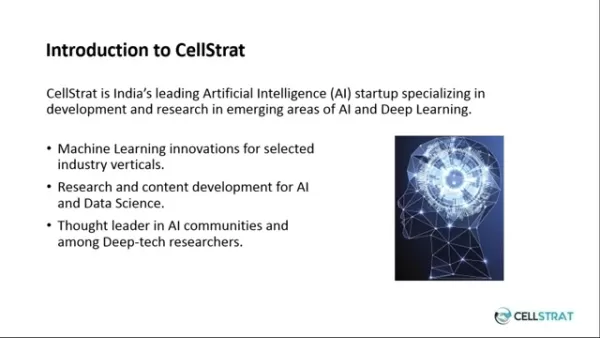
As a premier Artificial Intelligence startup, CellStrat focuses on research and development in cutting-edge areas of AI and Deep Learning. The company is a recognized thought leader within AI communities, regularly publishing research and content on AI, machine learning, and data science. Its mission is to equip individuals and organizations with the knowledge and tools needed to harness the transformative potential of AI through advanced technologies and expert mentorship.
CellStrat's core activities include:
- Developing Machine Learning solutions for specific industry sectors.
- Creating research and educational content for AI and Data Science.
- Establishing thought leadership within AI communities and among deep-tech researchers.
CellStrat is highly active in AI communities and on social media, working on numerous advanced projects in computer vision, NLP, and reinforcement learning. With an AI research lab based in Bengaluru, India, CellStrat shares its expertise with a worldwide audience.
The company offers a range of programs designed to upskill and reskill professionals in AI, machine learning, and data science. These include comprehensive courses tailored for both technical specialists and business leaders.
Revolutionizing Industries with AI Applications
Web & Mobile Banking: AI-Powered Transformation
The banking sector has been profoundly transformed by the integration of AI.
From fundamental online and mobile banking services to advanced intelligent robotic assistants (IRAs), AI is streamlining operations and elevating the customer experience.
This shift from traditional banking to AI-driven automation represents the move from Industry 3.0 to Industry 4.0, delivering significant advantages:
- Superior Customer Service
- Lower operational expenses
- Increased operational efficiency
- Tailored financial guidance
Object Detection in Action: Computer Vision Applications
Object detection is a fundamental technology within AI-powered computer vision.
This capability has countless practical uses, including:
- Driving Assistance and Evaluation: Object detection improves road safety by identifying traffic signs, pedestrians, and other vehicles in real time. It is the backbone of advanced driver-assistance systems (ADAS) and automated driving features.
- Automated Vehicle Damage Assessment: The insurance industry uses AI to assess vehicle damage, rapidly analyzing images of damaged cars to estimate repair costs and accelerate the claims process.
- Retail Traffic Analysis: In the retail sector, object detection is used to monitor vehicle counts in mall parking lots, offering valuable data on customer volume and store performance. It can also track in-store foot traffic to optimize staff allocation and marketing campaigns.
By leveraging computer vision, businesses can automate complex tasks, improve safety protocols, and derive actionable insights from visual information.
These examples demonstrate the adaptability and power of AI in addressing real-world challenges across different sectors.
Summary of Key AI Object Detection Applications
The table below provides a concise overview of the applications discussed:
Application Description Driving Assistance/AssessmentImproves driving safety through real-time object detection, powering ADAS.Vehicle Damage AssessmentAutomates car damage inspection to speed up insurance claim processing.Retail Footfall AnalysisMonitors parking lot vehicle counts and analyzes in-store customer traffic.Generative Modeling: Unleashing Creativity with AI
Generative modeling is an AI discipline that enables machines to produce original content, including images, music, and text. It is revolutionizing creative fields such as fashion, art, and film production. This technology can extract the content from one image and the artistic style from another, synthesizing them to create a completely new image.
Businesses are now employing Generative Adversarial Networks (GANs) to create novel designs for apparel, furniture, and architectural elements. These AI models merge the content of one source with the style of another, yielding unique and inventive results. This facilitates greater customization, accelerates design cycles, and opens up new avenues for artistic innovation.
Effective generative models require both a creative component and a mechanism for evaluating quality. This is often achieved through two competing neural networks—a generator and a discriminator. When this generative capability is integrated into an NLP project or visual creation, the result is content that the neural network perceives as authentic.
Stock Market Prediction: AI Navigating Financial Waters
AI methodologies are increasingly used to forecast stock prices with improved precision.
By analyzing time series data with Recurrent Neural Networks (RNNs), AI can detect underlying patterns and predict future stock values. RNNs are also highly effective for Natural Language Processing tasks like language translation and text mining. For instance, by analyzing the previous 20 days of stock market data, an RNN can forecast the price on the 21st day.
This technology is also applied to other forecasting domains, such as real estate prices, gold prices, and commodity markets. These models are capable of:
- Identifying market trends
- Predicting price volatility
- Supporting data-informed investment strategies
This capability provides a significant edge in the competitive financial markets.
Time Series Data Analysis Feature Description Analysis FrequencyCan be configured for daily, weekly, or monthly intervals depending on data detail. Higher data granularity and accuracy lead to more reliable price forecasts.How AI Models can be Used in a Retail Environment
Transforming Retail Operations: Cashier-less Checkout
Computer vision, powered by deep learning, is a prime example of AI's application in retail. The checkout process can be revolutionized using Object Detection to create a seamless, cashier-less experience.
Implementing this in a store involves several steps:
- Deploy a system utilizing the TensorFlow Object Detection API.
- It is critical to monitor the customer's hand movements to determine which product has been selected from the shelf.
- The system then automatically scans these items as they are placed into the shopping cart. For example, the camera must track the items and correctly identify whether it is a juice or a snack. The identified item is then added to the virtual cart for billing.
- A confidence score is used to ensure the item is identified accurately.
Upskill and Reskill with Machine Learning Courses
How CellStrat is offering Machine Learning and Deep Learning AI Training
CellStrat provides certified programs in Artificial Intelligence with specializations in ML and DL. The company offers extensive courses for both technical professionals and business managers, instructed by seasoned AI scientists and researchers. CellStrat's curriculum includes two main tracks: machine learning and deep learning. The machine learning course is a self-paced video program, affordably priced and available on-demand. The deep learning course, taught live by the instructor on Tuesday and Thursday evenings, is priced at 10,000 INR.

CellStrat also offers a research fellow program for advanced practitioners. In summary, the company provides learning options suitable for all levels of expertise.
Course INR Price Machine Learning Basics Certification Program2500Machine Learning Certification Program4000Deep Learning with TensorFlow (Early Bird)10,000Deep Learning with TensorFlow14,000CellStrat Research Fellow Program20,000Deep Learning Training with Certifications: Weighing the Benefits
Pros
Structured Curriculum: Comprehensive exploration of AI and ML concepts.
Expert Instruction: Learn from leading Data Scientists and AI mentors.
Practical Experience: Develop hands-on skills with real AI projects.
Cons
Time Investment: Earning certifications requires a commitment to attending live sessions.
Technical Prerequisites: A basic understanding of programming can facilitate a smoother learning curve.
Financial Outlay: The combined cost of course materials, certification fees, and tests should be considered.
CellStrat: Core Features of the Product
CellStrat: Product Features that Stand Out
CellStrat distinguishes itself from competitors through several key product attributes:
- Recognized as India's leading AI Startup, a status earned through their deep domain expertise.
- The courses deliver specialized Machine Learning innovations for targeted industries. The presenter also highlighted their work in creating AI and Data Science content and conducting research in these fields.
- The company is regarded as a thought leader and a hub for deep-tech researchers.
Use Case
Who is the target Customer?
Based on the presentation, the primary audience for CellStrat's offerings includes:
- IT professionals seeking to transition into a career in Artificial Intelligence.
- Recent graduates aiming to build a career in Machine Learning.
- Students interested in gaining foundational knowledge in Machine Learning.
- Established professionals looking to integrate AI and machine learning into business growth strategies.
Frequently Asked Questions about Machine Learning and Deep Learning
How are Deep Learning and Neural Networks similar?
Deep learning is a specific type of machine learning. Consequently, they share a foundational methodology. Deep learning is built upon neural networks. The system must be trained to comprehend information, similar to how neural networks operate in the human brain. However, since the human brain is a highly interconnected system, deep learning uses computational units to mimic its problem-solving and cognitive processes.
What language does the speaker prefer to use when creating machine learning project?
The presenter typically codes these algorithms in Python, which is the industry standard for AI, but he also notes the use of other languages such as R, Java, and C++.
The presenter mentioned that India does not have the infrastructure for driverless cars yet, what factors account for that?
India needs sustained and robust AI research to progress in areas like driverless car technology. It requires highly reliable AI algorithms and a supporting infrastructure capable of handling the unique challenges of Indian road conditions. Factors such as poor road quality, inconsistent traffic regulations and signage, and various unpredictable external elements make real-time adaptation particularly difficult.
Related Questions on AI Disruption, Machine Learning, and Deep Learning
What are some real-world examples of AI and machine learning in action today?
The material presented highlights several instances of AI's practical impact, demonstrating its role in transforming banking, enabling object detection and computer vision, and predicting stock market trends. It is unequivocally a disruptive force reshaping human experiences.
How can I stay current with advancements in the AI, ML, and DL fields?
Staying current requires a commitment to continuous education. You should engage with published research and participate in communities that foster the exchange of these evolving ideas.
What should I do to begin learning AI and Machine learning from square one?
You can start with any of the learning paths suggested by Vivek, the video presenter. These include foundational AI/ML courses, or specialized introductions to Computer Vision, NLP, or Reinforcement Learning to build a solid understanding of Machine Learning principles.
Related article
 Stripe to Acquire OpenRouter as AI Model Routing Gains Momentum
Stripe has agreed to acquire OpenRouter, an AI model-routing platform that gives developers access to hundreds of models through a single interface. The deal adds model selection and routing to Stripe’s existing work around AI usage and token-based b
Former OpenAI Researcher Barrett Zoph Returns to Google to Support Gemini Development
Barret Zoph, who previously abruptly left and joined OpenAI due to a disagreement with Thinking Machines Lab CEO Miriam Mularati, has once again changed employers. Alphabet's Google announced that Zoph will return as Vice President of Research, bring
How Recursive Intelligence Raised $335M at $4B Valuation in 4 Months
The co-founders of startup Ricursive Intelligence seemed destined to be co-founders.Anna Goldie, CEO, and Azalia Mirhoseini, CTO, are so well-known in the AI community that they were among those AI engineers who “got those weird emails from Zuckerber
Related Special Topic Recommendations
Design & Art
Stripe to Acquire OpenRouter as AI Model Routing Gains Momentum
Stripe has agreed to acquire OpenRouter, an AI model-routing platform that gives developers access to hundreds of models through a single interface. The deal adds model selection and routing to Stripe’s existing work around AI usage and token-based b
Former OpenAI Researcher Barrett Zoph Returns to Google to Support Gemini Development
Barret Zoph, who previously abruptly left and joined OpenAI due to a disagreement with Thinking Machines Lab CEO Miriam Mularati, has once again changed employers. Alphabet's Google announced that Zoph will return as Vice President of Research, bring
How Recursive Intelligence Raised $335M at $4B Valuation in 4 Months
The co-founders of startup Ricursive Intelligence seemed destined to be co-founders.Anna Goldie, CEO, and Azalia Mirhoseini, CTO, are so well-known in the AI community that they were among those AI engineers who “got those weird emails from Zuckerber
Related Special Topic Recommendations
Design & Art
 Top AI Illustration Tools: Create Editorial Scenes and Cover Art Faster
2026 Latest Top-rated AI Illustration Tools: Our curated list features the best powerfully designed tools for creating stunning editorial scenes and eye-catching cover art quickly. Each option has gone through rigorous real-world tests, offering a free vs paid comparison to help you find the perfect match for your workflow. Try these must-try solutions today to unlock your AI edge and boost your creative productivity. Explore now at XIX.AI.
 10 tools
 xix.ai
Education and Learning
Top AI Tutors for Exam Prep: Practice Math, Science, and English
xix.ai
Education and Learning
Top AI Tutors for Exam Prep: Practice Math, Science, and English
2026 Latest Top-Rated Best AI Tutors for Exam Prep are here on XIX.AI! Our curated list features powerful game-changing tools that offer free vs paid comparison, real-world tests, and weekly updated rankings. They help boost your writing efficiency, simplify complex topic learning, and unlock your academic potential. Explore now to Discover your perfect exam prep tool and Start creating today to Unlock your AI edge!
10 tools
xix.ai
Finance
AI Budget Planning Tools for Personal Money Management
2026 Latest Best Top-Rated AI Budget Planning Tools for Personal Money Management are here on XIX.AI! This curated collection features powerful, game-changing solutions that help you conduct real-world tests, understand spending habits, and create personalized plans to boost productivity. Enjoy a free vs paid comparison along with detailed rankings. Must-try tools designed to simplify money management and unlock your AI edge. Explore now!
11 tools
xix.ai
Health & Wellness
AI Sleep Tracking Assistants: Improve Recovery with Better Bedtime Habits
2026 Latest Best Top-Rated AI Sleep Tracking Assistants curated for ultimate recovery. This fully updated weekly guide features powerful tools that deliver real-world tests, free vs paid comparison, and detailed rankings to help you find the must-try solution that boosts sleep quality and supports better bedtime habits. Explore now at XIX.AI to Unlock your AI edge.
10 tools
xix.ai
Data Analysis
AI SQL Copilots for Product and Revenue Analytics
2026 Latest Best Top-Rated AI SQL Copilots for Product and Revenue Analytics! XIX.AI has curated a powerful, game-changing collection of must-try tools that undergo real-world tests through weekly updated rankings. These tools help users boost productivity significantly by accelerating data analysis, streamlining complex queries, and generating accurate insights to drive smarter business decisions. Explore now to Discover your perfect tool for unlocking your AI edge!
14 tools
xix.ai
Education and Learning
Best AI Homework Helpers That Teach: Learn Concepts, Not Just Answers
2026 Latest Best Top-Rated AI Homework Helpers That Teach Core Concepts Not Just Answers Powerful Tools for Students Must-Try Curated List Weekly Updated Free vs Paid Comparison Real-World Tests Accurate Rankings to Help You Unlock Your Full Learning Potential Explore now to Discover your perfect tool for smarter studying.
10 tools
xix.ai

 Comments (1)
0/500
Comments (1)
0/500
![NicholasAllen]()
感觉2026年AI要彻底颠覆很多行业了,机器学习深度学习这些技术已经不再是实验室里的玩具,而是实实在在的生产力工具。不过有点担心人类会不会被算法取代啊... 🤔
Artificial Intelligence (AI) is fundamentally reshaping our world, with Machine Learning (ML) and Deep Learning (DL) serving as its foundational pillars. These are no longer abstract, futuristic ideas but are actively powering innovation across a multitude of industries. This article explores the profound potential of AI, ML, and DL, examining their advanced applications and the promising career paths available in this fast-paced sector. We will also cover the core concepts of these technologies and provide guidance on how to launch a successful career in AI.
Key Points
The AI Disruption: Artificial Intelligence and its specialized fields, Machine Learning and Deep Learning, are fundamentally changing entire industries.
Machine Learning in Action: ML algorithms allow computers to learn directly from data, eliminating the need for rigid programming and enabling groundbreaking innovation.
The Power of Deep Learning: DL, modeled after the human brain's neural networks, achieves superior performance in complex tasks like image and speech recognition.
Career Pathways: The fields of AI, ML, and Data Science offer a wide array of fulfilling career options, such as data scientist and AI consultant.
Learning by Doing: Gaining hands-on experience through coding exercises and real-world projects is essential for truly mastering these technologies.
Generative AI: Understand the game-changing capabilities of Generative Adversarial Networks (GANs) within the AI landscape.
Optimization with RL: Reinforcement Learning (RL) is used to enhance decision-making processes in areas like robotics, gaming, and autonomous vehicles.
Unlocking Text Data: Text Mining and Natural Language Processing (NLP) are crucial for extracting meaningful insights from vast amounts of text.
Deep Learning Frameworks: Utilize powerful frameworks like TensorFlow to implement deep learning solutions for challenging problems.
Cons
tant Advancement: The AI field is in a state of perpetual evolution, demanding ongoing education and adaptation from professionals.AI: The Disruptive Force
The AI Revolution: Machine Learning and Deep Learning Defined
The AI revolution is well underway.
What was once confined to science fiction is now a tangible force, revolutionizing industries and creating opportunities that were previously unimaginable. Central to this transformation are Machine Learning (ML) and Deep Learning (DL), two powerful branches of AI.
Machine learning gives computers the ability to learn from data without relying on explicit, step-by-step instructions. Using sophisticated algorithms, systems can identify patterns, make predictions, and continuously improve their performance. This data-driven approach has unlocked countless applications. Consider algorithms that can forecast customer attrition, tailor product recommendations, or identify fraudulent financial activity—all by learning from historical data.
Deep learning, inspired by the complex structure of the human brain, elevates machine learning to a new level. It employs artificial neural networks with many layers to analyze highly complex data. This architecture allows deep learning models to excel at demanding tasks like image recognition, natural language processing, and speech recognition, achieving levels of accuracy and efficiency previously thought impossible. It is a specialized form of machine learning that uses networks of computational units, or neurons, to process information. The design of these models is directly inspired by the neural networks found in the human brain.
Introduction to CellStrat: Pioneers in AI Education and Innovation
CellStrat is a driving force in India's AI landscape.
As a premier Artificial Intelligence startup, CellStrat focuses on research and development in cutting-edge areas of AI and Deep Learning. The company is a recognized thought leader within AI communities, regularly publishing research and content on AI, machine learning, and data science. Its mission is to equip individuals and organizations with the knowledge and tools needed to harness the transformative potential of AI through advanced technologies and expert mentorship.
CellStrat's core activities include:
- Developing Machine Learning solutions for specific industry sectors.
- Creating research and educational content for AI and Data Science.
- Establishing thought leadership within AI communities and among deep-tech researchers.
CellStrat is highly active in AI communities and on social media, working on numerous advanced projects in computer vision, NLP, and reinforcement learning. With an AI research lab based in Bengaluru, India, CellStrat shares its expertise with a worldwide audience.
The company offers a range of programs designed to upskill and reskill professionals in AI, machine learning, and data science. These include comprehensive courses tailored for both technical specialists and business leaders.
Revolutionizing Industries with AI Applications
Web & Mobile Banking: AI-Powered Transformation
The banking sector has been profoundly transformed by the integration of AI.
From fundamental online and mobile banking services to advanced intelligent robotic assistants (IRAs), AI is streamlining operations and elevating the customer experience.
This shift from traditional banking to AI-driven automation represents the move from Industry 3.0 to Industry 4.0, delivering significant advantages:
- Superior Customer Service
- Lower operational expenses
- Increased operational efficiency
- Tailored financial guidance
Object Detection in Action: Computer Vision Applications
Object detection is a fundamental technology within AI-powered computer vision.
This capability has countless practical uses, including:
- Driving Assistance and Evaluation: Object detection improves road safety by identifying traffic signs, pedestrians, and other vehicles in real time. It is the backbone of advanced driver-assistance systems (ADAS) and automated driving features.
- Automated Vehicle Damage Assessment: The insurance industry uses AI to assess vehicle damage, rapidly analyzing images of damaged cars to estimate repair costs and accelerate the claims process.
- Retail Traffic Analysis: In the retail sector, object detection is used to monitor vehicle counts in mall parking lots, offering valuable data on customer volume and store performance. It can also track in-store foot traffic to optimize staff allocation and marketing campaigns.
By leveraging computer vision, businesses can automate complex tasks, improve safety protocols, and derive actionable insights from visual information.
These examples demonstrate the adaptability and power of AI in addressing real-world challenges across different sectors.
Summary of Key AI Object Detection Applications
The table below provides a concise overview of the applications discussed:
Generative Modeling: Unleashing Creativity with AI
Generative modeling is an AI discipline that enables machines to produce original content, including images, music, and text. It is revolutionizing creative fields such as fashion, art, and film production. This technology can extract the content from one image and the artistic style from another, synthesizing them to create a completely new image.
Businesses are now employing Generative Adversarial Networks (GANs) to create novel designs for apparel, furniture, and architectural elements. These AI models merge the content of one source with the style of another, yielding unique and inventive results. This facilitates greater customization, accelerates design cycles, and opens up new avenues for artistic innovation.
Effective generative models require both a creative component and a mechanism for evaluating quality. This is often achieved through two competing neural networks—a generator and a discriminator. When this generative capability is integrated into an NLP project or visual creation, the result is content that the neural network perceives as authentic.
Stock Market Prediction: AI Navigating Financial Waters
AI methodologies are increasingly used to forecast stock prices with improved precision.
By analyzing time series data with Recurrent Neural Networks (RNNs), AI can detect underlying patterns and predict future stock values. RNNs are also highly effective for Natural Language Processing tasks like language translation and text mining. For instance, by analyzing the previous 20 days of stock market data, an RNN can forecast the price on the 21st day.
This technology is also applied to other forecasting domains, such as real estate prices, gold prices, and commodity markets. These models are capable of:
- Identifying market trends
- Predicting price volatility
- Supporting data-informed investment strategies
This capability provides a significant edge in the competitive financial markets.
How AI Models can be Used in a Retail Environment
Transforming Retail Operations: Cashier-less Checkout
Computer vision, powered by deep learning, is a prime example of AI's application in retail. The checkout process can be revolutionized using Object Detection to create a seamless, cashier-less experience.
Implementing this in a store involves several steps:
- Deploy a system utilizing the TensorFlow Object Detection API.
- It is critical to monitor the customer's hand movements to determine which product has been selected from the shelf.
- The system then automatically scans these items as they are placed into the shopping cart. For example, the camera must track the items and correctly identify whether it is a juice or a snack. The identified item is then added to the virtual cart for billing.
- A confidence score is used to ensure the item is identified accurately.
Upskill and Reskill with Machine Learning Courses
How CellStrat is offering Machine Learning and Deep Learning AI Training
CellStrat provides certified programs in Artificial Intelligence with specializations in ML and DL. The company offers extensive courses for both technical professionals and business managers, instructed by seasoned AI scientists and researchers. CellStrat's curriculum includes two main tracks: machine learning and deep learning. The machine learning course is a self-paced video program, affordably priced and available on-demand. The deep learning course, taught live by the instructor on Tuesday and Thursday evenings, is priced at 10,000 INR.
CellStrat also offers a research fellow program for advanced practitioners. In summary, the company provides learning options suitable for all levels of expertise.
Deep Learning Training with Certifications: Weighing the Benefits
Pros
Structured Curriculum: Comprehensive exploration of AI and ML concepts.
Expert Instruction: Learn from leading Data Scientists and AI mentors.
Practical Experience: Develop hands-on skills with real AI projects.
Cons
Time Investment: Earning certifications requires a commitment to attending live sessions.
Technical Prerequisites: A basic understanding of programming can facilitate a smoother learning curve.
Financial Outlay: The combined cost of course materials, certification fees, and tests should be considered.
CellStrat: Core Features of the Product
CellStrat: Product Features that Stand Out
CellStrat distinguishes itself from competitors through several key product attributes:
- Recognized as India's leading AI Startup, a status earned through their deep domain expertise.
- The courses deliver specialized Machine Learning innovations for targeted industries. The presenter also highlighted their work in creating AI and Data Science content and conducting research in these fields.
- The company is regarded as a thought leader and a hub for deep-tech researchers.
Use Case
Who is the target Customer?
Based on the presentation, the primary audience for CellStrat's offerings includes:
- IT professionals seeking to transition into a career in Artificial Intelligence.
- Recent graduates aiming to build a career in Machine Learning.
- Students interested in gaining foundational knowledge in Machine Learning.
- Established professionals looking to integrate AI and machine learning into business growth strategies.
Frequently Asked Questions about Machine Learning and Deep Learning
How are Deep Learning and Neural Networks similar?
Deep learning is a specific type of machine learning. Consequently, they share a foundational methodology. Deep learning is built upon neural networks. The system must be trained to comprehend information, similar to how neural networks operate in the human brain. However, since the human brain is a highly interconnected system, deep learning uses computational units to mimic its problem-solving and cognitive processes.
What language does the speaker prefer to use when creating machine learning project?
The presenter typically codes these algorithms in Python, which is the industry standard for AI, but he also notes the use of other languages such as R, Java, and C++.
The presenter mentioned that India does not have the infrastructure for driverless cars yet, what factors account for that?
India needs sustained and robust AI research to progress in areas like driverless car technology. It requires highly reliable AI algorithms and a supporting infrastructure capable of handling the unique challenges of Indian road conditions. Factors such as poor road quality, inconsistent traffic regulations and signage, and various unpredictable external elements make real-time adaptation particularly difficult.
Related Questions on AI Disruption, Machine Learning, and Deep Learning
What are some real-world examples of AI and machine learning in action today?
The material presented highlights several instances of AI's practical impact, demonstrating its role in transforming banking, enabling object detection and computer vision, and predicting stock market trends. It is unequivocally a disruptive force reshaping human experiences.
How can I stay current with advancements in the AI, ML, and DL fields?
Staying current requires a commitment to continuous education. You should engage with published research and participate in communities that foster the exchange of these evolving ideas.
What should I do to begin learning AI and Machine learning from square one?
You can start with any of the learning paths suggested by Vivek, the video presenter. These include foundational AI/ML courses, or specialized introductions to Computer Vision, NLP, or Reinforcement Learning to build a solid understanding of Machine Learning principles.








 Stripe to Acquire OpenRouter as AI Model Routing Gains Momentum
Stripe has agreed to acquire OpenRouter, an AI model-routing platform that gives developers access to hundreds of models through a single interface. The deal adds model selection and routing to Stripe’s existing work around AI usage and token-based b
Stripe to Acquire OpenRouter as AI Model Routing Gains Momentum
Stripe has agreed to acquire OpenRouter, an AI model-routing platform that gives developers access to hundreds of models through a single interface. The deal adds model selection and routing to Stripe’s existing work around AI usage and token-based b
 Former OpenAI Researcher Barrett Zoph Returns to Google to Support Gemini Development
Barret Zoph, who previously abruptly left and joined OpenAI due to a disagreement with Thinking Machines Lab CEO Miriam Mularati, has once again changed employers. Alphabet's Google announced that Zoph will return as Vice President of Research, bring
Former OpenAI Researcher Barrett Zoph Returns to Google to Support Gemini Development
Barret Zoph, who previously abruptly left and joined OpenAI due to a disagreement with Thinking Machines Lab CEO Miriam Mularati, has once again changed employers. Alphabet's Google announced that Zoph will return as Vice President of Research, bring
 How Recursive Intelligence Raised $335M at $4B Valuation in 4 Months
The co-founders of startup Ricursive Intelligence seemed destined to be co-founders.Anna Goldie, CEO, and Azalia Mirhoseini, CTO, are so well-known in the AI community that they were among those AI engineers who “got those weird emails from Zuckerber
How Recursive Intelligence Raised $335M at $4B Valuation in 4 Months
The co-founders of startup Ricursive Intelligence seemed destined to be co-founders.Anna Goldie, CEO, and Azalia Mirhoseini, CTO, are so well-known in the AI community that they were among those AI engineers who “got those weird emails from Zuckerber

2026 Latest Top-rated AI Illustration Tools: Our curated list features the best powerfully designed tools for creating stunning editorial scenes and eye-catching cover art quickly. Each option has gone through rigorous real-world tests, offering a free vs paid comparison to help you find the perfect match for your workflow. Try these must-try solutions today to unlock your AI edge and boost your creative productivity. Explore now at XIX.AI.
10 tools
xix.ai

2026 Latest Top-Rated Best AI Tutors for Exam Prep are here on XIX.AI! Our curated list features powerful game-changing tools that offer free vs paid comparison, real-world tests, and weekly updated rankings. They help boost your writing efficiency, simplify complex topic learning, and unlock your academic potential. Explore now to Discover your perfect exam prep tool and Start creating today to Unlock your AI edge!
10 tools
xix.ai

2026 Latest Best Top-Rated AI Budget Planning Tools for Personal Money Management are here on XIX.AI! This curated collection features powerful, game-changing solutions that help you conduct real-world tests, understand spending habits, and create personalized plans to boost productivity. Enjoy a free vs paid comparison along with detailed rankings. Must-try tools designed to simplify money management and unlock your AI edge. Explore now!
11 tools
xix.ai

2026 Latest Best Top-Rated AI Sleep Tracking Assistants curated for ultimate recovery. This fully updated weekly guide features powerful tools that deliver real-world tests, free vs paid comparison, and detailed rankings to help you find the must-try solution that boosts sleep quality and supports better bedtime habits. Explore now at XIX.AI to Unlock your AI edge.
10 tools
xix.ai
2026 Latest Best Top-Rated AI SQL Copilots for Product and Revenue Analytics! XIX.AI has curated a powerful, game-changing collection of must-try tools that undergo real-world tests through weekly updated rankings. These tools help users boost productivity significantly by accelerating data analysis, streamlining complex queries, and generating accurate insights to drive smarter business decisions. Explore now to Discover your perfect tool for unlocking your AI edge!
14 tools
xix.ai

2026 Latest Best Top-Rated AI Homework Helpers That Teach Core Concepts Not Just Answers Powerful Tools for Students Must-Try Curated List Weekly Updated Free vs Paid Comparison Real-World Tests Accurate Rankings to Help You Unlock Your Full Learning Potential Explore now to Discover your perfect tool for smarter studying.
10 tools
xix.ai

感觉2026年AI要彻底颠覆很多行业了,机器学习深度学习这些技术已经不再是实验室里的玩具,而是实实在在的生产力工具。不过有点担心人类会不会被算法取代啊... 🤔












