


 Home
HomeAzure SQL Database Integrates Vector Search for AI Applications
Artificial intelligence is reshaping entire sectors, and vectors are central to many AI innovations. Azure SQL Database now integrates this technology directly into your data layer, empowering you to build AI solutions more effectively. Explore how these new vector capabilities can transform your approach to data and AI.
Key Points
Azure SQL Database introduces vector functions to support AI-driven applications.
Store and work with vectors directly inside your database using these functions.
They simplify creating AI features, such as semantic search systems.
Connect Azure SQL Database to Azure OpenAI and other services using REST API endpoints.
Vector functions are available now in an early adopter preview.
Understanding Vector Functions in Azure SQL Database
What are Vector Functions?
Vector functions in Azure SQL Database provide new tools for AI workloads, enabling direct storage and manipulation of data in vector form.

Vectors are essential in AI because they represent data in a format that machine learning models use to identify patterns and relationships. These are typically stored as optimized binary data within the database. Customer feedback highlighted a need for native vector handling in SQL to accelerate AI adoption. These functions streamline tasks such as:
- Semantic Search: Locate information based on conceptual meaning instead of literal text matches.
- Recommendation Engines: Propose relevant items or content to users.
- Anomaly Detection: Spot outliers or unusual data points.
Having vector operations built into Azure SQL Database removes the requirement for external vector databases or complex data pipelines. This integration can speed up development and boost performance.
Why Vector Functions are a Game Changer for AI
Adding vector functions to Azure SQL Database represents a major step in blending AI with data management. Keeping vector embeddings with your structured data provides multiple benefits:
- Simplified Architecture: Lowers complexity by housing both data and AI processing in one place.
- Improved Performance: Reduces latency by avoiding data movement between systems.
- Enhanced Security: Maintains sensitive information within Azure SQL Database's protected environment.
These improvements are especially valuable for businesses aiming to integrate AI into current applications without rebuilding their infrastructure. Running vector calculations directly in SQL enables more responsive and adaptable AI solutions.
Practical Applications of Vector Functions
Gift Recommendation Engine
Consider a real-world example: building a gift suggestion system. First, use Azure OpenAI via the sp_invoke_external_rest_endpoint procedure to turn product descriptions into vector embeddings.
These embeddings encapsulate the semantic content of the descriptions. Then, store the vectors in Azure SQL Database.
When a user looks for a gift, convert their query into a vector. Use distance functions (e.g., Cosine distance) to locate products with vectors most similar to the query. This provides a systematic way to implement AI.
For example:
SELECT TOP(50) id, product_name, [description], vector_distance('cosine', embeddings, @embedding) AS distanceFROM dbo.walmart_ecommerce_product_detailsWHERE category like '%Toys%'ORDER BY distance;
This semantic search technique often combines with traditional keyword search for the best outcomes.
Steps to Implement a Vector-Based Gift Recommendation System
Follow these steps to create a vector-powered gift recommendation system:
- Set up REST Endpoint: Configure the
sp_invoke_external_rest_endpoint stored procedure to interact with the OpenAI API. The ability to call OpenAI and process descriptions is essential. - Create Vector Data: The model will process sample text like 'King', 'Queen', or 'Pizza'.
- Load Vectors Into Database: Import the vector data into your database for querying.
- Get Embedding Output: Use
dbo.get_embeddings to convert the text into an embedding and store it as a vector.
declare @embedding varbinary(8000); EXEC dbo.get_embeddings @model = 'embeddings', @text = 'King', @embedding = @king output;
This process transforms your descriptions into an optimized binary format suitable for AI processing.
Enhancing SQL Queries with Hybrid Search
To improve search accuracy, adopt a hybrid search strategy. Combine vector search with standard SQL queries for optimal results.
For instance, utilize a public dataset like the Walmart product catalog. Define parameters including:
- ID
- Product name
- Description
- Vector distance
You can select these parameters using natural language as well.
This method offers greater flexibility and supports a wider range of SEO keywords in your database queries.
How to Utilize Vector Functions in Azure SQL Database
Creating and Validating Vectors
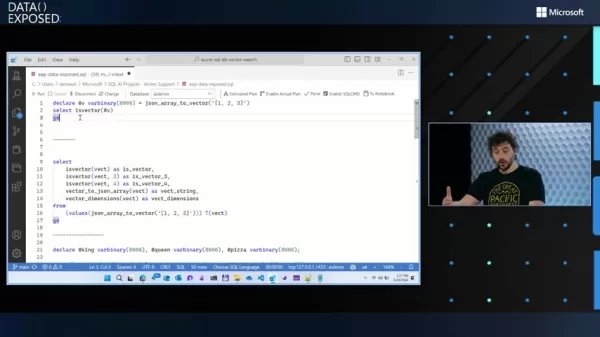
Start by generating vectors with the JSON_ARRAY_TO_VECTOR function. It converts a JSON array into a binary format optimized for vector storage.
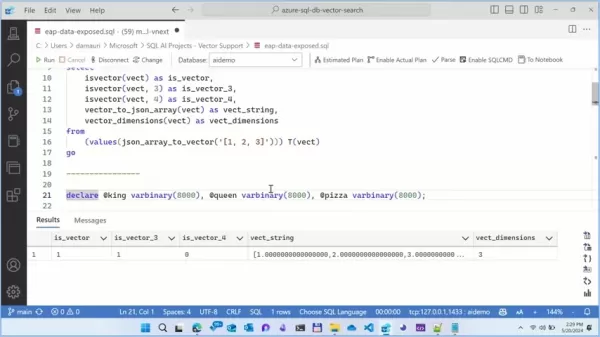
DECLARE @v varbinary(8000) = eap.JSON_ARRAY_TO_VECTOR('[1, 2, 3]');SELECT isVector(@v);
Then, verify a vector using the isVector function.
SELECT vect as is_vector, isVector(vect, 3) as is_vector_3, isVector(vect, 4) as is_vector_4, vector_to_JSON_array(vect) as vect_string, vector_dimensions(vect) as vect_dimensionsFROM (VALUES (eap.JSON_ARRAY_TO_VECTOR('[1, 2, 3]')) ) T(vect);
The system should confirm that the vector contains valid binary data.
Finding Similarity Using Vector Distance
To measure similarity between two vectors, use the vector_distance function. This new feature lets you efficiently search for suitable gift ideas.
DECLARE @king varbinary(8000), @queen varbinary(8000), @pizza varbinary(8000);EXEC dbo.get_embeddings @model = 'embeddings', @text = 'King', @embedding = @king output;EXEC dbo.get_embeddings @model = 'embeddings', @text = 'Queen', @embedding = @queen output;EXEC dbo.get_embeddings @model = 'embeddings', @text = 'Pizza', @embedding = @pizza output;SELECT v1.name, v2.name, vector_distance('cosine', v1.embedding, v2.embedding) as distanceFROM #t AS v1CROSS JOIN #t AS v2WHERE v1.name = 'Queen'ORDER BY distance;
This capability allows AI to identify connections between descriptions and parameters in your database. Since AI interprets information numerically, these functions help bridge your data with AI's numerical understanding.
Azure SQL Database Pricing and Availability
Understanding the Cost Implications
Azure SQL Database provides multiple pricing tiers to suit different requirements and budgets. Costs generally depend on:
- Compute Resources: The number of vCores and memory assigned to your instance.
- Storage: The volume of data and backup storage consumed.
- Networking: Data transferred to and from the database.
When using vector functions, account for the computational power needed for vector operations, particularly with large datasets. Optimize your queries and indexing to control expenses. Refer to the official Azure SQL Database pricing documentation for up-to-date information.
Weighing the Pros and Cons of Vector Functions
Pros
Streamlines AI Integration.
Performance Gains
Stronger Data Security
Model Flexibility
Cons
Initial learning period.
Requires query optimization.
Higher memory consumption
Core Features
SQL Database: What is it?
Microsoft SQL Database is a relational database management system (RDBMS) created by Microsoft. It supports diverse workloads including transaction processing, business intelligence, and analytics in corporate IT settings.
Microsoft SQL Server is among the top three database platforms. Azure provides several SQL Server deployment choices:
- SQL Server on Azure VMs: Offers full control over the virtual machine for hosting applications.
- Azure SQL Managed Instance: Delivers most SQL server capabilities as a managed service, minimizing administrative tasks.
- Azure SQL Database: A fully managed database service with extensive functionality and scalability.
Since SQL databases are used across numerous applications, these vector features can benefit many industries.
Notable Components of SQL Database
Key features of the database include:
- Tools for importing, analyzing, and reporting on data stored outside the SQL database.
- New T-SQL functions that enable interaction with cloud storage like Azure Blob storage and HDFS.
- A management and development environment with a graphical interface for accessing service features. SQL Server Management Studio is often cited as a compelling reason to select Microsoft's database solution. SSMS offers a more complete toolset.
Explore Azure SQL Database with Vector Functions Use Cases
E-Commerce Product Recommendations
Suggest related products by analyzing user activity and product information. Connect user search terms with product attributes to recommend similar items. This can boost sales and improve SEO performance.
Content Personalization
Customize content for individual user preferences in media and entertainment. Personalize SEO based on a user's historical data and AI insights.
Fraud Detection Systems
Detect suspicious financial transactions as they occur. Use AI to identify fraudulent patterns in real-time for improved security and fraud prevention.
FAQ
How can I get access to the private preview?
Follow the link in this article's description to register for early adopter access to the vector functions private preview. Early adopters can integrate and test the new functionality.
Do I need a special Azure SQL Database edition to use vector functions?
Detailed requirements will be specified in the private preview documentation. Check the documentation for database specifications.
Can I use vector functions with my existing Azure SQL Database?
You might need to update or modify your database setup to use vector functions. Further configuration details will be available in the documentation.
What happens to vector embeddings that exceed 8000 bytes?
While vector functions natively support vectors up to 8000 bytes, some applications may need larger embeddings. In those situations, you could distribute the vector across multiple columns or design custom storage solutions.
Related Questions
What is an embedding?
In machine learning, an embedding is a lower-dimensional space where high-dimensional vectors are mapped. For instance, a simple embedding might represent U.S. cities using two-dimensional (x, y) coordinates. The objective is to preserve the relationships between the original vectors in the geometry of the embedding space. Real-world implementations involve sophisticated mathematics. For example, creating a word embedding that maps 10,000 common English words into 300 dimensions involves processing vast text corpora (like Wikipedia or news archives) with machine learning algorithms. These algorithms identify words that frequently appear near each target word. Dimensionality reduction then projects these word vectors into the 300-dimensional embedding space. In such an embedding, words like "king" and "queen" are positioned close together, while "pizza" is farther away. Thus, the spatial arrangement of the embedding reflects the semantic relationships between words.
Related article
 AI Hallucination Nearly Triggers US Military Operation
During the spring, U.S. officials made a startling discovery while military aircraft were already airborne: the intelligence guiding an armed strike against a Chinese vessel was entirely fabricated by an AI chatbot. The operation was called off at th
Nvidia's Les Karpas: Robots Waiting for a ChatGPT Moment at TechCrunch Disrupt 2026
ChatGPT’s November 2022 launch abruptly shifted AI from theoretical hype to everyday utility, fundamentally changing how we interact with large language models.Robotics has long been a subject of discussion and development, yet it lacks that singular
Anthropic Warns Small AI Models May Self-Replicate by Year-End
Anthropic has issued another urgent warning: AI models could potentially learn to self-replicate within mere months, and once this process begins, there is effectively no "off" switch. According to the company's latest research, these programs lack a
Related Special Topic Recommendations
Design & Art
AI Hallucination Nearly Triggers US Military Operation
During the spring, U.S. officials made a startling discovery while military aircraft were already airborne: the intelligence guiding an armed strike against a Chinese vessel was entirely fabricated by an AI chatbot. The operation was called off at th
Nvidia's Les Karpas: Robots Waiting for a ChatGPT Moment at TechCrunch Disrupt 2026
ChatGPT’s November 2022 launch abruptly shifted AI from theoretical hype to everyday utility, fundamentally changing how we interact with large language models.Robotics has long been a subject of discussion and development, yet it lacks that singular
Anthropic Warns Small AI Models May Self-Replicate by Year-End
Anthropic has issued another urgent warning: AI models could potentially learn to self-replicate within mere months, and once this process begins, there is effectively no "off" switch. According to the company's latest research, these programs lack a
Related Special Topic Recommendations
Design & Art
 Top AI Illustration Tools: Create Editorial Scenes and Cover Art Faster
2026 Latest Top-rated AI Illustration Tools: Our curated list features the best powerfully designed tools for creating stunning editorial scenes and eye-catching cover art quickly. Each option has gone through rigorous real-world tests, offering a free vs paid comparison to help you find the perfect match for your workflow. Try these must-try solutions today to unlock your AI edge and boost your creative productivity. Explore now at XIX.AI.
 10 tools
 xix.ai
Education and Learning
Top AI Tutors for Exam Prep: Practice Math, Science, and English
xix.ai
Education and Learning
Top AI Tutors for Exam Prep: Practice Math, Science, and English
2026 Latest Top-Rated Best AI Tutors for Exam Prep are here on XIX.AI! Our curated list features powerful game-changing tools that offer free vs paid comparison, real-world tests, and weekly updated rankings. They help boost your writing efficiency, simplify complex topic learning, and unlock your academic potential. Explore now to Discover your perfect exam prep tool and Start creating today to Unlock your AI edge!
10 tools
xix.ai
Finance
AI Budget Planning Tools for Personal Money Management
2026 Latest Best Top-Rated AI Budget Planning Tools for Personal Money Management are here on XIX.AI! This curated collection features powerful, game-changing solutions that help you conduct real-world tests, understand spending habits, and create personalized plans to boost productivity. Enjoy a free vs paid comparison along with detailed rankings. Must-try tools designed to simplify money management and unlock your AI edge. Explore now!
11 tools
xix.ai
Health & Wellness
AI Sleep Tracking Assistants: Improve Recovery with Better Bedtime Habits
2026 Latest Best Top-Rated AI Sleep Tracking Assistants curated for ultimate recovery. This fully updated weekly guide features powerful tools that deliver real-world tests, free vs paid comparison, and detailed rankings to help you find the must-try solution that boosts sleep quality and supports better bedtime habits. Explore now at XIX.AI to Unlock your AI edge.
10 tools
xix.ai
Data Analysis
AI SQL Copilots for Product and Revenue Analytics
2026 Latest Best Top-Rated AI SQL Copilots for Product and Revenue Analytics! XIX.AI has curated a powerful, game-changing collection of must-try tools that undergo real-world tests through weekly updated rankings. These tools help users boost productivity significantly by accelerating data analysis, streamlining complex queries, and generating accurate insights to drive smarter business decisions. Explore now to Discover your perfect tool for unlocking your AI edge!
14 tools
xix.ai
Education and Learning
Best AI Homework Helpers That Teach: Learn Concepts, Not Just Answers
2026 Latest Best Top-Rated AI Homework Helpers That Teach Core Concepts Not Just Answers Powerful Tools for Students Must-Try Curated List Weekly Updated Free vs Paid Comparison Real-World Tests Accurate Rankings to Help You Unlock Your Full Learning Potential Explore now to Discover your perfect tool for smarter studying.
10 tools
xix.ai

 Comments (1)
0/500
Comments (1)
0/500
![BenGarcía]()
Wait, so Azure SQL now supports vector search natively? That's a game changer for building AI apps without extra services. But how's the performance compared to dedicated vector databases? 🤔
Artificial intelligence is reshaping entire sectors, and vectors are central to many AI innovations. Azure SQL Database now integrates this technology directly into your data layer, empowering you to build AI solutions more effectively. Explore how these new vector capabilities can transform your approach to data and AI.
Key Points
Azure SQL Database introduces vector functions to support AI-driven applications.
Store and work with vectors directly inside your database using these functions.
They simplify creating AI features, such as semantic search systems.
Connect Azure SQL Database to Azure OpenAI and other services using REST API endpoints.
Vector functions are available now in an early adopter preview.
Understanding Vector Functions in Azure SQL Database
What are Vector Functions?
Vector functions in Azure SQL Database provide new tools for AI workloads, enabling direct storage and manipulation of data in vector form.
Vectors are essential in AI because they represent data in a format that machine learning models use to identify patterns and relationships. These are typically stored as optimized binary data within the database. Customer feedback highlighted a need for native vector handling in SQL to accelerate AI adoption. These functions streamline tasks such as:
- Semantic Search: Locate information based on conceptual meaning instead of literal text matches.
- Recommendation Engines: Propose relevant items or content to users.
- Anomaly Detection: Spot outliers or unusual data points.
Having vector operations built into Azure SQL Database removes the requirement for external vector databases or complex data pipelines. This integration can speed up development and boost performance.
Why Vector Functions are a Game Changer for AI
Adding vector functions to Azure SQL Database represents a major step in blending AI with data management. Keeping vector embeddings with your structured data provides multiple benefits:
- Simplified Architecture: Lowers complexity by housing both data and AI processing in one place.
- Improved Performance: Reduces latency by avoiding data movement between systems.
- Enhanced Security: Maintains sensitive information within Azure SQL Database's protected environment.
These improvements are especially valuable for businesses aiming to integrate AI into current applications without rebuilding their infrastructure. Running vector calculations directly in SQL enables more responsive and adaptable AI solutions.
Practical Applications of Vector Functions
Gift Recommendation Engine
Consider a real-world example: building a gift suggestion system. First, use Azure OpenAI via the sp_invoke_external_rest_endpoint procedure to turn product descriptions into vector embeddings.
These embeddings encapsulate the semantic content of the descriptions. Then, store the vectors in Azure SQL Database.
When a user looks for a gift, convert their query into a vector. Use distance functions (e.g., Cosine distance) to locate products with vectors most similar to the query. This provides a systematic way to implement AI.
For example:
SELECT TOP(50) id, product_name, [description], vector_distance('cosine', embeddings, @embedding) AS distanceFROM dbo.walmart_ecommerce_product_detailsWHERE category like '%Toys%'ORDER BY distance;
This semantic search technique often combines with traditional keyword search for the best outcomes.
Steps to Implement a Vector-Based Gift Recommendation System
Follow these steps to create a vector-powered gift recommendation system:
- Set up REST Endpoint: Configure the
sp_invoke_external_rest_endpointstored procedure to interact with the OpenAI API. The ability to call OpenAI and process descriptions is essential. - Create Vector Data: The model will process sample text like 'King', 'Queen', or 'Pizza'.
- Load Vectors Into Database: Import the vector data into your database for querying.
- Get Embedding Output: Use
dbo.get_embeddingsto convert the text into an embedding and store it as a vector.
declare @embedding varbinary(8000); EXEC dbo.get_embeddings @model = 'embeddings', @text = 'King', @embedding = @king output;
This process transforms your descriptions into an optimized binary format suitable for AI processing.
Enhancing SQL Queries with Hybrid Search
To improve search accuracy, adopt a hybrid search strategy. Combine vector search with standard SQL queries for optimal results.
For instance, utilize a public dataset like the Walmart product catalog. Define parameters including:
- ID
- Product name
- Description
- Vector distance
You can select these parameters using natural language as well.
This method offers greater flexibility and supports a wider range of SEO keywords in your database queries.
How to Utilize Vector Functions in Azure SQL Database
Creating and Validating Vectors
Start by generating vectors with the JSON_ARRAY_TO_VECTOR function. It converts a JSON array into a binary format optimized for vector storage.
DECLARE @v varbinary(8000) = eap.JSON_ARRAY_TO_VECTOR('[1, 2, 3]');SELECT isVector(@v);
Then, verify a vector using the isVector function.
SELECT vect as is_vector, isVector(vect, 3) as is_vector_3, isVector(vect, 4) as is_vector_4, vector_to_JSON_array(vect) as vect_string, vector_dimensions(vect) as vect_dimensionsFROM (VALUES (eap.JSON_ARRAY_TO_VECTOR('[1, 2, 3]')) ) T(vect);
The system should confirm that the vector contains valid binary data.
Finding Similarity Using Vector Distance
To measure similarity between two vectors, use the vector_distance function. This new feature lets you efficiently search for suitable gift ideas.
DECLARE @king varbinary(8000), @queen varbinary(8000), @pizza varbinary(8000);EXEC dbo.get_embeddings @model = 'embeddings', @text = 'King', @embedding = @king output;EXEC dbo.get_embeddings @model = 'embeddings', @text = 'Queen', @embedding = @queen output;EXEC dbo.get_embeddings @model = 'embeddings', @text = 'Pizza', @embedding = @pizza output;SELECT v1.name, v2.name, vector_distance('cosine', v1.embedding, v2.embedding) as distanceFROM #t AS v1CROSS JOIN #t AS v2WHERE v1.name = 'Queen'ORDER BY distance;
This capability allows AI to identify connections between descriptions and parameters in your database. Since AI interprets information numerically, these functions help bridge your data with AI's numerical understanding.
Azure SQL Database Pricing and Availability
Understanding the Cost Implications
Azure SQL Database provides multiple pricing tiers to suit different requirements and budgets. Costs generally depend on:
- Compute Resources: The number of vCores and memory assigned to your instance.
- Storage: The volume of data and backup storage consumed.
- Networking: Data transferred to and from the database.
When using vector functions, account for the computational power needed for vector operations, particularly with large datasets. Optimize your queries and indexing to control expenses. Refer to the official Azure SQL Database pricing documentation for up-to-date information.
Weighing the Pros and Cons of Vector Functions
Pros
Streamlines AI Integration.
Performance Gains
Stronger Data Security
Model Flexibility
Cons
Initial learning period.
Requires query optimization.
Higher memory consumption
Core Features
SQL Database: What is it?
Microsoft SQL Database is a relational database management system (RDBMS) created by Microsoft. It supports diverse workloads including transaction processing, business intelligence, and analytics in corporate IT settings.
Microsoft SQL Server is among the top three database platforms. Azure provides several SQL Server deployment choices:
- SQL Server on Azure VMs: Offers full control over the virtual machine for hosting applications.
- Azure SQL Managed Instance: Delivers most SQL server capabilities as a managed service, minimizing administrative tasks.
- Azure SQL Database: A fully managed database service with extensive functionality and scalability.
Since SQL databases are used across numerous applications, these vector features can benefit many industries.
Notable Components of SQL Database
Key features of the database include:
- Tools for importing, analyzing, and reporting on data stored outside the SQL database.
- New T-SQL functions that enable interaction with cloud storage like Azure Blob storage and HDFS.
- A management and development environment with a graphical interface for accessing service features. SQL Server Management Studio is often cited as a compelling reason to select Microsoft's database solution. SSMS offers a more complete toolset.
Explore Azure SQL Database with Vector Functions Use Cases
E-Commerce Product Recommendations
Suggest related products by analyzing user activity and product information. Connect user search terms with product attributes to recommend similar items. This can boost sales and improve SEO performance.
Content Personalization
Customize content for individual user preferences in media and entertainment. Personalize SEO based on a user's historical data and AI insights.
Fraud Detection Systems
Detect suspicious financial transactions as they occur. Use AI to identify fraudulent patterns in real-time for improved security and fraud prevention.
FAQ
How can I get access to the private preview?
Follow the link in this article's description to register for early adopter access to the vector functions private preview. Early adopters can integrate and test the new functionality.
Do I need a special Azure SQL Database edition to use vector functions?
Detailed requirements will be specified in the private preview documentation. Check the documentation for database specifications.
Can I use vector functions with my existing Azure SQL Database?
You might need to update or modify your database setup to use vector functions. Further configuration details will be available in the documentation.
What happens to vector embeddings that exceed 8000 bytes?
While vector functions natively support vectors up to 8000 bytes, some applications may need larger embeddings. In those situations, you could distribute the vector across multiple columns or design custom storage solutions.
Related Questions
What is an embedding?
In machine learning, an embedding is a lower-dimensional space where high-dimensional vectors are mapped. For instance, a simple embedding might represent U.S. cities using two-dimensional (x, y) coordinates. The objective is to preserve the relationships between the original vectors in the geometry of the embedding space. Real-world implementations involve sophisticated mathematics. For example, creating a word embedding that maps 10,000 common English words into 300 dimensions involves processing vast text corpora (like Wikipedia or news archives) with machine learning algorithms. These algorithms identify words that frequently appear near each target word. Dimensionality reduction then projects these word vectors into the 300-dimensional embedding space. In such an embedding, words like "king" and "queen" are positioned close together, while "pizza" is farther away. Thus, the spatial arrangement of the embedding reflects the semantic relationships between words.








 AI Hallucination Nearly Triggers US Military Operation
During the spring, U.S. officials made a startling discovery while military aircraft were already airborne: the intelligence guiding an armed strike against a Chinese vessel was entirely fabricated by an AI chatbot. The operation was called off at th
AI Hallucination Nearly Triggers US Military Operation
During the spring, U.S. officials made a startling discovery while military aircraft were already airborne: the intelligence guiding an armed strike against a Chinese vessel was entirely fabricated by an AI chatbot. The operation was called off at th
 Nvidia's Les Karpas: Robots Waiting for a ChatGPT Moment at TechCrunch Disrupt 2026
ChatGPT’s November 2022 launch abruptly shifted AI from theoretical hype to everyday utility, fundamentally changing how we interact with large language models.Robotics has long been a subject of discussion and development, yet it lacks that singular
Nvidia's Les Karpas: Robots Waiting for a ChatGPT Moment at TechCrunch Disrupt 2026
ChatGPT’s November 2022 launch abruptly shifted AI from theoretical hype to everyday utility, fundamentally changing how we interact with large language models.Robotics has long been a subject of discussion and development, yet it lacks that singular
 Anthropic Warns Small AI Models May Self-Replicate by Year-End
Anthropic has issued another urgent warning: AI models could potentially learn to self-replicate within mere months, and once this process begins, there is effectively no "off" switch. According to the company's latest research, these programs lack a
Anthropic Warns Small AI Models May Self-Replicate by Year-End
Anthropic has issued another urgent warning: AI models could potentially learn to self-replicate within mere months, and once this process begins, there is effectively no "off" switch. According to the company's latest research, these programs lack a

2026 Latest Top-rated AI Illustration Tools: Our curated list features the best powerfully designed tools for creating stunning editorial scenes and eye-catching cover art quickly. Each option has gone through rigorous real-world tests, offering a free vs paid comparison to help you find the perfect match for your workflow. Try these must-try solutions today to unlock your AI edge and boost your creative productivity. Explore now at XIX.AI.
10 tools
xix.ai

2026 Latest Top-Rated Best AI Tutors for Exam Prep are here on XIX.AI! Our curated list features powerful game-changing tools that offer free vs paid comparison, real-world tests, and weekly updated rankings. They help boost your writing efficiency, simplify complex topic learning, and unlock your academic potential. Explore now to Discover your perfect exam prep tool and Start creating today to Unlock your AI edge!
10 tools
xix.ai

2026 Latest Best Top-Rated AI Budget Planning Tools for Personal Money Management are here on XIX.AI! This curated collection features powerful, game-changing solutions that help you conduct real-world tests, understand spending habits, and create personalized plans to boost productivity. Enjoy a free vs paid comparison along with detailed rankings. Must-try tools designed to simplify money management and unlock your AI edge. Explore now!
11 tools
xix.ai

2026 Latest Best Top-Rated AI Sleep Tracking Assistants curated for ultimate recovery. This fully updated weekly guide features powerful tools that deliver real-world tests, free vs paid comparison, and detailed rankings to help you find the must-try solution that boosts sleep quality and supports better bedtime habits. Explore now at XIX.AI to Unlock your AI edge.
10 tools
xix.ai

2026 Latest Best Top-Rated AI SQL Copilots for Product and Revenue Analytics! XIX.AI has curated a powerful, game-changing collection of must-try tools that undergo real-world tests through weekly updated rankings. These tools help users boost productivity significantly by accelerating data analysis, streamlining complex queries, and generating accurate insights to drive smarter business decisions. Explore now to Discover your perfect tool for unlocking your AI edge!
14 tools
xix.ai

2026 Latest Best Top-Rated AI Homework Helpers That Teach Core Concepts Not Just Answers Powerful Tools for Students Must-Try Curated List Weekly Updated Free vs Paid Comparison Real-World Tests Accurate Rankings to Help You Unlock Your Full Learning Potential Explore now to Discover your perfect tool for smarter studying.
10 tools
xix.ai

Wait, so Azure SQL now supports vector search natively? That's a game changer for building AI apps without extra services. But how's the performance compared to dedicated vector databases? 🤔












