


 Home
HomeHow to use UNet for medical image segmentation in 2026? Step-by-step tutorial.
Get hands-on with image segmentation using the UNet architecture in this practical tutorial designed for medical imaging. We'll cover the core concepts and guide you through implementing UNet step by step. Discover how deep learning can enhance the accuracy of medical image analysis.
Key Points
Discover the role and significance of image segmentation in medical imaging.
Learn the core principles of Artificial Intelligence (AI), Machine Learning (ML), and Deep Learning.
Explore the fundamentals of Neural Networks (NNs) and Convolutional Neural Networks (CNNs).
Understand the capabilities of Fully Convolutional Networks (FCNs).
Build a UNet model from the ground up through a practical implementation.
Grasp the basics of convolutions, pooling, deconvolution, and activation functions.
Apply U-Net to real-world medical imaging challenges.
Understanding the Foundation
Artificial Intelligence, Machine Learning, and Deep Learning
Let's start with the fundamentals before exploring UNet.
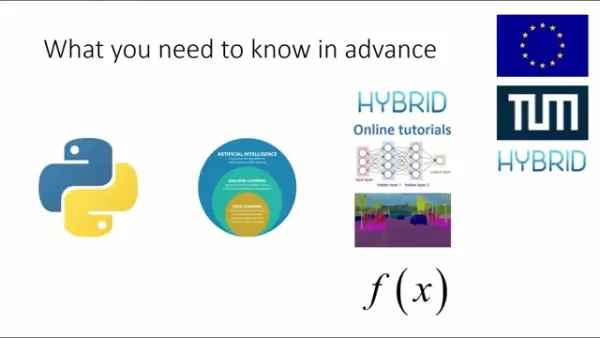
Artificial intelligence is a broad discipline focused on creating machines capable of human-like tasks. Machine learning, a branch of AI, uses algorithms to enable systems to learn directly from data. Deep learning, a specialized area within machine learning, employs multi-layered neural networks to analyze data with remarkable sophistication.
Deep learning has transformed areas such as image recognition, natural language processing, and medical image analysis. Its capacity to automatically identify features from raw data makes it especially powerful for segmentation tasks.
Neural Networks vs. Convolutional Neural Networks: Core Concepts
Neural networks (NNs) form the foundation of deep learning. They consist of interconnected neurons arranged in layers: input, hidden, and output. During training, the network adjusts connection weights to enhance performance.
Convolutional Neural Networks (CNNs) are specialized NNs optimized for grid-based data like images. Using convolutional layers with filters, CNNs detect features regardless of their position in the image, making them ideal for visual tasks.
Key differences between NNs and CNNs:
- NNs: General-purpose, often need manual feature engineering.
- CNNs: Built for grid data, automatically extract features.
The Power of Fully Convolutional Networks (FCNs)
Fully Convolutional Networks (FCNs) replace traditional dense layers with convolutional layers, enabling them to handle inputs of any size and produce corresponding outputs. This flexibility is crucial for image segmentation, where every pixel needs classification.
FCNs use convolutional and pooling layers to extract features, then apply deconvolutional layers for upsampling, generating precise pixel-level predictions.
Mathematical Underpinnings: Convolution, Pooling, Deconvolution, and Activation Functions
A solid understanding of core mathematical operations is essential for working with UNet. Let's examine the basics with some math:
- Convolution:
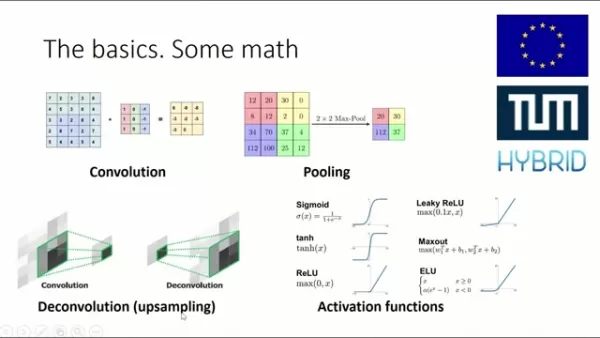
Convolution works by sliding a filter across an input image, performing element-wise multiplication, and summing results to create a feature map. This highlights specific patterns like edges or textures.
- Pooling:Pooling layers, such as max-pooling, shrink feature maps to reduce computation and improve feature detection stability. Max-pooling picks the highest value from each region of the feature map.
- Deconvolution (Upsampling):Deconvolution, or transposed convolution, increases feature map resolution. This step is vital in segmentation for producing detailed classifications from compressed features.
- Activation Functions:Activation functions add non-linearity to the network, enabling it to learn complex relationships. Popular choices include ReLU, sigmoid, and tanh. ReLU is often used in hidden layers for its efficiency and ability to prevent vanishing gradients.
Deep Dive into UNet Architecture
The UNet Architecture
UNet's design makes it perfect for medical image segmentation, combining broad context with precise details. Its U-shaped structure includes a contracting (encoder) path and an expansive (decoder) path.
Contracting Path (Encoder): The encoder uses convolutions and max-pooling to extract multi-scale features, capturing the image's context at different levels.
Expansive Path (Decoder): The decoder upsamples feature maps while merging them with corresponding encoder outputs. This blends high-level semantics with fine spatial details.
Skip Connections: Skip connections are crucial in UNet, directly transferring encoder features to the decoder. This restores resolution lost during downsampling and ensures precise segmentation edges.By integrating these components, UNet achieves highly accurate segmentations, making it a top choice in medical imaging. The model excels by combining local features with contextual understanding.
Getting Started: Coding Your Own UNet
Setting Up Your Python Environment
Prepare your Python environment by installing essential libraries, such as:
- TensorFlow or Keras: Frameworks for building and training your UNet model.
- NumPy: For numerical operations.
- Matplotlib: For visualizing outputs.
Install them via pip with this command:
pip install tensorflow numpy matplotlib
Building the Basic UNet Model: Code Walkthrough
We'll construct the UNet model from scratch using Python, defining each layer, activations, and the forward pass. Start with these import statements:
import kerasfrom keras.models import Modelfrom keras.layers import Input, Conv2D, MaxPooling2D, UpSampling2D, concatenatefrom keras.optimizers import Adam
Next, create a function to build the model.
def unet(pretrained_weights=None, input_size=(256,256,1)):inputs = Input(input_size)
The Price?
Is UNet Really Free?
As a language model, I don't set prices for UNet, which is an open-source architecture, not commercial software. While using UNet may involve computing and data costs, the architecture itself is free to use.
Here's a clearer breakdown of potential costs:
- UNet Architecture: Open-source and free to implement.
- Implementation Costs: Cover libraries (e.g., TensorFlow, Keras), computing resources (e.g., cloud GPUs), and data preparation.
UNet: Advantages and Disadvantages
Pros
Delivers outstanding segmentation accuracy, especially for medical images.
Effectively combines global context with detailed local features.
Performs well across different medical imaging modalities.
Highly adaptable and versatile
Cons
Can be resource-intensive, often needing powerful GPUs.
Might require substantial labeled data for training.
Prone to overfitting without appropriate regularization.
Contains many parameters that require careful tuning
Frequently Asked Questions
What are the prerequisites for understanding this tutorial?
A basic understanding of Python, AI, machine learning, and deep learning is helpful. Familiarity with neural network concepts is also beneficial.
Is UNet suitable for all types of image segmentation tasks?
UNet is highly effective but may not be the best choice for every scenario. It might struggle with low-contrast images or objects with highly variable shapes.
What are the limitations of U-Net?
It often needs large training datasets, can be computationally demanding, and may overfit without proper regularization.
What libraries do I need to implement UNet in Python?
Essential libraries include TensorFlow or Keras, NumPy, and Matplotlib. Install them using pip.
Deep Dive Into UNet in Medical Imaging
What specific types of medical images benefit the most from UNet-based segmentation?
UNet performs exceptionally well across various medical imaging types and structures. Key applications include:MRI Scans: Precisely outlines tumors, organs, and anatomical regions in MRI scans.CT Scans: Effectively segments organs and tissues in CT images, useful for identifying abnormalities.Microscopy Images: Excellent for segmenting cells and cellular structures in microscopy, supporting pathological review.Retinal Images: Segments retinal vessels and optic discs, aiding in eye disease diagnosis.
Related article
 Apple Smart Glasses Could Debut at WWDC27, Highlighting Privacy Protection
Bloomberg’s Mark Gurman reports that Apple’s smart glasses, codenamed N50, are slated for a WWDC27 debut in June 2027, with a retail launch expected in autumn 2027. Originally targeted for late this year and early 2027, the device’s release has been
Inside Details Exposed About Next-Gen Gemini: Strained Computing Power, Internal Teams Disagreed on Development Priorities and Resource Allocation
Reports indicate that the launch of Google’s highly anticipated next-generation Gemini model has been pushed back. Internal disagreements over development priorities and resource allocation, combined with limited computing capacity and complex approv
OpenAI Dismisses Growth Slowdown Concerns, Says Multiple Business Units Accelerating
In response to external scrutiny regarding decelerating sales growth and missed internal benchmarks, AI leader OpenAI issued a confident statement on Tuesday, April 28. The company clarified that its consumer products and enterprise services are adva
Related Special Topic Recommendations
Data Analysis
Apple Smart Glasses Could Debut at WWDC27, Highlighting Privacy Protection
Bloomberg’s Mark Gurman reports that Apple’s smart glasses, codenamed N50, are slated for a WWDC27 debut in June 2027, with a retail launch expected in autumn 2027. Originally targeted for late this year and early 2027, the device’s release has been
Inside Details Exposed About Next-Gen Gemini: Strained Computing Power, Internal Teams Disagreed on Development Priorities and Resource Allocation
Reports indicate that the launch of Google’s highly anticipated next-generation Gemini model has been pushed back. Internal disagreements over development priorities and resource allocation, combined with limited computing capacity and complex approv
OpenAI Dismisses Growth Slowdown Concerns, Says Multiple Business Units Accelerating
In response to external scrutiny regarding decelerating sales growth and missed internal benchmarks, AI leader OpenAI issued a confident statement on Tuesday, April 28. The company clarified that its consumer products and enterprise services are adva
Related Special Topic Recommendations
Data Analysis
 AI SQL Copilots for Revenue Dashboards, Funnel Analysis, and Product Metrics
2026 Latest Best AI SQL Copilots Ranked Top-Rated! XIX.AI curates a powerful game-changing collection for weekly updated real-world tests. These must-try tools help you generate accurate revenue dashboards, analyze sales funnels, and track product metrics swiftly, boosting productivity massively. Explore now to Discover your perfect tool for data-driven decision making! 238 characters
 9 tools
 xix.ai
Music composition
Best AI Melody Writing Tools for Song Drafts
xix.ai
Music composition
Best AI Melody Writing Tools for Song Drafts
2026 Latest Best Top-Rated AI Melody Writing Tools for Song Drafts! XIX.AI has curated a highly powerful game-changing collection that goes through rigorous real-world tests to deliver the best writing experience. You can find detailed free vs paid comparisons, accurate rankings, and must-try options designed to help you create stunning song drafts effortlessly and boost your creative productivity significantly. Explore now to discover your perfect tool!
8 tools
xix.ai
chatbot
Best AI Conversation Trainer Tools for Interview Practice
2026 Latest Best Top-rated AI Conversation Trainer Tools for Interview Practice are here on XIX.AI! This curated collection features powerful, game-changing tools that go through rigorous real-world tests to deliver accurate feedback. You’ll find a free vs paid comparison and detailed rankings to help you choose the must-try option that boosts your confidence and skills. Explore now to Discover your perfect tool for interview success!
12 tools
xix.ai
Design & Art
Best AI Style Transfer Tools for Creative Experiments
2026 Latest Best Top-rated AI Style Transfer Tools for Creative Experiments! XIX.AI has curated a powerful, game-changing collection of must-try tools that deliver exceptional results through real-world tests and rigorous rankings. These top solutions help creatives boost productivity significantly by accelerating content creation and unlocking endless creative possibilities. Explore now to discover your perfect tool and start creating today!
9 tools
xix.ai
Comic Creation
Best AI Dialogue Bubble Tools for Visual Storytelling
2026 Latest Best Top-Rated AI Dialogue Bubble Tools for Visual Storytelling are here on XIX.AI! This curated collection features powerful, game-changing tools that help creators boost productivity and overcome creative bottlenecks. Get a free vs paid comparison, see real-world tests, and check the latest rankings to find the must-try solutions perfect for crafting engaging visual narratives. Explore now to discover your ideal tool!
10 tools
xix.ai
Meeting Assistant
Top AI Meeting Summary Tools: Track Decisions and Follow-Ups Clearly
2026 Latest Top-Rated Best AI Meeting Summary Tools for Clear Decision Tracking and Effortless Follow-Ups. This curated list showcases powerful, game-changing solutions that boost productivity dramatically by automating meeting notes, identifying key action items, and streamlining team coordination across all projects. Get a free vs paid comparison along with real-world tests and weekly updated rankings to help you find the perfect tool. Explore now to unlock your AI edge!
9 tools
xix.ai

 Comments (1)
0/500
Comments (1)
0/500
![KevinHarris]()
Неужели в 2026 году UNet всё ещё будет актуален для медицинских снимков? 🤔 Интересно, не появились ли уже более современные архитектуры. Хотелось бы сравнить эффективность с трансформерами в сегментации МРТ.
Get hands-on with image segmentation using the UNet architecture in this practical tutorial designed for medical imaging. We'll cover the core concepts and guide you through implementing UNet step by step. Discover how deep learning can enhance the accuracy of medical image analysis.
Key Points
Discover the role and significance of image segmentation in medical imaging.
Learn the core principles of Artificial Intelligence (AI), Machine Learning (ML), and Deep Learning.
Explore the fundamentals of Neural Networks (NNs) and Convolutional Neural Networks (CNNs).
Understand the capabilities of Fully Convolutional Networks (FCNs).
Build a UNet model from the ground up through a practical implementation.
Grasp the basics of convolutions, pooling, deconvolution, and activation functions.
Apply U-Net to real-world medical imaging challenges.
Understanding the Foundation
Artificial Intelligence, Machine Learning, and Deep Learning
Let's start with the fundamentals before exploring UNet.
Artificial intelligence is a broad discipline focused on creating machines capable of human-like tasks. Machine learning, a branch of AI, uses algorithms to enable systems to learn directly from data. Deep learning, a specialized area within machine learning, employs multi-layered neural networks to analyze data with remarkable sophistication.
Deep learning has transformed areas such as image recognition, natural language processing, and medical image analysis. Its capacity to automatically identify features from raw data makes it especially powerful for segmentation tasks.
Neural Networks vs. Convolutional Neural Networks: Core Concepts
Neural networks (NNs) form the foundation of deep learning. They consist of interconnected neurons arranged in layers: input, hidden, and output. During training, the network adjusts connection weights to enhance performance.
Convolutional Neural Networks (CNNs) are specialized NNs optimized for grid-based data like images. Using convolutional layers with filters, CNNs detect features regardless of their position in the image, making them ideal for visual tasks.
Key differences between NNs and CNNs:
- NNs: General-purpose, often need manual feature engineering.
- CNNs: Built for grid data, automatically extract features.
The Power of Fully Convolutional Networks (FCNs)
Fully Convolutional Networks (FCNs) replace traditional dense layers with convolutional layers, enabling them to handle inputs of any size and produce corresponding outputs. This flexibility is crucial for image segmentation, where every pixel needs classification.
FCNs use convolutional and pooling layers to extract features, then apply deconvolutional layers for upsampling, generating precise pixel-level predictions.
Mathematical Underpinnings: Convolution, Pooling, Deconvolution, and Activation Functions
A solid understanding of core mathematical operations is essential for working with UNet. Let's examine the basics with some math:
- Convolution:
Convolution works by sliding a filter across an input image, performing element-wise multiplication, and summing results to create a feature map. This highlights specific patterns like edges or textures.
- Pooling:Pooling layers, such as max-pooling, shrink feature maps to reduce computation and improve feature detection stability. Max-pooling picks the highest value from each region of the feature map.
- Deconvolution (Upsampling):Deconvolution, or transposed convolution, increases feature map resolution. This step is vital in segmentation for producing detailed classifications from compressed features.
- Activation Functions:Activation functions add non-linearity to the network, enabling it to learn complex relationships. Popular choices include ReLU, sigmoid, and tanh. ReLU is often used in hidden layers for its efficiency and ability to prevent vanishing gradients.
Deep Dive into UNet Architecture
The UNet Architecture
UNet's design makes it perfect for medical image segmentation, combining broad context with precise details. Its U-shaped structure includes a contracting (encoder) path and an expansive (decoder) path.
Contracting Path (Encoder): The encoder uses convolutions and max-pooling to extract multi-scale features, capturing the image's context at different levels.
Expansive Path (Decoder): The decoder upsamples feature maps while merging them with corresponding encoder outputs. This blends high-level semantics with fine spatial details.
Skip Connections: Skip connections are crucial in UNet, directly transferring encoder features to the decoder. This restores resolution lost during downsampling and ensures precise segmentation edges.By integrating these components, UNet achieves highly accurate segmentations, making it a top choice in medical imaging. The model excels by combining local features with contextual understanding.
Getting Started: Coding Your Own UNet
Setting Up Your Python Environment
Prepare your Python environment by installing essential libraries, such as:
- TensorFlow or Keras: Frameworks for building and training your UNet model.
- NumPy: For numerical operations.
- Matplotlib: For visualizing outputs.
Install them via pip with this command:
pip install tensorflow numpy matplotlib
Building the Basic UNet Model: Code Walkthrough
We'll construct the UNet model from scratch using Python, defining each layer, activations, and the forward pass. Start with these import statements:
import kerasfrom keras.models import Modelfrom keras.layers import Input, Conv2D, MaxPooling2D, UpSampling2D, concatenatefrom keras.optimizers import Adam
Next, create a function to build the model.
def unet(pretrained_weights=None, input_size=(256,256,1)):inputs = Input(input_size)
The Price?
Is UNet Really Free?
As a language model, I don't set prices for UNet, which is an open-source architecture, not commercial software. While using UNet may involve computing and data costs, the architecture itself is free to use.
Here's a clearer breakdown of potential costs:
- UNet Architecture: Open-source and free to implement.
- Implementation Costs: Cover libraries (e.g., TensorFlow, Keras), computing resources (e.g., cloud GPUs), and data preparation.
UNet: Advantages and Disadvantages
Pros
Delivers outstanding segmentation accuracy, especially for medical images.
Effectively combines global context with detailed local features.
Performs well across different medical imaging modalities.
Highly adaptable and versatile
Cons
Can be resource-intensive, often needing powerful GPUs.
Might require substantial labeled data for training.
Prone to overfitting without appropriate regularization.
Contains many parameters that require careful tuning
Frequently Asked Questions
What are the prerequisites for understanding this tutorial?
A basic understanding of Python, AI, machine learning, and deep learning is helpful. Familiarity with neural network concepts is also beneficial.
Is UNet suitable for all types of image segmentation tasks?
UNet is highly effective but may not be the best choice for every scenario. It might struggle with low-contrast images or objects with highly variable shapes.
What are the limitations of U-Net?
It often needs large training datasets, can be computationally demanding, and may overfit without proper regularization.
What libraries do I need to implement UNet in Python?
Essential libraries include TensorFlow or Keras, NumPy, and Matplotlib. Install them using pip.
Deep Dive Into UNet in Medical Imaging
What specific types of medical images benefit the most from UNet-based segmentation?
UNet performs exceptionally well across various medical imaging types and structures. Key applications include:MRI Scans: Precisely outlines tumors, organs, and anatomical regions in MRI scans.CT Scans: Effectively segments organs and tissues in CT images, useful for identifying abnormalities.Microscopy Images: Excellent for segmenting cells and cellular structures in microscopy, supporting pathological review.Retinal Images: Segments retinal vessels and optic discs, aiding in eye disease diagnosis.








 Apple Smart Glasses Could Debut at WWDC27, Highlighting Privacy Protection
Bloomberg’s Mark Gurman reports that Apple’s smart glasses, codenamed N50, are slated for a WWDC27 debut in June 2027, with a retail launch expected in autumn 2027. Originally targeted for late this year and early 2027, the device’s release has been
Apple Smart Glasses Could Debut at WWDC27, Highlighting Privacy Protection
Bloomberg’s Mark Gurman reports that Apple’s smart glasses, codenamed N50, are slated for a WWDC27 debut in June 2027, with a retail launch expected in autumn 2027. Originally targeted for late this year and early 2027, the device’s release has been
 Inside Details Exposed About Next-Gen Gemini: Strained Computing Power, Internal Teams Disagreed on Development Priorities and Resource Allocation
Reports indicate that the launch of Google’s highly anticipated next-generation Gemini model has been pushed back. Internal disagreements over development priorities and resource allocation, combined with limited computing capacity and complex approv
Inside Details Exposed About Next-Gen Gemini: Strained Computing Power, Internal Teams Disagreed on Development Priorities and Resource Allocation
Reports indicate that the launch of Google’s highly anticipated next-generation Gemini model has been pushed back. Internal disagreements over development priorities and resource allocation, combined with limited computing capacity and complex approv
 OpenAI Dismisses Growth Slowdown Concerns, Says Multiple Business Units Accelerating
In response to external scrutiny regarding decelerating sales growth and missed internal benchmarks, AI leader OpenAI issued a confident statement on Tuesday, April 28. The company clarified that its consumer products and enterprise services are adva
OpenAI Dismisses Growth Slowdown Concerns, Says Multiple Business Units Accelerating
In response to external scrutiny regarding decelerating sales growth and missed internal benchmarks, AI leader OpenAI issued a confident statement on Tuesday, April 28. The company clarified that its consumer products and enterprise services are adva

2026 Latest Best AI SQL Copilots Ranked Top-Rated! XIX.AI curates a powerful game-changing collection for weekly updated real-world tests. These must-try tools help you generate accurate revenue dashboards, analyze sales funnels, and track product metrics swiftly, boosting productivity massively. Explore now to Discover your perfect tool for data-driven decision making! 238 characters
9 tools
xix.ai

2026 Latest Best Top-Rated AI Melody Writing Tools for Song Drafts! XIX.AI has curated a highly powerful game-changing collection that goes through rigorous real-world tests to deliver the best writing experience. You can find detailed free vs paid comparisons, accurate rankings, and must-try options designed to help you create stunning song drafts effortlessly and boost your creative productivity significantly. Explore now to discover your perfect tool!
8 tools
xix.ai

2026 Latest Best Top-rated AI Conversation Trainer Tools for Interview Practice are here on XIX.AI! This curated collection features powerful, game-changing tools that go through rigorous real-world tests to deliver accurate feedback. You’ll find a free vs paid comparison and detailed rankings to help you choose the must-try option that boosts your confidence and skills. Explore now to Discover your perfect tool for interview success!
12 tools
xix.ai

2026 Latest Best Top-rated AI Style Transfer Tools for Creative Experiments! XIX.AI has curated a powerful, game-changing collection of must-try tools that deliver exceptional results through real-world tests and rigorous rankings. These top solutions help creatives boost productivity significantly by accelerating content creation and unlocking endless creative possibilities. Explore now to discover your perfect tool and start creating today!
9 tools
xix.ai

2026 Latest Best Top-Rated AI Dialogue Bubble Tools for Visual Storytelling are here on XIX.AI! This curated collection features powerful, game-changing tools that help creators boost productivity and overcome creative bottlenecks. Get a free vs paid comparison, see real-world tests, and check the latest rankings to find the must-try solutions perfect for crafting engaging visual narratives. Explore now to discover your ideal tool!
10 tools
xix.ai
2026 Latest Top-Rated Best AI Meeting Summary Tools for Clear Decision Tracking and Effortless Follow-Ups. This curated list showcases powerful, game-changing solutions that boost productivity dramatically by automating meeting notes, identifying key action items, and streamlining team coordination across all projects. Get a free vs paid comparison along with real-world tests and weekly updated rankings to help you find the perfect tool. Explore now to unlock your AI edge!
9 tools
xix.ai

Неужели в 2026 году UNet всё ещё будет актуален для медицинских снимков? 🤔 Интересно, не появились ли уже более современные архитектуры. Хотелось бы сравнить эффективность с трансформерами в сегментации МРТ.












