


 Home
HomeTop AI Models Struggle Most with Self-Correction Despite High Confidence
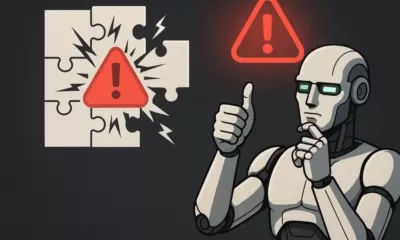
The AI community widely anticipates that the next major breakthrough will usher in an era of self-improving artificial intelligence, where systems enhance themselves autonomously without human input. The reasoning goes that as models become more advanced, they will eventually learn not only from data but also from their own outputs. Each new iteration would refine the last, identifying, correcting, and eliminating errors. Over time, this compounding progress could spark an intelligence explosion, with AI systems designing even more capable AI. This vision fuels excitement around recursive AI, autonomous agents, and the long-awaited intelligence explosion. Central to this idea is the capacity for AI systems to reliably fix their own mistakes. Without robust self-correction, self-improvement remains out of reach. A system that cannot determine when it is wrong cannot meaningfully learn from its outputs, regardless of its apparent power.
It has long been assumed that self-correction would naturally emerge as models grew more capable. This seems intuitive—after all, more powerful models possess greater knowledge, better reasoning skills, and excel across various tasks. However, recent studies present a surprising discovery: more advanced models often have difficulty correcting their own errors, while less capable models perform better at self-correction. This phenomenon, known as the Accuracy-Correction Paradox, challenges our assumptions about AI reasoning and raises questions about our readiness for self-improving AI.
Understanding Self-Improving AI
Self-improving AI refers to systems that can identify their own mistakes, learn from them, and iteratively improve their performance. Unlike traditional models that depend solely on human-curated training data, self-improving AI actively evaluates its outputs and adapts over time. In theory, this creates a feedback loop where each learning cycle builds upon the previous one, potentially leading to what is often called an intelligence explosion.
However, achieving this is far from simple. Self-improvement demands more than computational power or larger datasets. It requires reliable self-assessment—the ability to detect errors, pinpoint their origins, and generate corrected solutions. Without these skills, a model cannot differentiate between sound reasoning and flawed logic. Iterating on incorrect solutions, no matter how quickly, only entrenches mistakes rather than improving performance.
This distinction is crucial. Human learning from errors involves reflection, hypothesis testing, and adjustments. For AI, these processes must be embedded within the system itself. If a model cannot reliably recognize and fix its mistakes, it cannot engage in a meaningful self-improvement cycle, leaving the promise of recursive intelligence theoretical rather than achievable.
The Accuracy-Correction Paradox
Self-correction is often viewed as a single skill, but it actually combines several distinct abilities that should be evaluated separately. At a minimum, we can break it down into three measurable components: error detection, error localization (or source identification), and error correction. Error detection assesses whether a model can recognize that its output is incorrect. Error localization focuses on determining where the mistake occurred. Error correction refers to the ability to produce an accurate solution.
By evaluating these capabilities individually, researchers gain valuable insights into the limitations of current systems. They observe that models perform unevenly across these areas. Some are adept at spotting errors but poor at resolving them. Others barely notice mistakes yet still manage to correct them through repeated attempts. More importantly, these findings show that progress in one area does not guarantee improvement in the others.
When researchers tested advanced models on complex mathematical reasoning tasks, these models made fewer mistakes—as expected. The surprising result was that when these models did err, they were less likely to correct themselves. In contrast, weaker models, despite making more errors, were significantly better at fixing their mistakes without external input. In other words, researchers found that accuracy and self-correction moved in opposite directions, a paradox termed the accuracy-correction paradox. This challenges a core assumption in AI development: that scaling models improves all aspects of intelligence. The paradox reveals that this is not always true, particularly for introspective abilities.
The Error Depth Hypothesis
This paradox raises an important question: why do less capable models outperform stronger ones in self-correction? Researchers found the answer by analyzing the types of errors models make. They discovered that stronger models make fewer errors, but the mistakes they do make are "deeper" and harder to correct. Conversely, weaker models make "shallower" errors that are easier to fix in a second attempt.
Researchers call this the error depth hypothesis. They classify errors into setup, logic, and calculation mistakes. Setup errors involve misinterpreting the problem. Logic errors occur when the reasoning process is fundamentally flawed. Calculation errors are simple arithmetic slips. For GPT-3.5, most errors (62%) are simple calculation mistakes—shallow errors. When prompted to "check carefully," the model often finds and corrects these math slips. However, for DeepSeek, 77% of its errors are setup or logic mistakes. These deep failures require the model to completely rethink its approach. Strong models struggle with this because they tend to stick to their initial reasoning. As model intelligence increases, only the most persistent and challenging errors remain.
Why Detecting Errors Does Not Guarantee Fixing Them
One of the most striking research findings is that error detection does not necessarily lead to error correction. A model might correctly identify that its answer is wrong yet still fail to fix it. Another model might barely detect errors yet improve by repeatedly re-solving the problem. Claude-3-Haiku offers a clear example. Claude detected only 10.1% of its own errors, the lowest among tested models. Despite this poor detection, it achieved the highest intrinsic correction rate at 29.1%. In comparison, GPT-3.5 detected 81.5% of its errors but corrected only 26.8%.
This suggests that some models may "accidentally" correct errors by re-solving the problem through a different approach, even without recognizing that their first attempt was wrong. This disconnect poses risks in real-world applications. When a model is overconfident and fails to detect its own logical errors, it may present a plausible but incorrect explanation as fact. In some cases, asking a model to identify its mistakes can make things worse. If a model incorrectly diagnoses where it went wrong, it may fixate on a flawed explanation and reinforce the error. Instead of helping, self-generated hints can trap the model in an incorrect reasoning pattern. This behavior resembles human cognitive bias—once we believe we know the cause of a mistake, we stop looking for deeper issues.
Iteration Helps, But Not Equally
The research also indicates that iterative reflection often improves outcomes, but not all models benefit equally. Weaker models see significant gains from multiple rounds of rethinking, as each iteration offers another opportunity to address surface-level issues. Stronger models show much smaller improvements from iteration. Their errors are not easily resolved through repetition. Without external guidance, additional attempts often reproduce the same flawed reasoning in different words. This insight implies that self-refinement techniques are not universally effective. Their success depends on the nature of the errors, not just the model's intelligence.
What This Means for AI System Design
These findings have practical implications. First, we should no longer assume that higher accuracy automatically means better self-correction. Systems designed for autonomous self-improvement must be explicitly tested for correction behavior, not just final performance. Second, different models may need different intervention strategies. Weaker models may benefit from simple verification and iteration. Stronger models might require external feedback, structured verification, or tool-based checks to overcome deep reasoning errors. Third, self-correction pipelines should be error-aware. Understanding whether a task is prone to shallow or deep errors can indicate whether self-correction is likely to succeed. Finally, evaluation benchmarks should separate detection, localization, and correction. Treating them as a single metric obscures critical weaknesses that affect real-world performance.
The Bottom Line
Self-improving AI depends not only on producing correct answers but also on the ability to recognize, diagnose, and revise incorrect ones. The accuracy-correction paradox shows that stronger models are not inherently better at this task. As models advance, their errors become deeper, harder to detect, and more resistant to self-correction. This means that progress through model scaling alone is insufficient. If we want AI systems that can truly learn from their mistakes, self-correction must be treated as a distinct capability—explicitly measured, trained, and supported.
Related article
 Anthropic Expands Claude AI Coding Tools to Japan in Push for Overseas Growth
Anthropic, a prominent U.S. artificial intelligence firm, is intensifying its global outreach. On Wednesday, the company hosted a major developer gathering, "Code with Claude," in Tokyo, drawing close to 500 software engineers. This initiative seeks
India’s Software Giant Cuts Hiring, Promises No Layoffs as AI Agents Scale Up
As artificial intelligence reshapes traditional labor-intensive business models, Tata Consultancy Services (TCS), a premier Indian software outsourcing firm, has unveiled its strategic response. During Tuesday’s annual general meeting, the chairman o
China Locks AI Models During Gaokam to Block Instant Homework Help
With the 2026 Gaokao fast approaching, rumors regarding the suspension of AI tools during the exam period have ignited intense online debate. In response to public concern, major AI platforms and educational apps have clarified their stance: rather t
Related Special Topic Recommendations
Design & Art
Anthropic Expands Claude AI Coding Tools to Japan in Push for Overseas Growth
Anthropic, a prominent U.S. artificial intelligence firm, is intensifying its global outreach. On Wednesday, the company hosted a major developer gathering, "Code with Claude," in Tokyo, drawing close to 500 software engineers. This initiative seeks
India’s Software Giant Cuts Hiring, Promises No Layoffs as AI Agents Scale Up
As artificial intelligence reshapes traditional labor-intensive business models, Tata Consultancy Services (TCS), a premier Indian software outsourcing firm, has unveiled its strategic response. During Tuesday’s annual general meeting, the chairman o
China Locks AI Models During Gaokam to Block Instant Homework Help
With the 2026 Gaokao fast approaching, rumors regarding the suspension of AI tools during the exam period have ignited intense online debate. In response to public concern, major AI platforms and educational apps have clarified their stance: rather t
Related Special Topic Recommendations
Design & Art
 Best AI Style Transfer Tools for Creative Experiments
2026 Latest Best Top-rated AI Style Transfer Tools for Creative Experiments! XIX.AI has curated a powerful, game-changing collection of must-try tools that deliver exceptional results through real-world tests and rigorous rankings. These top solutions help creatives boost productivity significantly by accelerating content creation and unlocking endless creative possibilities. Explore now to discover your perfect tool and start creating today!
 9 tools
 xix.ai
Comic Creation
Best AI Dialogue Bubble Tools for Visual Storytelling
xix.ai
Comic Creation
Best AI Dialogue Bubble Tools for Visual Storytelling
2026 Latest Best Top-Rated AI Dialogue Bubble Tools for Visual Storytelling are here on XIX.AI! This curated collection features powerful, game-changing tools that help creators boost productivity and overcome creative bottlenecks. Get a free vs paid comparison, see real-world tests, and check the latest rankings to find the must-try solutions perfect for crafting engaging visual narratives. Explore now to discover your ideal tool!
10 tools
xix.ai
Meeting Assistant
Top AI Meeting Summary Tools: Track Decisions and Follow-Ups Clearly
2026 Latest Top-Rated Best AI Meeting Summary Tools for Clear Decision Tracking and Effortless Follow-Ups. This curated list showcases powerful, game-changing solutions that boost productivity dramatically by automating meeting notes, identifying key action items, and streamlining team coordination across all projects. Get a free vs paid comparison along with real-world tests and weekly updated rankings to help you find the perfect tool. Explore now to unlock your AI edge!
9 tools
xix.ai
Data Analysis
Best AI Data Cleaning Tools: Fix Missing Values and Duplicates Fast
2026 Latest Best Top-rated AI Data Cleaning Tools for quick fixing of missing values and duplicates. This curated list showcases powerful, game-changing solutions that boost productivity significantly. Each option has undergone rigorous real-world tests to ensure reliability. Get a free vs paid comparison and discover the must-try tool that fits your needs best. Explore now at XIX.AI to Unlock your AI edge.
11 tools
xix.ai
Design & Art
Best AI Creative Ideation Tools for Artists: Break Through Visual Blocks
2026 Latest Best Top-Rated AI Creative Ideation Tools for Artists are curated by XIX.AI to help creators break through visual blocks and boost creativity instantly. These powerful game-changing tools offer real-world tests, detailed free vs paid comparison, and weekly updated rankings. Discover your perfect tool to accelerate content creation and unlock your AI edge today. Explore now!
14 tools
xix.ai
Music composition
AI Beat Makers for TikTok Background Tracks, Reels Audio, and Creator Promo Music
2026 Latest Best AI Beat Makers for TikTok Background Tracks, Reels Audio, and Creator Promo Music! XIX.AI has curated a top-rated list of powerful game-changing tools that go through real-world tests to deliver flawless music for every content need. You’ll find detailed free vs paid comparison data, weekly updated rankings, and must-try options to help you boost creativity and productivity. Explore now to discover your perfect tool!
11 tools
xix.ai

 Comments (2)
0/500
Comments (2)
0/500
![DennisMartinez]()
I was totally surprised to read that even the most advanced AI models still can’t fix their own mistakes reliably despite sounding super confident. It makes me wonder if we’re pushing for self-improving AI too fast without solving these core issues first.
![RichardWhite]()
I was actually surprised to learn that even the most advanced AIs still can't fix their own mistakes reliably despite sounding so confident. It makes me wonder if we’re overestimating how soon true self-improving AI will actually exist.
The AI community widely anticipates that the next major breakthrough will usher in an era of self-improving artificial intelligence, where systems enhance themselves autonomously without human input. The reasoning goes that as models become more advanced, they will eventually learn not only from data but also from their own outputs. Each new iteration would refine the last, identifying, correcting, and eliminating errors. Over time, this compounding progress could spark an intelligence explosion, with AI systems designing even more capable AI. This vision fuels excitement around recursive AI, autonomous agents, and the long-awaited intelligence explosion. Central to this idea is the capacity for AI systems to reliably fix their own mistakes. Without robust self-correction, self-improvement remains out of reach. A system that cannot determine when it is wrong cannot meaningfully learn from its outputs, regardless of its apparent power.
It has long been assumed that self-correction would naturally emerge as models grew more capable. This seems intuitive—after all, more powerful models possess greater knowledge, better reasoning skills, and excel across various tasks. However, recent studies present a surprising discovery: more advanced models often have difficulty correcting their own errors, while less capable models perform better at self-correction. This phenomenon, known as the Accuracy-Correction Paradox, challenges our assumptions about AI reasoning and raises questions about our readiness for self-improving AI.
Understanding Self-Improving AI
Self-improving AI refers to systems that can identify their own mistakes, learn from them, and iteratively improve their performance. Unlike traditional models that depend solely on human-curated training data, self-improving AI actively evaluates its outputs and adapts over time. In theory, this creates a feedback loop where each learning cycle builds upon the previous one, potentially leading to what is often called an intelligence explosion.
However, achieving this is far from simple. Self-improvement demands more than computational power or larger datasets. It requires reliable self-assessment—the ability to detect errors, pinpoint their origins, and generate corrected solutions. Without these skills, a model cannot differentiate between sound reasoning and flawed logic. Iterating on incorrect solutions, no matter how quickly, only entrenches mistakes rather than improving performance.
This distinction is crucial. Human learning from errors involves reflection, hypothesis testing, and adjustments. For AI, these processes must be embedded within the system itself. If a model cannot reliably recognize and fix its mistakes, it cannot engage in a meaningful self-improvement cycle, leaving the promise of recursive intelligence theoretical rather than achievable.
The Accuracy-Correction Paradox
Self-correction is often viewed as a single skill, but it actually combines several distinct abilities that should be evaluated separately. At a minimum, we can break it down into three measurable components: error detection, error localization (or source identification), and error correction. Error detection assesses whether a model can recognize that its output is incorrect. Error localization focuses on determining where the mistake occurred. Error correction refers to the ability to produce an accurate solution.
By evaluating these capabilities individually, researchers gain valuable insights into the limitations of current systems. They observe that models perform unevenly across these areas. Some are adept at spotting errors but poor at resolving them. Others barely notice mistakes yet still manage to correct them through repeated attempts. More importantly, these findings show that progress in one area does not guarantee improvement in the others.
When researchers tested advanced models on complex mathematical reasoning tasks, these models made fewer mistakes—as expected. The surprising result was that when these models did err, they were less likely to correct themselves. In contrast, weaker models, despite making more errors, were significantly better at fixing their mistakes without external input. In other words, researchers found that accuracy and self-correction moved in opposite directions, a paradox termed the accuracy-correction paradox. This challenges a core assumption in AI development: that scaling models improves all aspects of intelligence. The paradox reveals that this is not always true, particularly for introspective abilities.
The Error Depth Hypothesis
This paradox raises an important question: why do less capable models outperform stronger ones in self-correction? Researchers found the answer by analyzing the types of errors models make. They discovered that stronger models make fewer errors, but the mistakes they do make are "deeper" and harder to correct. Conversely, weaker models make "shallower" errors that are easier to fix in a second attempt.
Researchers call this the error depth hypothesis. They classify errors into setup, logic, and calculation mistakes. Setup errors involve misinterpreting the problem. Logic errors occur when the reasoning process is fundamentally flawed. Calculation errors are simple arithmetic slips. For GPT-3.5, most errors (62%) are simple calculation mistakes—shallow errors. When prompted to "check carefully," the model often finds and corrects these math slips. However, for DeepSeek, 77% of its errors are setup or logic mistakes. These deep failures require the model to completely rethink its approach. Strong models struggle with this because they tend to stick to their initial reasoning. As model intelligence increases, only the most persistent and challenging errors remain.
Why Detecting Errors Does Not Guarantee Fixing Them
One of the most striking research findings is that error detection does not necessarily lead to error correction. A model might correctly identify that its answer is wrong yet still fail to fix it. Another model might barely detect errors yet improve by repeatedly re-solving the problem. Claude-3-Haiku offers a clear example. Claude detected only 10.1% of its own errors, the lowest among tested models. Despite this poor detection, it achieved the highest intrinsic correction rate at 29.1%. In comparison, GPT-3.5 detected 81.5% of its errors but corrected only 26.8%.
This suggests that some models may "accidentally" correct errors by re-solving the problem through a different approach, even without recognizing that their first attempt was wrong. This disconnect poses risks in real-world applications. When a model is overconfident and fails to detect its own logical errors, it may present a plausible but incorrect explanation as fact. In some cases, asking a model to identify its mistakes can make things worse. If a model incorrectly diagnoses where it went wrong, it may fixate on a flawed explanation and reinforce the error. Instead of helping, self-generated hints can trap the model in an incorrect reasoning pattern. This behavior resembles human cognitive bias—once we believe we know the cause of a mistake, we stop looking for deeper issues.
Iteration Helps, But Not Equally
The research also indicates that iterative reflection often improves outcomes, but not all models benefit equally. Weaker models see significant gains from multiple rounds of rethinking, as each iteration offers another opportunity to address surface-level issues. Stronger models show much smaller improvements from iteration. Their errors are not easily resolved through repetition. Without external guidance, additional attempts often reproduce the same flawed reasoning in different words. This insight implies that self-refinement techniques are not universally effective. Their success depends on the nature of the errors, not just the model's intelligence.
What This Means for AI System Design
These findings have practical implications. First, we should no longer assume that higher accuracy automatically means better self-correction. Systems designed for autonomous self-improvement must be explicitly tested for correction behavior, not just final performance. Second, different models may need different intervention strategies. Weaker models may benefit from simple verification and iteration. Stronger models might require external feedback, structured verification, or tool-based checks to overcome deep reasoning errors. Third, self-correction pipelines should be error-aware. Understanding whether a task is prone to shallow or deep errors can indicate whether self-correction is likely to succeed. Finally, evaluation benchmarks should separate detection, localization, and correction. Treating them as a single metric obscures critical weaknesses that affect real-world performance.
The Bottom Line
Self-improving AI depends not only on producing correct answers but also on the ability to recognize, diagnose, and revise incorrect ones. The accuracy-correction paradox shows that stronger models are not inherently better at this task. As models advance, their errors become deeper, harder to detect, and more resistant to self-correction. This means that progress through model scaling alone is insufficient. If we want AI systems that can truly learn from their mistakes, self-correction must be treated as a distinct capability—explicitly measured, trained, and supported.








 Anthropic Expands Claude AI Coding Tools to Japan in Push for Overseas Growth
Anthropic, a prominent U.S. artificial intelligence firm, is intensifying its global outreach. On Wednesday, the company hosted a major developer gathering, "Code with Claude," in Tokyo, drawing close to 500 software engineers. This initiative seeks
Anthropic Expands Claude AI Coding Tools to Japan in Push for Overseas Growth
Anthropic, a prominent U.S. artificial intelligence firm, is intensifying its global outreach. On Wednesday, the company hosted a major developer gathering, "Code with Claude," in Tokyo, drawing close to 500 software engineers. This initiative seeks
 India’s Software Giant Cuts Hiring, Promises No Layoffs as AI Agents Scale Up
As artificial intelligence reshapes traditional labor-intensive business models, Tata Consultancy Services (TCS), a premier Indian software outsourcing firm, has unveiled its strategic response. During Tuesday’s annual general meeting, the chairman o
India’s Software Giant Cuts Hiring, Promises No Layoffs as AI Agents Scale Up
As artificial intelligence reshapes traditional labor-intensive business models, Tata Consultancy Services (TCS), a premier Indian software outsourcing firm, has unveiled its strategic response. During Tuesday’s annual general meeting, the chairman o
 China Locks AI Models During Gaokam to Block Instant Homework Help
With the 2026 Gaokao fast approaching, rumors regarding the suspension of AI tools during the exam period have ignited intense online debate. In response to public concern, major AI platforms and educational apps have clarified their stance: rather t
China Locks AI Models During Gaokam to Block Instant Homework Help
With the 2026 Gaokao fast approaching, rumors regarding the suspension of AI tools during the exam period have ignited intense online debate. In response to public concern, major AI platforms and educational apps have clarified their stance: rather t

2026 Latest Best Top-rated AI Style Transfer Tools for Creative Experiments! XIX.AI has curated a powerful, game-changing collection of must-try tools that deliver exceptional results through real-world tests and rigorous rankings. These top solutions help creatives boost productivity significantly by accelerating content creation and unlocking endless creative possibilities. Explore now to discover your perfect tool and start creating today!
9 tools
xix.ai

2026 Latest Best Top-Rated AI Dialogue Bubble Tools for Visual Storytelling are here on XIX.AI! This curated collection features powerful, game-changing tools that help creators boost productivity and overcome creative bottlenecks. Get a free vs paid comparison, see real-world tests, and check the latest rankings to find the must-try solutions perfect for crafting engaging visual narratives. Explore now to discover your ideal tool!
10 tools
xix.ai

2026 Latest Top-Rated Best AI Meeting Summary Tools for Clear Decision Tracking and Effortless Follow-Ups. This curated list showcases powerful, game-changing solutions that boost productivity dramatically by automating meeting notes, identifying key action items, and streamlining team coordination across all projects. Get a free vs paid comparison along with real-world tests and weekly updated rankings to help you find the perfect tool. Explore now to unlock your AI edge!
9 tools
xix.ai

2026 Latest Best Top-rated AI Data Cleaning Tools for quick fixing of missing values and duplicates. This curated list showcases powerful, game-changing solutions that boost productivity significantly. Each option has undergone rigorous real-world tests to ensure reliability. Get a free vs paid comparison and discover the must-try tool that fits your needs best. Explore now at XIX.AI to Unlock your AI edge.
11 tools
xix.ai

2026 Latest Best Top-Rated AI Creative Ideation Tools for Artists are curated by XIX.AI to help creators break through visual blocks and boost creativity instantly. These powerful game-changing tools offer real-world tests, detailed free vs paid comparison, and weekly updated rankings. Discover your perfect tool to accelerate content creation and unlock your AI edge today. Explore now!
14 tools
xix.ai

2026 Latest Best AI Beat Makers for TikTok Background Tracks, Reels Audio, and Creator Promo Music! XIX.AI has curated a top-rated list of powerful game-changing tools that go through real-world tests to deliver flawless music for every content need. You’ll find detailed free vs paid comparison data, weekly updated rankings, and must-try options to help you boost creativity and productivity. Explore now to discover your perfect tool!
11 tools
xix.ai

I was totally surprised to read that even the most advanced AI models still can’t fix their own mistakes reliably despite sounding super confident. It makes me wonder if we’re pushing for self-improving AI too fast without solving these core issues first.
I was actually surprised to learn that even the most advanced AIs still can't fix their own mistakes reliably despite sounding so confident. It makes me wonder if we’re overestimating how soon true self-improving AI will actually exist.












