


 Home
HomeHow does Textero AI revolutionize academic research writing in 2026?
AI-driven research tools are revolutionizing academic writing by providing powerful solutions for content creation, text rewriting, and citation generation. Consolidating these functions into a single platform significantly boosts productivity and accuracy. This review focuses on Textero.ai, an all-in-one AI tool developed to simplify academic and research writing. With its extensive database of verified sources and comprehensive feature set, Textero AI aims to transform how researchers and academics handle writing projects. This guide offers a detailed examination of Textero AI, covering its capabilities, advantages, and real-world uses to help you decide if it’s the right fit for improving your research and writing process.
Key Points
Textero AI is an AI-powered tool for academic and research writing.
It draws from a database of over 250 million verified sources to ensure data reliability.
Provides a unified platform for rewriting, summarizing, and detecting AI-generated or plagiarized content.
Trained on 15 million human-written essays to deliver high-quality, natural-sounding text.
What is Textero AI?
An In-Depth Look at Textero AI
Textero AI is an innovative platform built to support academics and researchers throughout the writing process.

It stands out by integrating multiple AI-powered tools into a seamless interface, offering functions like content generation, rewriting, summarization, and citation creation. Textero AI is designed to make research and writing workflows more efficient and less time-intensive.
A major benefit of Textero AI is its connection to a vast collection of over 250 million verified sources. This guarantees that any data generated or sourced through the platform is based on authentic and trustworthy information, strengthening the credibility of your research. The tool addresses a broad spectrum of academic writing needs, from composing literature reviews to producing original content. What makes Textero AI unique is its ability to bring all these features together in one platform, eliminating the need for multiple tools and boosting productivity.
Textero AI has been trained using a massive dataset of 15 million human-written essays. This ensures the AI-generated content maintains high quality and closely mirrors human writing—a key factor for academic acceptance. The platform includes several powerful features, such as the ability to base writing on custom sources, verified in-text citations, and AI-driven writing assistance, making it a versatile resource for academic work. Textero AI serves as a comprehensive solution, meeting the diverse demands of academic writing through a single, integrated interface.
Key Features Offered by Textero AI:
- Content rewriting and paraphrasing.
- Text summarization.
- AI content detection.
- Plagiarism checking.
- Citation generation.
- Essay topic finding.
- Grammar checking.
- Essay grading.
Why Choose Textero AI Over Other AI Tools?
Textero AI sets itself apart from general AI writing tools like ChatGPT by specializing in academic and research writing. Unlike broad-purpose AI, Textero AI is trained on academic datasets, ensuring the content it produces meets scholarly standards and conventions. This focus delivers several important advantages:
- Enhanced Accuracy and Reliability: With access to over 250 million academic sources, Textero AI reduces the risk of generating incorrect or fabricated information, a common problem with general AI models.
- Tailored for Academic Writing: The tool is built to handle the specific demands of academic papers, including proper citation formats and adherence to scholarly styles.
- Comprehensive Feature Integration: Textero AI combines multiple essential writing tools in one platform, streamlining your workflow and removing the need for several subscriptions.
- Human-Like Writing Quality: Trained on 15 million human-written essays, Textero AI generates content that closely resembles human writing, which is vital for academic credibility.
While general AI tools can help with writing tasks, Textero AI offers a more specialized, dependable, and efficient solution for academic and research writing, making it the top choice for scholars and researchers.
How to Use Textero AI
Getting Started with Textero AI
Using Textero AI is simple. Begin by visiting the official website and setting up an account. Here are the initial steps to get started:
- Visit the Official Website:
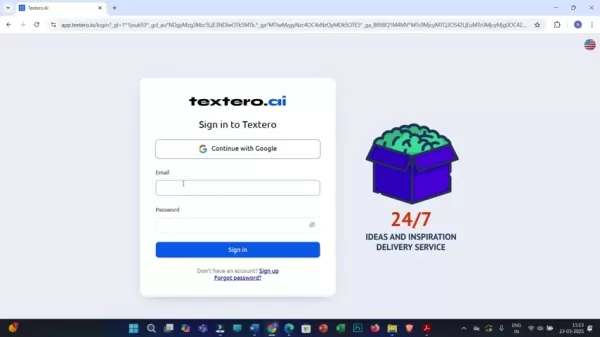
Go to Textero.ai to access the platform.
- Sign Up or Log In: Create a new account with basic details, or log in using your Google account for faster access.
After logging in, you’ll be taken to the dashboard, which features a user-friendly interface with various options for creating and managing documents.
Exploring Key Features and Functionalities
Navigating Textero AI’s interface reveals a suite of powerful features designed for academic writing. Here’s how to access and use the main functions:
- Creating a Document: Click ‘Create a Document’ to begin a new writing project.
This opens a blank document where you can start writing or paste existing text.
- Using the Essay Topic Finder: If you need topic ideas, use the ‘Essay Topic Finder’ to explore unique options. Enter a keyword to get a list of relevant essay and research topics.
- Generating an Essay: To generate an essay, paste your topic, choose the number of pages, select your sources (from your library or let Textero AI find external ones), pick a citation style, and click ‘Generate.’
- Checking for Plagiarism and AI:
Once your document is generated, use the ‘Detection’ feature to check for plagiarism and AI content. This helps ensure your work is original.
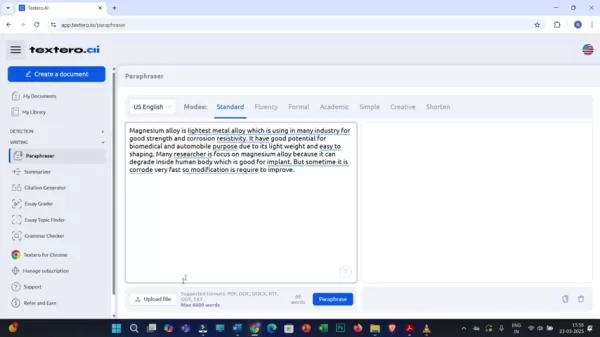
- Using the Paraphraser:
To rewrite text, select the text, click ‘AI Commands,’ and choose ‘Paraphrase.’ Pick a suitable mode (e.g., Academic) to rephrase the content effectively.
- Summarizing Text:

The Summarizer tool condenses long texts into shorter, manageable summaries. Select a mode (Bullet Points, Short, Medium, or Long) to customize the summary to your needs.
- Generating Citations: Use the ‘Citation Generator’ to create accurate citations. Enter the source details (webpage, journal article, or book) to generate a citation in your preferred style.
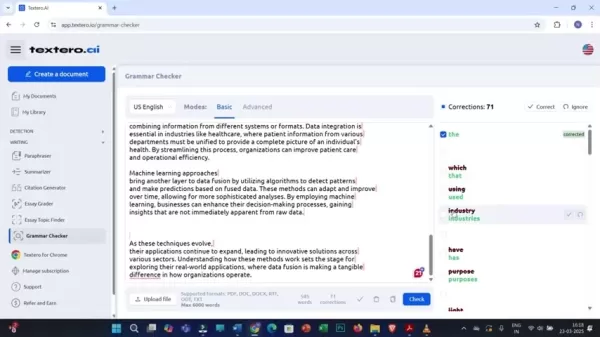
- Grammar Checking: Ensure your writing is error-free with the ‘Grammar Checker.’ Paste your text and click ‘Check’ to find and fix grammatical mistakes.
- Grading Your Essay: For feedback on your essay, use the ‘Essay Grader.’ Paste your text and click ‘Grade’ to receive suggestions for improving your document’s quality.
Understanding Textero AI Pricing
Textero AI pricing tiers
Textero AI provides several pricing plans to suit different user needs. Whether you're a student, researcher, or professional, there's likely a plan that matches your budget and requirements.
Plan Type Features Price FreeLimited access to basic featuresFreePremium (Monthly)Full access to all features, unlimited usage$XX/monthPremium (Annually)Discounted rate for full access to all features with a yearly commitment$YY/yearVisit the official Textero AI website for the latest pricing details, including any special promotions or discounts.
Textero AI: Weighing the Pros
and Cons
Pros
Extensive Source Database: Access to over 250 million verified sources ensures data accuracy and reliability.
Comprehensive Feature Integration: Combines multiple essential writing tools in one platform.
High-Quality Content: Trained on 15 million human-written essays, delivering natural, human-like writing.
Efficiency: Streamlines research and writing workflows, saving time and boosting productivity.
User-Friendly Interface: Simple and intuitive design makes it easy to navigate and use all features.
Plagiarism and AI Detection: Helps maintain academic integrity by identifying unoriginal content.
Cons
Dependence on AI: Over-reliance on AI may impede the development of critical thinking and writing skills.
Cost: Premium plans may be costly for some users.
Limited Creativity: AI-generated content might lack the creativity and subtlety of human writing.
Potential for Inaccuracy: Although connected to verified sources, AI-generated content could still contain errors that need human review.
Learning Curve: New users might need time to fully grasp and utilize all features effectively.
Core Features of Textero AI
Content Generation and Rewriting
Textero AI excels at generating and rewriting content, helping users overcome writer’s block and enhance existing text. The AI can produce original content based on a given topic or rewrite current text to improve clarity, coherence, and style. This feature is especially useful for researchers who need to produce large volumes of written material quickly.
AI-Driven Summarization
Textero AI’s summarization feature allows users to condense long articles, papers, and documents into shorter, more digestible summaries. This is invaluable for literature reviews, enabling researchers to quickly capture the main points of multiple sources. The tool offers various summarization modes, including bullet points, short summaries, medium summaries, and long summaries, to suit different needs.
Plagiarism and AI Content Detection
Maintaining originality in academic work is essential. Textero AI includes strong plagiarism detection tools that compare your content against millions of sources to spot any unoriginal text. Additionally, the AI content detection feature helps identify sections that might be flagged as AI-generated, allowing you to adjust your writing for a more natural tone.
Automated Citation Generation
Citations are a critical part of academic writing, and Textero AI simplifies the process with its automated citation generation tool. Users can input source details (webpage, journal article, or book) and generate citations in their preferred style (APA, MLA, Chicago, etc.). This feature ensures all sources are properly cited, saving time and reducing the risk of accidental plagiarism.
Grammar and Readability Enhancement
Textero AI includes a comprehensive grammar checker that identifies and corrects spelling, grammar, and punctuation errors. The tool also offers suggestions for improving text readability, ensuring your writing is clear, concise, and engaging. By enhancing overall writing quality, Textero AI helps you communicate your ideas more effectively.
Effective Use Cases for Textero AI
Literature Reviews
Textero AI simplifies literature reviews by quickly summarizing multiple sources and identifying key themes and arguments. This lets researchers efficiently gather information and build a thorough understanding of their research area.
Generating Original Content
When facing writer’s block, Textero AI can help by generating original content based on a given topic. The AI can produce outlines, drafts, and even complete papers, providing a foundation that users can then refine and expand.
Improving Writing Quality
Textero AI enhances academic writing quality by spotting and correcting grammar, spelling, and punctuation errors. The tool also suggests improvements for clarity, coherence, and style, ensuring your writing is polished and professional.
Ensuring Academic Integrity
Textero AI’s plagiarism detection feature helps users maintain academic integrity by identifying unoriginal text. This ensures all content is properly attributed, lowering the risk of plagiarism and upholding ethical research standards.
Frequently Asked Questions About Textero AI
How accurate is Textero AI?
Textero AI is linked to over 250 million verified sources, ensuring the data it uses is accurate and reliable. However, as with any AI tool, it’s important to review and verify the generated content to make sure it aligns with your research and academic standards. Always cross-check information with trusted sources and make any needed adjustments.
Can Textero AI replace human writers?
While Textero AI can greatly assist with various writing tasks, it isn’t meant to replace human writers. Instead, it acts as a powerful tool to boost productivity, overcome writer’s block, and improve writing quality. Human oversight and critical thinking are still essential to ensure the final product’s accuracy, originality, and coherence. Use Textero AI as a writing assistant to streamline your workflow, but always apply your expertise and judgment to refine and validate the content.
Is Textero AI suitable for all academic disciplines?
Textero AI is designed to be versatile and applicable across various academic fields. Its extensive database of verified sources covers a wide range of topics, making it a valuable tool for researchers and academics in diverse areas. Whether you’re in the humanities, social sciences, natural sciences, or engineering, Textero AI can assist with your writing tasks and enhance your research quality. Confirm with your academic institution that using AI tools in academic writing is permitted to avoid plagiarism concerns.
Related Questions About AI in Academic Writing
What are the ethical considerations of using AI in academic writing?
Using AI in academic writing brings several ethical considerations that researchers and academics must address. A primary concern is ensuring originality and avoiding plagiarism. AI-generated content must be properly cited and attributed to avoid presenting it as your own work. Transparency is also crucial. Disclose the use of AI tools in your research to maintain honesty and integrity. It’s equally important to critically assess the generated content for accuracy and coherence. AI can support writing tasks, but human oversight and judgment remain vital to uphold ethical standards in academic research. Always follow your institution’s guidelines and ethical codes when using AI tools in your writing process.
Related article
 Apple Smart Glasses Could Debut at WWDC27, Highlighting Privacy Protection
Bloomberg’s Mark Gurman reports that Apple’s smart glasses, codenamed N50, are slated for a WWDC27 debut in June 2027, with a retail launch expected in autumn 2027. Originally targeted for late this year and early 2027, the device’s release has been
Inside Details Exposed About Next-Gen Gemini: Strained Computing Power, Internal Teams Disagreed on Development Priorities and Resource Allocation
Reports indicate that the launch of Google’s highly anticipated next-generation Gemini model has been pushed back. Internal disagreements over development priorities and resource allocation, combined with limited computing capacity and complex approv
OpenAI Dismisses Growth Slowdown Concerns, Says Multiple Business Units Accelerating
In response to external scrutiny regarding decelerating sales growth and missed internal benchmarks, AI leader OpenAI issued a confident statement on Tuesday, April 28. The company clarified that its consumer products and enterprise services are adva
Related Special Topic Recommendations
Data Analysis
Apple Smart Glasses Could Debut at WWDC27, Highlighting Privacy Protection
Bloomberg’s Mark Gurman reports that Apple’s smart glasses, codenamed N50, are slated for a WWDC27 debut in June 2027, with a retail launch expected in autumn 2027. Originally targeted for late this year and early 2027, the device’s release has been
Inside Details Exposed About Next-Gen Gemini: Strained Computing Power, Internal Teams Disagreed on Development Priorities and Resource Allocation
Reports indicate that the launch of Google’s highly anticipated next-generation Gemini model has been pushed back. Internal disagreements over development priorities and resource allocation, combined with limited computing capacity and complex approv
OpenAI Dismisses Growth Slowdown Concerns, Says Multiple Business Units Accelerating
In response to external scrutiny regarding decelerating sales growth and missed internal benchmarks, AI leader OpenAI issued a confident statement on Tuesday, April 28. The company clarified that its consumer products and enterprise services are adva
Related Special Topic Recommendations
Data Analysis
 AI SQL Copilots for Revenue Dashboards, Funnel Analysis, and Product Metrics
2026 Latest Best AI SQL Copilots Ranked Top-Rated! XIX.AI curates a powerful game-changing collection for weekly updated real-world tests. These must-try tools help you generate accurate revenue dashboards, analyze sales funnels, and track product metrics swiftly, boosting productivity massively. Explore now to Discover your perfect tool for data-driven decision making! 238 characters
 9 tools
 xix.ai
Music composition
Best AI Melody Writing Tools for Song Drafts
xix.ai
Music composition
Best AI Melody Writing Tools for Song Drafts
2026 Latest Best Top-Rated AI Melody Writing Tools for Song Drafts! XIX.AI has curated a highly powerful game-changing collection that goes through rigorous real-world tests to deliver the best writing experience. You can find detailed free vs paid comparisons, accurate rankings, and must-try options designed to help you create stunning song drafts effortlessly and boost your creative productivity significantly. Explore now to discover your perfect tool!
8 tools
xix.ai
chatbot
Best AI Conversation Trainer Tools for Interview Practice
2026 Latest Best Top-rated AI Conversation Trainer Tools for Interview Practice are here on XIX.AI! This curated collection features powerful, game-changing tools that go through rigorous real-world tests to deliver accurate feedback. You’ll find a free vs paid comparison and detailed rankings to help you choose the must-try option that boosts your confidence and skills. Explore now to Discover your perfect tool for interview success!
12 tools
xix.ai
Design & Art
Best AI Style Transfer Tools for Creative Experiments
2026 Latest Best Top-rated AI Style Transfer Tools for Creative Experiments! XIX.AI has curated a powerful, game-changing collection of must-try tools that deliver exceptional results through real-world tests and rigorous rankings. These top solutions help creatives boost productivity significantly by accelerating content creation and unlocking endless creative possibilities. Explore now to discover your perfect tool and start creating today!
9 tools
xix.ai
Comic Creation
Best AI Dialogue Bubble Tools for Visual Storytelling
2026 Latest Best Top-Rated AI Dialogue Bubble Tools for Visual Storytelling are here on XIX.AI! This curated collection features powerful, game-changing tools that help creators boost productivity and overcome creative bottlenecks. Get a free vs paid comparison, see real-world tests, and check the latest rankings to find the must-try solutions perfect for crafting engaging visual narratives. Explore now to discover your ideal tool!
10 tools
xix.ai
Meeting Assistant
Top AI Meeting Summary Tools: Track Decisions and Follow-Ups Clearly
2026 Latest Top-Rated Best AI Meeting Summary Tools for Clear Decision Tracking and Effortless Follow-Ups. This curated list showcases powerful, game-changing solutions that boost productivity dramatically by automating meeting notes, identifying key action items, and streamlining team coordination across all projects. Get a free vs paid comparison along with real-world tests and weekly updated rankings to help you find the perfect tool. Explore now to unlock your AI edge!
9 tools
xix.ai

 Comments (0)
0/500
Comments (0)
0/500
AI-driven research tools are revolutionizing academic writing by providing powerful solutions for content creation, text rewriting, and citation generation. Consolidating these functions into a single platform significantly boosts productivity and accuracy. This review focuses on Textero.ai, an all-in-one AI tool developed to simplify academic and research writing. With its extensive database of verified sources and comprehensive feature set, Textero AI aims to transform how researchers and academics handle writing projects. This guide offers a detailed examination of Textero AI, covering its capabilities, advantages, and real-world uses to help you decide if it’s the right fit for improving your research and writing process.
Key Points
Textero AI is an AI-powered tool for academic and research writing.
It draws from a database of over 250 million verified sources to ensure data reliability.
Provides a unified platform for rewriting, summarizing, and detecting AI-generated or plagiarized content.
Trained on 15 million human-written essays to deliver high-quality, natural-sounding text.
What is Textero AI?
An In-Depth Look at Textero AI
Textero AI is an innovative platform built to support academics and researchers throughout the writing process.
It stands out by integrating multiple AI-powered tools into a seamless interface, offering functions like content generation, rewriting, summarization, and citation creation. Textero AI is designed to make research and writing workflows more efficient and less time-intensive.
A major benefit of Textero AI is its connection to a vast collection of over 250 million verified sources. This guarantees that any data generated or sourced through the platform is based on authentic and trustworthy information, strengthening the credibility of your research. The tool addresses a broad spectrum of academic writing needs, from composing literature reviews to producing original content. What makes Textero AI unique is its ability to bring all these features together in one platform, eliminating the need for multiple tools and boosting productivity.
Textero AI has been trained using a massive dataset of 15 million human-written essays. This ensures the AI-generated content maintains high quality and closely mirrors human writing—a key factor for academic acceptance. The platform includes several powerful features, such as the ability to base writing on custom sources, verified in-text citations, and AI-driven writing assistance, making it a versatile resource for academic work. Textero AI serves as a comprehensive solution, meeting the diverse demands of academic writing through a single, integrated interface.
Key Features Offered by Textero AI:
- Content rewriting and paraphrasing.
- Text summarization.
- AI content detection.
- Plagiarism checking.
- Citation generation.
- Essay topic finding.
- Grammar checking.
- Essay grading.
Why Choose Textero AI Over Other AI Tools?
Textero AI sets itself apart from general AI writing tools like ChatGPT by specializing in academic and research writing. Unlike broad-purpose AI, Textero AI is trained on academic datasets, ensuring the content it produces meets scholarly standards and conventions. This focus delivers several important advantages:
- Enhanced Accuracy and Reliability: With access to over 250 million academic sources, Textero AI reduces the risk of generating incorrect or fabricated information, a common problem with general AI models.
- Tailored for Academic Writing: The tool is built to handle the specific demands of academic papers, including proper citation formats and adherence to scholarly styles.
- Comprehensive Feature Integration: Textero AI combines multiple essential writing tools in one platform, streamlining your workflow and removing the need for several subscriptions.
- Human-Like Writing Quality: Trained on 15 million human-written essays, Textero AI generates content that closely resembles human writing, which is vital for academic credibility.
While general AI tools can help with writing tasks, Textero AI offers a more specialized, dependable, and efficient solution for academic and research writing, making it the top choice for scholars and researchers.
How to Use Textero AI
Getting Started with Textero AI
Using Textero AI is simple. Begin by visiting the official website and setting up an account. Here are the initial steps to get started:
- Visit the Official Website:
Go to Textero.ai to access the platform.
- Sign Up or Log In: Create a new account with basic details, or log in using your Google account for faster access.
After logging in, you’ll be taken to the dashboard, which features a user-friendly interface with various options for creating and managing documents.
Exploring Key Features and Functionalities
Navigating Textero AI’s interface reveals a suite of powerful features designed for academic writing. Here’s how to access and use the main functions:
- Creating a Document: Click ‘Create a Document’ to begin a new writing project.
This opens a blank document where you can start writing or paste existing text.
- Using the Essay Topic Finder: If you need topic ideas, use the ‘Essay Topic Finder’ to explore unique options. Enter a keyword to get a list of relevant essay and research topics.
- Generating an Essay: To generate an essay, paste your topic, choose the number of pages, select your sources (from your library or let Textero AI find external ones), pick a citation style, and click ‘Generate.’
- Checking for Plagiarism and AI:
Once your document is generated, use the ‘Detection’ feature to check for plagiarism and AI content. This helps ensure your work is original.
- Using the Paraphraser:
To rewrite text, select the text, click ‘AI Commands,’ and choose ‘Paraphrase.’ Pick a suitable mode (e.g., Academic) to rephrase the content effectively.
- Summarizing Text:
The Summarizer tool condenses long texts into shorter, manageable summaries. Select a mode (Bullet Points, Short, Medium, or Long) to customize the summary to your needs.
- Generating Citations: Use the ‘Citation Generator’ to create accurate citations. Enter the source details (webpage, journal article, or book) to generate a citation in your preferred style.
- Grammar Checking: Ensure your writing is error-free with the ‘Grammar Checker.’ Paste your text and click ‘Check’ to find and fix grammatical mistakes.
- Grading Your Essay: For feedback on your essay, use the ‘Essay Grader.’ Paste your text and click ‘Grade’ to receive suggestions for improving your document’s quality.
Understanding Textero AI Pricing
Textero AI pricing tiers
Textero AI provides several pricing plans to suit different user needs. Whether you're a student, researcher, or professional, there's likely a plan that matches your budget and requirements.
Visit the official Textero AI website for the latest pricing details, including any special promotions or discounts.
Textero AI: Weighing the Pros
and Cons
Pros
Extensive Source Database: Access to over 250 million verified sources ensures data accuracy and reliability.
Comprehensive Feature Integration: Combines multiple essential writing tools in one platform.
High-Quality Content: Trained on 15 million human-written essays, delivering natural, human-like writing.
Efficiency: Streamlines research and writing workflows, saving time and boosting productivity.
User-Friendly Interface: Simple and intuitive design makes it easy to navigate and use all features.
Plagiarism and AI Detection: Helps maintain academic integrity by identifying unoriginal content.
Cons
Dependence on AI: Over-reliance on AI may impede the development of critical thinking and writing skills.
Cost: Premium plans may be costly for some users.
Limited Creativity: AI-generated content might lack the creativity and subtlety of human writing.
Potential for Inaccuracy: Although connected to verified sources, AI-generated content could still contain errors that need human review.
Learning Curve: New users might need time to fully grasp and utilize all features effectively.
Core Features of Textero AI
Content Generation and Rewriting
Textero AI excels at generating and rewriting content, helping users overcome writer’s block and enhance existing text. The AI can produce original content based on a given topic or rewrite current text to improve clarity, coherence, and style. This feature is especially useful for researchers who need to produce large volumes of written material quickly.
AI-Driven Summarization
Textero AI’s summarization feature allows users to condense long articles, papers, and documents into shorter, more digestible summaries. This is invaluable for literature reviews, enabling researchers to quickly capture the main points of multiple sources. The tool offers various summarization modes, including bullet points, short summaries, medium summaries, and long summaries, to suit different needs.
Plagiarism and AI Content Detection
Maintaining originality in academic work is essential. Textero AI includes strong plagiarism detection tools that compare your content against millions of sources to spot any unoriginal text. Additionally, the AI content detection feature helps identify sections that might be flagged as AI-generated, allowing you to adjust your writing for a more natural tone.
Automated Citation Generation
Citations are a critical part of academic writing, and Textero AI simplifies the process with its automated citation generation tool. Users can input source details (webpage, journal article, or book) and generate citations in their preferred style (APA, MLA, Chicago, etc.). This feature ensures all sources are properly cited, saving time and reducing the risk of accidental plagiarism.
Grammar and Readability Enhancement
Textero AI includes a comprehensive grammar checker that identifies and corrects spelling, grammar, and punctuation errors. The tool also offers suggestions for improving text readability, ensuring your writing is clear, concise, and engaging. By enhancing overall writing quality, Textero AI helps you communicate your ideas more effectively.
Effective Use Cases for Textero AI
Literature Reviews
Textero AI simplifies literature reviews by quickly summarizing multiple sources and identifying key themes and arguments. This lets researchers efficiently gather information and build a thorough understanding of their research area.
Generating Original Content
When facing writer’s block, Textero AI can help by generating original content based on a given topic. The AI can produce outlines, drafts, and even complete papers, providing a foundation that users can then refine and expand.
Improving Writing Quality
Textero AI enhances academic writing quality by spotting and correcting grammar, spelling, and punctuation errors. The tool also suggests improvements for clarity, coherence, and style, ensuring your writing is polished and professional.
Ensuring Academic Integrity
Textero AI’s plagiarism detection feature helps users maintain academic integrity by identifying unoriginal text. This ensures all content is properly attributed, lowering the risk of plagiarism and upholding ethical research standards.
Frequently Asked Questions About Textero AI
How accurate is Textero AI?
Textero AI is linked to over 250 million verified sources, ensuring the data it uses is accurate and reliable. However, as with any AI tool, it’s important to review and verify the generated content to make sure it aligns with your research and academic standards. Always cross-check information with trusted sources and make any needed adjustments.
Can Textero AI replace human writers?
While Textero AI can greatly assist with various writing tasks, it isn’t meant to replace human writers. Instead, it acts as a powerful tool to boost productivity, overcome writer’s block, and improve writing quality. Human oversight and critical thinking are still essential to ensure the final product’s accuracy, originality, and coherence. Use Textero AI as a writing assistant to streamline your workflow, but always apply your expertise and judgment to refine and validate the content.
Is Textero AI suitable for all academic disciplines?
Textero AI is designed to be versatile and applicable across various academic fields. Its extensive database of verified sources covers a wide range of topics, making it a valuable tool for researchers and academics in diverse areas. Whether you’re in the humanities, social sciences, natural sciences, or engineering, Textero AI can assist with your writing tasks and enhance your research quality. Confirm with your academic institution that using AI tools in academic writing is permitted to avoid plagiarism concerns.
Related Questions About AI in Academic Writing
What are the ethical considerations of using AI in academic writing?
Using AI in academic writing brings several ethical considerations that researchers and academics must address. A primary concern is ensuring originality and avoiding plagiarism. AI-generated content must be properly cited and attributed to avoid presenting it as your own work. Transparency is also crucial. Disclose the use of AI tools in your research to maintain honesty and integrity. It’s equally important to critically assess the generated content for accuracy and coherence. AI can support writing tasks, but human oversight and judgment remain vital to uphold ethical standards in academic research. Always follow your institution’s guidelines and ethical codes when using AI tools in your writing process.








 Apple Smart Glasses Could Debut at WWDC27, Highlighting Privacy Protection
Bloomberg’s Mark Gurman reports that Apple’s smart glasses, codenamed N50, are slated for a WWDC27 debut in June 2027, with a retail launch expected in autumn 2027. Originally targeted for late this year and early 2027, the device’s release has been
Apple Smart Glasses Could Debut at WWDC27, Highlighting Privacy Protection
Bloomberg’s Mark Gurman reports that Apple’s smart glasses, codenamed N50, are slated for a WWDC27 debut in June 2027, with a retail launch expected in autumn 2027. Originally targeted for late this year and early 2027, the device’s release has been
 Inside Details Exposed About Next-Gen Gemini: Strained Computing Power, Internal Teams Disagreed on Development Priorities and Resource Allocation
Reports indicate that the launch of Google’s highly anticipated next-generation Gemini model has been pushed back. Internal disagreements over development priorities and resource allocation, combined with limited computing capacity and complex approv
Inside Details Exposed About Next-Gen Gemini: Strained Computing Power, Internal Teams Disagreed on Development Priorities and Resource Allocation
Reports indicate that the launch of Google’s highly anticipated next-generation Gemini model has been pushed back. Internal disagreements over development priorities and resource allocation, combined with limited computing capacity and complex approv
 OpenAI Dismisses Growth Slowdown Concerns, Says Multiple Business Units Accelerating
In response to external scrutiny regarding decelerating sales growth and missed internal benchmarks, AI leader OpenAI issued a confident statement on Tuesday, April 28. The company clarified that its consumer products and enterprise services are adva
OpenAI Dismisses Growth Slowdown Concerns, Says Multiple Business Units Accelerating
In response to external scrutiny regarding decelerating sales growth and missed internal benchmarks, AI leader OpenAI issued a confident statement on Tuesday, April 28. The company clarified that its consumer products and enterprise services are adva
2026 Latest Best AI SQL Copilots Ranked Top-Rated! XIX.AI curates a powerful game-changing collection for weekly updated real-world tests. These must-try tools help you generate accurate revenue dashboards, analyze sales funnels, and track product metrics swiftly, boosting productivity massively. Explore now to Discover your perfect tool for data-driven decision making! 238 characters
9 tools
xix.ai
2026 Latest Best Top-Rated AI Melody Writing Tools for Song Drafts! XIX.AI has curated a highly powerful game-changing collection that goes through rigorous real-world tests to deliver the best writing experience. You can find detailed free vs paid comparisons, accurate rankings, and must-try options designed to help you create stunning song drafts effortlessly and boost your creative productivity significantly. Explore now to discover your perfect tool!
8 tools
xix.ai
2026 Latest Best Top-rated AI Conversation Trainer Tools for Interview Practice are here on XIX.AI! This curated collection features powerful, game-changing tools that go through rigorous real-world tests to deliver accurate feedback. You’ll find a free vs paid comparison and detailed rankings to help you choose the must-try option that boosts your confidence and skills. Explore now to Discover your perfect tool for interview success!
12 tools
xix.ai

2026 Latest Best Top-rated AI Style Transfer Tools for Creative Experiments! XIX.AI has curated a powerful, game-changing collection of must-try tools that deliver exceptional results through real-world tests and rigorous rankings. These top solutions help creatives boost productivity significantly by accelerating content creation and unlocking endless creative possibilities. Explore now to discover your perfect tool and start creating today!
9 tools
xix.ai
2026 Latest Best Top-Rated AI Dialogue Bubble Tools for Visual Storytelling are here on XIX.AI! This curated collection features powerful, game-changing tools that help creators boost productivity and overcome creative bottlenecks. Get a free vs paid comparison, see real-world tests, and check the latest rankings to find the must-try solutions perfect for crafting engaging visual narratives. Explore now to discover your ideal tool!
10 tools
xix.ai

2026 Latest Top-Rated Best AI Meeting Summary Tools for Clear Decision Tracking and Effortless Follow-Ups. This curated list showcases powerful, game-changing solutions that boost productivity dramatically by automating meeting notes, identifying key action items, and streamlining team coordination across all projects. Get a free vs paid comparison along with real-world tests and weekly updated rankings to help you find the perfect tool. Explore now to unlock your AI edge!
9 tools
xix.ai












