

 Home
Superconductor Launches as Rust-Based AI Agent Tool, Integrating Claude and Gemini
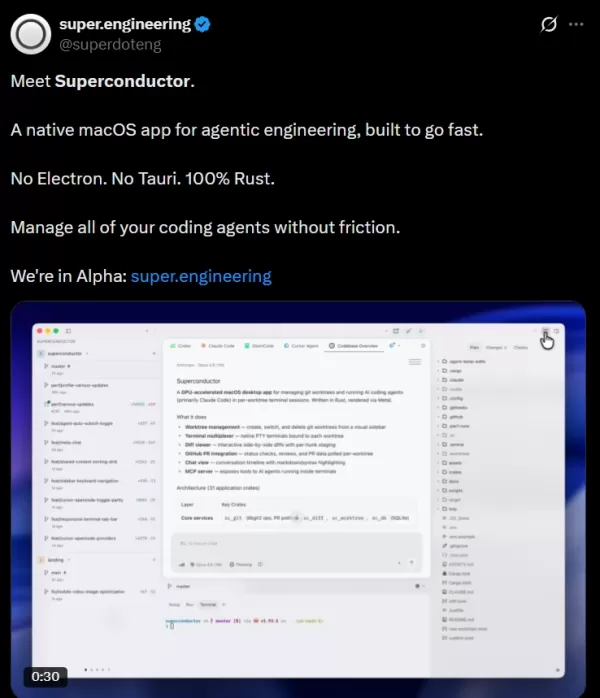
The AI coding tools landscape has just welcomed a significant new entrant. A software named Superconductor, an Agent aggregator, has officially entered its Alpha testing phase. Built with 100% native Rust and no Electron framework, it has rapidly captured developer attention. It enables users to launch and manage multiple leading AI coding agents within a single unified interface, facilitating seamless parallel work and substantially boosting efficiency for complex project development.
Superconductor's Core Positioning
Superconductor is a native macOS application built for "agentic engineering." It completely departs from traditional Electron or Tauri frameworks, utilizing pure Rust and Metal GPU-accelerated terminal rendering. With startup times under 50 milliseconds and exceptionally low memory usage, it is designed for developers who demand ultimate speed and a fluid experience. Currently, it supports macOS only, with Windows and Linux versions planned.
Experience it here: https://super.engineering/
A Unified Hub for Multiple Agents, Liberating Your Workflow
The software's standout feature is its powerful agent aggregation capability. Users can simultaneously launch and run Claude Code, Codex, Gemini CLI, OpenCode, Cursor Agent, and any custom CLI coding agent within one application, eliminating the need to switch between multiple CLI tools. All agents run as native child processes, supporting unlimited parallel tabs and independent workspaces, making it ideal for multitasking and large-scale code engineering.
Isolated Git Worktrees & Deep Integration for an Automated Loop
Superconductor incorporates an isolated Git worktree mechanism that automatically provisions a separate environment for each agent, preventing conflicts. It also integrates a complete Git workflow: real-time diff viewing, branch management, PR creation, conflict resolution, and merging are all achievable with a click. It supports cross-repository collaboration. Users can quickly execute commit, push, and create PR operations via smart action buttons, drastically reducing manual, repetitive steps. Additionally, the software offers session persistence for seamless context resumption after interruptions and supports native macOS notifications.
Highly Customizable, Keyboard-Optimized Experience
To meet professional developers' needs, Superconductor supports flexible layouts (stacked, horizontal, bottom terminal, etc.), picture-in-picture floating tabs, dark/light/system theme switching, and customizable colors, fonts, and keyboard shortcuts. Users can also configure setup, run, and cleanup scripts for different repositories and customize commands and prompt templates at both global and project levels, enabling highly personalized workflow tailoring. All data is stored locally with no telemetry or data collection, ensuring complete privacy and security.
Superior Performance & Architectural Advantages
Unlike web-based tools often limited to 5-7 agents, Superconductor leverages its native architecture to fully harness hardware resources for genuine unlimited parallelism. GPU-accelerated terminals, multi-session terminal reusers, rich-text chat interfaces, and free switching between rich-text and native terminals give it significant advantages in speed, stability, and scalability over similar products. Currently in Alpha, interested developers can download and try it via the official website: https://super.engineering/.
AIbase Review
Related article
 Former OpenAI Researcher Barrett Zoph Returns to Google to Support Gemini Development
Barret Zoph, who previously abruptly left and joined OpenAI due to a disagreement with Thinking Machines Lab CEO Miriam Mularati, has once again changed employers. Alphabet's Google announced that Zoph will return as Vice President of Research, bring
How Recursive Intelligence Raised $335M at $4B Valuation in 4 Months
The co-founders of startup Ricursive Intelligence seemed destined to be co-founders.Anna Goldie, CEO, and Azalia Mirhoseini, CTO, are so well-known in the AI community that they were among those AI engineers who “got those weird emails from Zuckerber
AI race won’t wait, nor will this TechCrunch Disrupt 25% discount
Every founder building in AI right now is asking the same question: Are we moving fast enough, and effectively enough? TechCrunch Disrupt 2026 puts you in the same room as the people wrestling with that existential question at the highest levels. Fro
Related Special Topic Recommendations
Design & Art
 Top AI Illustration Tools: Create Editorial Scenes and Cover Art Faster
2026 Latest Top-rated AI Illustration Tools: Our curated list features the best powerfully designed tools for creating stunning editorial scenes and eye-catching cover art quickly. Each option has gone through rigorous real-world tests, offering a free vs paid comparison to help you find the perfect match for your workflow. Try these must-try solutions today to unlock your AI edge and boost your creative productivity. Explore now at XIX.AI.
 10 tools
 xix.ai
Education and Learning
Top AI Tutors for Exam Prep: Practice Math, Science, and English
2026 Latest Top-Rated Best AI Tutors for Exam Prep are here on XIX.AI! Our curated list features powerful game-changing tools that offer free vs paid comparison, real-world tests, and weekly updated rankings. They help boost your writing efficiency, simplify complex topic learning, and unlock your academic potential. Explore now to Discover your perfect exam prep tool and Start creating today to Unlock your AI edge!
10 tools
xix.ai
Finance
AI Budget Planning Tools for Personal Money Management
2026 Latest Best Top-Rated AI Budget Planning Tools for Personal Money Management are here on XIX.AI! This curated collection features powerful, game-changing solutions that help you conduct real-world tests, understand spending habits, and create personalized plans to boost productivity. Enjoy a free vs paid comparison along with detailed rankings. Must-try tools designed to simplify money management and unlock your AI edge. Explore now!
11 tools
xix.ai
Health & Wellness
AI Sleep Tracking Assistants: Improve Recovery with Better Bedtime Habits
2026 Latest Best Top-Rated AI Sleep Tracking Assistants curated for ultimate recovery. This fully updated weekly guide features powerful tools that deliver real-world tests, free vs paid comparison, and detailed rankings to help you find the must-try solution that boosts sleep quality and supports better bedtime habits. Explore now at XIX.AI to Unlock your AI edge.
10 tools
xix.ai
Data Analysis
AI SQL Copilots for Product and Revenue Analytics
2026 Latest Best Top-Rated AI SQL Copilots for Product and Revenue Analytics! XIX.AI has curated a powerful, game-changing collection of must-try tools that undergo real-world tests through weekly updated rankings. These tools help users boost productivity significantly by accelerating data analysis, streamlining complex queries, and generating accurate insights to drive smarter business decisions. Explore now to Discover your perfect tool for unlocking your AI edge!
14 tools
xix.ai
Education and Learning
Best AI Homework Helpers That Teach: Learn Concepts, Not Just Answers
2026 Latest Best Top-Rated AI Homework Helpers That Teach Core Concepts Not Just Answers Powerful Tools for Students Must-Try Curated List Weekly Updated Free vs Paid Comparison Real-World Tests Accurate Rankings to Help You Unlock Your Full Learning Potential Explore now to Discover your perfect tool for smarter studying.
10 tools
xix.ai

 Comments (0)
0/500
The AI coding tools landscape has just welcomed a significant new entrant. A software named Superconductor, an Agent aggregator, has officially entered its Alpha testing phase. Built with 100% native Rust and no Electron framework, it has rapidly captured developer attention. It enables users to launch and manage multiple leading AI coding agents within a single unified interface, facilitating seamless parallel work and substantially boosting efficiency for complex project development.
Superconductor's Core Positioning
Superconductor is a native macOS application built for "agentic engineering." It completely departs from traditional Electron or Tauri frameworks, utilizing pure Rust and Metal GPU-accelerated terminal rendering. With startup times under 50 milliseconds and exceptionally low memory usage, it is designed for developers who demand ultimate speed and a fluid experience. Currently, it supports macOS only, with Windows and Linux versions planned.
Experience it here: https://super.engineering/
A Unified Hub for Multiple Agents, Liberating Your Workflow
The software's standout feature is its powerful agent aggregation capability. Users can simultaneously launch and run Claude Code, Codex, Gemini CLI, OpenCode, Cursor Agent, and any custom CLI coding agent within one application, eliminating the need to switch between multiple CLI tools. All agents run as native child processes, supporting unlimited parallel tabs and independent workspaces, making it ideal for multitasking and large-scale code engineering.
Isolated Git Worktrees & Deep Integration for an Automated Loop
Superconductor incorporates an isolated Git worktree mechanism that automatically provisions a separate environment for each agent, preventing conflicts. It also integrates a complete Git workflow: real-time diff viewing, branch management, PR creation, conflict resolution, and merging are all achievable with a click. It supports cross-repository collaboration. Users can quickly execute commit, push, and create PR operations via smart action buttons, drastically reducing manual, repetitive steps. Additionally, the software offers session persistence for seamless context resumption after interruptions and supports native macOS notifications.
Highly Customizable, Keyboard-Optimized Experience
To meet professional developers' needs, Superconductor supports flexible layouts (stacked, horizontal, bottom terminal, etc.), picture-in-picture floating tabs, dark/light/system theme switching, and customizable colors, fonts, and keyboard shortcuts. Users can also configure setup, run, and cleanup scripts for different repositories and customize commands and prompt templates at both global and project levels, enabling highly personalized workflow tailoring. All data is stored locally with no telemetry or data collection, ensuring complete privacy and security.
Superior Performance & Architectural Advantages
Unlike web-based tools often limited to 5-7 agents, Superconductor leverages its native architecture to fully harness hardware resources for genuine unlimited parallelism. GPU-accelerated terminals, multi-session terminal reusers, rich-text chat interfaces, and free switching between rich-text and native terminals give it significant advantages in speed, stability, and scalability over similar products. Currently in Alpha, interested developers can download and try it via the official website: https://super.engineering/.
AIbase Review








 Former OpenAI Researcher Barrett Zoph Returns to Google to Support Gemini Development
Barret Zoph, who previously abruptly left and joined OpenAI due to a disagreement with Thinking Machines Lab CEO Miriam Mularati, has once again changed employers. Alphabet's Google announced that Zoph will return as Vice President of Research, bring
 How Recursive Intelligence Raised $335M at $4B Valuation in 4 Months
The co-founders of startup Ricursive Intelligence seemed destined to be co-founders.Anna Goldie, CEO, and Azalia Mirhoseini, CTO, are so well-known in the AI community that they were among those AI engineers who “got those weird emails from Zuckerber
 AI race won’t wait, nor will this TechCrunch Disrupt 25% discount
Every founder building in AI right now is asking the same question: Are we moving fast enough, and effectively enough? TechCrunch Disrupt 2026 puts you in the same room as the people wrestling with that existential question at the highest levels. Fro

2026 Latest Top-rated AI Illustration Tools: Our curated list features the best powerfully designed tools for creating stunning editorial scenes and eye-catching cover art quickly. Each option has gone through rigorous real-world tests, offering a free vs paid comparison to help you find the perfect match for your workflow. Try these must-try solutions today to unlock your AI edge and boost your creative productivity. Explore now at XIX.AI.
10 tools
xix.ai

2026 Latest Top-Rated Best AI Tutors for Exam Prep are here on XIX.AI! Our curated list features powerful game-changing tools that offer free vs paid comparison, real-world tests, and weekly updated rankings. They help boost your writing efficiency, simplify complex topic learning, and unlock your academic potential. Explore now to Discover your perfect exam prep tool and Start creating today to Unlock your AI edge!
10 tools
xix.ai

2026 Latest Best Top-Rated AI Budget Planning Tools for Personal Money Management are here on XIX.AI! This curated collection features powerful, game-changing solutions that help you conduct real-world tests, understand spending habits, and create personalized plans to boost productivity. Enjoy a free vs paid comparison along with detailed rankings. Must-try tools designed to simplify money management and unlock your AI edge. Explore now!
11 tools
xix.ai

2026 Latest Best Top-Rated AI Sleep Tracking Assistants curated for ultimate recovery. This fully updated weekly guide features powerful tools that deliver real-world tests, free vs paid comparison, and detailed rankings to help you find the must-try solution that boosts sleep quality and supports better bedtime habits. Explore now at XIX.AI to Unlock your AI edge.
10 tools
xix.ai

2026 Latest Best Top-Rated AI SQL Copilots for Product and Revenue Analytics! XIX.AI has curated a powerful, game-changing collection of must-try tools that undergo real-world tests through weekly updated rankings. These tools help users boost productivity significantly by accelerating data analysis, streamlining complex queries, and generating accurate insights to drive smarter business decisions. Explore now to Discover your perfect tool for unlocking your AI edge!
14 tools
xix.ai

2026 Latest Best Top-Rated AI Homework Helpers That Teach Core Concepts Not Just Answers Powerful Tools for Students Must-Try Curated List Weekly Updated Free vs Paid Comparison Real-World Tests Accurate Rankings to Help You Unlock Your Full Learning Potential Explore now to Discover your perfect tool for smarter studying.
10 tools
xix.ai