


 Home
HomeSAP data conversion in 2025? A complete migration strategy guide for 2025.
Data conversion and migration are pivotal components of any SAP implementation or upgrade initiative. A clearly outlined strategy guarantees data integrity, reduces system downtime, and significantly increases the likelihood of a successful project launch. This article explores the core components of an effective SAP data conversion and migration strategy, offering guidance on defining scope, choosing a methodology, performing a thorough data assessment, and ensuring seamless execution. By mastering these principles, project teams can reduce risks and ensure a smooth transition to the new SAP landscape. A well-structured conversion plan is fundamental to achieving precise, consistent data that underpins sound business decisions.
Key Points
A clearly defined data conversion scope is fundamental to project success.
Choosing the optimal conversion method (manual or automated) directly influences resource requirements and project schedules.
A comprehensive data assessment reveals quality issues and potential conversion hurdles.
Ensuring conversion readiness paves the way for a smooth transition and reduces post-launch complications.
Conducting dry runs is essential for validating the conversion process and uncovering potential problems.
Data cleansing must be a continuous effort throughout the entire project lifecycle.
Clear communication and thorough documentation are critical for a successful data conversion.
Understanding Data Conversion Scope and Strategy
Defining the Conversion Scope
The initial and most critical step in an SAP data conversion or migration is to meticulously define the project's scope. This process entails determining exactly which data must be converted and loaded into the new SAP system. A precise scope is essential to prevent uncontrolled expansion, manage resources efficiently, and maintain project momentum.
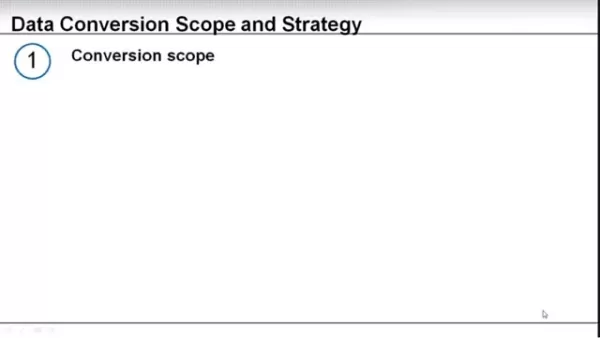
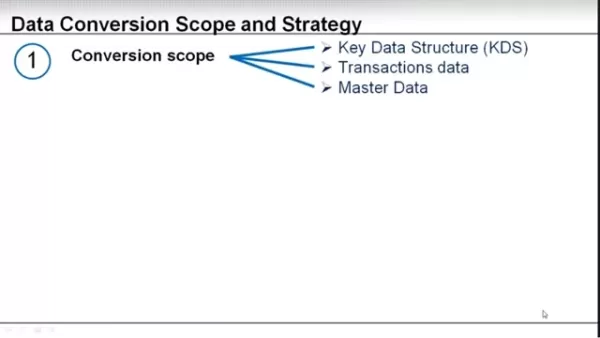
Defining the scope requires identifying the key data structures, transaction records, and master data sets that need migration.
- Key Data Structures (KDS): Pinpointing the essential data elements in the current system is a foundational task. This includes critical fields, database tables, and their interconnections that are vital for business operations. These elements must be accurately aligned with the corresponding structures in SAP.
- Transaction Data: This category includes historical records of business activities. Teams must decide which transactions, such as sales orders, purchase orders, financial entries, and inventory movements, require migration and determine the necessary historical depth for the new system.
- Master Data: Master data serves as the core reference information for business processes, including customer, vendor, material, and financial account data. Establishing a robust master data strategy is key to ensuring consistency and accuracy.
The scope should be clearly established, with its conceptual framework defined, during the business blueprint phase. Your blueprint document should detail the key data structure elements required and the primary considerations for data conversion.
Selecting the Right Conversion Method
The subsequent strategic choice involves selecting the most suitable conversion approach. Typically, projects choose between two main methods: manual entry and automated conversion. The decision depends on factors like data volume, complexity, budget, and resource availability.
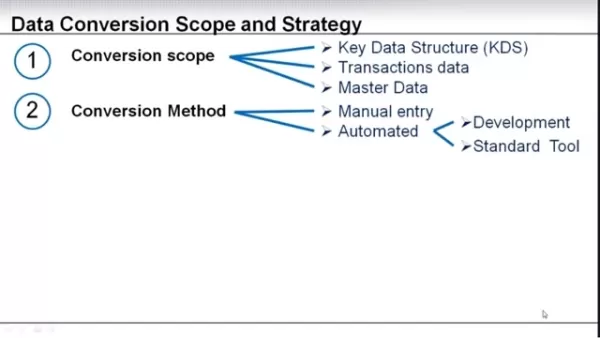
- Manual Entry: This method involves inputting data manually into the new SAP system. It is best suited for small datasets with simple structures and minimal transformation needs. However, it is labor-intensive, susceptible to human error, and can burden resources.
- Automated Conversion: This approach utilizes specialized tools and programs to extract, transform, and load data into SAP. It is ideal for large datasets, complex transformations, and scenarios where accuracy is paramount. Automation reduces manual effort, minimizes errors, and speeds up the conversion process.
When opting for automation, the next consideration is whether to develop a custom solution or use a standardized tool. The choice of tool and conversion methodology are central elements of your overall conversion strategy.
Data Assessment: Understanding Your Data Landscape
A thorough data assessment is indispensable before launching the conversion process. This evaluation provides a clear understanding of data quality, volume, and sources, while highlighting potential issues that may emerge during conversion.
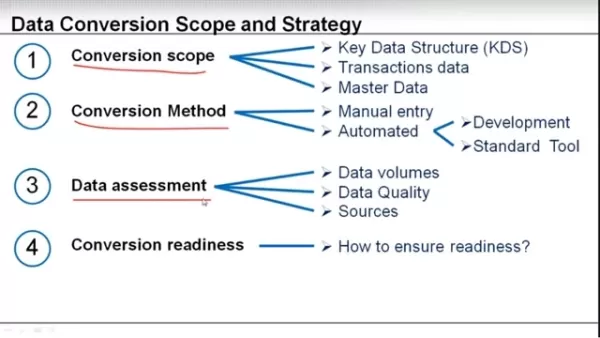
- Data Volumes: Estimating the amount of data for conversion helps determine necessary resources and timelines. It also influences the choice of conversion methods and tools, with high volumes typically requiring automation.
- Data Quality: Data quality is critical for implementation success. The assessment should evaluate the accuracy, completeness, consistency, and validity of existing data, identifying issues like missing values, duplicates, and inconsistencies.
- Sources: Understanding the various data sources is vital. These may include legacy systems, databases, spreadsheets, and external sources, each with unique formats and structures that necessitate specific extraction and transformation methods.
Accurately assessing these components is key to success and directly informs your state of conversion readiness. Readiness ensures a smooth process and helps identify potential roadblocks, such as poor data quality or excessive data volume.
Conversion Readiness and Test Runs
Conversion readiness involves confirming that all preparations are complete before the actual data transfer begins. Test runs are vital for validating the conversion process, identifying issues, and ensuring data is migrated accurately.
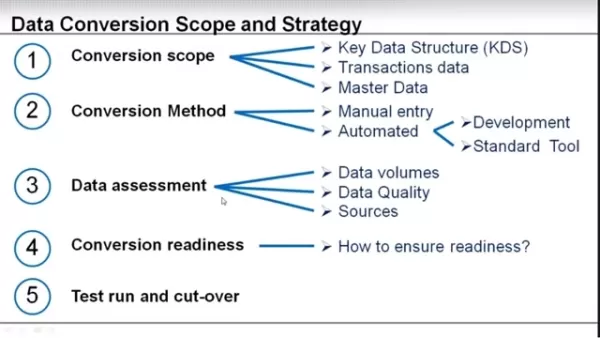
Test runs are crucial for verifying data accuracy before the final launch. Readiness for these tests requires clarity on scope and method, along with completed data assessments.
Key elements of conversion readiness include:
- Data Mapping and Transformation Rules: Ensure all mapping and transformation rules are clearly defined, documented, and validated to guarantee accurate translation of data from the old system to SAP.
- System Configuration: Verify that the SAP system is correctly configured to receive the converted data, including proper setup of data structures, validation rules, and authorization settings.
- Resource Availability: Confirm that adequate resources—including technical staff, business users, and project managers—are available to execute the conversion.
Key metrics to consider for assessing readiness include:
Metric Description Data Migration CompletionPercentage of data successfully migrated to the new system; indicates progress and potential bottlenecks in the migration process.Data Quality MetricsMeasurements of data integrity, accuracy, and consistency; alerts to data cleansing needs and errors introduced during conversion.System PerformanceKey indicators such as data load times and system responsiveness; provides insights into system readiness for handling migrated data volumes.User Acceptance testingFeedback from end-users testing the data in the new system; ensures that the data meets user needs and that any usability issues are identified before the go-live date.Issue Resolution RateThe speed at which identified data or system issues are resolved; indicates the project team’s efficiency and ability to handle problems that arise during migration, impacting overall timelines and risks.Key Data Conversion Activities: A Project Timeline
Mapping Activities to the Project Phases
Understanding where specific conversion activities fit within the overall project timeline is essential for planning and allocating resources. These activities align with the standard phases of an SAP project:
Project Preparation: Initial data conversion strategy formulation and tool selection.
Business Blueprint: Finalize conversion design and perform detailed data assessment, including "as-is" and "to-be" process models.
Realization: Build and rigorously test the data conversion programs and processes.
Final Preparation: Execute a full Dry Run of the data conversion and conduct user testing.
Go-Live & Support: Perform the final, live data conversion with full production data loads.
Throughout all phases, it is imperative to continuously track and manage the data cleansing process.
Checklist for Successful Conversion Strategy Execution
Key Steps
Executing a conversion strategy involves several critical steps that require careful consideration.
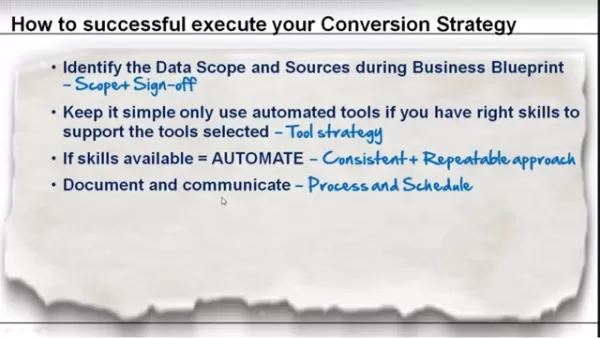
The following checklist outlines these steps and key considerations:
- Identify Data Scope and Sources: Develop an initial conversion strategy and select appropriate tools, ideally before the business blueprint phase begins.
- Keep it Simple: Employ automated tools only if your team possesses the necessary skills to support them effectively.
- If Skills are Available: Leverage automated tools for a consistent and repeatable conversion approach.
- Track Data: Monitor both data preparation and execution phases closely.
- At Least 1 Data Conversion Dry-Run: Conduct at least one comprehensive dry-run to prevent potential go-live failures.
- Data Cleansing: Begin data cleansing activities as early as possible. Do not delay this critical task; start as soon as data is available.
FAQ
What is SAP Data Conversion?
SAP Data Conversion is the process of transforming and migrating data from legacy or older SAP systems into a new SAP environment. It encompasses data extraction, cleansing, transformation to align with the new system's structures, and final loading. The objective is to ensure all vital business data is accurately and consistently available in the new system after migration.
What is data cleansing and why is it important for SAP data conversion?
Data cleansing involves correcting or removing inaccurate, incomplete, or irrelevant data. It is crucial because the reliability of the new SAP environment depends entirely on the quality of the migrated data. Clean data ensures smooth operational processes, accurate reporting, and reliable information for business decision-making.
What are some common challenges in SAP data conversion projects?
Typical challenges include poor-quality data in source systems, complex data mapping and transformation requirements, managing large data volumes, ensuring data security during the transfer, and consolidating data from multiple disparate systems. Proper planning, data profiling, and thorough testing are essential to overcoming these obstacles.
What is a dry run in SAP data conversion, and why is it important?
A dry run is a full-scale rehearsal of the data migration conducted in a test environment, without impacting the live production system. This step is critical for uncovering errors, performance issues, and flaws in conversion routines, allowing the team to resolve them before the final go-live event.
How do you handle data that doesn't fit into the new SAP data model?
Data that doesn't directly correspond to the new SAP model requires careful transformation. Solutions may include splitting data across multiple fields, combining fields, or applying default values. Thorough documentation of these transformations is essential for maintaining data integrity and ensuring future clarity on data lineage.
Related Questions
What are the key roles in an SAP Data Conversion project?
Project success relies on a cross-functional team with distinct responsibilities. Key roles typically include: Project Manager: Leads the initiative, sets direction, manages budget and timeline, and ensures team alignment.Data Architect: Oversees data modeling and architecture, aligning the SAP data environment with organizational needs and preparing it for future scalability.Data Analysts: Experts in data profiling who analyze data to identify patterns, anomalies, and inconsistencies. Their insights guide effective cleansing and conversion, ensuring data reliability.SAP Functional Consultants: Specialists in aligning business processes with SAP functionality. They design solutions for custom data transformations and validations, safeguarding data integrity.ABAP Developers: Create custom programs for extracting, transforming, and loading (ETL) data, tailored to specific business requirements.Testing Team: Conducts rigorous testing to validate the accuracy, integrity, and functionality of migrated data against business and technical specifications.Business Users: Provide crucial operational insight and data requirements. They perform User Acceptance Testing (UAT) to confirm the system meets business needs, playing a key role in final approval.Data Governance Team: Establishes data quality standards and governance policies, ensuring migrated data meets these criteria and that quality is maintained over the long term.
Related article
 Showcase at TechCrunch Disrupt 2026 to Engage Over 10,000 Tech Leaders
Exhibit bookings for TechCrunch Disrupt 2026 close in less than 24 hours. On October 13–15, 10,000+ founders, investors, operators, and tech leaders will arrive at San Francisco’s Moscone West looking for companies, products, ideas, and people worth
StepZen Unveils Step 3.7 Flash Large Model, Twice as Fast
China’s large model landscape has reached a new milestone with Step Zenith’s official release and open-sourcing of Step 3.7 Flash. Purpose-built for agent industrialization, this model features deep system-level optimizations for coding, web search,
Anthropic officially launches the new Claude Mythos series Fable5 model
Anthropic, the artificial intelligence firm behind Claude, officially released its latest Fable5 model from the Claude Mythos lineup on Tuesday. This marks the first public debut of this advanced model family, which was previously restricted to inter
Related Special Topic Recommendations
writing
Showcase at TechCrunch Disrupt 2026 to Engage Over 10,000 Tech Leaders
Exhibit bookings for TechCrunch Disrupt 2026 close in less than 24 hours. On October 13–15, 10,000+ founders, investors, operators, and tech leaders will arrive at San Francisco’s Moscone West looking for companies, products, ideas, and people worth
StepZen Unveils Step 3.7 Flash Large Model, Twice as Fast
China’s large model landscape has reached a new milestone with Step Zenith’s official release and open-sourcing of Step 3.7 Flash. Purpose-built for agent industrialization, this model features deep system-level optimizations for coding, web search,
Anthropic officially launches the new Claude Mythos series Fable5 model
Anthropic, the artificial intelligence firm behind Claude, officially released its latest Fable5 model from the Claude Mythos lineup on Tuesday. This marks the first public debut of this advanced model family, which was previously restricted to inter
Related Special Topic Recommendations
writing
 AI Technical Documentation Tools for API Guides, Release Notes, and Onboarding Docs
2026 Latest Best Top-rated AI Technical Documentation Tools for API Guides Release Notes and Onboarding Docs. This curated list features powerful game-changing solutions that streamline content creation boost writing efficiency and save time across all project phases. XIX.AI provides weekly updated rankings along with free vs paid comparison results from real-world tests. Explore now to Discover your perfect tool and Unlock your AI edge.
 10 tools
 xix.ai
design
AI Dashboard Wireframing Tools for B2B Product Teams
xix.ai
design
AI Dashboard Wireframing Tools for B2B Product Teams
2026 Latest Best AI Dashboard Wireframing Tools for B2B Product Teams! XIX.AI has curated a top-rated list of powerful, game-changing tools that go through rigorous real-world tests to deliver exceptional results. You’ll find detailed free vs paid comparison insights and updated weekly rankings showing which options offer the most value for streamlining product design workflows and boosting overall productivity. Must-try choices are clearly highlighted to help you unlock your AI edge. Explore now!
11 tools
xix.ai
Business
AI Proposal Writing Assistants for Agencies: Draft Better Client Pitches
2026 Latest Best AI Proposal Writing Assistants for Agencies: XIX.AI curates a top-rated list of powerful tools that go through rigorous real-world tests to deliver game-changing results. These must-try solutions help agencies craft highly persuasive client pitches faster, boosting productivity significantly. Get a free vs paid comparison and see the rankings for yourself before exploring now to find your perfect tool.
8 tools
xix.ai
Social Media
AI TikTok Hook Generators for Short-Form Creators
2026 Latest Best AI TikTok Hook Generators for Short-Form Creators! XIX.AI has curated a top-rated list of powerful, game-changing tools that go through real-world tests to deliver must-try hooks every week. You’ll find easy free vs paid comparison options along with detailed rankings to help you find the perfect solution for boosting your content creation efficiency. Explore now to Unlock your AI edge!
16 tools
xix.ai
Productivity
Best AI Email Triage Tools for Team Productivity
2026 Latest Best Top-Rated AI Email Triage Tools for Team Productivity! XIX.AI curates a powerful, game-changing collection of must-try tools that help teams quickly sort through massive email volumes, boost writing efficiency, and save countless hours each week. Our rigorous real-world tests and updated rankings ensure you find the perfect fit for your workflow. Explore now to unlock your AI edge!
10 tools
xix.ai
Music composition
Top AI Songwriting Assistants: Develop Lyrics, Chords, and Melodies
2026 Latest Top-Rated Best AI Songwriting Assistants are here on XIX.AI! This curated list features powerfully efficient tools that go through real-world tests to deliver high-quality lyrics, chords, and melodies effortlessly. Get a free vs paid comparison to find the perfect fit for your creative needs. Explore now to unlock your AI edge in music creation!
12 tools
xix.ai

 Comments (0)
0/500
Comments (0)
0/500
Data conversion and migration are pivotal components of any SAP implementation or upgrade initiative. A clearly outlined strategy guarantees data integrity, reduces system downtime, and significantly increases the likelihood of a successful project launch. This article explores the core components of an effective SAP data conversion and migration strategy, offering guidance on defining scope, choosing a methodology, performing a thorough data assessment, and ensuring seamless execution. By mastering these principles, project teams can reduce risks and ensure a smooth transition to the new SAP landscape. A well-structured conversion plan is fundamental to achieving precise, consistent data that underpins sound business decisions.
Key Points
A clearly defined data conversion scope is fundamental to project success.
Choosing the optimal conversion method (manual or automated) directly influences resource requirements and project schedules.
A comprehensive data assessment reveals quality issues and potential conversion hurdles.
Ensuring conversion readiness paves the way for a smooth transition and reduces post-launch complications.
Conducting dry runs is essential for validating the conversion process and uncovering potential problems.
Data cleansing must be a continuous effort throughout the entire project lifecycle.
Clear communication and thorough documentation are critical for a successful data conversion.
Understanding Data Conversion Scope and Strategy
Defining the Conversion Scope
The initial and most critical step in an SAP data conversion or migration is to meticulously define the project's scope. This process entails determining exactly which data must be converted and loaded into the new SAP system. A precise scope is essential to prevent uncontrolled expansion, manage resources efficiently, and maintain project momentum.
Defining the scope requires identifying the key data structures, transaction records, and master data sets that need migration.
- Key Data Structures (KDS): Pinpointing the essential data elements in the current system is a foundational task. This includes critical fields, database tables, and their interconnections that are vital for business operations. These elements must be accurately aligned with the corresponding structures in SAP.
- Transaction Data: This category includes historical records of business activities. Teams must decide which transactions, such as sales orders, purchase orders, financial entries, and inventory movements, require migration and determine the necessary historical depth for the new system.
- Master Data: Master data serves as the core reference information for business processes, including customer, vendor, material, and financial account data. Establishing a robust master data strategy is key to ensuring consistency and accuracy.
The scope should be clearly established, with its conceptual framework defined, during the business blueprint phase. Your blueprint document should detail the key data structure elements required and the primary considerations for data conversion.
Selecting the Right Conversion Method
The subsequent strategic choice involves selecting the most suitable conversion approach. Typically, projects choose between two main methods: manual entry and automated conversion. The decision depends on factors like data volume, complexity, budget, and resource availability.
- Manual Entry: This method involves inputting data manually into the new SAP system. It is best suited for small datasets with simple structures and minimal transformation needs. However, it is labor-intensive, susceptible to human error, and can burden resources.
- Automated Conversion: This approach utilizes specialized tools and programs to extract, transform, and load data into SAP. It is ideal for large datasets, complex transformations, and scenarios where accuracy is paramount. Automation reduces manual effort, minimizes errors, and speeds up the conversion process.
When opting for automation, the next consideration is whether to develop a custom solution or use a standardized tool. The choice of tool and conversion methodology are central elements of your overall conversion strategy.
Data Assessment: Understanding Your Data Landscape
A thorough data assessment is indispensable before launching the conversion process. This evaluation provides a clear understanding of data quality, volume, and sources, while highlighting potential issues that may emerge during conversion.
- Data Volumes: Estimating the amount of data for conversion helps determine necessary resources and timelines. It also influences the choice of conversion methods and tools, with high volumes typically requiring automation.
- Data Quality: Data quality is critical for implementation success. The assessment should evaluate the accuracy, completeness, consistency, and validity of existing data, identifying issues like missing values, duplicates, and inconsistencies.
- Sources: Understanding the various data sources is vital. These may include legacy systems, databases, spreadsheets, and external sources, each with unique formats and structures that necessitate specific extraction and transformation methods.
Accurately assessing these components is key to success and directly informs your state of conversion readiness. Readiness ensures a smooth process and helps identify potential roadblocks, such as poor data quality or excessive data volume.
Conversion Readiness and Test Runs
Conversion readiness involves confirming that all preparations are complete before the actual data transfer begins. Test runs are vital for validating the conversion process, identifying issues, and ensuring data is migrated accurately.
Test runs are crucial for verifying data accuracy before the final launch. Readiness for these tests requires clarity on scope and method, along with completed data assessments.
Key elements of conversion readiness include:
- Data Mapping and Transformation Rules: Ensure all mapping and transformation rules are clearly defined, documented, and validated to guarantee accurate translation of data from the old system to SAP.
- System Configuration: Verify that the SAP system is correctly configured to receive the converted data, including proper setup of data structures, validation rules, and authorization settings.
- Resource Availability: Confirm that adequate resources—including technical staff, business users, and project managers—are available to execute the conversion.
Key metrics to consider for assessing readiness include:
Key Data Conversion Activities: A Project Timeline
Mapping Activities to the Project Phases
Understanding where specific conversion activities fit within the overall project timeline is essential for planning and allocating resources. These activities align with the standard phases of an SAP project:
Project Preparation: Initial data conversion strategy formulation and tool selection.
Business Blueprint: Finalize conversion design and perform detailed data assessment, including "as-is" and "to-be" process models.
Realization: Build and rigorously test the data conversion programs and processes.
Final Preparation: Execute a full Dry Run of the data conversion and conduct user testing.
Go-Live & Support: Perform the final, live data conversion with full production data loads.
Throughout all phases, it is imperative to continuously track and manage the data cleansing process.
Checklist for Successful Conversion Strategy Execution
Key Steps
Executing a conversion strategy involves several critical steps that require careful consideration.
The following checklist outlines these steps and key considerations:
- Identify Data Scope and Sources: Develop an initial conversion strategy and select appropriate tools, ideally before the business blueprint phase begins.
- Keep it Simple: Employ automated tools only if your team possesses the necessary skills to support them effectively.
- If Skills are Available: Leverage automated tools for a consistent and repeatable conversion approach.
- Track Data: Monitor both data preparation and execution phases closely.
- At Least 1 Data Conversion Dry-Run: Conduct at least one comprehensive dry-run to prevent potential go-live failures.
- Data Cleansing: Begin data cleansing activities as early as possible. Do not delay this critical task; start as soon as data is available.
FAQ
What is SAP Data Conversion?
SAP Data Conversion is the process of transforming and migrating data from legacy or older SAP systems into a new SAP environment. It encompasses data extraction, cleansing, transformation to align with the new system's structures, and final loading. The objective is to ensure all vital business data is accurately and consistently available in the new system after migration.
What is data cleansing and why is it important for SAP data conversion?
Data cleansing involves correcting or removing inaccurate, incomplete, or irrelevant data. It is crucial because the reliability of the new SAP environment depends entirely on the quality of the migrated data. Clean data ensures smooth operational processes, accurate reporting, and reliable information for business decision-making.
What are some common challenges in SAP data conversion projects?
Typical challenges include poor-quality data in source systems, complex data mapping and transformation requirements, managing large data volumes, ensuring data security during the transfer, and consolidating data from multiple disparate systems. Proper planning, data profiling, and thorough testing are essential to overcoming these obstacles.
What is a dry run in SAP data conversion, and why is it important?
A dry run is a full-scale rehearsal of the data migration conducted in a test environment, without impacting the live production system. This step is critical for uncovering errors, performance issues, and flaws in conversion routines, allowing the team to resolve them before the final go-live event.
How do you handle data that doesn't fit into the new SAP data model?
Data that doesn't directly correspond to the new SAP model requires careful transformation. Solutions may include splitting data across multiple fields, combining fields, or applying default values. Thorough documentation of these transformations is essential for maintaining data integrity and ensuring future clarity on data lineage.
Related Questions
What are the key roles in an SAP Data Conversion project?
Project success relies on a cross-functional team with distinct responsibilities. Key roles typically include: Project Manager: Leads the initiative, sets direction, manages budget and timeline, and ensures team alignment.Data Architect: Oversees data modeling and architecture, aligning the SAP data environment with organizational needs and preparing it for future scalability.Data Analysts: Experts in data profiling who analyze data to identify patterns, anomalies, and inconsistencies. Their insights guide effective cleansing and conversion, ensuring data reliability.SAP Functional Consultants: Specialists in aligning business processes with SAP functionality. They design solutions for custom data transformations and validations, safeguarding data integrity.ABAP Developers: Create custom programs for extracting, transforming, and loading (ETL) data, tailored to specific business requirements.Testing Team: Conducts rigorous testing to validate the accuracy, integrity, and functionality of migrated data against business and technical specifications.Business Users: Provide crucial operational insight and data requirements. They perform User Acceptance Testing (UAT) to confirm the system meets business needs, playing a key role in final approval.Data Governance Team: Establishes data quality standards and governance policies, ensuring migrated data meets these criteria and that quality is maintained over the long term.








 Showcase at TechCrunch Disrupt 2026 to Engage Over 10,000 Tech Leaders
Exhibit bookings for TechCrunch Disrupt 2026 close in less than 24 hours. On October 13–15, 10,000+ founders, investors, operators, and tech leaders will arrive at San Francisco’s Moscone West looking for companies, products, ideas, and people worth
Showcase at TechCrunch Disrupt 2026 to Engage Over 10,000 Tech Leaders
Exhibit bookings for TechCrunch Disrupt 2026 close in less than 24 hours. On October 13–15, 10,000+ founders, investors, operators, and tech leaders will arrive at San Francisco’s Moscone West looking for companies, products, ideas, and people worth
 StepZen Unveils Step 3.7 Flash Large Model, Twice as Fast
China’s large model landscape has reached a new milestone with Step Zenith’s official release and open-sourcing of Step 3.7 Flash. Purpose-built for agent industrialization, this model features deep system-level optimizations for coding, web search,
StepZen Unveils Step 3.7 Flash Large Model, Twice as Fast
China’s large model landscape has reached a new milestone with Step Zenith’s official release and open-sourcing of Step 3.7 Flash. Purpose-built for agent industrialization, this model features deep system-level optimizations for coding, web search,
 Anthropic officially launches the new Claude Mythos series Fable5 model
Anthropic, the artificial intelligence firm behind Claude, officially released its latest Fable5 model from the Claude Mythos lineup on Tuesday. This marks the first public debut of this advanced model family, which was previously restricted to inter
Anthropic officially launches the new Claude Mythos series Fable5 model
Anthropic, the artificial intelligence firm behind Claude, officially released its latest Fable5 model from the Claude Mythos lineup on Tuesday. This marks the first public debut of this advanced model family, which was previously restricted to inter
2026 Latest Best Top-rated AI Technical Documentation Tools for API Guides Release Notes and Onboarding Docs. This curated list features powerful game-changing solutions that streamline content creation boost writing efficiency and save time across all project phases. XIX.AI provides weekly updated rankings along with free vs paid comparison results from real-world tests. Explore now to Discover your perfect tool and Unlock your AI edge.
10 tools
xix.ai

2026 Latest Best AI Dashboard Wireframing Tools for B2B Product Teams! XIX.AI has curated a top-rated list of powerful, game-changing tools that go through rigorous real-world tests to deliver exceptional results. You’ll find detailed free vs paid comparison insights and updated weekly rankings showing which options offer the most value for streamlining product design workflows and boosting overall productivity. Must-try choices are clearly highlighted to help you unlock your AI edge. Explore now!
11 tools
xix.ai

2026 Latest Best AI Proposal Writing Assistants for Agencies: XIX.AI curates a top-rated list of powerful tools that go through rigorous real-world tests to deliver game-changing results. These must-try solutions help agencies craft highly persuasive client pitches faster, boosting productivity significantly. Get a free vs paid comparison and see the rankings for yourself before exploring now to find your perfect tool.
8 tools
xix.ai

2026 Latest Best AI TikTok Hook Generators for Short-Form Creators! XIX.AI has curated a top-rated list of powerful, game-changing tools that go through real-world tests to deliver must-try hooks every week. You’ll find easy free vs paid comparison options along with detailed rankings to help you find the perfect solution for boosting your content creation efficiency. Explore now to Unlock your AI edge!
16 tools
xix.ai

2026 Latest Best Top-Rated AI Email Triage Tools for Team Productivity! XIX.AI curates a powerful, game-changing collection of must-try tools that help teams quickly sort through massive email volumes, boost writing efficiency, and save countless hours each week. Our rigorous real-world tests and updated rankings ensure you find the perfect fit for your workflow. Explore now to unlock your AI edge!
10 tools
xix.ai

2026 Latest Top-Rated Best AI Songwriting Assistants are here on XIX.AI! This curated list features powerfully efficient tools that go through real-world tests to deliver high-quality lyrics, chords, and melodies effortlessly. Get a free vs paid comparison to find the perfect fit for your creative needs. Explore now to unlock your AI edge in music creation!
12 tools
xix.ai












