


 Home
HomeRobot brain builders are pushing out of their GPT-2 era
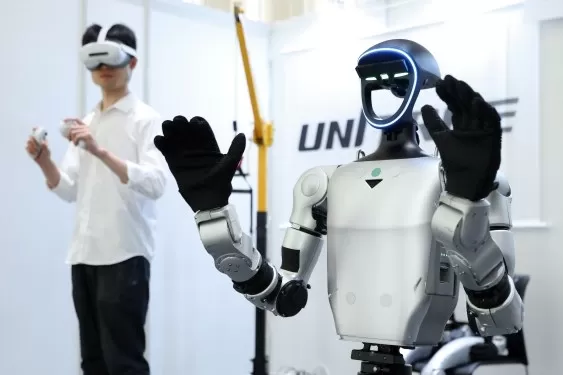
Physical AI has emerged as one of the most dynamic sectors in venture capital, with companies securing billions in funding to apply the foundational tools behind Large Language Models to the field of robotics.
This enthusiasm drove a major IPO for Unitree, China’s premier robot manufacturer, which initially reached a $66 billion valuation upon listing on China’s NASDAQ equivalent. However, the market sentiment shifted sharply this week, erasing nearly half of that value. Analysts attribute this decline to a critical gap: while robotic physical capabilities are advancing, they still lack the practical know-how to perform value-generating tasks.
At last week’s Actuate conference, a summit for developers creating AI systems for robots, the industry’s optimism was palpable. According to Foxglove, an organizer that assists physical AI model builders in managing and visualizing data, the event has tripled in size since its inception in 2023, drawing 1,500 attendees.
The underlying risks were also apparent. A booth for Avala, another player in physical AI infrastructure, displayed a sign promising to resolve “the robotics data crisis.”
This crisis stems from a shortage of high-quality training data for AI models. The goal of building generalized robots capable of performing any task remains distant, and end-to-end learning for specific tasks has yet to yield products with reliable, commercial-grade performance. For developers, the solution lies in emulating the progress of leading AI labs: acquiring or generating more diverse datasets, experimenting with varied training methods, and refining reinforcement learning scenarios.
Harry Mellsop, founder of Antioch, a startup developing simulation tools for model builders, describes physical AI as being in its “GPT-2 era,” referring to the OpenAI model that preceded ChatGPT. Overcoming current limitations will require more data and computing power, particularly GPUs optimized for ray tracing to create high-fidelity simulations.
Autonomous vehicles are currently the furthest along, partly due to the ability to collect relevant data from human-driven cars and partly because their primary objective is collision avoidance rather than manipulating the physical environment. Much of the tooling for model development originates from autonomous vehicle firms; for instance, Foxglove was founded by former employees of Cruise, General Motors’ previous self-driving initiative.
Consequently, these automotive companies are increasingly betting that their investments in machine learning tooling will enable them to compete with dedicated humanoid robot manufacturers. Tesla is already pursuing this strategy with its Optimus robot, and now both Wayve, an autonomous vehicle-focused firm, and ride-share giant Uber have established robotics labs dedicated to humanoid form factors as part of their research and development efforts.
“I believe you need to start with vehicles… manipulation robotics is where self-driving was five years ago,” Alex Kendall, CEO of Wayve, told TechCrunch. “The data infrastructure, simulation, and ML ops infrastructure will likely be shared, but the specific world model for the simulator will require different post-training. There will be significant commonality, but there will also need to be differences for various embodiments.”
Kendall argues that it is premature to commit to any single hardware platform, as advancements in sensors and other components are occurring rapidly, and a truly general model should remain hardware-agnostic.
Théophile Gervet, CEO of Genesis AI, a vertically integrated humanoid robotics company that secured a $105 million seed round this year, disagreed. He told TechCrunch, “We are too early in this wave for a pure brain strategy to succeed; our view is that there are numerous opportunities to co-design hardware and AI.”
Gervet also addressed another prominent topic in the sector: how to specifically focus a physical AI business. Robotics companies targeting specific tasks are deploying their robots in the field—Gritt is constructing solar farms, Agility is operating robots in industrial settings, and Bedrock is running excavators autonomously. Meanwhile, general-purpose humanoids remain largely confined to laboratories.
“No customer cares about a general-purpose robot that operates with an 80% success rate,” Gervet explained regarding this dilemma. “We see many other players pursue a general approach, but they provide no value without a vertical focus. However, if you build for a narrow vertical on top of a GPT-2 level model, you will be outcompeted by companies building on GPT-4.”
The temptation to invest in a specific vertical is strong, as it generates not only revenue but also real-world deployment data. While task-specific data may lack the diversity needed to advance general-purpose models, it is crucial for creating robots that deliver tangible value. Bedrock CTO Kevin Peterson noted that his company started with excavation to understand the challenges of “manipulation in the wild,” but plans to develop an intelligence layer that spans a series of construction machines.
Managing this volume of data is challenging, particularly due to the density of visual and LiDAR information. This week, Foxglove announced a new product built on Nvidia’s Cosmos open-weight world model, enabling engineers to search data using sophisticated natural language queries to build evaluations and simulations. The objective is faster triage and debugging, allowing model builders to iterate more quickly.
So, what will be the fabled ChatGPT moment for physical AI, which Sam Altman recently suggested is just a few years away? Kendall points out that the largest robot deployments globally are still consumer vacuum cleaners. For him, a ChatGPT moment would involve something that excites consumers, rather than investors, who are already highly enthusiastic.
“One example would be achieving eyes-off autonomy for less than $1,000 worth of hardware in a car,” Kendall stated. Not coincidentally, his company is licensing models to automakers with the goal of achieving exactly that. He views this business as a multi-billion-dollar opportunity that will enable the creation of a truly general embodied AI model.
For Gervet, the moment when physical AI becomes mainstream is “manipulation that simply works out of the box. You can instruct a robot in natural language to perform any basic manipulation task, such as pushing, pulling, closing a laptop, or cleaning a table, and it executes reliably—let’s say with 80% success out of the box. That would roughly mirror the ChatGPT experience.”
Adrian Macneil, CEO of Foxglove, approaches the question from a different perspective.
“There will not be a ChatGPT moment for robotics,” he told TechCrunch. “What made ChatGPT a historic moment was its distribution—they went from zero to approximately one million active users in about a week. Distribution in the real world is far more difficult. I would be very excited for an Apple II or IBM PC moment in robotics: when can I purchase a home robot that starts performing useful and enjoyable tasks?”
Related article
 AstroForge Deploys AI to Control Next Spacecraft
Reaching an asteroid, landing safely, and executing flawless maneuvers sounds simple—but it’s far from easy.NASA spacecraft exploring the solar system rely on redundancy and automation, yet flight controllers on Earth still manage most operations. Th
Prentis, New AI Lab Co-Founded by Reid Hoffman and Mark Pincus, in Talks to Raise $100M
Prentis, an emerging AI research lab specializing in computer-use models and co-founded by serial entrepreneur Ritankar Das alongside tech industry veterans Reid Hoffman and Mark Pincus, is currently negotiating to secure $100 million in funding at a
DeepMind Trio Behind Poker AI Now Generating Returns for Quant Hedge Funds
Three ex-DeepMind researchers, who previously developed an AI capable of defeating human poker champions, have pivoted that technology to financial markets — and the strategy is yielding significant returns. Their Prague-based AI venture, EquiLibre T
Related Special Topic Recommendations
Design & Art
AstroForge Deploys AI to Control Next Spacecraft
Reaching an asteroid, landing safely, and executing flawless maneuvers sounds simple—but it’s far from easy.NASA spacecraft exploring the solar system rely on redundancy and automation, yet flight controllers on Earth still manage most operations. Th
Prentis, New AI Lab Co-Founded by Reid Hoffman and Mark Pincus, in Talks to Raise $100M
Prentis, an emerging AI research lab specializing in computer-use models and co-founded by serial entrepreneur Ritankar Das alongside tech industry veterans Reid Hoffman and Mark Pincus, is currently negotiating to secure $100 million in funding at a
DeepMind Trio Behind Poker AI Now Generating Returns for Quant Hedge Funds
Three ex-DeepMind researchers, who previously developed an AI capable of defeating human poker champions, have pivoted that technology to financial markets — and the strategy is yielding significant returns. Their Prague-based AI venture, EquiLibre T
Related Special Topic Recommendations
Design & Art
 Top AI Illustration Tools: Create Editorial Scenes and Cover Art Faster
2026 Latest Top-rated AI Illustration Tools: Our curated list features the best powerfully designed tools for creating stunning editorial scenes and eye-catching cover art quickly. Each option has gone through rigorous real-world tests, offering a free vs paid comparison to help you find the perfect match for your workflow. Try these must-try solutions today to unlock your AI edge and boost your creative productivity. Explore now at XIX.AI.
 10 tools
 xix.ai
Education and Learning
Top AI Tutors for Exam Prep: Practice Math, Science, and English
xix.ai
Education and Learning
Top AI Tutors for Exam Prep: Practice Math, Science, and English
2026 Latest Top-Rated Best AI Tutors for Exam Prep are here on XIX.AI! Our curated list features powerful game-changing tools that offer free vs paid comparison, real-world tests, and weekly updated rankings. They help boost your writing efficiency, simplify complex topic learning, and unlock your academic potential. Explore now to Discover your perfect exam prep tool and Start creating today to Unlock your AI edge!
10 tools
xix.ai
Finance
AI Budget Planning Tools for Personal Money Management
2026 Latest Best Top-Rated AI Budget Planning Tools for Personal Money Management are here on XIX.AI! This curated collection features powerful, game-changing solutions that help you conduct real-world tests, understand spending habits, and create personalized plans to boost productivity. Enjoy a free vs paid comparison along with detailed rankings. Must-try tools designed to simplify money management and unlock your AI edge. Explore now!
11 tools
xix.ai
Health & Wellness
AI Sleep Tracking Assistants: Improve Recovery with Better Bedtime Habits
2026 Latest Best Top-Rated AI Sleep Tracking Assistants curated for ultimate recovery. This fully updated weekly guide features powerful tools that deliver real-world tests, free vs paid comparison, and detailed rankings to help you find the must-try solution that boosts sleep quality and supports better bedtime habits. Explore now at XIX.AI to Unlock your AI edge.
10 tools
xix.ai
Data Analysis
AI SQL Copilots for Product and Revenue Analytics
2026 Latest Best Top-Rated AI SQL Copilots for Product and Revenue Analytics! XIX.AI has curated a powerful, game-changing collection of must-try tools that undergo real-world tests through weekly updated rankings. These tools help users boost productivity significantly by accelerating data analysis, streamlining complex queries, and generating accurate insights to drive smarter business decisions. Explore now to Discover your perfect tool for unlocking your AI edge!
14 tools
xix.ai
Education and Learning
Best AI Homework Helpers That Teach: Learn Concepts, Not Just Answers
2026 Latest Best Top-Rated AI Homework Helpers That Teach Core Concepts Not Just Answers Powerful Tools for Students Must-Try Curated List Weekly Updated Free vs Paid Comparison Real-World Tests Accurate Rankings to Help You Unlock Your Full Learning Potential Explore now to Discover your perfect tool for smarter studying.
10 tools
xix.ai

 Comments (0)
0/500
Comments (0)
0/500
Physical AI has emerged as one of the most dynamic sectors in venture capital, with companies securing billions in funding to apply the foundational tools behind Large Language Models to the field of robotics.
This enthusiasm drove a major IPO for Unitree, China’s premier robot manufacturer, which initially reached a $66 billion valuation upon listing on China’s NASDAQ equivalent. However, the market sentiment shifted sharply this week, erasing nearly half of that value. Analysts attribute this decline to a critical gap: while robotic physical capabilities are advancing, they still lack the practical know-how to perform value-generating tasks.
At last week’s Actuate conference, a summit for developers creating AI systems for robots, the industry’s optimism was palpable. According to Foxglove, an organizer that assists physical AI model builders in managing and visualizing data, the event has tripled in size since its inception in 2023, drawing 1,500 attendees.
The underlying risks were also apparent. A booth for Avala, another player in physical AI infrastructure, displayed a sign promising to resolve “the robotics data crisis.”
This crisis stems from a shortage of high-quality training data for AI models. The goal of building generalized robots capable of performing any task remains distant, and end-to-end learning for specific tasks has yet to yield products with reliable, commercial-grade performance. For developers, the solution lies in emulating the progress of leading AI labs: acquiring or generating more diverse datasets, experimenting with varied training methods, and refining reinforcement learning scenarios.
Harry Mellsop, founder of Antioch, a startup developing simulation tools for model builders, describes physical AI as being in its “GPT-2 era,” referring to the OpenAI model that preceded ChatGPT. Overcoming current limitations will require more data and computing power, particularly GPUs optimized for ray tracing to create high-fidelity simulations.
Autonomous vehicles are currently the furthest along, partly due to the ability to collect relevant data from human-driven cars and partly because their primary objective is collision avoidance rather than manipulating the physical environment. Much of the tooling for model development originates from autonomous vehicle firms; for instance, Foxglove was founded by former employees of Cruise, General Motors’ previous self-driving initiative.
Consequently, these automotive companies are increasingly betting that their investments in machine learning tooling will enable them to compete with dedicated humanoid robot manufacturers. Tesla is already pursuing this strategy with its Optimus robot, and now both Wayve, an autonomous vehicle-focused firm, and ride-share giant Uber have established robotics labs dedicated to humanoid form factors as part of their research and development efforts.
“I believe you need to start with vehicles… manipulation robotics is where self-driving was five years ago,” Alex Kendall, CEO of Wayve, told TechCrunch. “The data infrastructure, simulation, and ML ops infrastructure will likely be shared, but the specific world model for the simulator will require different post-training. There will be significant commonality, but there will also need to be differences for various embodiments.”
Kendall argues that it is premature to commit to any single hardware platform, as advancements in sensors and other components are occurring rapidly, and a truly general model should remain hardware-agnostic.
Théophile Gervet, CEO of Genesis AI, a vertically integrated humanoid robotics company that secured a $105 million seed round this year, disagreed. He told TechCrunch, “We are too early in this wave for a pure brain strategy to succeed; our view is that there are numerous opportunities to co-design hardware and AI.”
Gervet also addressed another prominent topic in the sector: how to specifically focus a physical AI business. Robotics companies targeting specific tasks are deploying their robots in the field—Gritt is constructing solar farms, Agility is operating robots in industrial settings, and Bedrock is running excavators autonomously. Meanwhile, general-purpose humanoids remain largely confined to laboratories.
“No customer cares about a general-purpose robot that operates with an 80% success rate,” Gervet explained regarding this dilemma. “We see many other players pursue a general approach, but they provide no value without a vertical focus. However, if you build for a narrow vertical on top of a GPT-2 level model, you will be outcompeted by companies building on GPT-4.”
The temptation to invest in a specific vertical is strong, as it generates not only revenue but also real-world deployment data. While task-specific data may lack the diversity needed to advance general-purpose models, it is crucial for creating robots that deliver tangible value. Bedrock CTO Kevin Peterson noted that his company started with excavation to understand the challenges of “manipulation in the wild,” but plans to develop an intelligence layer that spans a series of construction machines.
Managing this volume of data is challenging, particularly due to the density of visual and LiDAR information. This week, Foxglove announced a new product built on Nvidia’s Cosmos open-weight world model, enabling engineers to search data using sophisticated natural language queries to build evaluations and simulations. The objective is faster triage and debugging, allowing model builders to iterate more quickly.
So, what will be the fabled ChatGPT moment for physical AI, which Sam Altman recently suggested is just a few years away? Kendall points out that the largest robot deployments globally are still consumer vacuum cleaners. For him, a ChatGPT moment would involve something that excites consumers, rather than investors, who are already highly enthusiastic.
“One example would be achieving eyes-off autonomy for less than $1,000 worth of hardware in a car,” Kendall stated. Not coincidentally, his company is licensing models to automakers with the goal of achieving exactly that. He views this business as a multi-billion-dollar opportunity that will enable the creation of a truly general embodied AI model.
For Gervet, the moment when physical AI becomes mainstream is “manipulation that simply works out of the box. You can instruct a robot in natural language to perform any basic manipulation task, such as pushing, pulling, closing a laptop, or cleaning a table, and it executes reliably—let’s say with 80% success out of the box. That would roughly mirror the ChatGPT experience.”
Adrian Macneil, CEO of Foxglove, approaches the question from a different perspective.
“There will not be a ChatGPT moment for robotics,” he told TechCrunch. “What made ChatGPT a historic moment was its distribution—they went from zero to approximately one million active users in about a week. Distribution in the real world is far more difficult. I would be very excited for an Apple II or IBM PC moment in robotics: when can I purchase a home robot that starts performing useful and enjoyable tasks?”







 AstroForge Deploys AI to Control Next Spacecraft
Reaching an asteroid, landing safely, and executing flawless maneuvers sounds simple—but it’s far from easy.NASA spacecraft exploring the solar system rely on redundancy and automation, yet flight controllers on Earth still manage most operations. Th
AstroForge Deploys AI to Control Next Spacecraft
Reaching an asteroid, landing safely, and executing flawless maneuvers sounds simple—but it’s far from easy.NASA spacecraft exploring the solar system rely on redundancy and automation, yet flight controllers on Earth still manage most operations. Th
 Prentis, New AI Lab Co-Founded by Reid Hoffman and Mark Pincus, in Talks to Raise $100M
Prentis, an emerging AI research lab specializing in computer-use models and co-founded by serial entrepreneur Ritankar Das alongside tech industry veterans Reid Hoffman and Mark Pincus, is currently negotiating to secure $100 million in funding at a
Prentis, New AI Lab Co-Founded by Reid Hoffman and Mark Pincus, in Talks to Raise $100M
Prentis, an emerging AI research lab specializing in computer-use models and co-founded by serial entrepreneur Ritankar Das alongside tech industry veterans Reid Hoffman and Mark Pincus, is currently negotiating to secure $100 million in funding at a
 DeepMind Trio Behind Poker AI Now Generating Returns for Quant Hedge Funds
Three ex-DeepMind researchers, who previously developed an AI capable of defeating human poker champions, have pivoted that technology to financial markets — and the strategy is yielding significant returns. Their Prague-based AI venture, EquiLibre T
DeepMind Trio Behind Poker AI Now Generating Returns for Quant Hedge Funds
Three ex-DeepMind researchers, who previously developed an AI capable of defeating human poker champions, have pivoted that technology to financial markets — and the strategy is yielding significant returns. Their Prague-based AI venture, EquiLibre T

2026 Latest Top-rated AI Illustration Tools: Our curated list features the best powerfully designed tools for creating stunning editorial scenes and eye-catching cover art quickly. Each option has gone through rigorous real-world tests, offering a free vs paid comparison to help you find the perfect match for your workflow. Try these must-try solutions today to unlock your AI edge and boost your creative productivity. Explore now at XIX.AI.
10 tools
xix.ai

2026 Latest Top-Rated Best AI Tutors for Exam Prep are here on XIX.AI! Our curated list features powerful game-changing tools that offer free vs paid comparison, real-world tests, and weekly updated rankings. They help boost your writing efficiency, simplify complex topic learning, and unlock your academic potential. Explore now to Discover your perfect exam prep tool and Start creating today to Unlock your AI edge!
10 tools
xix.ai

2026 Latest Best Top-Rated AI Budget Planning Tools for Personal Money Management are here on XIX.AI! This curated collection features powerful, game-changing solutions that help you conduct real-world tests, understand spending habits, and create personalized plans to boost productivity. Enjoy a free vs paid comparison along with detailed rankings. Must-try tools designed to simplify money management and unlock your AI edge. Explore now!
11 tools
xix.ai

2026 Latest Best Top-Rated AI Sleep Tracking Assistants curated for ultimate recovery. This fully updated weekly guide features powerful tools that deliver real-world tests, free vs paid comparison, and detailed rankings to help you find the must-try solution that boosts sleep quality and supports better bedtime habits. Explore now at XIX.AI to Unlock your AI edge.
10 tools
xix.ai

2026 Latest Best Top-Rated AI SQL Copilots for Product and Revenue Analytics! XIX.AI has curated a powerful, game-changing collection of must-try tools that undergo real-world tests through weekly updated rankings. These tools help users boost productivity significantly by accelerating data analysis, streamlining complex queries, and generating accurate insights to drive smarter business decisions. Explore now to Discover your perfect tool for unlocking your AI edge!
14 tools
xix.ai

2026 Latest Best Top-Rated AI Homework Helpers That Teach Core Concepts Not Just Answers Powerful Tools for Students Must-Try Curated List Weekly Updated Free vs Paid Comparison Real-World Tests Accurate Rankings to Help You Unlock Your Full Learning Potential Explore now to Discover your perfect tool for smarter studying.
10 tools
xix.ai












