


 Home
RevenueCat 2026 Report: AI App Retention Rate at 21%, Churn 30% Faster Than Traditional Apps
RevenueCat published the 2026 State of Subscription Apps Report on March 10, 2026, highlighting the nuanced ways AI integration affects mobile app retention. The report finds that while AI can significantly improve early conversion rates, it struggles to foster long-term user loyalty.
The report, based on data from over 75,000 developers, 1 billion transactions, and $11 billion in annual revenue on its platform, reveals that only 27.1% of apps have integrated AI, but that share is growing rapidly. Photo and video apps lead with a 61.4% adoption rate, while games and travel have lower penetration.
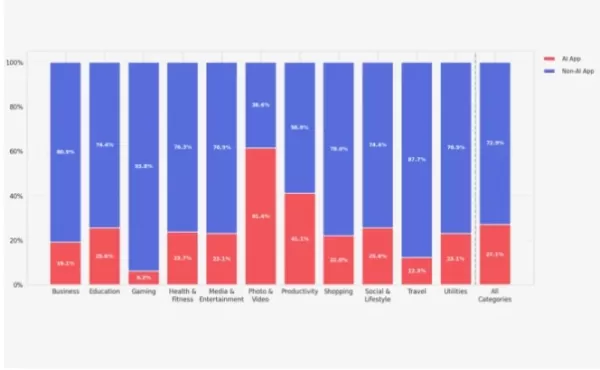
Key data reveals that the median annual retention rate for AI-driven apps is only 21.1%, markedly lower than 30.7% for non-AI apps. Their monthly retention rate also sits at just 6.1%, trailing the 9.5% of non-AI apps. This high churn is especially evident in subscription cancellations: AI app users cancel annual subscriptions 30% faster than traditional app users, and the median refund rate is 20% higher. However, in monetization efficiency, AI apps demonstrate strong potential, with a trial conversion rate of 8.5%—52% higher than non-AI apps—and a download monetization rate roughly 20% higher. Additionally, the realized lifetime value (RLTV) from paying users, both monthly and annually, significantly exceeds that of traditional apps.

This gap between high conversion and low retention indicates that the AI app market remains in a technology-driven experimentation phase. Users tend to rapidly switch between apps in search of the latest features, leading to volatile revenue and experience bottlenecks. From an industry perspective, AI integration no longer guarantees profitability. The key challenge for AI app developers moving forward will be shifting from initial traffic acquisition to deep user value retention.
Related article
 TechCrunch Disrupt 2026 breakout session agenda unveiled
TechCrunch Disrupt 2026 arrives at Moscone West in San Francisco, October 13–15, uniting 10,000+ founders, investors, operators, and tech leaders for three days of insight, networking, and forward-looking dialogue. Register now to save up to $100 on
Dark Web AI Computing Power Rush: Top Accounts at 30% Discount, Stolen Models Used for Attacks
The illicit acquisition of AI models and computing resources is surging to the top of underground market "most wanted" lists. Cybercriminals are increasingly leveraging these costly large language models for ransomware campaigns, cyber warfare, and e
Nvidia to Derive 25% of Next Year’s Revenue from Funded Labs
Nvidia has deployed nearly US$50 billion into AI labs purchasing its chips, securing commitments for over $500 billion in total.On August 26, CFO Colette Kress informed analysts that these labs, backed by Nvidia’s balance sheet, will account for roug
Related Special Topic Recommendations
Design & Art
 Top AI Illustration Tools: Create Editorial Scenes and Cover Art Faster
2026 Latest Top-rated AI Illustration Tools: Our curated list features the best powerfully designed tools for creating stunning editorial scenes and eye-catching cover art quickly. Each option has gone through rigorous real-world tests, offering a free vs paid comparison to help you find the perfect match for your workflow. Try these must-try solutions today to unlock your AI edge and boost your creative productivity. Explore now at XIX.AI.
 10 tools
 xix.ai
Education and Learning
Top AI Tutors for Exam Prep: Practice Math, Science, and English
2026 Latest Top-Rated Best AI Tutors for Exam Prep are here on XIX.AI! Our curated list features powerful game-changing tools that offer free vs paid comparison, real-world tests, and weekly updated rankings. They help boost your writing efficiency, simplify complex topic learning, and unlock your academic potential. Explore now to Discover your perfect exam prep tool and Start creating today to Unlock your AI edge!
10 tools
xix.ai
Finance
AI Budget Planning Tools for Personal Money Management
2026 Latest Best Top-Rated AI Budget Planning Tools for Personal Money Management are here on XIX.AI! This curated collection features powerful, game-changing solutions that help you conduct real-world tests, understand spending habits, and create personalized plans to boost productivity. Enjoy a free vs paid comparison along with detailed rankings. Must-try tools designed to simplify money management and unlock your AI edge. Explore now!
11 tools
xix.ai
Health & Wellness
AI Sleep Tracking Assistants: Improve Recovery with Better Bedtime Habits
2026 Latest Best Top-Rated AI Sleep Tracking Assistants curated for ultimate recovery. This fully updated weekly guide features powerful tools that deliver real-world tests, free vs paid comparison, and detailed rankings to help you find the must-try solution that boosts sleep quality and supports better bedtime habits. Explore now at XIX.AI to Unlock your AI edge.
10 tools
xix.ai
Data Analysis
AI SQL Copilots for Product and Revenue Analytics
2026 Latest Best Top-Rated AI SQL Copilots for Product and Revenue Analytics! XIX.AI has curated a powerful, game-changing collection of must-try tools that undergo real-world tests through weekly updated rankings. These tools help users boost productivity significantly by accelerating data analysis, streamlining complex queries, and generating accurate insights to drive smarter business decisions. Explore now to Discover your perfect tool for unlocking your AI edge!
14 tools
xix.ai
Education and Learning
Best AI Homework Helpers That Teach: Learn Concepts, Not Just Answers
2026 Latest Best Top-Rated AI Homework Helpers That Teach Core Concepts Not Just Answers Powerful Tools for Students Must-Try Curated List Weekly Updated Free vs Paid Comparison Real-World Tests Accurate Rankings to Help You Unlock Your Full Learning Potential Explore now to Discover your perfect tool for smarter studying.
10 tools
xix.ai

 Comments (0)
0/500
The report, based on data from over 75,000 developers, 1 billion transactions, and $11 billion in annual revenue on its platform, reveals that only 27.1% of apps have integrated AI, but that share is growing rapidly. Photo and video apps lead with a 61.4% adoption rate, while games and travel have lower penetration.
Key data reveals that the median annual retention rate for AI-driven apps is only 21.1%, markedly lower than 30.7% for non-AI apps. Their monthly retention rate also sits at just 6.1%, trailing the 9.5% of non-AI apps. This high churn is especially evident in subscription cancellations: AI app users cancel annual subscriptions 30% faster than traditional app users, and the median refund rate is 20% higher. However, in monetization efficiency, AI apps demonstrate strong potential, with a trial conversion rate of 8.5%—52% higher than non-AI apps—and a download monetization rate roughly 20% higher. Additionally, the realized lifetime value (RLTV) from paying users, both monthly and annually, significantly exceeds that of traditional apps.
This gap between high conversion and low retention indicates that the AI app market remains in a technology-driven experimentation phase. Users tend to rapidly switch between apps in search of the latest features, leading to volatile revenue and experience bottlenecks. From an industry perspective, AI integration no longer guarantees profitability. The key challenge for AI app developers moving forward will be shifting from initial traffic acquisition to deep user value retention.








 TechCrunch Disrupt 2026 breakout session agenda unveiled
TechCrunch Disrupt 2026 arrives at Moscone West in San Francisco, October 13–15, uniting 10,000+ founders, investors, operators, and tech leaders for three days of insight, networking, and forward-looking dialogue. Register now to save up to $100 on
 Dark Web AI Computing Power Rush: Top Accounts at 30% Discount, Stolen Models Used for Attacks
The illicit acquisition of AI models and computing resources is surging to the top of underground market "most wanted" lists. Cybercriminals are increasingly leveraging these costly large language models for ransomware campaigns, cyber warfare, and e
 Nvidia to Derive 25% of Next Year’s Revenue from Funded Labs
Nvidia has deployed nearly US$50 billion into AI labs purchasing its chips, securing commitments for over $500 billion in total.On August 26, CFO Colette Kress informed analysts that these labs, backed by Nvidia’s balance sheet, will account for roug

2026 Latest Top-rated AI Illustration Tools: Our curated list features the best powerfully designed tools for creating stunning editorial scenes and eye-catching cover art quickly. Each option has gone through rigorous real-world tests, offering a free vs paid comparison to help you find the perfect match for your workflow. Try these must-try solutions today to unlock your AI edge and boost your creative productivity. Explore now at XIX.AI.
10 tools
xix.ai

2026 Latest Top-Rated Best AI Tutors for Exam Prep are here on XIX.AI! Our curated list features powerful game-changing tools that offer free vs paid comparison, real-world tests, and weekly updated rankings. They help boost your writing efficiency, simplify complex topic learning, and unlock your academic potential. Explore now to Discover your perfect exam prep tool and Start creating today to Unlock your AI edge!
10 tools
xix.ai

2026 Latest Best Top-Rated AI Budget Planning Tools for Personal Money Management are here on XIX.AI! This curated collection features powerful, game-changing solutions that help you conduct real-world tests, understand spending habits, and create personalized plans to boost productivity. Enjoy a free vs paid comparison along with detailed rankings. Must-try tools designed to simplify money management and unlock your AI edge. Explore now!
11 tools
xix.ai

2026 Latest Best Top-Rated AI Sleep Tracking Assistants curated for ultimate recovery. This fully updated weekly guide features powerful tools that deliver real-world tests, free vs paid comparison, and detailed rankings to help you find the must-try solution that boosts sleep quality and supports better bedtime habits. Explore now at XIX.AI to Unlock your AI edge.
10 tools
xix.ai

2026 Latest Best Top-Rated AI SQL Copilots for Product and Revenue Analytics! XIX.AI has curated a powerful, game-changing collection of must-try tools that undergo real-world tests through weekly updated rankings. These tools help users boost productivity significantly by accelerating data analysis, streamlining complex queries, and generating accurate insights to drive smarter business decisions. Explore now to Discover your perfect tool for unlocking your AI edge!
14 tools
xix.ai

2026 Latest Best Top-Rated AI Homework Helpers That Teach Core Concepts Not Just Answers Powerful Tools for Students Must-Try Curated List Weekly Updated Free vs Paid Comparison Real-World Tests Accurate Rankings to Help You Unlock Your Full Learning Potential Explore now to Discover your perfect tool for smarter studying.
10 tools
xix.ai












