


 Home
HomeGoogle's SEO Strategy for AI-Generated Content: A Comprehensive Guide
Quality content is the backbone of any successful online presence. For bloggers, website managers, and digital creators, finding efficient methods to produce compelling material is a constant pursuit. AI writing assistants, such as ChatGPT and DeepSeek, present an attractive option. However, a critical question remains: is content created by artificial intelligence capable of achieving high rankings on Google? This exploration delves into Google's official position on AI-generated material and offers actionable strategies to refine your AI-assisted content for better search engine visibility.
Key Points
Google's primary focus is on rewarding high-quality, original content, irrespective of whether it is produced by a human or an AI system.
Adherence to the E-E-A-T principles (Experience, Expertise, Authoritativeness, and Trustworthiness) is fundamental for achieving strong rankings.
Content authored with AI assistance can rank successfully provided it aligns with Google's quality standards and satisfies user search intent.
Enhance AI-generated drafts by infusing them with unique perspectives, supporting data, and concrete examples.
Leverage advanced AI tools like DeepSeek to produce original, non-plagiarized content that reads naturally.
The Reality of Ranking AI Content on Google
Google's Stance on AI-Generated Content
The question of whether AI-generated content can achieve strong Google rankings is a topic of lively discussion.

Opinions within the content creation community are divided, with some professionals advocating for its use and others expressing caution.
To grasp the actual potential, it's essential to examine Google's publicly stated policies. Google's overarching mission is to deliver the most relevant and high-quality search results to its users. As clarified in Google's official guidance on AI-generated content, their ranking systems are designed to reward original, high-quality content that exemplifies E-E-A-T. Consequently, the origin of the content—whether human or machine—is not the primary factor; its inherent quality is.
The fundamental determinant is content quality. Google's sophisticated algorithms are engineered to identify and favor material that offers genuine value to searchers. If your AI-assisted content is well-structured, informative, and directly addresses the user's query, it possesses a solid foundation for ranking competitively.
This indicates a viable future for AI in SEO strategies, but success hinges on meticulous optimization. The content must convincingly meet the criteria of the E-E-A-T framework.
The E-E-A-T Framework: Google's Ranking Signal
E-E-A-T represents the core qualities—Experience, Expertise, Authoritativeness, and Trustworthiness—that Google uses to assess content quality.
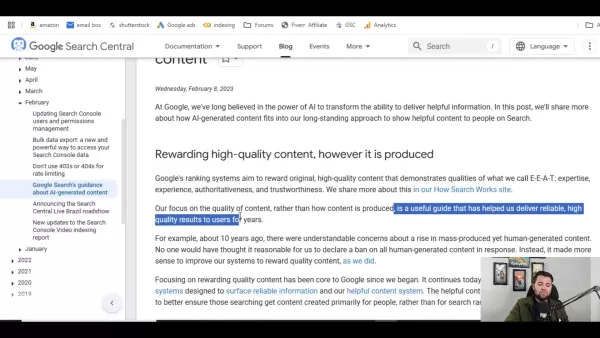
Here is a detailed breakdown of each component:
- Experience: Presenting content grounded in firsthand, practical knowledge of the subject.
- Expertise: Demonstrating a comprehensive and skilled understanding of the topic area.
- Authoritativeness: Establishing your website or author as a credible and recognized source.
- Trustworthiness: Ensuring the information is accurate, transparent, and comes from a secure source.
To achieve high search rankings, your content must consistently embody these values. A successful blog requires not only high-quality content but also technical SEO optimization, a strong backlink profile, and a positive user experience—all factors search engines value highly.
Common Concerns and Misconceptions
A prevalent concern among content creators is the fear of a Google penalty specifically for using AI. Google has explicitly stated that it does not penalize content solely based on its AI origin. Penalties are applied to low-quality or unoriginal content, regardless of how it was created. Let's address some widespread misconceptions:
- Myth: AI content is automatically penalized. Reality: Google evaluates content quality, not its creation method.
- Myth: AI content is inherently unoriginal. Reality: With skilled prompting and thoughtful editing, AI can produce unique and valuable material.
- Myth: AI will fully replace human writers. Reality: AI serves best as a tool to enhance human creativity and expertise, not to replace it.
Optimizing AI-Generated Content for Ranking
Step-by-Step Optimization Strategies
If you utilize AI for content creation, what specific steps can you take to improve its chances of ranking highly? To maximize the performance of your AI-generated content in Google search results, implement these strategic optimizations:
- Humanize the content: AI drafts can occasionally have a sterile tone. Carefully edit the text to inject your unique brand voice, style, and personality.
- Add unique insights: Avoid publishing raw AI output. Supplement the draft with your own expert analysis, personal experiences, and distinct viewpoints.
- Provide data and examples: Strengthen arguments by incorporating relevant data points, statistics, and practical, real-life examples to build credibility.
- Optimize for keywords: Perform comprehensive keyword research and integrate target keywords strategically throughout the content, including titles, headers, and body text. Utilize SEO tools like Semrush, Ahrefs, and Moz for insights.
- Ensure readability: Write in clear, concise language and format the content for easy consumption using headings, subheadings, bulleted lists, and relevant images.
- Build high-quality backlinks: Earn links from authoritative, relevant websites to boost your site's overall authority and trust signals.
- Improve technical SEO: Strengthen your blog's foundation by optimizing meta tags, implementing a logical internal linking structure, and adding descriptive alt text to all images.
- Address E-E-A-T: Consciously create content that demonstrates deep expertise, establishes authority, and builds trust, while also showcasing relevant experience.
- Optimize User Experience: Include internal links to related content on your site and ensure your content is fully optimized for mobile devices.
- Refresh Content Regularly: Information can become outdated. Periodically review and update your AI-generated content to ensure it remains current and accurate.
Leveraging DeepSeek for Non-Plagiarized, Undetectable Content
DeepSeek is a sophisticated AI tool capable of assisting in the creation of original, natural-sounding content.
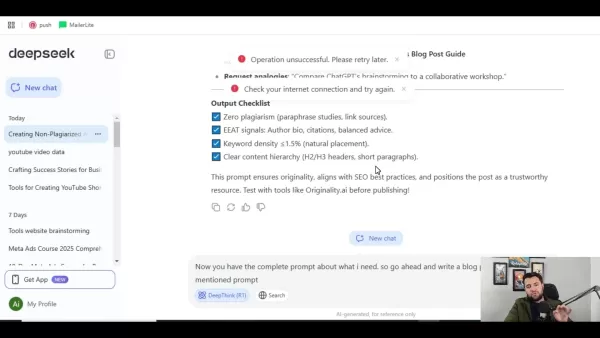
By harnessing DeepSeek's advanced capabilities, you can generate high-caliber content that is both unique and engaging. Effective methods include:
- Provide Clear Instructions: When using DeepSeek, furnish detailed and specific prompts that clearly outline the desired content type, scope, and objectives.
- Specify E-E-A-T Requirements: Explicitly instruct the AI to generate content that demonstrates expertise, authoritativeness, and trustworthiness.
- Request Unique Examples: Ask the tool to incorporate specific data points, unique examples, and fresh perspectives not commonly found in existing content.
- Iterate and Refine: Meticulously review the initial output and refine your prompts through iteration to continuously improve the quality of the generated content.
Analyzing Success Stories and Examples
Numerous content creators have successfully ranked AI-assisted content on Google. By studying their approaches, we can identify effective tactics. Common factors in these successes include:
- Niche Expertise: Top-performing AI content often targets specific niches where the creator possesses deep, authentic knowledge.
- Data-Driven Content: Content supported by original research, unique data analysis, or detailed case studies typically earns higher engagement and credibility.
- User Engagement: Content designed to foster interaction—such as comments, social shares, and discussion—is often favored by ranking algorithms.
Ultimately, search engine ranking is a combination of exceptional content quality and sound technical SEO practices, all centered on delivering an outstanding experience for the reader.
How to Use DeepSeek for Content Creation
Crafting a Successful Prompt for DeepSeek
To generate effective content with tools like DeepSeek, mastering the art of prompt engineering is crucial. Well-crafted instructions guide the AI to produce the desired output.

Consider these essential tips for creating effective prompts:
- Start with a Clear Objective: Begin by succinctly stating the primary goal and purpose of the content piece.
- Define Key Parameters: Specify important details such as the target audience, desired tone of voice, and approximate word count.
- Incorporate Keywords Naturally: Seamlessly integrate primary and secondary keywords into the prompt instructions.
- Request Specific Examples: To add authenticity, ask the AI to generate examples or scenarios based on your specific area of expertise or industry.
Pricing
DeepSeek's Pricing Plans
DeepSeek typically offers a range of pricing plans designed to accommodate different user requirements and budgets. These plans often include:
- Free Plan: A starter plan with basic features, suitable for limited content generation needs.
- Premium Plans: Subscription-based plans that offer higher usage limits, access to advanced features, and prioritized customer support.
Pricing is generally based on factors like the volume of content generated, output length, and the level of feature access.
AI Content Creation: Weighing the Advantages and Disadvantages
Pros
Increased Efficiency: AI can drastically accelerate the content creation process compared to manual writing.
Cost Savings: Automating routine writing tasks can lead to significant reductions in content production expenses.
Scalability: AI tools enable you to scale your content output efficiently to match demand.
Improved Consistency: AI helps maintain a consistent tone, style, and quality level across all content assets.
Reduced manual workload: By handling repetitive drafting tasks, AI frees up human creators to focus on strategic and creative work.
Cons
Potential Lack of Originality: Without proper guidance, AI-generated content can lack a unique perspective or creative flair.
Risk of Inaccuracy: AI outputs may contain factual errors or outdated information if not rigorously fact-checked.
Ethical Concerns: The use of AI in content creation raises important questions about transparency, algorithmic bias, and the impact on writing professions.
Oversimplification: AI models sometimes simplify complex subjects, potentially resulting in content that lacks depth.
FAQ
Can AI-generated content rank on Google?
Yes, content created with AI assistance can achieve high Google rankings, provided it is high-quality, original, thoroughly optimized for both users and SEO, and aligns with the E-E-A-T principles.
How can I ensure my AI content is original?
Utilize AI platforms like DeepSeek that are engineered to produce non-plagiarized text. Always augment the AI's draft with your own unique analysis, verifiable data, and specific examples. Properly attribute all sources.
What is E-E-A-T, and why is it important?
E-E-A-T stands for Experience, Expertise, Authoritativeness, and Trustworthiness. These are the core qualities Google uses to evaluate content quality. Demonstrating strong E-E-A-T signals is crucial for achieving and maintaining high search rankings.
Are there any risks associated with using AI to generate content?
Yes, potential risks exist. AI-generated content can be generic, contain inaccuracies, or inadvertently plagiarize if not carefully reviewed and edited. Over-dependence on AI may also hinder the development of original critical thinking. Mitigate these risks by treating AI as an assistant and maintaining rigorous editorial oversight.
Related Questions
What are the best AI tools for content creation?
The market offers a variety of AI content creation tools, each with distinct features. Popular choices include ChatGPT, DeepSeek, Jasper, Copy.ai, and Rytr. The optimal tool depends on your specific requirements, such as content type, budget, and desired level of control. ChatGPT: A highly versatile language model capable of generating diverse content formats. DeepSeek: Specializes in producing original, natural-sounding text. Jasper: A robust AI writing assistant designed for marketing and commercial content. Copy.ai: Focused on generating persuasive marketing and advertising copy. Rytr: A user-friendly option suitable for various general writing tasks.
How can I improve the readability of my AI-generated content?
Enhancing readability involves several key practices: Use short sentences and paragraphs: Break down complex information into easily digestible sections. Use clear and concise language: Prioritize simplicity and avoid unnecessary jargon. Use headings and subheadings: Structure your content logically with descriptive headings to guide the reader. Use bullet points and lists: Present information in a scannable, organized format. Use visuals: Incorporate relevant images, charts, or videos to complement the text and improve engagement.
What are some ethical considerations when using AI to generate content?
Responsible use of AI for content creation involves several ethical considerations: Transparency: Consider disclosing the use of AI tools to your audience to maintain trust. Accuracy: Take full responsibility for fact-checking all AI-generated information before publication. Bias: Be aware that AI models can reflect biases present in their training data; review content critically for fairness. Plagiarism: Use AI tools responsibly to create original work and always provide proper citations. Job Displacement: View AI as a collaborative tool that augments human skills rather than as a direct replacement for creative professionals.
Related article
 Anthropic Expands Claude AI Coding Tools to Japan in Push for Overseas Growth
Anthropic, a prominent U.S. artificial intelligence firm, is intensifying its global outreach. On Wednesday, the company hosted a major developer gathering, "Code with Claude," in Tokyo, drawing close to 500 software engineers. This initiative seeks
India’s Software Giant Cuts Hiring, Promises No Layoffs as AI Agents Scale Up
As artificial intelligence reshapes traditional labor-intensive business models, Tata Consultancy Services (TCS), a premier Indian software outsourcing firm, has unveiled its strategic response. During Tuesday’s annual general meeting, the chairman o
China Locks AI Models During Gaokam to Block Instant Homework Help
With the 2026 Gaokao fast approaching, rumors regarding the suspension of AI tools during the exam period have ignited intense online debate. In response to public concern, major AI platforms and educational apps have clarified their stance: rather t
Related Special Topic Recommendations
Design & Art
Anthropic Expands Claude AI Coding Tools to Japan in Push for Overseas Growth
Anthropic, a prominent U.S. artificial intelligence firm, is intensifying its global outreach. On Wednesday, the company hosted a major developer gathering, "Code with Claude," in Tokyo, drawing close to 500 software engineers. This initiative seeks
India’s Software Giant Cuts Hiring, Promises No Layoffs as AI Agents Scale Up
As artificial intelligence reshapes traditional labor-intensive business models, Tata Consultancy Services (TCS), a premier Indian software outsourcing firm, has unveiled its strategic response. During Tuesday’s annual general meeting, the chairman o
China Locks AI Models During Gaokam to Block Instant Homework Help
With the 2026 Gaokao fast approaching, rumors regarding the suspension of AI tools during the exam period have ignited intense online debate. In response to public concern, major AI platforms and educational apps have clarified their stance: rather t
Related Special Topic Recommendations
Design & Art
 Best AI Style Transfer Tools for Creative Experiments
2026 Latest Best Top-rated AI Style Transfer Tools for Creative Experiments! XIX.AI has curated a powerful, game-changing collection of must-try tools that deliver exceptional results through real-world tests and rigorous rankings. These top solutions help creatives boost productivity significantly by accelerating content creation and unlocking endless creative possibilities. Explore now to discover your perfect tool and start creating today!
 9 tools
 xix.ai
Comic Creation
Best AI Dialogue Bubble Tools for Visual Storytelling
xix.ai
Comic Creation
Best AI Dialogue Bubble Tools for Visual Storytelling
2026 Latest Best Top-Rated AI Dialogue Bubble Tools for Visual Storytelling are here on XIX.AI! This curated collection features powerful, game-changing tools that help creators boost productivity and overcome creative bottlenecks. Get a free vs paid comparison, see real-world tests, and check the latest rankings to find the must-try solutions perfect for crafting engaging visual narratives. Explore now to discover your ideal tool!
10 tools
xix.ai
Meeting Assistant
Top AI Meeting Summary Tools: Track Decisions and Follow-Ups Clearly
2026 Latest Top-Rated Best AI Meeting Summary Tools for Clear Decision Tracking and Effortless Follow-Ups. This curated list showcases powerful, game-changing solutions that boost productivity dramatically by automating meeting notes, identifying key action items, and streamlining team coordination across all projects. Get a free vs paid comparison along with real-world tests and weekly updated rankings to help you find the perfect tool. Explore now to unlock your AI edge!
9 tools
xix.ai
Data Analysis
Best AI Data Cleaning Tools: Fix Missing Values and Duplicates Fast
2026 Latest Best Top-rated AI Data Cleaning Tools for quick fixing of missing values and duplicates. This curated list showcases powerful, game-changing solutions that boost productivity significantly. Each option has undergone rigorous real-world tests to ensure reliability. Get a free vs paid comparison and discover the must-try tool that fits your needs best. Explore now at XIX.AI to Unlock your AI edge.
11 tools
xix.ai
Design & Art
Best AI Creative Ideation Tools for Artists: Break Through Visual Blocks
2026 Latest Best Top-Rated AI Creative Ideation Tools for Artists are curated by XIX.AI to help creators break through visual blocks and boost creativity instantly. These powerful game-changing tools offer real-world tests, detailed free vs paid comparison, and weekly updated rankings. Discover your perfect tool to accelerate content creation and unlock your AI edge today. Explore now!
14 tools
xix.ai
Music composition
AI Beat Makers for TikTok Background Tracks, Reels Audio, and Creator Promo Music
2026 Latest Best AI Beat Makers for TikTok Background Tracks, Reels Audio, and Creator Promo Music! XIX.AI has curated a top-rated list of powerful game-changing tools that go through real-world tests to deliver flawless music for every content need. You’ll find detailed free vs paid comparison data, weekly updated rankings, and must-try options to help you boost creativity and productivity. Explore now to discover your perfect tool!
11 tools
xix.ai

 Comments (1)
0/500
Comments (1)
0/500
![HarryNelson]()
這篇文章真的點出了AI寫作的關鍵!Google的SEO策略一直在變,但優質內容始終是王道。用AI輔助創作可以節省時間,但如何保持內容的獨特性和深度才是挑戰。我最近也在嘗試用ChatGPT生成草稿,再手動加入個人經驗和數據,效果不錯!大家有試過其他AI工具嗎?😊
Quality content is the backbone of any successful online presence. For bloggers, website managers, and digital creators, finding efficient methods to produce compelling material is a constant pursuit. AI writing assistants, such as ChatGPT and DeepSeek, present an attractive option. However, a critical question remains: is content created by artificial intelligence capable of achieving high rankings on Google? This exploration delves into Google's official position on AI-generated material and offers actionable strategies to refine your AI-assisted content for better search engine visibility.
Key Points
Google's primary focus is on rewarding high-quality, original content, irrespective of whether it is produced by a human or an AI system.
Adherence to the E-E-A-T principles (Experience, Expertise, Authoritativeness, and Trustworthiness) is fundamental for achieving strong rankings.
Content authored with AI assistance can rank successfully provided it aligns with Google's quality standards and satisfies user search intent.
Enhance AI-generated drafts by infusing them with unique perspectives, supporting data, and concrete examples.
Leverage advanced AI tools like DeepSeek to produce original, non-plagiarized content that reads naturally.
The Reality of Ranking AI Content on Google
Google's Stance on AI-Generated Content
The question of whether AI-generated content can achieve strong Google rankings is a topic of lively discussion.
Opinions within the content creation community are divided, with some professionals advocating for its use and others expressing caution.
To grasp the actual potential, it's essential to examine Google's publicly stated policies. Google's overarching mission is to deliver the most relevant and high-quality search results to its users. As clarified in Google's official guidance on AI-generated content, their ranking systems are designed to reward original, high-quality content that exemplifies E-E-A-T. Consequently, the origin of the content—whether human or machine—is not the primary factor; its inherent quality is.
The fundamental determinant is content quality. Google's sophisticated algorithms are engineered to identify and favor material that offers genuine value to searchers. If your AI-assisted content is well-structured, informative, and directly addresses the user's query, it possesses a solid foundation for ranking competitively.
This indicates a viable future for AI in SEO strategies, but success hinges on meticulous optimization. The content must convincingly meet the criteria of the E-E-A-T framework.
The E-E-A-T Framework: Google's Ranking Signal
E-E-A-T represents the core qualities—Experience, Expertise, Authoritativeness, and Trustworthiness—that Google uses to assess content quality.
Here is a detailed breakdown of each component:
- Experience: Presenting content grounded in firsthand, practical knowledge of the subject.
- Expertise: Demonstrating a comprehensive and skilled understanding of the topic area.
- Authoritativeness: Establishing your website or author as a credible and recognized source.
- Trustworthiness: Ensuring the information is accurate, transparent, and comes from a secure source.
To achieve high search rankings, your content must consistently embody these values. A successful blog requires not only high-quality content but also technical SEO optimization, a strong backlink profile, and a positive user experience—all factors search engines value highly.
Common Concerns and Misconceptions
A prevalent concern among content creators is the fear of a Google penalty specifically for using AI. Google has explicitly stated that it does not penalize content solely based on its AI origin. Penalties are applied to low-quality or unoriginal content, regardless of how it was created. Let's address some widespread misconceptions:
- Myth: AI content is automatically penalized. Reality: Google evaluates content quality, not its creation method.
- Myth: AI content is inherently unoriginal. Reality: With skilled prompting and thoughtful editing, AI can produce unique and valuable material.
- Myth: AI will fully replace human writers. Reality: AI serves best as a tool to enhance human creativity and expertise, not to replace it.
Optimizing AI-Generated Content for Ranking
Step-by-Step Optimization Strategies
If you utilize AI for content creation, what specific steps can you take to improve its chances of ranking highly? To maximize the performance of your AI-generated content in Google search results, implement these strategic optimizations:
- Humanize the content: AI drafts can occasionally have a sterile tone. Carefully edit the text to inject your unique brand voice, style, and personality.
- Add unique insights: Avoid publishing raw AI output. Supplement the draft with your own expert analysis, personal experiences, and distinct viewpoints.
- Provide data and examples: Strengthen arguments by incorporating relevant data points, statistics, and practical, real-life examples to build credibility.
- Optimize for keywords: Perform comprehensive keyword research and integrate target keywords strategically throughout the content, including titles, headers, and body text. Utilize SEO tools like Semrush, Ahrefs, and Moz for insights.
- Ensure readability: Write in clear, concise language and format the content for easy consumption using headings, subheadings, bulleted lists, and relevant images.
- Build high-quality backlinks: Earn links from authoritative, relevant websites to boost your site's overall authority and trust signals.
- Improve technical SEO: Strengthen your blog's foundation by optimizing meta tags, implementing a logical internal linking structure, and adding descriptive alt text to all images.
- Address E-E-A-T: Consciously create content that demonstrates deep expertise, establishes authority, and builds trust, while also showcasing relevant experience.
- Optimize User Experience: Include internal links to related content on your site and ensure your content is fully optimized for mobile devices.
- Refresh Content Regularly: Information can become outdated. Periodically review and update your AI-generated content to ensure it remains current and accurate.
Leveraging DeepSeek for Non-Plagiarized, Undetectable Content
DeepSeek is a sophisticated AI tool capable of assisting in the creation of original, natural-sounding content.
By harnessing DeepSeek's advanced capabilities, you can generate high-caliber content that is both unique and engaging. Effective methods include:
- Provide Clear Instructions: When using DeepSeek, furnish detailed and specific prompts that clearly outline the desired content type, scope, and objectives.
- Specify E-E-A-T Requirements: Explicitly instruct the AI to generate content that demonstrates expertise, authoritativeness, and trustworthiness.
- Request Unique Examples: Ask the tool to incorporate specific data points, unique examples, and fresh perspectives not commonly found in existing content.
- Iterate and Refine: Meticulously review the initial output and refine your prompts through iteration to continuously improve the quality of the generated content.
Analyzing Success Stories and Examples
Numerous content creators have successfully ranked AI-assisted content on Google. By studying their approaches, we can identify effective tactics. Common factors in these successes include:
- Niche Expertise: Top-performing AI content often targets specific niches where the creator possesses deep, authentic knowledge.
- Data-Driven Content: Content supported by original research, unique data analysis, or detailed case studies typically earns higher engagement and credibility.
- User Engagement: Content designed to foster interaction—such as comments, social shares, and discussion—is often favored by ranking algorithms.
Ultimately, search engine ranking is a combination of exceptional content quality and sound technical SEO practices, all centered on delivering an outstanding experience for the reader.
How to Use DeepSeek for Content Creation
Crafting a Successful Prompt for DeepSeek
To generate effective content with tools like DeepSeek, mastering the art of prompt engineering is crucial. Well-crafted instructions guide the AI to produce the desired output.
Consider these essential tips for creating effective prompts:
- Start with a Clear Objective: Begin by succinctly stating the primary goal and purpose of the content piece.
- Define Key Parameters: Specify important details such as the target audience, desired tone of voice, and approximate word count.
- Incorporate Keywords Naturally: Seamlessly integrate primary and secondary keywords into the prompt instructions.
- Request Specific Examples: To add authenticity, ask the AI to generate examples or scenarios based on your specific area of expertise or industry.
Pricing
DeepSeek's Pricing Plans
DeepSeek typically offers a range of pricing plans designed to accommodate different user requirements and budgets. These plans often include:
- Free Plan: A starter plan with basic features, suitable for limited content generation needs.
- Premium Plans: Subscription-based plans that offer higher usage limits, access to advanced features, and prioritized customer support.
Pricing is generally based on factors like the volume of content generated, output length, and the level of feature access.
AI Content Creation: Weighing the Advantages and Disadvantages
Pros
Increased Efficiency: AI can drastically accelerate the content creation process compared to manual writing.
Cost Savings: Automating routine writing tasks can lead to significant reductions in content production expenses.
Scalability: AI tools enable you to scale your content output efficiently to match demand.
Improved Consistency: AI helps maintain a consistent tone, style, and quality level across all content assets.
Reduced manual workload: By handling repetitive drafting tasks, AI frees up human creators to focus on strategic and creative work.
Cons
Potential Lack of Originality: Without proper guidance, AI-generated content can lack a unique perspective or creative flair.
Risk of Inaccuracy: AI outputs may contain factual errors or outdated information if not rigorously fact-checked.
Ethical Concerns: The use of AI in content creation raises important questions about transparency, algorithmic bias, and the impact on writing professions.
Oversimplification: AI models sometimes simplify complex subjects, potentially resulting in content that lacks depth.
FAQ
Can AI-generated content rank on Google?
Yes, content created with AI assistance can achieve high Google rankings, provided it is high-quality, original, thoroughly optimized for both users and SEO, and aligns with the E-E-A-T principles.
How can I ensure my AI content is original?
Utilize AI platforms like DeepSeek that are engineered to produce non-plagiarized text. Always augment the AI's draft with your own unique analysis, verifiable data, and specific examples. Properly attribute all sources.
What is E-E-A-T, and why is it important?
E-E-A-T stands for Experience, Expertise, Authoritativeness, and Trustworthiness. These are the core qualities Google uses to evaluate content quality. Demonstrating strong E-E-A-T signals is crucial for achieving and maintaining high search rankings.
Are there any risks associated with using AI to generate content?
Yes, potential risks exist. AI-generated content can be generic, contain inaccuracies, or inadvertently plagiarize if not carefully reviewed and edited. Over-dependence on AI may also hinder the development of original critical thinking. Mitigate these risks by treating AI as an assistant and maintaining rigorous editorial oversight.
Related Questions
What are the best AI tools for content creation?
The market offers a variety of AI content creation tools, each with distinct features. Popular choices include ChatGPT, DeepSeek, Jasper, Copy.ai, and Rytr. The optimal tool depends on your specific requirements, such as content type, budget, and desired level of control. ChatGPT: A highly versatile language model capable of generating diverse content formats. DeepSeek: Specializes in producing original, natural-sounding text. Jasper: A robust AI writing assistant designed for marketing and commercial content. Copy.ai: Focused on generating persuasive marketing and advertising copy. Rytr: A user-friendly option suitable for various general writing tasks.
How can I improve the readability of my AI-generated content?
Enhancing readability involves several key practices: Use short sentences and paragraphs: Break down complex information into easily digestible sections. Use clear and concise language: Prioritize simplicity and avoid unnecessary jargon. Use headings and subheadings: Structure your content logically with descriptive headings to guide the reader. Use bullet points and lists: Present information in a scannable, organized format. Use visuals: Incorporate relevant images, charts, or videos to complement the text and improve engagement.
What are some ethical considerations when using AI to generate content?
Responsible use of AI for content creation involves several ethical considerations: Transparency: Consider disclosing the use of AI tools to your audience to maintain trust. Accuracy: Take full responsibility for fact-checking all AI-generated information before publication. Bias: Be aware that AI models can reflect biases present in their training data; review content critically for fairness. Plagiarism: Use AI tools responsibly to create original work and always provide proper citations. Job Displacement: View AI as a collaborative tool that augments human skills rather than as a direct replacement for creative professionals.








 Anthropic Expands Claude AI Coding Tools to Japan in Push for Overseas Growth
Anthropic, a prominent U.S. artificial intelligence firm, is intensifying its global outreach. On Wednesday, the company hosted a major developer gathering, "Code with Claude," in Tokyo, drawing close to 500 software engineers. This initiative seeks
Anthropic Expands Claude AI Coding Tools to Japan in Push for Overseas Growth
Anthropic, a prominent U.S. artificial intelligence firm, is intensifying its global outreach. On Wednesday, the company hosted a major developer gathering, "Code with Claude," in Tokyo, drawing close to 500 software engineers. This initiative seeks
 India’s Software Giant Cuts Hiring, Promises No Layoffs as AI Agents Scale Up
As artificial intelligence reshapes traditional labor-intensive business models, Tata Consultancy Services (TCS), a premier Indian software outsourcing firm, has unveiled its strategic response. During Tuesday’s annual general meeting, the chairman o
India’s Software Giant Cuts Hiring, Promises No Layoffs as AI Agents Scale Up
As artificial intelligence reshapes traditional labor-intensive business models, Tata Consultancy Services (TCS), a premier Indian software outsourcing firm, has unveiled its strategic response. During Tuesday’s annual general meeting, the chairman o
 China Locks AI Models During Gaokam to Block Instant Homework Help
With the 2026 Gaokao fast approaching, rumors regarding the suspension of AI tools during the exam period have ignited intense online debate. In response to public concern, major AI platforms and educational apps have clarified their stance: rather t
China Locks AI Models During Gaokam to Block Instant Homework Help
With the 2026 Gaokao fast approaching, rumors regarding the suspension of AI tools during the exam period have ignited intense online debate. In response to public concern, major AI platforms and educational apps have clarified their stance: rather t

2026 Latest Best Top-rated AI Style Transfer Tools for Creative Experiments! XIX.AI has curated a powerful, game-changing collection of must-try tools that deliver exceptional results through real-world tests and rigorous rankings. These top solutions help creatives boost productivity significantly by accelerating content creation and unlocking endless creative possibilities. Explore now to discover your perfect tool and start creating today!
9 tools
xix.ai

2026 Latest Best Top-Rated AI Dialogue Bubble Tools for Visual Storytelling are here on XIX.AI! This curated collection features powerful, game-changing tools that help creators boost productivity and overcome creative bottlenecks. Get a free vs paid comparison, see real-world tests, and check the latest rankings to find the must-try solutions perfect for crafting engaging visual narratives. Explore now to discover your ideal tool!
10 tools
xix.ai
2026 Latest Top-Rated Best AI Meeting Summary Tools for Clear Decision Tracking and Effortless Follow-Ups. This curated list showcases powerful, game-changing solutions that boost productivity dramatically by automating meeting notes, identifying key action items, and streamlining team coordination across all projects. Get a free vs paid comparison along with real-world tests and weekly updated rankings to help you find the perfect tool. Explore now to unlock your AI edge!
9 tools
xix.ai

2026 Latest Best Top-rated AI Data Cleaning Tools for quick fixing of missing values and duplicates. This curated list showcases powerful, game-changing solutions that boost productivity significantly. Each option has undergone rigorous real-world tests to ensure reliability. Get a free vs paid comparison and discover the must-try tool that fits your needs best. Explore now at XIX.AI to Unlock your AI edge.
11 tools
xix.ai

2026 Latest Best Top-Rated AI Creative Ideation Tools for Artists are curated by XIX.AI to help creators break through visual blocks and boost creativity instantly. These powerful game-changing tools offer real-world tests, detailed free vs paid comparison, and weekly updated rankings. Discover your perfect tool to accelerate content creation and unlock your AI edge today. Explore now!
14 tools
xix.ai

2026 Latest Best AI Beat Makers for TikTok Background Tracks, Reels Audio, and Creator Promo Music! XIX.AI has curated a top-rated list of powerful game-changing tools that go through real-world tests to deliver flawless music for every content need. You’ll find detailed free vs paid comparison data, weekly updated rankings, and must-try options to help you boost creativity and productivity. Explore now to discover your perfect tool!
11 tools
xix.ai

這篇文章真的點出了AI寫作的關鍵!Google的SEO策略一直在變,但優質內容始終是王道。用AI輔助創作可以節省時間,但如何保持內容的獨特性和深度才是挑戰。我最近也在嘗試用ChatGPT生成草稿,再手動加入個人經驗和數據,效果不錯!大家有試過其他AI工具嗎?😊












