


 Home
QueryStory urges caution on AI-generated content
In 2009, Shapor Naghibzadeh discovered the power of compelling storytelling while working as a Google sysops engineer. During Operation Aurora, when state-sponsored hackers targeted the tech giant, he was summoned to a crisis room to clarify server activities, learning firsthand that verified knowledge is essential for tracing cyberattacks across fragmented networks—a process he found both expensive and slow. He believes large language models can replicate this verification capability across diverse databases in a fraction of the time.
For the next six years, Naghibzadeh focused on merging data and cybersecurity, leveraging Google’s infrastructure to create tools enabling security analysts to query complex datasets. In 2016, he co-founded Chronicle, a startup within Google’s X Labs, to extend these capabilities to external enterprises.
Last year, recognizing the growing role of large language models in data analysis, Naghibzadeh identified an opportunity to adapt his cybersecurity techniques for broader analytics applications. He co-founded QueryStory, launching from stealth today, alongside CTO Stanley Yang, a former Google colleague and lead engineer at EvolutionIQ, and CPO David Glusic, an Accenture veteran.
“Investigations follow a pattern: you ask the data a series of questions, then synthesize those answers into a coherent narrative,” Naghibzadeh explained. “That concept inspired the name QueryStory. It’s about constructing truthful, data-driven narratives.”
QueryStory secured a $6 million seed round in late 2025 from Brightmind Ventures and New York Life Ventures, valuing the company at $60 million. During this period, the startup has refined its product through customer pilots. Targeting large enterprises with extensive proprietary databases, QueryStory serves as a unified platform for data analysis and review, supporting teams such as sales and operations.
“We bridge the trust gap in AI by providing enterprises with actionable, reliable answers,” Naghibzadeh stated. “Rather than relying on human judgment or deploying armies of engineers, we have productized that expertise.”
Tim Del Bello, a partner at New York Life Ventures, invested in the company and is already using the platform to replace manual reporting processes, aiming to transform quarterly business reviews into real-time dashboards.
“This product is designed for decision-makers who need ground truth from complex, disparate data sources but lack dedicated data science or BI teams, particularly in highly regulated industries,” he told TechCrunch.
Solving the problem of brittle AI systems
I shared a database tracking space activity to help understand orbital operations by companies like SpaceX. QueryStory generated a visualization of this data within hours—a task that previously required a developer and several weeks. The platform produced sophisticated dashboards and, notably, included a confidence indicator explaining why the AI agents deemed the analyses accurate.

A visualization of satellites in orbit around the Earth.Image Credits:QueryStory / QueryStory
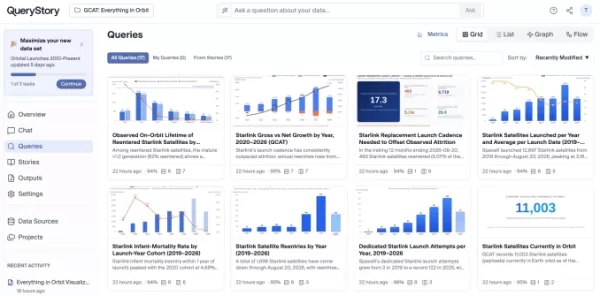
A set of queries derived from the space data.Image Credits:QueryStory / QueryStory
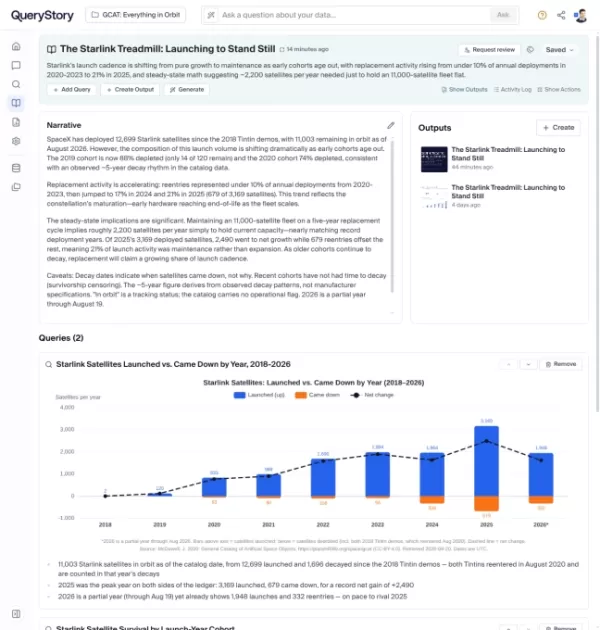
A QueryStory.Image Credits:QueryStory / QueryStory
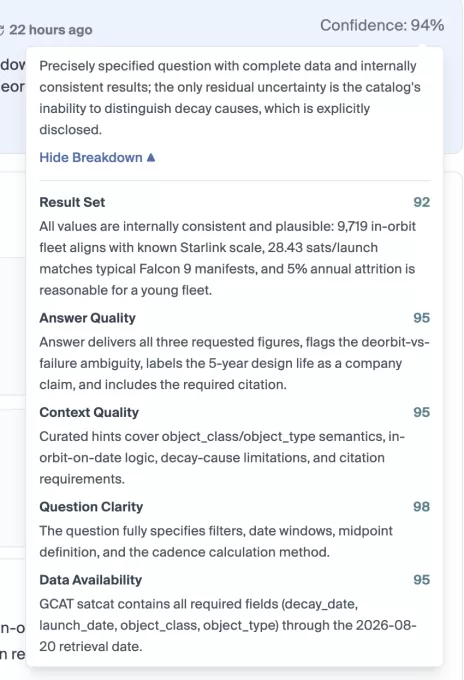
QueryStory’s confidence indicator.Image Credits:QueryStory / QueryStory
While frontier labs offer co-working tools, these are intentionally restricted in user experience. QueryStory’s strategy assumes that enterprise users demand greater transparency, reliability, and control when integrating AI into their workflows.
For instance, a tech executive recently described using Claude Cowork to query a company database, then manually verifying the generated SQL queries before sending them to a data analyst for review. In QueryStory, these SQL queries appear automatically, and users can flag analyses for human review, with all feedback recorded directly on the platform.
“AI is more fragile than people realize when building durable systems that large-scale businesses depend on,” Tayler Sipperly, a partner at Brightmind Partners, told TechCrunch.
Naghibzadeh notes that connecting enterprise data to an LLM’s chat interface often results in hundreds or thousands of employees asking questions, generating conflicting versions of the truth, and creating unmanageable spreadsheets with no centralized source of record.
Economic factors also play a role. Although QueryStory is model-agnostic and currently utilizes the latest models from frontier labs, Naghibzadeh believes customers prefer service providers not incentivized to maximize intelligence consumption.
“We have a distinct advantage in not building our business around consuming compute, storage, or tokens,” Naghibzadeh said. He argues that purpose-built tools like QueryStory can achieve greater efficiency and accuracy than general-purpose agents by preserving context.
“What we sell is trust in the answers,” he said. “We deliver business value by empowering CFOs to understand exactly what these solutions will cost.”
Related article
 French Startup ZML Unveils Free Tool to Accelerate AI Inference Across Multiple Chips
Nvidia’s era of unchecked market supremacy may be winding down, yet competitors and alternatives are emerging from every angle.ZML, a prominent French AI startup backed by Turing Award laureate Yann LeCun, has unveiled inference-performance software
Anthropic Unveils Opus 4.6, a Controversial Content Generator
Anthropic’s universal usage standards for Claude prohibit the model from generating sexually explicit content, including depicting or requesting sexual intercourse or sex acts, generating content related to sexual fetishes or fantasies, or engaging i
Marc Benioff-backed startup aims to solve AI deployment challenges
Big enterprises face such steep challenges in deploying reliable AI tools that entire teams of forward-deployed engineers—specialists embedded within client companies to operationalize AI systems—are emerging to bridge the gap.“Paradoxically, AI driv
Related Special Topic Recommendations
Design & Art
 Top AI Illustration Tools: Create Editorial Scenes and Cover Art Faster
2026 Latest Top-rated AI Illustration Tools: Our curated list features the best powerfully designed tools for creating stunning editorial scenes and eye-catching cover art quickly. Each option has gone through rigorous real-world tests, offering a free vs paid comparison to help you find the perfect match for your workflow. Try these must-try solutions today to unlock your AI edge and boost your creative productivity. Explore now at XIX.AI.
 10 tools
 xix.ai
Education and Learning
Top AI Tutors for Exam Prep: Practice Math, Science, and English
2026 Latest Top-Rated Best AI Tutors for Exam Prep are here on XIX.AI! Our curated list features powerful game-changing tools that offer free vs paid comparison, real-world tests, and weekly updated rankings. They help boost your writing efficiency, simplify complex topic learning, and unlock your academic potential. Explore now to Discover your perfect exam prep tool and Start creating today to Unlock your AI edge!
10 tools
xix.ai
Finance
AI Budget Planning Tools for Personal Money Management
2026 Latest Best Top-Rated AI Budget Planning Tools for Personal Money Management are here on XIX.AI! This curated collection features powerful, game-changing solutions that help you conduct real-world tests, understand spending habits, and create personalized plans to boost productivity. Enjoy a free vs paid comparison along with detailed rankings. Must-try tools designed to simplify money management and unlock your AI edge. Explore now!
11 tools
xix.ai
Health & Wellness
AI Sleep Tracking Assistants: Improve Recovery with Better Bedtime Habits
2026 Latest Best Top-Rated AI Sleep Tracking Assistants curated for ultimate recovery. This fully updated weekly guide features powerful tools that deliver real-world tests, free vs paid comparison, and detailed rankings to help you find the must-try solution that boosts sleep quality and supports better bedtime habits. Explore now at XIX.AI to Unlock your AI edge.
10 tools
xix.ai
Data Analysis
AI SQL Copilots for Product and Revenue Analytics
2026 Latest Best Top-Rated AI SQL Copilots for Product and Revenue Analytics! XIX.AI has curated a powerful, game-changing collection of must-try tools that undergo real-world tests through weekly updated rankings. These tools help users boost productivity significantly by accelerating data analysis, streamlining complex queries, and generating accurate insights to drive smarter business decisions. Explore now to Discover your perfect tool for unlocking your AI edge!
14 tools
xix.ai
Education and Learning
Best AI Homework Helpers That Teach: Learn Concepts, Not Just Answers
2026 Latest Best Top-Rated AI Homework Helpers That Teach Core Concepts Not Just Answers Powerful Tools for Students Must-Try Curated List Weekly Updated Free vs Paid Comparison Real-World Tests Accurate Rankings to Help You Unlock Your Full Learning Potential Explore now to Discover your perfect tool for smarter studying.
10 tools
xix.ai

 Comments (0)
0/500
In 2009, Shapor Naghibzadeh discovered the power of compelling storytelling while working as a Google sysops engineer. During Operation Aurora, when state-sponsored hackers targeted the tech giant, he was summoned to a crisis room to clarify server activities, learning firsthand that verified knowledge is essential for tracing cyberattacks across fragmented networks—a process he found both expensive and slow. He believes large language models can replicate this verification capability across diverse databases in a fraction of the time.
For the next six years, Naghibzadeh focused on merging data and cybersecurity, leveraging Google’s infrastructure to create tools enabling security analysts to query complex datasets. In 2016, he co-founded Chronicle, a startup within Google’s X Labs, to extend these capabilities to external enterprises.
Last year, recognizing the growing role of large language models in data analysis, Naghibzadeh identified an opportunity to adapt his cybersecurity techniques for broader analytics applications. He co-founded QueryStory, launching from stealth today, alongside CTO Stanley Yang, a former Google colleague and lead engineer at EvolutionIQ, and CPO David Glusic, an Accenture veteran.
“Investigations follow a pattern: you ask the data a series of questions, then synthesize those answers into a coherent narrative,” Naghibzadeh explained. “That concept inspired the name QueryStory. It’s about constructing truthful, data-driven narratives.”
QueryStory secured a $6 million seed round in late 2025 from Brightmind Ventures and New York Life Ventures, valuing the company at $60 million. During this period, the startup has refined its product through customer pilots. Targeting large enterprises with extensive proprietary databases, QueryStory serves as a unified platform for data analysis and review, supporting teams such as sales and operations.
“We bridge the trust gap in AI by providing enterprises with actionable, reliable answers,” Naghibzadeh stated. “Rather than relying on human judgment or deploying armies of engineers, we have productized that expertise.”
Tim Del Bello, a partner at New York Life Ventures, invested in the company and is already using the platform to replace manual reporting processes, aiming to transform quarterly business reviews into real-time dashboards.
“This product is designed for decision-makers who need ground truth from complex, disparate data sources but lack dedicated data science or BI teams, particularly in highly regulated industries,” he told TechCrunch.
Solving the problem of brittle AI systems
I shared a database tracking space activity to help understand orbital operations by companies like SpaceX. QueryStory generated a visualization of this data within hours—a task that previously required a developer and several weeks. The platform produced sophisticated dashboards and, notably, included a confidence indicator explaining why the AI agents deemed the analyses accurate.
A visualization of satellites in orbit around the Earth.Image Credits:QueryStory / QueryStory
A set of queries derived from the space data.Image Credits:QueryStory / QueryStory
A QueryStory.Image Credits:QueryStory / QueryStory
QueryStory’s confidence indicator.Image Credits:QueryStory / QueryStory
While frontier labs offer co-working tools, these are intentionally restricted in user experience. QueryStory’s strategy assumes that enterprise users demand greater transparency, reliability, and control when integrating AI into their workflows.
For instance, a tech executive recently described using Claude Cowork to query a company database, then manually verifying the generated SQL queries before sending them to a data analyst for review. In QueryStory, these SQL queries appear automatically, and users can flag analyses for human review, with all feedback recorded directly on the platform.
“AI is more fragile than people realize when building durable systems that large-scale businesses depend on,” Tayler Sipperly, a partner at Brightmind Partners, told TechCrunch.
Naghibzadeh notes that connecting enterprise data to an LLM’s chat interface often results in hundreds or thousands of employees asking questions, generating conflicting versions of the truth, and creating unmanageable spreadsheets with no centralized source of record.
Economic factors also play a role. Although QueryStory is model-agnostic and currently utilizes the latest models from frontier labs, Naghibzadeh believes customers prefer service providers not incentivized to maximize intelligence consumption.
“We have a distinct advantage in not building our business around consuming compute, storage, or tokens,” Naghibzadeh said. He argues that purpose-built tools like QueryStory can achieve greater efficiency and accuracy than general-purpose agents by preserving context.
“What we sell is trust in the answers,” he said. “We deliver business value by empowering CFOs to understand exactly what these solutions will cost.”








 French Startup ZML Unveils Free Tool to Accelerate AI Inference Across Multiple Chips
Nvidia’s era of unchecked market supremacy may be winding down, yet competitors and alternatives are emerging from every angle.ZML, a prominent French AI startup backed by Turing Award laureate Yann LeCun, has unveiled inference-performance software
 Anthropic Unveils Opus 4.6, a Controversial Content Generator
Anthropic’s universal usage standards for Claude prohibit the model from generating sexually explicit content, including depicting or requesting sexual intercourse or sex acts, generating content related to sexual fetishes or fantasies, or engaging i
 Marc Benioff-backed startup aims to solve AI deployment challenges
Big enterprises face such steep challenges in deploying reliable AI tools that entire teams of forward-deployed engineers—specialists embedded within client companies to operationalize AI systems—are emerging to bridge the gap.“Paradoxically, AI driv

2026 Latest Top-rated AI Illustration Tools: Our curated list features the best powerfully designed tools for creating stunning editorial scenes and eye-catching cover art quickly. Each option has gone through rigorous real-world tests, offering a free vs paid comparison to help you find the perfect match for your workflow. Try these must-try solutions today to unlock your AI edge and boost your creative productivity. Explore now at XIX.AI.
10 tools
xix.ai

2026 Latest Top-Rated Best AI Tutors for Exam Prep are here on XIX.AI! Our curated list features powerful game-changing tools that offer free vs paid comparison, real-world tests, and weekly updated rankings. They help boost your writing efficiency, simplify complex topic learning, and unlock your academic potential. Explore now to Discover your perfect exam prep tool and Start creating today to Unlock your AI edge!
10 tools
xix.ai

2026 Latest Best Top-Rated AI Budget Planning Tools for Personal Money Management are here on XIX.AI! This curated collection features powerful, game-changing solutions that help you conduct real-world tests, understand spending habits, and create personalized plans to boost productivity. Enjoy a free vs paid comparison along with detailed rankings. Must-try tools designed to simplify money management and unlock your AI edge. Explore now!
11 tools
xix.ai

2026 Latest Best Top-Rated AI Sleep Tracking Assistants curated for ultimate recovery. This fully updated weekly guide features powerful tools that deliver real-world tests, free vs paid comparison, and detailed rankings to help you find the must-try solution that boosts sleep quality and supports better bedtime habits. Explore now at XIX.AI to Unlock your AI edge.
10 tools
xix.ai

2026 Latest Best Top-Rated AI SQL Copilots for Product and Revenue Analytics! XIX.AI has curated a powerful, game-changing collection of must-try tools that undergo real-world tests through weekly updated rankings. These tools help users boost productivity significantly by accelerating data analysis, streamlining complex queries, and generating accurate insights to drive smarter business decisions. Explore now to Discover your perfect tool for unlocking your AI edge!
14 tools
xix.ai

2026 Latest Best Top-Rated AI Homework Helpers That Teach Core Concepts Not Just Answers Powerful Tools for Students Must-Try Curated List Weekly Updated Free vs Paid Comparison Real-World Tests Accurate Rankings to Help You Unlock Your Full Learning Potential Explore now to Discover your perfect tool for smarter studying.
10 tools
xix.ai












