


 Home
HomeOver 1,100 AI Staff Urge US Government to Pace Progress; Altman Rarely Backs Call
Recently, 1,134 employees from leading AI companies such as OpenAI, Anthropic, Google, and Meta jointly signed an open letter, urging the U.S. government to support international cooperation in developing the necessary technologies and governance tools to “consciously pace” AI development when needed. Sam Altman, CEO of OpenAI, rarely expressed support for this initiative.
The initiative is called “Pacing the Frontier,” and signatories include Dario Amodei, CEO of Anthropic, co-founder Jack Clark, Jared Kaplan, Chief Scientist Yakub Peharzki and Chief Research Officer Mark Chen of OpenAI, Chief Scientist Shengjia Zhao of Meta, Anca Dragan, head of AI safety and alignment at Google DeepMind, and John Schulman, Chief Scientist at Thinking Machines, among others.
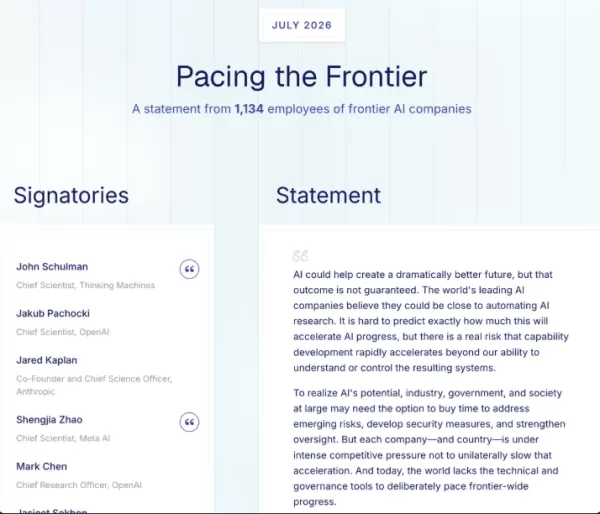
The core concern of the open letter is “automated AI development”—the ability of AI systems to develop and improve AI on their own, a concept known in the industry as “recursive self-improvement.” Anthropic previously stated that its Claude series models are rapidly approaching this threshold. The letter states: “It is difficult to accurately predict how much this will accelerate AI progress, but there is indeed a real risk that the development of AI capabilities may quickly outpace our ability to understand or control these systems.”
OpenAI responded on the X platform: “We believe that at some point in the future, AI acceleration in frontier model development may be so rapid that the world will need to pace the speed of AI progress.” Anthropic, meanwhile, said: “Our research released last month on recursive self-improvement shows that we need certain tools to consciously regulate the pace of AI development, giving society time to prepare.”
Altman’s shift in stance has attracted particular attention. In the past, he avoided signing initiatives calling for slowing down AI development. A similar open letter from 2023 was criticized by him as “lacking key technical details about what specific areas should be paused.” However, in a recent episode of the “Invest Like the Best” podcast, he stated: “We may need to pace the development of AI, giving ourselves enough time for society to adapt to these new capability levels and establish protective mechanisms. At the same time, we also need to find ways to do this without making anyone feel it’s regulatory capture or collusion between leading AI labs.”
Currently, AI companies are competing to develop increasingly powerful systems, and there is growing concern that the pace of AI development may exceed the capacity of existing security measures, governance systems, and regulatory mechanisms. This joint letter indicates that anxiety over “uncontrolled acceleration” has moved from the margins to the mainstream within the AI industry.
Related article
 Samsung Electronics\' Quarterly Profit Surges 180 Times: AI Storage Holds the Line, Phones and Home Appliances Are Losing Money
Samsung Electronics unveiled its Q2 2026 financial performance on July 30. Fueled by a surge in both volume and pricing for AI storage chips, total revenue hit 171.5 trillion South Korean won (approximately 805 billion Chinese yuan), marking a 130% y
How to fix Core Web Vitals for better SEO rankings
Is the Cubo AI Sleep Safety Bundle a Smart Investment? Here’s What You Need to KnowTable of Contents:IntroductionWhat Is the Cubo AI Sleep Sensor?Why Safe Sleep Practices MatterCubo AI vs. Competitors: How It Stacks UpHow to Set Up the Cubo AI Sleep
MIIT, three other agencies release national standard on AI terminal intelligence grading
On May 8, the Ministry of Industry and Information Technology, the State Administration for Market Regulation, and the Ministry of Commerce jointly released the "Intelligent Grading of AI Terminals" (GB/Z177-2026) series of national standards, offici
Related Special Topic Recommendations
Academic Research
Samsung Electronics\' Quarterly Profit Surges 180 Times: AI Storage Holds the Line, Phones and Home Appliances Are Losing Money
Samsung Electronics unveiled its Q2 2026 financial performance on July 30. Fueled by a surge in both volume and pricing for AI storage chips, total revenue hit 171.5 trillion South Korean won (approximately 805 billion Chinese yuan), marking a 130% y
How to fix Core Web Vitals for better SEO rankings
Is the Cubo AI Sleep Safety Bundle a Smart Investment? Here’s What You Need to KnowTable of Contents:IntroductionWhat Is the Cubo AI Sleep Sensor?Why Safe Sleep Practices MatterCubo AI vs. Competitors: How It Stacks UpHow to Set Up the Cubo AI Sleep
MIIT, three other agencies release national standard on AI terminal intelligence grading
On May 8, the Ministry of Industry and Information Technology, the State Administration for Market Regulation, and the Ministry of Commerce jointly released the "Intelligent Grading of AI Terminals" (GB/Z177-2026) series of national standards, offici
Related Special Topic Recommendations
Academic Research
 AI PDF Citation Extractors for Journal Articles, Methods Sections, and References
2026 Latest Best Top-rated AI PDF Citation Extractors for Journal Articles, Methods Sections, and References are here on XIX.AI. This curated list features powerful game-changing tools that go through real-world tests to deliver accurate results every time. You can find a free vs paid comparison along with detailed rankings to help you choose the must-try option that boosts your research efficiency significantly. Explore now to discover your perfect tool for faster academic work!
 9 tools
 xix.ai
Design & Art
Canva AI Brand Kit Assistants for Social Creatives, Decks, and Campaign Assets
xix.ai
Design & Art
Canva AI Brand Kit Assistants for Social Creatives, Decks, and Campaign Assets
2026 Latest Best Canva AI Brand Kit Assistants for Social Creatives, Decks, and Campaign Assets! This curated top-rated list features powerful game-changing tools that help social creatives streamline content creation, boost writing efficiency, and produce high-quality assets fast through real-world tests. XIX.AI offers a free vs paid comparison to help you find the perfect fit. Explore now to unlock your AI edge!
12 tools
xix.ai
automation
AI Integration Tools for No Code Automation Teams
2026 Latest Best AI Integration Tools for No Code Automation Teams are here on XIX.AI! This curated list features top-rated, powerful solutions that help teams streamline workflows, boost productivity, and tackle complex automation tasks with ease. We conduct real-world tests to deliver accurate rankings and a free vs paid comparison, making it simple to find the must-try option that fits your needs. Explore now to uncover your perfect tool for seamless no code integration!
8 tools
xix.ai
Video creation
Best AI Screen Recording Editors for Product Demos, Walkthroughs, and Training Clips
2026 Latest Best Top-rated AI screen recording editors curated by XIX.AI for product demos, walkthroughs, and training clips. These powerful game-changing tools offer real-world tests, free vs paid comparison, and weekly updated rankings to help you boost productivity significantly. Explore now to Discover your perfect tool for streamlining creative workflows! 238 characters
10 tools
xix.ai
Video creation
Best AI Screen Recording Editors for Product Demo Videos
2026 Latest Best Top-rated AI screen recording editors for product demo videos are here on XIX.AI! This curated list features powerful, game-changing tools that help you create professional-quality demos fast, boost writing efficiency, and deliver seamless results. Get a free vs paid comparison, see real-world tests, and check our updated weekly rankings. Explore now to discover your perfect tool and unlock your AI edge!
9 tools
xix.ai
design
AI Logo Drafting Tools for Early Brand Concepts
2026 Latest Best Top-Rated AI Logo Drafting Tools for Early Brand Concepts! This curated list features powerful game-changing solutions that help entrepreneurs and creatives quickly create professional logo designs, boost branding efficiency, and stay ahead in the competitive market. XIX.AI offers a free vs paid comparison along with real-world tests and weekly updated rankings to help you find the perfect tool. Explore now to Unlock your AI edge!
9 tools
xix.ai

 Comments (0)
0/500
Comments (0)
0/500
Recently, 1,134 employees from leading AI companies such as OpenAI, Anthropic, Google, and Meta jointly signed an open letter, urging the U.S. government to support international cooperation in developing the necessary technologies and governance tools to “consciously pace” AI development when needed. Sam Altman, CEO of OpenAI, rarely expressed support for this initiative.
The initiative is called “Pacing the Frontier,” and signatories include Dario Amodei, CEO of Anthropic, co-founder Jack Clark, Jared Kaplan, Chief Scientist Yakub Peharzki and Chief Research Officer Mark Chen of OpenAI, Chief Scientist Shengjia Zhao of Meta, Anca Dragan, head of AI safety and alignment at Google DeepMind, and John Schulman, Chief Scientist at Thinking Machines, among others.
The core concern of the open letter is “automated AI development”—the ability of AI systems to develop and improve AI on their own, a concept known in the industry as “recursive self-improvement.” Anthropic previously stated that its Claude series models are rapidly approaching this threshold. The letter states: “It is difficult to accurately predict how much this will accelerate AI progress, but there is indeed a real risk that the development of AI capabilities may quickly outpace our ability to understand or control these systems.”
OpenAI responded on the X platform: “We believe that at some point in the future, AI acceleration in frontier model development may be so rapid that the world will need to pace the speed of AI progress.” Anthropic, meanwhile, said: “Our research released last month on recursive self-improvement shows that we need certain tools to consciously regulate the pace of AI development, giving society time to prepare.”
Altman’s shift in stance has attracted particular attention. In the past, he avoided signing initiatives calling for slowing down AI development. A similar open letter from 2023 was criticized by him as “lacking key technical details about what specific areas should be paused.” However, in a recent episode of the “Invest Like the Best” podcast, he stated: “We may need to pace the development of AI, giving ourselves enough time for society to adapt to these new capability levels and establish protective mechanisms. At the same time, we also need to find ways to do this without making anyone feel it’s regulatory capture or collusion between leading AI labs.”
Currently, AI companies are competing to develop increasingly powerful systems, and there is growing concern that the pace of AI development may exceed the capacity of existing security measures, governance systems, and regulatory mechanisms. This joint letter indicates that anxiety over “uncontrolled acceleration” has moved from the margins to the mainstream within the AI industry.








 Samsung Electronics\' Quarterly Profit Surges 180 Times: AI Storage Holds the Line, Phones and Home Appliances Are Losing Money
Samsung Electronics unveiled its Q2 2026 financial performance on July 30. Fueled by a surge in both volume and pricing for AI storage chips, total revenue hit 171.5 trillion South Korean won (approximately 805 billion Chinese yuan), marking a 130% y
Samsung Electronics\' Quarterly Profit Surges 180 Times: AI Storage Holds the Line, Phones and Home Appliances Are Losing Money
Samsung Electronics unveiled its Q2 2026 financial performance on July 30. Fueled by a surge in both volume and pricing for AI storage chips, total revenue hit 171.5 trillion South Korean won (approximately 805 billion Chinese yuan), marking a 130% y
 How to fix Core Web Vitals for better SEO rankings
Is the Cubo AI Sleep Safety Bundle a Smart Investment? Here’s What You Need to KnowTable of Contents:IntroductionWhat Is the Cubo AI Sleep Sensor?Why Safe Sleep Practices MatterCubo AI vs. Competitors: How It Stacks UpHow to Set Up the Cubo AI Sleep
How to fix Core Web Vitals for better SEO rankings
Is the Cubo AI Sleep Safety Bundle a Smart Investment? Here’s What You Need to KnowTable of Contents:IntroductionWhat Is the Cubo AI Sleep Sensor?Why Safe Sleep Practices MatterCubo AI vs. Competitors: How It Stacks UpHow to Set Up the Cubo AI Sleep
 MIIT, three other agencies release national standard on AI terminal intelligence grading
On May 8, the Ministry of Industry and Information Technology, the State Administration for Market Regulation, and the Ministry of Commerce jointly released the "Intelligent Grading of AI Terminals" (GB/Z177-2026) series of national standards, offici
MIIT, three other agencies release national standard on AI terminal intelligence grading
On May 8, the Ministry of Industry and Information Technology, the State Administration for Market Regulation, and the Ministry of Commerce jointly released the "Intelligent Grading of AI Terminals" (GB/Z177-2026) series of national standards, offici

2026 Latest Best Top-rated AI PDF Citation Extractors for Journal Articles, Methods Sections, and References are here on XIX.AI. This curated list features powerful game-changing tools that go through real-world tests to deliver accurate results every time. You can find a free vs paid comparison along with detailed rankings to help you choose the must-try option that boosts your research efficiency significantly. Explore now to discover your perfect tool for faster academic work!
9 tools
xix.ai

2026 Latest Best Canva AI Brand Kit Assistants for Social Creatives, Decks, and Campaign Assets! This curated top-rated list features powerful game-changing tools that help social creatives streamline content creation, boost writing efficiency, and produce high-quality assets fast through real-world tests. XIX.AI offers a free vs paid comparison to help you find the perfect fit. Explore now to unlock your AI edge!
12 tools
xix.ai

2026 Latest Best AI Integration Tools for No Code Automation Teams are here on XIX.AI! This curated list features top-rated, powerful solutions that help teams streamline workflows, boost productivity, and tackle complex automation tasks with ease. We conduct real-world tests to deliver accurate rankings and a free vs paid comparison, making it simple to find the must-try option that fits your needs. Explore now to uncover your perfect tool for seamless no code integration!
8 tools
xix.ai

2026 Latest Best Top-rated AI screen recording editors curated by XIX.AI for product demos, walkthroughs, and training clips. These powerful game-changing tools offer real-world tests, free vs paid comparison, and weekly updated rankings to help you boost productivity significantly. Explore now to Discover your perfect tool for streamlining creative workflows! 238 characters
10 tools
xix.ai

2026 Latest Best Top-rated AI screen recording editors for product demo videos are here on XIX.AI! This curated list features powerful, game-changing tools that help you create professional-quality demos fast, boost writing efficiency, and deliver seamless results. Get a free vs paid comparison, see real-world tests, and check our updated weekly rankings. Explore now to discover your perfect tool and unlock your AI edge!
9 tools
xix.ai

2026 Latest Best Top-Rated AI Logo Drafting Tools for Early Brand Concepts! This curated list features powerful game-changing solutions that help entrepreneurs and creatives quickly create professional logo designs, boost branding efficiency, and stay ahead in the competitive market. XIX.AI offers a free vs paid comparison along with real-world tests and weekly updated rankings to help you find the perfect tool. Explore now to Unlock your AI edge!
9 tools
xix.ai












