


 Home
OpenRouter Unveils Fusion API to Optimize AI Team Shopping Performance and Cost
In the realm of large AI models, the pursuit of higher performance and lower costs has long been a priority for developers and companies. Recently, the well-known AI model aggregation platform OpenRouter introduced a composite model service called "Fusion API," designed to offer users a solution that balances performance and cost-efficiency through multi-model collaboration.
The Fusion API is not powered by a single model but rather by a mature multi-model collaboration system. Its workflow sends the user's query to multiple models for parallel processing, then a review model performs structured analysis of each response, and finally a model integrates the best final answer. This "multi-model complementarity" mechanism effectively enhances the accuracy and quality of the answers.
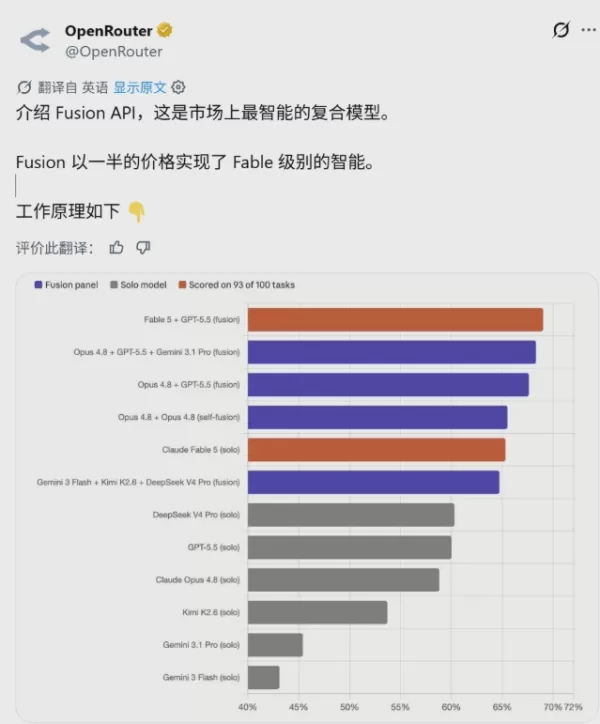
According to benchmark test data released by OpenRouter, the system delivers strong performance. A configuration combining Claude Opus4.8 and GPT-5.5, with Opus4.8 handling the final synthesis, achieved a performance score of 69.0%, surpassing the industry-recognized high-performance model Claude Fable5 . Additionally, a "three strong" collaboration including Claude Opus4.8, GPT-5.5, and Gemini3.1Pro also outperformed Claude Fable5 overall.
Beyond performance breakthroughs, Fusion API is also highly competitive in cost control. Official tests show that by cleverly combining Gemini3Flash, Kimi K2.6, and DeepSeek V4Pro, users can keep the test score difference within 1% while paying only about half the cost of Claude Fable5, demonstrating an exceptional cost-performance ratio.
As the application scenarios of AI large models continue to expand, optimizing resource allocation and reducing call costs through technical means has become a common industry challenge. The collaborative service introduced by OpenRouter, Fusion API, offers developers a new technical approach that could change the cost calculation logic when selecting and applying large models.
Related article
 OpenAI appoints prominent AI doomer to board
Paul Christiano, a prominent AI researcher dedicated to ensuring artificial intelligence remains aligned with human values and under human oversight, has been appointed to the OpenAI Foundation board, the company announced on Wednesday.“I now believe
Last chance to save up to $200 on TechCrunch Founder Summit pass: Early booking ends October 16
Every funding round, hiring decision, and product pivot shapes your startup’s trajectory for years. The most valuable investment you can make is pausing to critically evaluate your strategy.Save up to $200 on TechCrunch Founder Summit passes before t
U.S. Government Actions Against Anthropic AI Spark Claims of Political Retribution
Amid the collision of AI capabilities and national security, a rare legal showdown is unfolding in a U.S. court. Federal Judge Rita Lin recently cast doubt on the Biden administration’s decision to blacklist AI firm Anthropic, suggesting the move app
Related Special Topic Recommendations
Design & Art
 Top AI Illustration Tools: Create Editorial Scenes and Cover Art Faster
2026 Latest Top-rated AI Illustration Tools: Our curated list features the best powerfully designed tools for creating stunning editorial scenes and eye-catching cover art quickly. Each option has gone through rigorous real-world tests, offering a free vs paid comparison to help you find the perfect match for your workflow. Try these must-try solutions today to unlock your AI edge and boost your creative productivity. Explore now at XIX.AI.
 10 tools
 xix.ai
Education and Learning
Top AI Tutors for Exam Prep: Practice Math, Science, and English
2026 Latest Top-Rated Best AI Tutors for Exam Prep are here on XIX.AI! Our curated list features powerful game-changing tools that offer free vs paid comparison, real-world tests, and weekly updated rankings. They help boost your writing efficiency, simplify complex topic learning, and unlock your academic potential. Explore now to Discover your perfect exam prep tool and Start creating today to Unlock your AI edge!
10 tools
xix.ai
Finance
AI Budget Planning Tools for Personal Money Management
2026 Latest Best Top-Rated AI Budget Planning Tools for Personal Money Management are here on XIX.AI! This curated collection features powerful, game-changing solutions that help you conduct real-world tests, understand spending habits, and create personalized plans to boost productivity. Enjoy a free vs paid comparison along with detailed rankings. Must-try tools designed to simplify money management and unlock your AI edge. Explore now!
11 tools
xix.ai
Health & Wellness
AI Sleep Tracking Assistants: Improve Recovery with Better Bedtime Habits
2026 Latest Best Top-Rated AI Sleep Tracking Assistants curated for ultimate recovery. This fully updated weekly guide features powerful tools that deliver real-world tests, free vs paid comparison, and detailed rankings to help you find the must-try solution that boosts sleep quality and supports better bedtime habits. Explore now at XIX.AI to Unlock your AI edge.
10 tools
xix.ai
Data Analysis
AI SQL Copilots for Product and Revenue Analytics
2026 Latest Best Top-Rated AI SQL Copilots for Product and Revenue Analytics! XIX.AI has curated a powerful, game-changing collection of must-try tools that undergo real-world tests through weekly updated rankings. These tools help users boost productivity significantly by accelerating data analysis, streamlining complex queries, and generating accurate insights to drive smarter business decisions. Explore now to Discover your perfect tool for unlocking your AI edge!
14 tools
xix.ai
Education and Learning
Best AI Homework Helpers That Teach: Learn Concepts, Not Just Answers
2026 Latest Best Top-Rated AI Homework Helpers That Teach Core Concepts Not Just Answers Powerful Tools for Students Must-Try Curated List Weekly Updated Free vs Paid Comparison Real-World Tests Accurate Rankings to Help You Unlock Your Full Learning Potential Explore now to Discover your perfect tool for smarter studying.
10 tools
xix.ai

 Comments (0)
0/500
In the realm of large AI models, the pursuit of higher performance and lower costs has long been a priority for developers and companies. Recently, the well-known AI model aggregation platform
The Fusion API is not powered by a single model but rather by a mature multi-model collaboration system. Its workflow sends the user's query to multiple models for parallel processing, then a review model performs structured analysis of each response, and finally a model integrates the best final answer. This "multi-model complementarity" mechanism effectively enhances the accuracy and quality of the answers.
According to benchmark test data released by OpenRouter, the system delivers strong performance. A configuration combining Claude Opus4.8 and GPT-5.5, with Opus4.8 handling the final synthesis, achieved a performance score of 69.0%, surpassing the industry-recognized high-performance model
Beyond performance breakthroughs, Fusion API is also highly competitive in cost control. Official tests show that by cleverly combining Gemini3Flash, Kimi K2.6, and DeepSeek V4Pro, users can keep the test score difference within 1% while paying only about half the cost of Claude Fable5, demonstrating an exceptional cost-performance ratio.
As the application scenarios of AI large models continue to expand, optimizing resource allocation and reducing call costs through technical means has become a common industry challenge. The collaborative service introduced by OpenRouter, Fusion API, offers developers a new technical approach that could change the cost calculation logic when selecting and applying large models.








 OpenAI appoints prominent AI doomer to board
Paul Christiano, a prominent AI researcher dedicated to ensuring artificial intelligence remains aligned with human values and under human oversight, has been appointed to the OpenAI Foundation board, the company announced on Wednesday.“I now believe
 Last chance to save up to $200 on TechCrunch Founder Summit pass: Early booking ends October 16
Every funding round, hiring decision, and product pivot shapes your startup’s trajectory for years. The most valuable investment you can make is pausing to critically evaluate your strategy.Save up to $200 on TechCrunch Founder Summit passes before t
 U.S. Government Actions Against Anthropic AI Spark Claims of Political Retribution
Amid the collision of AI capabilities and national security, a rare legal showdown is unfolding in a U.S. court. Federal Judge Rita Lin recently cast doubt on the Biden administration’s decision to blacklist AI firm Anthropic, suggesting the move app

2026 Latest Top-rated AI Illustration Tools: Our curated list features the best powerfully designed tools for creating stunning editorial scenes and eye-catching cover art quickly. Each option has gone through rigorous real-world tests, offering a free vs paid comparison to help you find the perfect match for your workflow. Try these must-try solutions today to unlock your AI edge and boost your creative productivity. Explore now at XIX.AI.
10 tools
xix.ai

2026 Latest Top-Rated Best AI Tutors for Exam Prep are here on XIX.AI! Our curated list features powerful game-changing tools that offer free vs paid comparison, real-world tests, and weekly updated rankings. They help boost your writing efficiency, simplify complex topic learning, and unlock your academic potential. Explore now to Discover your perfect exam prep tool and Start creating today to Unlock your AI edge!
10 tools
xix.ai

2026 Latest Best Top-Rated AI Budget Planning Tools for Personal Money Management are here on XIX.AI! This curated collection features powerful, game-changing solutions that help you conduct real-world tests, understand spending habits, and create personalized plans to boost productivity. Enjoy a free vs paid comparison along with detailed rankings. Must-try tools designed to simplify money management and unlock your AI edge. Explore now!
11 tools
xix.ai

2026 Latest Best Top-Rated AI Sleep Tracking Assistants curated for ultimate recovery. This fully updated weekly guide features powerful tools that deliver real-world tests, free vs paid comparison, and detailed rankings to help you find the must-try solution that boosts sleep quality and supports better bedtime habits. Explore now at XIX.AI to Unlock your AI edge.
10 tools
xix.ai

2026 Latest Best Top-Rated AI SQL Copilots for Product and Revenue Analytics! XIX.AI has curated a powerful, game-changing collection of must-try tools that undergo real-world tests through weekly updated rankings. These tools help users boost productivity significantly by accelerating data analysis, streamlining complex queries, and generating accurate insights to drive smarter business decisions. Explore now to Discover your perfect tool for unlocking your AI edge!
14 tools
xix.ai

2026 Latest Best Top-Rated AI Homework Helpers That Teach Core Concepts Not Just Answers Powerful Tools for Students Must-Try Curated List Weekly Updated Free vs Paid Comparison Real-World Tests Accurate Rankings to Help You Unlock Your Full Learning Potential Explore now to Discover your perfect tool for smarter studying.
10 tools
xix.ai












