


 Home
HomeOpenClaw's AReaL v1.0 Framework Enables Concurrent AI Agent Training
On March 4th, Ant Group, in collaboration with Tsinghua University, released the stable version of the open-source reinforcement learning training framework, AReaL v1.0. This release centers on enabling "one-click RL training access for Agents." It requires no code modifications, is compatible with diverse Agent frameworks, and allows intelligent agents to begin reinforcement learning training immediately.
Since early 2026, Agents have maintained strong growth momentum. Frameworks like LangChain, Claude Code, and OpenClaw have advanced rapidly, yet they highlight two significant bottlenecks. First, the barrier to training access is high: existing agent frameworks use varied interfaces, often necessitating extensive adaptation code for integration. Second, Agents lack continuous evolution: most rely on fixed model weights from their initial training phase. Once deployed, they cannot be optimized further for specific scenarios, with their capabilities capped at launch.
AReaL is the first fully asynchronous, training-inference decoupled large-scale reinforcement learning system. It enables Agents to receive feedback and continuously refine their decisions through real-world task interactions. The v1.0 release allows any Agent to connect to RL training without changes. By inserting a Proxy Worker layer between the agent and the training system, developers only need to redirect a single request address to enable training.
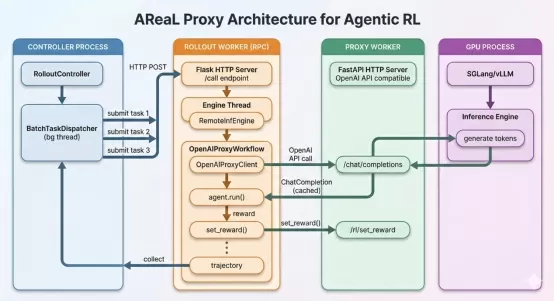
(Figure: AReaL's asynchronous training architecture seamlessly integrated into agents)
Take the popular OpenClaw framework as an example. Developers simply need to point the `base_url` and `api_key` in OpenClaw's configuration to the AReaL gateway. Their OpenClaw agent is then connected to reinforcement learning training. The agent continues performing tasks normally, while users periodically rate its performance. AReaL automatically gathers this training data and updates the model in the background, enabling the agent to evolve autonomously through continuous use.
The AReaL v1.0 release also introduces the native training engine, Archon. Built on PyTorch's native capabilities, it achieves full 5D parallelism—data, pipeline, tensor, context, and expert parallelism—lowering the installation and debugging barrier. It also offers multiple backend options for training and inference, facilitating flexible deployment across different environments. Remarkably, this complex distributed system was developed and validated from scratch in just one person-month. Within 32 days, nearly a million lines of code were modified to fully implement the Archon engine, enabling it to train billion-parameter Mixture-of-Experts (MoE) models.
The secret behind this efficiency breakthrough is AReaL's integrated AI-assisted development system, which automates highly complex engineering tasks.
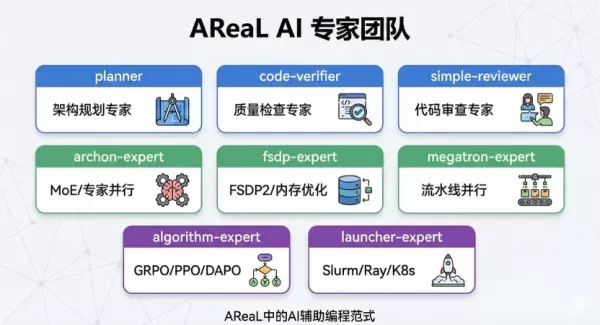
AReaL v1.0 features an AI-assisted development workflow that provides end-to-end support, from planning and coding to verification and PR creation. When working on core modules like MoE parallelism, memory optimization, and algorithm implementation, a dedicated AI programming assistant acts as a senior expert. It provides timely, targeted guidance during code changes, ensuring the correctness of every modification. AReaL's AI-assisted programming is more than just a productivity tool; it can undertake "deliverable" R&D work in complex infrastructure projects, pioneering the next paradigm for AI infrastructure engineering.
The AReaL team has stated they will continue to iterate on the training engines, usability, and multimodal agent training. The code and documentation for AReaL v1.0 are now open-sourced in the inclusionAI community.
· GitHub repository: https://github.com/inclusionAI/AReaL
· Related paper: https://arxiv.org/abs/2505.24298
Related article
 Stripe to Acquire OpenRouter as AI Model Routing Gains Momentum
Stripe has agreed to acquire OpenRouter, an AI model-routing platform that gives developers access to hundreds of models through a single interface. The deal adds model selection and routing to Stripe’s existing work around AI usage and token-based b
Former OpenAI Researcher Barrett Zoph Returns to Google to Support Gemini Development
Barret Zoph, who previously abruptly left and joined OpenAI due to a disagreement with Thinking Machines Lab CEO Miriam Mularati, has once again changed employers. Alphabet's Google announced that Zoph will return as Vice President of Research, bring
How Recursive Intelligence Raised $335M at $4B Valuation in 4 Months
The co-founders of startup Ricursive Intelligence seemed destined to be co-founders.Anna Goldie, CEO, and Azalia Mirhoseini, CTO, are so well-known in the AI community that they were among those AI engineers who “got those weird emails from Zuckerber
Related Special Topic Recommendations
Design & Art
Stripe to Acquire OpenRouter as AI Model Routing Gains Momentum
Stripe has agreed to acquire OpenRouter, an AI model-routing platform that gives developers access to hundreds of models through a single interface. The deal adds model selection and routing to Stripe’s existing work around AI usage and token-based b
Former OpenAI Researcher Barrett Zoph Returns to Google to Support Gemini Development
Barret Zoph, who previously abruptly left and joined OpenAI due to a disagreement with Thinking Machines Lab CEO Miriam Mularati, has once again changed employers. Alphabet's Google announced that Zoph will return as Vice President of Research, bring
How Recursive Intelligence Raised $335M at $4B Valuation in 4 Months
The co-founders of startup Ricursive Intelligence seemed destined to be co-founders.Anna Goldie, CEO, and Azalia Mirhoseini, CTO, are so well-known in the AI community that they were among those AI engineers who “got those weird emails from Zuckerber
Related Special Topic Recommendations
Design & Art
 Top AI Illustration Tools: Create Editorial Scenes and Cover Art Faster
2026 Latest Top-rated AI Illustration Tools: Our curated list features the best powerfully designed tools for creating stunning editorial scenes and eye-catching cover art quickly. Each option has gone through rigorous real-world tests, offering a free vs paid comparison to help you find the perfect match for your workflow. Try these must-try solutions today to unlock your AI edge and boost your creative productivity. Explore now at XIX.AI.
 10 tools
 xix.ai
Education and Learning
Top AI Tutors for Exam Prep: Practice Math, Science, and English
xix.ai
Education and Learning
Top AI Tutors for Exam Prep: Practice Math, Science, and English
2026 Latest Top-Rated Best AI Tutors for Exam Prep are here on XIX.AI! Our curated list features powerful game-changing tools that offer free vs paid comparison, real-world tests, and weekly updated rankings. They help boost your writing efficiency, simplify complex topic learning, and unlock your academic potential. Explore now to Discover your perfect exam prep tool and Start creating today to Unlock your AI edge!
10 tools
xix.ai
Finance
AI Budget Planning Tools for Personal Money Management
2026 Latest Best Top-Rated AI Budget Planning Tools for Personal Money Management are here on XIX.AI! This curated collection features powerful, game-changing solutions that help you conduct real-world tests, understand spending habits, and create personalized plans to boost productivity. Enjoy a free vs paid comparison along with detailed rankings. Must-try tools designed to simplify money management and unlock your AI edge. Explore now!
11 tools
xix.ai
Health & Wellness
AI Sleep Tracking Assistants: Improve Recovery with Better Bedtime Habits
2026 Latest Best Top-Rated AI Sleep Tracking Assistants curated for ultimate recovery. This fully updated weekly guide features powerful tools that deliver real-world tests, free vs paid comparison, and detailed rankings to help you find the must-try solution that boosts sleep quality and supports better bedtime habits. Explore now at XIX.AI to Unlock your AI edge.
10 tools
xix.ai
Data Analysis
AI SQL Copilots for Product and Revenue Analytics
2026 Latest Best Top-Rated AI SQL Copilots for Product and Revenue Analytics! XIX.AI has curated a powerful, game-changing collection of must-try tools that undergo real-world tests through weekly updated rankings. These tools help users boost productivity significantly by accelerating data analysis, streamlining complex queries, and generating accurate insights to drive smarter business decisions. Explore now to Discover your perfect tool for unlocking your AI edge!
14 tools
xix.ai
Education and Learning
Best AI Homework Helpers That Teach: Learn Concepts, Not Just Answers
2026 Latest Best Top-Rated AI Homework Helpers That Teach Core Concepts Not Just Answers Powerful Tools for Students Must-Try Curated List Weekly Updated Free vs Paid Comparison Real-World Tests Accurate Rankings to Help You Unlock Your Full Learning Potential Explore now to Discover your perfect tool for smarter studying.
10 tools
xix.ai

 Comments (1)
0/500
Comments (1)
0/500
![NicholasDavis]()
這個框架讓AI訓練變得好簡單!不過,如果人人都能輕鬆訓練AI,未來市場上的AI產品會不會變得太相似,反而缺乏創新呢?🤔 有點期待又怕受傷害。
On March 4th, Ant Group, in collaboration with Tsinghua University, released the stable version of the open-source reinforcement learning training framework, AReaL v1.0. This release centers on enabling "one-click RL training access for Agents." It requires no code modifications, is compatible with diverse Agent frameworks, and allows intelligent agents to begin reinforcement learning training immediately.
Since early 2026, Agents have maintained strong growth momentum. Frameworks like LangChain, Claude Code, and OpenClaw have advanced rapidly, yet they highlight two significant bottlenecks. First, the barrier to training access is high: existing agent frameworks use varied interfaces, often necessitating extensive adaptation code for integration. Second, Agents lack continuous evolution: most rely on fixed model weights from their initial training phase. Once deployed, they cannot be optimized further for specific scenarios, with their capabilities capped at launch.
AReaL is the first fully asynchronous, training-inference decoupled large-scale reinforcement learning system. It enables Agents to receive feedback and continuously refine their decisions through real-world task interactions. The v1.0 release allows any Agent to connect to RL training without changes. By inserting a Proxy Worker layer between the agent and the training system, developers only need to redirect a single request address to enable training.
(Figure: AReaL's asynchronous training architecture seamlessly integrated into agents)
Take the popular OpenClaw framework as an example. Developers simply need to point the `base_url` and `api_key` in OpenClaw's configuration to the AReaL gateway. Their OpenClaw agent is then connected to reinforcement learning training. The agent continues performing tasks normally, while users periodically rate its performance. AReaL automatically gathers this training data and updates the model in the background, enabling the agent to evolve autonomously through continuous use.
The AReaL v1.0 release also introduces the native training engine, Archon. Built on PyTorch's native capabilities, it achieves full 5D parallelism—data, pipeline, tensor, context, and expert parallelism—lowering the installation and debugging barrier. It also offers multiple backend options for training and inference, facilitating flexible deployment across different environments. Remarkably, this complex distributed system was developed and validated from scratch in just one person-month. Within 32 days, nearly a million lines of code were modified to fully implement the Archon engine, enabling it to train billion-parameter Mixture-of-Experts (MoE) models.
The secret behind this efficiency breakthrough is AReaL's integrated AI-assisted development system, which automates highly complex engineering tasks.
AReaL v1.0 features an AI-assisted development workflow that provides end-to-end support, from planning and coding to verification and PR creation. When working on core modules like MoE parallelism, memory optimization, and algorithm implementation, a dedicated AI programming assistant acts as a senior expert. It provides timely, targeted guidance during code changes, ensuring the correctness of every modification. AReaL's AI-assisted programming is more than just a productivity tool; it can undertake "deliverable" R&D work in complex infrastructure projects, pioneering the next paradigm for AI infrastructure engineering.
The AReaL team has stated they will continue to iterate on the training engines, usability, and multimodal agent training. The code and documentation for AReaL v1.0 are now open-sourced in the inclusionAI community.
· GitHub repository: https://github.com/inclusionAI/AReaL
· Related paper: https://arxiv.org/abs/2505.24298








 Stripe to Acquire OpenRouter as AI Model Routing Gains Momentum
Stripe has agreed to acquire OpenRouter, an AI model-routing platform that gives developers access to hundreds of models through a single interface. The deal adds model selection and routing to Stripe’s existing work around AI usage and token-based b
Stripe to Acquire OpenRouter as AI Model Routing Gains Momentum
Stripe has agreed to acquire OpenRouter, an AI model-routing platform that gives developers access to hundreds of models through a single interface. The deal adds model selection and routing to Stripe’s existing work around AI usage and token-based b
 Former OpenAI Researcher Barrett Zoph Returns to Google to Support Gemini Development
Barret Zoph, who previously abruptly left and joined OpenAI due to a disagreement with Thinking Machines Lab CEO Miriam Mularati, has once again changed employers. Alphabet's Google announced that Zoph will return as Vice President of Research, bring
Former OpenAI Researcher Barrett Zoph Returns to Google to Support Gemini Development
Barret Zoph, who previously abruptly left and joined OpenAI due to a disagreement with Thinking Machines Lab CEO Miriam Mularati, has once again changed employers. Alphabet's Google announced that Zoph will return as Vice President of Research, bring
 How Recursive Intelligence Raised $335M at $4B Valuation in 4 Months
The co-founders of startup Ricursive Intelligence seemed destined to be co-founders.Anna Goldie, CEO, and Azalia Mirhoseini, CTO, are so well-known in the AI community that they were among those AI engineers who “got those weird emails from Zuckerber
How Recursive Intelligence Raised $335M at $4B Valuation in 4 Months
The co-founders of startup Ricursive Intelligence seemed destined to be co-founders.Anna Goldie, CEO, and Azalia Mirhoseini, CTO, are so well-known in the AI community that they were among those AI engineers who “got those weird emails from Zuckerber

2026 Latest Top-rated AI Illustration Tools: Our curated list features the best powerfully designed tools for creating stunning editorial scenes and eye-catching cover art quickly. Each option has gone through rigorous real-world tests, offering a free vs paid comparison to help you find the perfect match for your workflow. Try these must-try solutions today to unlock your AI edge and boost your creative productivity. Explore now at XIX.AI.
10 tools
xix.ai

2026 Latest Top-Rated Best AI Tutors for Exam Prep are here on XIX.AI! Our curated list features powerful game-changing tools that offer free vs paid comparison, real-world tests, and weekly updated rankings. They help boost your writing efficiency, simplify complex topic learning, and unlock your academic potential. Explore now to Discover your perfect exam prep tool and Start creating today to Unlock your AI edge!
10 tools
xix.ai

2026 Latest Best Top-Rated AI Budget Planning Tools for Personal Money Management are here on XIX.AI! This curated collection features powerful, game-changing solutions that help you conduct real-world tests, understand spending habits, and create personalized plans to boost productivity. Enjoy a free vs paid comparison along with detailed rankings. Must-try tools designed to simplify money management and unlock your AI edge. Explore now!
11 tools
xix.ai

2026 Latest Best Top-Rated AI Sleep Tracking Assistants curated for ultimate recovery. This fully updated weekly guide features powerful tools that deliver real-world tests, free vs paid comparison, and detailed rankings to help you find the must-try solution that boosts sleep quality and supports better bedtime habits. Explore now at XIX.AI to Unlock your AI edge.
10 tools
xix.ai

2026 Latest Best Top-Rated AI SQL Copilots for Product and Revenue Analytics! XIX.AI has curated a powerful, game-changing collection of must-try tools that undergo real-world tests through weekly updated rankings. These tools help users boost productivity significantly by accelerating data analysis, streamlining complex queries, and generating accurate insights to drive smarter business decisions. Explore now to Discover your perfect tool for unlocking your AI edge!
14 tools
xix.ai

2026 Latest Best Top-Rated AI Homework Helpers That Teach Core Concepts Not Just Answers Powerful Tools for Students Must-Try Curated List Weekly Updated Free vs Paid Comparison Real-World Tests Accurate Rankings to Help You Unlock Your Full Learning Potential Explore now to Discover your perfect tool for smarter studying.
10 tools
xix.ai

這個框架讓AI訓練變得好簡單!不過,如果人人都能輕鬆訓練AI,未來市場上的AI產品會不會變得太相似,反而缺乏創新呢?🤔 有點期待又怕受傷害。












