


 Home
HomeOpenAI Unveils Its First Collaborative Hardware: Codex Micro Keyboard, $230, Glows
OpenAI has finally entered the hardware arena with a ceremonial move. The company recently launched a $230 keyboard that lights up on its own, designed specifically for its AI code assistant, Codex. The keyboard, named Codex Micro, was developed in collaboration with professional keyboard designer Work Louder. Its target audience is clear: users who rely on ChatGPT to command a fleet of AI coding agents. These "agent armies" are semi-autonomous bots that require minimal supervision, capable of writing and executing code independently. Now, managing this team comes with a new and more expensive method.
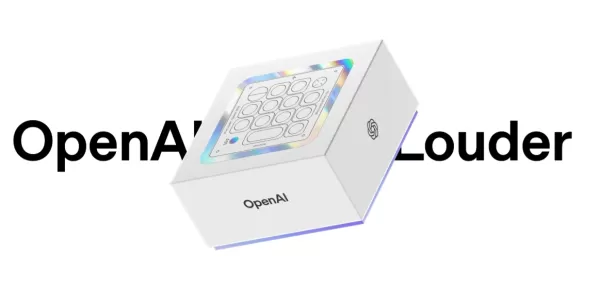
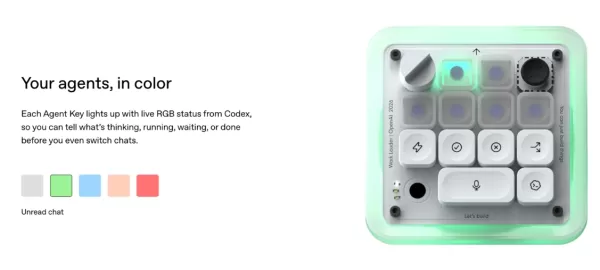
The keyboard's most notable feature is the row of glowing agent keys, which act as status indicators, showing in real time which agents are active and which are idle. Customizable command keys are programmed for Codex's frequent operations, eliminating the need to dig through menus. A joystick enables quick launching of common workflows, effectively serving as a shortcut for repetitive tasks. The most ingenious element is the physical dial—turning it adjusts the reasoning level the agent applies to a specific task, meaning you manually control how much time and computing power the AI dedicates to the matter. It brings a scheduling control that was once hidden behind the screen into a tangible, rotating metal knob.
OpenAI's message is clear: managing AI agents no longer requires a phone or desktop app. This Micro keyboard serves as the command center for agent operations. On a desk, it exudes a futuristic feel, and its glowing appearance signals that the owner is harnessing advanced productivity. Control and customization are handled through the ChatGPT desktop app, creating a tightly integrated ecosystem. However, OpenAI acknowledged in an email to the media that the Micro is a limited edition collaborative product. Essentially, it is more of a distinctive, symbolic gadget than a mass-market item. Yet the message it sends is unmistakable: the company has officially planted its first flag in the hardware landscape.
The truly groundbreaking hardware news may lie in a different clue. On Tuesday, Bloomberg reported that OpenAI is developing a new, unreleased device, which appears to be part of a long-term strategy. The device is described as a portable, screenless smart speaker, not only equipped with ChatGPT but also featuring moving mechanical components. At this stage, it's difficult to envision how these disparate elements—screenless, portable, and mobile—could be combined into a cohesive product, and OpenAI is keeping details under wraps. Yet this very secrecy paints an intriguing picture. Bloomberg also noted that the device is still in development, and its final form could change at any time.
A revealing detail: the new device is said to have involved former Apple engineers, and Apple is currently suing OpenAI for stealing trade secrets. This subtle connection naturally attracted attention. Just last week, Apple filed a lawsuit against OpenAI, accusing its executives of deliberately stealing confidential information and claiming that OpenAI used it to develop its own hardware. OpenAI's response was straightforward: denying any wrongdoing.
With a glowing keyboard and a moving speaker both on the scene, OpenAI's hardware ambitions are no longer concealed. As for the outcome of the lawsuit with Apple, it could be the key variable that determines how far this new frontier can be explored.
Related article
 Swedish AI Startup Lovable Eyes $13.2 Billion Valuation After Major Funding Round
As AI-driven coding tools gain traction, Swedish startup Lovable has secured a major funding round. The company aims to raise $3 billion, potentially boosting its valuation to $13.2 billion—double the $6.6 billion recorded last December. Menlo Ventur
Google Tests Remy AI Agent for Gemini as Focus Shifts to User Control
According to Business Insider, Google is testing Remy, a new AI personal agent for Gemini. This tool aims to execute tasks on behalf of users, streamlining both professional workflows and daily routines.Currently, Remy is undergoing testing in an int
How to fix Core Web Vitals for better SEO rankings
Streamline Report Card Comments with AI ToolsIntroductionAI Tools for Generating Report Card CommentsMagic SchoolAlmanac AIChat GPTUsing Magic School to Generate Report Card CommentsLogging into Magic SchoolSelecting the Report Card Comments ToolCust
Related Special Topic Recommendations
writing
Swedish AI Startup Lovable Eyes $13.2 Billion Valuation After Major Funding Round
As AI-driven coding tools gain traction, Swedish startup Lovable has secured a major funding round. The company aims to raise $3 billion, potentially boosting its valuation to $13.2 billion—double the $6.6 billion recorded last December. Menlo Ventur
Google Tests Remy AI Agent for Gemini as Focus Shifts to User Control
According to Business Insider, Google is testing Remy, a new AI personal agent for Gemini. This tool aims to execute tasks on behalf of users, streamlining both professional workflows and daily routines.Currently, Remy is undergoing testing in an int
How to fix Core Web Vitals for better SEO rankings
Streamline Report Card Comments with AI ToolsIntroductionAI Tools for Generating Report Card CommentsMagic SchoolAlmanac AIChat GPTUsing Magic School to Generate Report Card CommentsLogging into Magic SchoolSelecting the Report Card Comments ToolCust
Related Special Topic Recommendations
writing
 Best AI Outline Generators for Long-Form SEO Articles
2026 Latest Best Top-Rated AI Outline Generators for Long-Form SEO Articles, meticulously curated by XIX.AI. These powerful tools offer game-changing assistance in creating high-quality content quickly, boosting writing efficiency significantly. Get a free vs paid comparison along with real-world tests and detailed rankings to help you find the must-try option that suits your needs. Explore now to unlock your AI edge.
 8 tools
 xix.ai
Education and Learning
AI Study Tools for Homework and Exam Prep
xix.ai
Education and Learning
AI Study Tools for Homework and Exam Prep
2026 Latest Best AI Study Tools for Homework and Exam Prep! XIX.AI curates a top-rated list of powerful, game-changing tools that help students boost productivity, streamline homework completion, and ace exams through real-world tests. Get a free vs paid comparison, detailed rankings, and must-try options to unlock your AI edge. Explore now!
10 tools
xix.ai
Music composition
AI Vocal Demo Tools for Songwriters, Hooks, Toplines, and Multilingual Draft Sessions
2026 Latest Best AI Vocal Demo Tools for Songwriters, Hook Creators, and Multi-Language Content Teams! XIX.AI has curated a top-rated list of powerful game-changing tools that go through rigorous real-world tests. You’ll find detailed free vs paid comparison data, comprehensive rankings, and must-try options to help you boost writing efficiency and unlock your creative potential. Explore now to discover your perfect tool for all your content needs!
9 tools
xix.ai
Business
Best AI Competitive Research Tools for Small Businesses
2026 Latest Best Top-rated AI Competitive Research Tools for Small Businesses! XIX.AI has curated a highly powerful game-changing collection, updated weekly with rigorous real-world tests and detailed rankings. You can find a comprehensive free vs paid comparison to help you identify the must-try tools that boost your productivity and give you a competitive edge. Explore now to discover your perfect tool!
9 tools
xix.ai
Image editing
Photoshop AI Retouch Tools for Ecommerce Apparel, Skin Cleanup, and Color Consistency
2026 Latest Best Photoshop AI retouch tools for ecommerce apparel, skin cleanup, and color consistency! This top-rated curated list features powerful game-changing solutions that help you boost writing efficiency, streamline content creation, and achieve perfect visual results effortlessly. Each tool has undergone real-world tests through weekly updated rankings, complete with free vs paid comparison details. Backed by XIX.AI, it’s the must-try guide for anyone aiming to unlock your AI edge. Explore now!
10 tools
xix.ai
Prompt
Best AI Prompt Libraries for ChatGPT Workflows
2026 Latest Best Top-Rated AI Prompt Libraries for optimizing all types of ChatGPT workflows. XIX.AI has curated a powerful, game-changing collection that goes through rigorous real-world tests to ensure top performance. You can find detailed free vs paid comparisons and expert rankings to help you choose the must-try tools that boost your productivity and unlock your AI edge. Explore now!
11 tools
xix.ai

 Comments (0)
0/500
Comments (0)
0/500
OpenAI has finally entered the hardware arena with a ceremonial move. The company recently launched a $230 keyboard that lights up on its own, designed specifically for its AI code assistant, Codex. The keyboard, named Codex Micro, was developed in collaboration with professional keyboard designer Work Louder. Its target audience is clear: users who rely on ChatGPT to command a fleet of AI coding agents. These "agent armies" are semi-autonomous bots that require minimal supervision, capable of writing and executing code independently. Now, managing this team comes with a new and more expensive method.
The keyboard's most notable feature is the row of glowing agent keys, which act as status indicators, showing in real time which agents are active and which are idle. Customizable command keys are programmed for Codex's frequent operations, eliminating the need to dig through menus. A joystick enables quick launching of common workflows, effectively serving as a shortcut for repetitive tasks. The most ingenious element is the physical dial—turning it adjusts the reasoning level the agent applies to a specific task, meaning you manually control how much time and computing power the AI dedicates to the matter. It brings a scheduling control that was once hidden behind the screen into a tangible, rotating metal knob.
OpenAI's message is clear: managing AI agents no longer requires a phone or desktop app. This Micro keyboard serves as the command center for agent operations. On a desk, it exudes a futuristic feel, and its glowing appearance signals that the owner is harnessing advanced productivity. Control and customization are handled through the ChatGPT desktop app, creating a tightly integrated ecosystem. However, OpenAI acknowledged in an email to the media that the Micro is a limited edition collaborative product. Essentially, it is more of a distinctive, symbolic gadget than a mass-market item. Yet the message it sends is unmistakable: the company has officially planted its first flag in the hardware landscape.
The truly groundbreaking hardware news may lie in a different clue. On Tuesday, Bloomberg reported that OpenAI is developing a new, unreleased device, which appears to be part of a long-term strategy. The device is described as a portable, screenless smart speaker, not only equipped with ChatGPT but also featuring moving mechanical components. At this stage, it's difficult to envision how these disparate elements—screenless, portable, and mobile—could be combined into a cohesive product, and OpenAI is keeping details under wraps. Yet this very secrecy paints an intriguing picture. Bloomberg also noted that the device is still in development, and its final form could change at any time.
A revealing detail: the new device is said to have involved former Apple engineers, and Apple is currently suing OpenAI for stealing trade secrets. This subtle connection naturally attracted attention. Just last week, Apple filed a lawsuit against OpenAI, accusing its executives of deliberately stealing confidential information and claiming that OpenAI used it to develop its own hardware. OpenAI's response was straightforward: denying any wrongdoing.
With a glowing keyboard and a moving speaker both on the scene, OpenAI's hardware ambitions are no longer concealed. As for the outcome of the lawsuit with Apple, it could be the key variable that determines how far this new frontier can be explored.








 Swedish AI Startup Lovable Eyes $13.2 Billion Valuation After Major Funding Round
As AI-driven coding tools gain traction, Swedish startup Lovable has secured a major funding round. The company aims to raise $3 billion, potentially boosting its valuation to $13.2 billion—double the $6.6 billion recorded last December. Menlo Ventur
Google Tests Remy AI Agent for Gemini as Focus Shifts to User Control
According to Business Insider, Google is testing Remy, a new AI personal agent for Gemini. This tool aims to execute tasks on behalf of users, streamlining both professional workflows and daily routines.Currently, Remy is undergoing testing in an int
Swedish AI Startup Lovable Eyes $13.2 Billion Valuation After Major Funding Round
As AI-driven coding tools gain traction, Swedish startup Lovable has secured a major funding round. The company aims to raise $3 billion, potentially boosting its valuation to $13.2 billion—double the $6.6 billion recorded last December. Menlo Ventur
Google Tests Remy AI Agent for Gemini as Focus Shifts to User Control
According to Business Insider, Google is testing Remy, a new AI personal agent for Gemini. This tool aims to execute tasks on behalf of users, streamlining both professional workflows and daily routines.Currently, Remy is undergoing testing in an int
 How to fix Core Web Vitals for better SEO rankings
Streamline Report Card Comments with AI ToolsIntroductionAI Tools for Generating Report Card CommentsMagic SchoolAlmanac AIChat GPTUsing Magic School to Generate Report Card CommentsLogging into Magic SchoolSelecting the Report Card Comments ToolCust
How to fix Core Web Vitals for better SEO rankings
Streamline Report Card Comments with AI ToolsIntroductionAI Tools for Generating Report Card CommentsMagic SchoolAlmanac AIChat GPTUsing Magic School to Generate Report Card CommentsLogging into Magic SchoolSelecting the Report Card Comments ToolCust

2026 Latest Best Top-Rated AI Outline Generators for Long-Form SEO Articles, meticulously curated by XIX.AI. These powerful tools offer game-changing assistance in creating high-quality content quickly, boosting writing efficiency significantly. Get a free vs paid comparison along with real-world tests and detailed rankings to help you find the must-try option that suits your needs. Explore now to unlock your AI edge.
8 tools
xix.ai

2026 Latest Best AI Study Tools for Homework and Exam Prep! XIX.AI curates a top-rated list of powerful, game-changing tools that help students boost productivity, streamline homework completion, and ace exams through real-world tests. Get a free vs paid comparison, detailed rankings, and must-try options to unlock your AI edge. Explore now!
10 tools
xix.ai

2026 Latest Best AI Vocal Demo Tools for Songwriters, Hook Creators, and Multi-Language Content Teams! XIX.AI has curated a top-rated list of powerful game-changing tools that go through rigorous real-world tests. You’ll find detailed free vs paid comparison data, comprehensive rankings, and must-try options to help you boost writing efficiency and unlock your creative potential. Explore now to discover your perfect tool for all your content needs!
9 tools
xix.ai

2026 Latest Best Top-rated AI Competitive Research Tools for Small Businesses! XIX.AI has curated a highly powerful game-changing collection, updated weekly with rigorous real-world tests and detailed rankings. You can find a comprehensive free vs paid comparison to help you identify the must-try tools that boost your productivity and give you a competitive edge. Explore now to discover your perfect tool!
9 tools
xix.ai

2026 Latest Best Photoshop AI retouch tools for ecommerce apparel, skin cleanup, and color consistency! This top-rated curated list features powerful game-changing solutions that help you boost writing efficiency, streamline content creation, and achieve perfect visual results effortlessly. Each tool has undergone real-world tests through weekly updated rankings, complete with free vs paid comparison details. Backed by XIX.AI, it’s the must-try guide for anyone aiming to unlock your AI edge. Explore now!
10 tools
xix.ai

2026 Latest Best Top-Rated AI Prompt Libraries for optimizing all types of ChatGPT workflows. XIX.AI has curated a powerful, game-changing collection that goes through rigorous real-world tests to ensure top performance. You can find detailed free vs paid comparisons and expert rankings to help you choose the must-try tools that boost your productivity and unlock your AI edge. Explore now!
11 tools
xix.ai












