


 Home
HomeOpenAI Files IPO Draft; Altman Reiterates AGI Popularization Vision
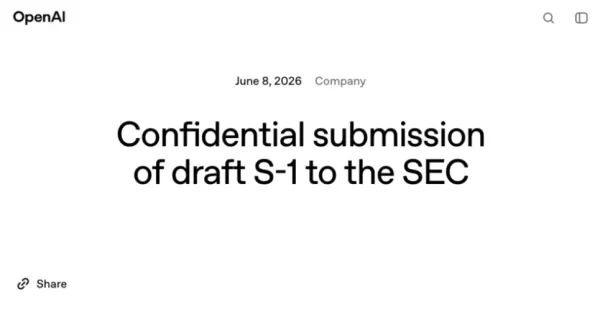
The competitive dynamics in artificial intelligence are shifting rapidly. After Anthropic, the parent company of Claude, confidentially filed its S-1 draft, OpenAI has now submitted its own IPO application to the U.S. Securities and Exchange Commission, marking a significant move toward public markets.
While OpenAI's announcement acknowledged the benefits of remaining private, the company ultimately decided to proceed with the IPO after weighing the trade-offs. In contrast to its competitor's restrained tone, OpenAI CEO Sam Altman published an article titled "Built to Benefit Everyone: Our Plan," reaffirming the company's founding mission to build AI for all of humanity and outlining a core goal of providing personal AGI to every person on Earth.
Reflecting on OpenAI's journey, it represents a complex evolution from a nonprofit origin to a commercial powerhouse. Starting as a purely nonprofit organization in 2015, introducing a capped-profit model in 2019, and undergoing a full restructuring by the end of 2025—the for-profit arm was reorganized into OpenAI Group, a public benefit corporation (PBC), while the original nonprofit parent became the OpenAI Foundation, holding roughly 26% of shares. These structural changes were both compromises to secure the enormous capital needed for computing power and a balancing act between commercial ambitions and social responsibility.
Public data shows OpenAI's commercial growth has been exceptionally fast, with annualized revenue surpassing $20 billion as of January this year. But behind this success lies an equally staggering pace of spending. Multiple estimates suggest OpenAI's potential loss could range from $14 billion to $25 billion in 2026. Given the enormous costs of computing power, turning to the capital market has become a necessary step to sustain ongoing R&D investment.
In his article, Altman outlined three core goals for OpenAI's future: first, building an "automated AI researcher" that collaborates with human researchers to iterate and accelerate breakthroughs in alignment technology; second, driving economic growth and scientific progress to ensure AI-driven prosperity is broadly distributed; and third, turning advanced AI into personalized products that are accessible to everyone.
Industry analysts predict that as both OpenAI and Anthropic pursue IPOs, these two leading AI unicorns could reach trillion-dollar valuations after going public. This wave of listings not only represents a head-to-head competition between the two front-runners but also serves as a large-scale "vote" by global capital markets on the future prospects of artificial general intelligence (AGI).
Related article
 Apple Smart Glasses Could Debut at WWDC27, Highlighting Privacy Protection
Bloomberg’s Mark Gurman reports that Apple’s smart glasses, codenamed N50, are slated for a WWDC27 debut in June 2027, with a retail launch expected in autumn 2027. Originally targeted for late this year and early 2027, the device’s release has been
Inside Details Exposed About Next-Gen Gemini: Strained Computing Power, Internal Teams Disagreed on Development Priorities and Resource Allocation
Reports indicate that the launch of Google’s highly anticipated next-generation Gemini model has been pushed back. Internal disagreements over development priorities and resource allocation, combined with limited computing capacity and complex approv
OpenAI Dismisses Growth Slowdown Concerns, Says Multiple Business Units Accelerating
In response to external scrutiny regarding decelerating sales growth and missed internal benchmarks, AI leader OpenAI issued a confident statement on Tuesday, April 28. The company clarified that its consumer products and enterprise services are adva
Related Special Topic Recommendations
Data Analysis
Apple Smart Glasses Could Debut at WWDC27, Highlighting Privacy Protection
Bloomberg’s Mark Gurman reports that Apple’s smart glasses, codenamed N50, are slated for a WWDC27 debut in June 2027, with a retail launch expected in autumn 2027. Originally targeted for late this year and early 2027, the device’s release has been
Inside Details Exposed About Next-Gen Gemini: Strained Computing Power, Internal Teams Disagreed on Development Priorities and Resource Allocation
Reports indicate that the launch of Google’s highly anticipated next-generation Gemini model has been pushed back. Internal disagreements over development priorities and resource allocation, combined with limited computing capacity and complex approv
OpenAI Dismisses Growth Slowdown Concerns, Says Multiple Business Units Accelerating
In response to external scrutiny regarding decelerating sales growth and missed internal benchmarks, AI leader OpenAI issued a confident statement on Tuesday, April 28. The company clarified that its consumer products and enterprise services are adva
Related Special Topic Recommendations
Data Analysis
 AI SQL Copilots for Revenue Dashboards, Funnel Analysis, and Product Metrics
2026 Latest Best AI SQL Copilots Ranked Top-Rated! XIX.AI curates a powerful game-changing collection for weekly updated real-world tests. These must-try tools help you generate accurate revenue dashboards, analyze sales funnels, and track product metrics swiftly, boosting productivity massively. Explore now to Discover your perfect tool for data-driven decision making! 238 characters
 9 tools
 xix.ai
Music composition
Best AI Melody Writing Tools for Song Drafts
xix.ai
Music composition
Best AI Melody Writing Tools for Song Drafts
2026 Latest Best Top-Rated AI Melody Writing Tools for Song Drafts! XIX.AI has curated a highly powerful game-changing collection that goes through rigorous real-world tests to deliver the best writing experience. You can find detailed free vs paid comparisons, accurate rankings, and must-try options designed to help you create stunning song drafts effortlessly and boost your creative productivity significantly. Explore now to discover your perfect tool!
8 tools
xix.ai
chatbot
Best AI Conversation Trainer Tools for Interview Practice
2026 Latest Best Top-rated AI Conversation Trainer Tools for Interview Practice are here on XIX.AI! This curated collection features powerful, game-changing tools that go through rigorous real-world tests to deliver accurate feedback. You’ll find a free vs paid comparison and detailed rankings to help you choose the must-try option that boosts your confidence and skills. Explore now to Discover your perfect tool for interview success!
12 tools
xix.ai
Design & Art
Best AI Style Transfer Tools for Creative Experiments
2026 Latest Best Top-rated AI Style Transfer Tools for Creative Experiments! XIX.AI has curated a powerful, game-changing collection of must-try tools that deliver exceptional results through real-world tests and rigorous rankings. These top solutions help creatives boost productivity significantly by accelerating content creation and unlocking endless creative possibilities. Explore now to discover your perfect tool and start creating today!
9 tools
xix.ai
Comic Creation
Best AI Dialogue Bubble Tools for Visual Storytelling
2026 Latest Best Top-Rated AI Dialogue Bubble Tools for Visual Storytelling are here on XIX.AI! This curated collection features powerful, game-changing tools that help creators boost productivity and overcome creative bottlenecks. Get a free vs paid comparison, see real-world tests, and check the latest rankings to find the must-try solutions perfect for crafting engaging visual narratives. Explore now to discover your ideal tool!
10 tools
xix.ai
Meeting Assistant
Top AI Meeting Summary Tools: Track Decisions and Follow-Ups Clearly
2026 Latest Top-Rated Best AI Meeting Summary Tools for Clear Decision Tracking and Effortless Follow-Ups. This curated list showcases powerful, game-changing solutions that boost productivity dramatically by automating meeting notes, identifying key action items, and streamlining team coordination across all projects. Get a free vs paid comparison along with real-world tests and weekly updated rankings to help you find the perfect tool. Explore now to unlock your AI edge!
9 tools
xix.ai

 Comments (0)
0/500
Comments (0)
0/500
The competitive dynamics in artificial intelligence are shifting rapidly. After Anthropic, the parent company of Claude, confidentially filed its S-1 draft, OpenAI has now submitted its own IPO application to the U.S. Securities and Exchange Commission, marking a significant move toward public markets.
While OpenAI's announcement acknowledged the benefits of remaining private, the company ultimately decided to proceed with the IPO after weighing the trade-offs. In contrast to its competitor's restrained tone, OpenAI CEO Sam Altman published an article titled "Built to Benefit Everyone: Our Plan," reaffirming the company's founding mission to build AI for all of humanity and outlining a core goal of providing personal AGI to every person on Earth.
Reflecting on OpenAI's journey, it represents a complex evolution from a nonprofit origin to a commercial powerhouse. Starting as a purely nonprofit organization in 2015, introducing a capped-profit model in 2019, and undergoing a full restructuring by the end of 2025—the for-profit arm was reorganized into OpenAI Group, a public benefit corporation (PBC), while the original nonprofit parent became the OpenAI Foundation, holding roughly 26% of shares. These structural changes were both compromises to secure the enormous capital needed for computing power and a balancing act between commercial ambitions and social responsibility.
Public data shows OpenAI's commercial growth has been exceptionally fast, with annualized revenue surpassing $20 billion as of January this year. But behind this success lies an equally staggering pace of spending. Multiple estimates suggest OpenAI's potential loss could range from $14 billion to $25 billion in 2026. Given the enormous costs of computing power, turning to the capital market has become a necessary step to sustain ongoing R&D investment.
In his article, Altman outlined three core goals for OpenAI's future: first, building an "automated AI researcher" that collaborates with human researchers to iterate and accelerate breakthroughs in alignment technology; second, driving economic growth and scientific progress to ensure AI-driven prosperity is broadly distributed; and third, turning advanced AI into personalized products that are accessible to everyone.
Industry analysts predict that as both OpenAI and Anthropic pursue IPOs, these two leading AI unicorns could reach trillion-dollar valuations after going public. This wave of listings not only represents a head-to-head competition between the two front-runners but also serves as a large-scale "vote" by global capital markets on the future prospects of artificial general intelligence (AGI).








 Apple Smart Glasses Could Debut at WWDC27, Highlighting Privacy Protection
Bloomberg’s Mark Gurman reports that Apple’s smart glasses, codenamed N50, are slated for a WWDC27 debut in June 2027, with a retail launch expected in autumn 2027. Originally targeted for late this year and early 2027, the device’s release has been
Apple Smart Glasses Could Debut at WWDC27, Highlighting Privacy Protection
Bloomberg’s Mark Gurman reports that Apple’s smart glasses, codenamed N50, are slated for a WWDC27 debut in June 2027, with a retail launch expected in autumn 2027. Originally targeted for late this year and early 2027, the device’s release has been
 Inside Details Exposed About Next-Gen Gemini: Strained Computing Power, Internal Teams Disagreed on Development Priorities and Resource Allocation
Reports indicate that the launch of Google’s highly anticipated next-generation Gemini model has been pushed back. Internal disagreements over development priorities and resource allocation, combined with limited computing capacity and complex approv
Inside Details Exposed About Next-Gen Gemini: Strained Computing Power, Internal Teams Disagreed on Development Priorities and Resource Allocation
Reports indicate that the launch of Google’s highly anticipated next-generation Gemini model has been pushed back. Internal disagreements over development priorities and resource allocation, combined with limited computing capacity and complex approv
 OpenAI Dismisses Growth Slowdown Concerns, Says Multiple Business Units Accelerating
In response to external scrutiny regarding decelerating sales growth and missed internal benchmarks, AI leader OpenAI issued a confident statement on Tuesday, April 28. The company clarified that its consumer products and enterprise services are adva
OpenAI Dismisses Growth Slowdown Concerns, Says Multiple Business Units Accelerating
In response to external scrutiny regarding decelerating sales growth and missed internal benchmarks, AI leader OpenAI issued a confident statement on Tuesday, April 28. The company clarified that its consumer products and enterprise services are adva

2026 Latest Best AI SQL Copilots Ranked Top-Rated! XIX.AI curates a powerful game-changing collection for weekly updated real-world tests. These must-try tools help you generate accurate revenue dashboards, analyze sales funnels, and track product metrics swiftly, boosting productivity massively. Explore now to Discover your perfect tool for data-driven decision making! 238 characters
9 tools
xix.ai

2026 Latest Best Top-Rated AI Melody Writing Tools for Song Drafts! XIX.AI has curated a highly powerful game-changing collection that goes through rigorous real-world tests to deliver the best writing experience. You can find detailed free vs paid comparisons, accurate rankings, and must-try options designed to help you create stunning song drafts effortlessly and boost your creative productivity significantly. Explore now to discover your perfect tool!
8 tools
xix.ai

2026 Latest Best Top-rated AI Conversation Trainer Tools for Interview Practice are here on XIX.AI! This curated collection features powerful, game-changing tools that go through rigorous real-world tests to deliver accurate feedback. You’ll find a free vs paid comparison and detailed rankings to help you choose the must-try option that boosts your confidence and skills. Explore now to Discover your perfect tool for interview success!
12 tools
xix.ai

2026 Latest Best Top-rated AI Style Transfer Tools for Creative Experiments! XIX.AI has curated a powerful, game-changing collection of must-try tools that deliver exceptional results through real-world tests and rigorous rankings. These top solutions help creatives boost productivity significantly by accelerating content creation and unlocking endless creative possibilities. Explore now to discover your perfect tool and start creating today!
9 tools
xix.ai

2026 Latest Best Top-Rated AI Dialogue Bubble Tools for Visual Storytelling are here on XIX.AI! This curated collection features powerful, game-changing tools that help creators boost productivity and overcome creative bottlenecks. Get a free vs paid comparison, see real-world tests, and check the latest rankings to find the must-try solutions perfect for crafting engaging visual narratives. Explore now to discover your ideal tool!
10 tools
xix.ai
2026 Latest Top-Rated Best AI Meeting Summary Tools for Clear Decision Tracking and Effortless Follow-Ups. This curated list showcases powerful, game-changing solutions that boost productivity dramatically by automating meeting notes, identifying key action items, and streamlining team coordination across all projects. Get a free vs paid comparison along with real-world tests and weekly updated rankings to help you find the perfect tool. Explore now to unlock your AI edge!
9 tools
xix.ai












