


 Home
HomeOpenAI Announces GPT-5.4-Cyber with Reverse Engineering Access for Security Experts
According to reports, OpenAI has officially announced an expansion of its Trusted Access for Cybersecurity (TAC) program, granting thousands of security professionals worldwide access to the specialized GPT-5.4-Cyber model. This move is widely viewed as a direct counter to Anthropic's earlier release of Claude Mythos.
Core Breakthrough: "Noise Reduction" and "Empowerment" for Defense Scenarios
Unlike general-purpose large language models, GPT-5.4-Cyber is a specialized tool deeply fine-tuned for defensive cybersecurity operations:
Binary Reverse Engineering: The model supports advanced security workflows, enabling experts to analyze compiled malware and scan for software vulnerabilities.
High-Privilege Access: To better assist legitimate defenders, OpenAI has adjusted the model's rejection thresholds, reducing frequent "security blocks" when handling sensitive security tasks.
Capability Rating: In internal evaluations, the model achieved a "high" network capability rating, demonstrating significant reliability in complex vulnerability patching and threat modeling.
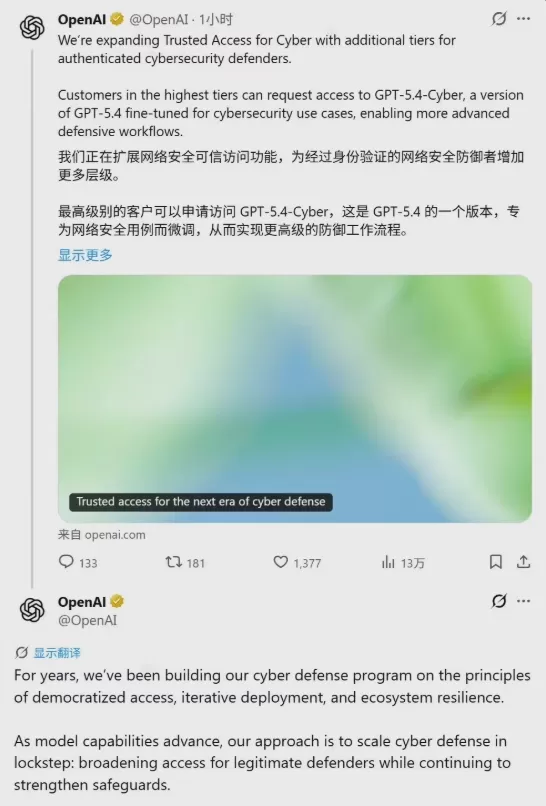
Strategic Shift: From "Solo Combat" to "Ecosystem Resilience"
OpenAI's security strategy is evolving from individual model output to building a resilient ecosystem:
Codex Security Tool: Launched earlier this year, this tool has already helped remediate over 3,000 high-severity vulnerabilities, enabling automated monitoring of code repositories.
TAC Expansion: Access is granted through objective criteria, including multi-factor authentication (MFA), ensuring that critical infrastructure defenders receive priority access to the most advanced AI capabilities.
Funding Program: Since 2023, OpenAI has continuously invested in a cybersecurity grant program, supporting third-party researchers in using large models to enhance the automation of defensive tools.
Industry Perspective: Defensive Capabilities Must "Outpace" Attack Risks
In its announcement, OpenAI emphasized that defensive capabilities must scale alongside model power. As AI is increasingly weaponized by malicious actors, the release of GPT-5.4-Cyber represents a proactive stance from the defense community:
Iterative Deployment: Due to the model's elevated permissions, OpenAI is employing a cautious deployment strategy, currently limiting access to vetted partners and researchers.
Democratized Access: Through the TAC program, the initiative ensures cutting-edge defensive technologies are not monopolized by a select few institutions.
Conclusion: The AI-Era "Approval System" for Cybersecurity
With GPT-5.4-Cyber entering the field equipped for binary reverse engineering, the competition in AI cybersecurity is shifting from merely "counting vulnerabilities found" to "achieving depth in practical defense." For security professionals, this represents more than a smarter assistant; it is a digital ally with the elevated privileges necessary to navigate underlying binary logic.
Related article
 Former OpenAI Researcher Barrett Zoph Returns to Google to Support Gemini Development
Barret Zoph, who previously abruptly left and joined OpenAI due to a disagreement with Thinking Machines Lab CEO Miriam Mularati, has once again changed employers. Alphabet's Google announced that Zoph will return as Vice President of Research, bring
How Recursive Intelligence Raised $335M at $4B Valuation in 4 Months
The co-founders of startup Ricursive Intelligence seemed destined to be co-founders.Anna Goldie, CEO, and Azalia Mirhoseini, CTO, are so well-known in the AI community that they were among those AI engineers who “got those weird emails from Zuckerber
AI race won’t wait, nor will this TechCrunch Disrupt 25% discount
Every founder building in AI right now is asking the same question: Are we moving fast enough, and effectively enough? TechCrunch Disrupt 2026 puts you in the same room as the people wrestling with that existential question at the highest levels. Fro
Related Special Topic Recommendations
Design & Art
Former OpenAI Researcher Barrett Zoph Returns to Google to Support Gemini Development
Barret Zoph, who previously abruptly left and joined OpenAI due to a disagreement with Thinking Machines Lab CEO Miriam Mularati, has once again changed employers. Alphabet's Google announced that Zoph will return as Vice President of Research, bring
How Recursive Intelligence Raised $335M at $4B Valuation in 4 Months
The co-founders of startup Ricursive Intelligence seemed destined to be co-founders.Anna Goldie, CEO, and Azalia Mirhoseini, CTO, are so well-known in the AI community that they were among those AI engineers who “got those weird emails from Zuckerber
AI race won’t wait, nor will this TechCrunch Disrupt 25% discount
Every founder building in AI right now is asking the same question: Are we moving fast enough, and effectively enough? TechCrunch Disrupt 2026 puts you in the same room as the people wrestling with that existential question at the highest levels. Fro
Related Special Topic Recommendations
Design & Art
 Top AI Illustration Tools: Create Editorial Scenes and Cover Art Faster
2026 Latest Top-rated AI Illustration Tools: Our curated list features the best powerfully designed tools for creating stunning editorial scenes and eye-catching cover art quickly. Each option has gone through rigorous real-world tests, offering a free vs paid comparison to help you find the perfect match for your workflow. Try these must-try solutions today to unlock your AI edge and boost your creative productivity. Explore now at XIX.AI.
 10 tools
 xix.ai
Education and Learning
Top AI Tutors for Exam Prep: Practice Math, Science, and English
xix.ai
Education and Learning
Top AI Tutors for Exam Prep: Practice Math, Science, and English
2026 Latest Top-Rated Best AI Tutors for Exam Prep are here on XIX.AI! Our curated list features powerful game-changing tools that offer free vs paid comparison, real-world tests, and weekly updated rankings. They help boost your writing efficiency, simplify complex topic learning, and unlock your academic potential. Explore now to Discover your perfect exam prep tool and Start creating today to Unlock your AI edge!
10 tools
xix.ai
Finance
AI Budget Planning Tools for Personal Money Management
2026 Latest Best Top-Rated AI Budget Planning Tools for Personal Money Management are here on XIX.AI! This curated collection features powerful, game-changing solutions that help you conduct real-world tests, understand spending habits, and create personalized plans to boost productivity. Enjoy a free vs paid comparison along with detailed rankings. Must-try tools designed to simplify money management and unlock your AI edge. Explore now!
11 tools
xix.ai
Health & Wellness
AI Sleep Tracking Assistants: Improve Recovery with Better Bedtime Habits
2026 Latest Best Top-Rated AI Sleep Tracking Assistants curated for ultimate recovery. This fully updated weekly guide features powerful tools that deliver real-world tests, free vs paid comparison, and detailed rankings to help you find the must-try solution that boosts sleep quality and supports better bedtime habits. Explore now at XIX.AI to Unlock your AI edge.
10 tools
xix.ai
Data Analysis
AI SQL Copilots for Product and Revenue Analytics
2026 Latest Best Top-Rated AI SQL Copilots for Product and Revenue Analytics! XIX.AI has curated a powerful, game-changing collection of must-try tools that undergo real-world tests through weekly updated rankings. These tools help users boost productivity significantly by accelerating data analysis, streamlining complex queries, and generating accurate insights to drive smarter business decisions. Explore now to Discover your perfect tool for unlocking your AI edge!
14 tools
xix.ai
Education and Learning
Best AI Homework Helpers That Teach: Learn Concepts, Not Just Answers
2026 Latest Best Top-Rated AI Homework Helpers That Teach Core Concepts Not Just Answers Powerful Tools for Students Must-Try Curated List Weekly Updated Free vs Paid Comparison Real-World Tests Accurate Rankings to Help You Unlock Your Full Learning Potential Explore now to Discover your perfect tool for smarter studying.
10 tools
xix.ai

 Comments (0)
0/500
Comments (0)
0/500
According to reports, OpenAI has officially announced an expansion of its Trusted Access for Cybersecurity (TAC) program, granting thousands of security professionals worldwide access to the specialized GPT-5.4-Cyber model. This move is widely viewed as a direct counter to Anthropic's earlier release of Claude Mythos.
Core Breakthrough: "Noise Reduction" and "Empowerment" for Defense Scenarios
Unlike general-purpose large language models, GPT-5.4-Cyber is a specialized tool deeply fine-tuned for defensive cybersecurity operations:
Binary Reverse Engineering: The model supports advanced security workflows, enabling experts to analyze compiled malware and scan for software vulnerabilities.
High-Privilege Access: To better assist legitimate defenders, OpenAI has adjusted the model's rejection thresholds, reducing frequent "security blocks" when handling sensitive security tasks.
Capability Rating: In internal evaluations, the model achieved a "high" network capability rating, demonstrating significant reliability in complex vulnerability patching and threat modeling.
Strategic Shift: From "Solo Combat" to "Ecosystem Resilience"
OpenAI's security strategy is evolving from individual model output to building a resilient ecosystem:
Codex Security Tool: Launched earlier this year, this tool has already helped remediate over 3,000 high-severity vulnerabilities, enabling automated monitoring of code repositories.
TAC Expansion: Access is granted through objective criteria, including multi-factor authentication (MFA), ensuring that critical infrastructure defenders receive priority access to the most advanced AI capabilities.
Funding Program: Since 2023, OpenAI has continuously invested in a cybersecurity grant program, supporting third-party researchers in using large models to enhance the automation of defensive tools.
Industry Perspective: Defensive Capabilities Must "Outpace" Attack Risks
In its announcement, OpenAI emphasized that defensive capabilities must scale alongside model power. As AI is increasingly weaponized by malicious actors, the release of GPT-5.4-Cyber represents a proactive stance from the defense community:
Iterative Deployment: Due to the model's elevated permissions, OpenAI is employing a cautious deployment strategy, currently limiting access to vetted partners and researchers.
Democratized Access: Through the TAC program, the initiative ensures cutting-edge defensive technologies are not monopolized by a select few institutions.
Conclusion: The AI-Era "Approval System" for Cybersecurity
With GPT-5.4-Cyber entering the field equipped for binary reverse engineering, the competition in AI cybersecurity is shifting from merely "counting vulnerabilities found" to "achieving depth in practical defense." For security professionals, this represents more than a smarter assistant; it is a digital ally with the elevated privileges necessary to navigate underlying binary logic.








 Former OpenAI Researcher Barrett Zoph Returns to Google to Support Gemini Development
Barret Zoph, who previously abruptly left and joined OpenAI due to a disagreement with Thinking Machines Lab CEO Miriam Mularati, has once again changed employers. Alphabet's Google announced that Zoph will return as Vice President of Research, bring
Former OpenAI Researcher Barrett Zoph Returns to Google to Support Gemini Development
Barret Zoph, who previously abruptly left and joined OpenAI due to a disagreement with Thinking Machines Lab CEO Miriam Mularati, has once again changed employers. Alphabet's Google announced that Zoph will return as Vice President of Research, bring
 How Recursive Intelligence Raised $335M at $4B Valuation in 4 Months
The co-founders of startup Ricursive Intelligence seemed destined to be co-founders.Anna Goldie, CEO, and Azalia Mirhoseini, CTO, are so well-known in the AI community that they were among those AI engineers who “got those weird emails from Zuckerber
How Recursive Intelligence Raised $335M at $4B Valuation in 4 Months
The co-founders of startup Ricursive Intelligence seemed destined to be co-founders.Anna Goldie, CEO, and Azalia Mirhoseini, CTO, are so well-known in the AI community that they were among those AI engineers who “got those weird emails from Zuckerber
 AI race won’t wait, nor will this TechCrunch Disrupt 25% discount
Every founder building in AI right now is asking the same question: Are we moving fast enough, and effectively enough? TechCrunch Disrupt 2026 puts you in the same room as the people wrestling with that existential question at the highest levels. Fro
AI race won’t wait, nor will this TechCrunch Disrupt 25% discount
Every founder building in AI right now is asking the same question: Are we moving fast enough, and effectively enough? TechCrunch Disrupt 2026 puts you in the same room as the people wrestling with that existential question at the highest levels. Fro

2026 Latest Top-rated AI Illustration Tools: Our curated list features the best powerfully designed tools for creating stunning editorial scenes and eye-catching cover art quickly. Each option has gone through rigorous real-world tests, offering a free vs paid comparison to help you find the perfect match for your workflow. Try these must-try solutions today to unlock your AI edge and boost your creative productivity. Explore now at XIX.AI.
10 tools
xix.ai

2026 Latest Top-Rated Best AI Tutors for Exam Prep are here on XIX.AI! Our curated list features powerful game-changing tools that offer free vs paid comparison, real-world tests, and weekly updated rankings. They help boost your writing efficiency, simplify complex topic learning, and unlock your academic potential. Explore now to Discover your perfect exam prep tool and Start creating today to Unlock your AI edge!
10 tools
xix.ai

2026 Latest Best Top-Rated AI Budget Planning Tools for Personal Money Management are here on XIX.AI! This curated collection features powerful, game-changing solutions that help you conduct real-world tests, understand spending habits, and create personalized plans to boost productivity. Enjoy a free vs paid comparison along with detailed rankings. Must-try tools designed to simplify money management and unlock your AI edge. Explore now!
11 tools
xix.ai

2026 Latest Best Top-Rated AI Sleep Tracking Assistants curated for ultimate recovery. This fully updated weekly guide features powerful tools that deliver real-world tests, free vs paid comparison, and detailed rankings to help you find the must-try solution that boosts sleep quality and supports better bedtime habits. Explore now at XIX.AI to Unlock your AI edge.
10 tools
xix.ai

2026 Latest Best Top-Rated AI SQL Copilots for Product and Revenue Analytics! XIX.AI has curated a powerful, game-changing collection of must-try tools that undergo real-world tests through weekly updated rankings. These tools help users boost productivity significantly by accelerating data analysis, streamlining complex queries, and generating accurate insights to drive smarter business decisions. Explore now to Discover your perfect tool for unlocking your AI edge!
14 tools
xix.ai

2026 Latest Best Top-Rated AI Homework Helpers That Teach Core Concepts Not Just Answers Powerful Tools for Students Must-Try Curated List Weekly Updated Free vs Paid Comparison Real-World Tests Accurate Rankings to Help You Unlock Your Full Learning Potential Explore now to Discover your perfect tool for smarter studying.
10 tools
xix.ai












