


 Home
HomeOpenAI Adds Google Gemini Developer Shazeer to Its Roster
The movement of skilled professionals in the field of artificial intelligence has become increasingly common, and the fierce competition among leading tech firms for such talent has intensified once again. On June 20th, Noam Shazeer, Google’s vice president of engineering and co-lead of the Gemini technology project, officially announced his resignation and simultaneously revealed that he would be joining OpenAI.
As a prominent figure within the AI academic community, Shazeer has had an exceptionally impressive career trajectory. He was one of the core authors of the influential paper “Attention Is All You Need,” which significantly shaped the direction of artificial intelligence research. In addition, he contributed to landmark projects such as LaMDA and introduced the highly impactful Sparsely-gated Mixture of Experts architecture in 2016.
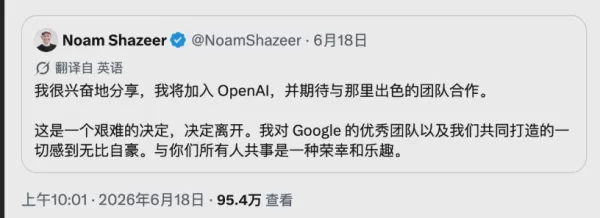
Shazeer’s professional journey is closely linked to Google. He left the company in 2021 to co-found Character.AI. In 2024, Google acquired that firm, bringing Shazeer and his highly skilled research team under its umbrella. After returning to Google, he was entrusted with a vital role, taking direct responsibility for the development of Gemini’s core technology and serving as a key asset in the company’s competition within the industry.
This development has received considerable attention from Sam Altman, OpenAI’s CEO. Altman publicly welcomed Shazeer’s decision to join the company and shared an intriguing detail: even during the early stages of OpenAI, Shazeer was among the top talent individuals Altman hoped to collaborate with. He went on to say, “It took me ten years to invite him, and I believe every moment of waiting was worth it.”
This personnel change has quickly sparked widespread discussion within the industry. As large language model technology development enters what experts refer to as a “deep water zone,” professionals like Shazeer, who combine strong academic expertise with extensive product experience, have become essential for leading companies to strengthen their technical advantages. With Shazeer now part of OpenAI, future advancements in industry technology may see significant changes.
Related article
 OpenAI Unveils Base Large Model Under New Pre-training Project Doug
As artificial intelligence technology continues to evolve, the industry's focus on the underlying architecture of foundational large models has never waned. Recently, an X user who has long tracked developments in large models revealed that OpenAI is
Deltek Study: 91% of Firms Call AI Critical to Success
Deltek research reveals that while project firms anticipate higher profits, execution gaps currently limit the measurable impact of AI. Credit: Nitat Termmee/Getty ImagesAccording to Deltek’s Heather Larkin, leading firms are successfully linking dat
Critical Gap Identified in Current Robot Safety Protocols
Figure 1. VicOne’s lifecycle approach combines AI model and vulnerability scanning, simulation-based validation, and continuous monitoring to help secure robots from development through operation.While cybersecurity does not replace functional safety
Related Special Topic Recommendations
Text-to-speech
OpenAI Unveils Base Large Model Under New Pre-training Project Doug
As artificial intelligence technology continues to evolve, the industry's focus on the underlying architecture of foundational large models has never waned. Recently, an X user who has long tracked developments in large models revealed that OpenAI is
Deltek Study: 91% of Firms Call AI Critical to Success
Deltek research reveals that while project firms anticipate higher profits, execution gaps currently limit the measurable impact of AI. Credit: Nitat Termmee/Getty ImagesAccording to Deltek’s Heather Larkin, leading firms are successfully linking dat
Critical Gap Identified in Current Robot Safety Protocols
Figure 1. VicOne’s lifecycle approach combines AI model and vulnerability scanning, simulation-based validation, and continuous monitoring to help secure robots from development through operation.While cybersecurity does not replace functional safety
Related Special Topic Recommendations
Text-to-speech
 ElevenLabs Voice Cloning Tools for Podcasts, Courses, and Product Walkthroughs
2026 Latest Best Top-rated Voice Cloning Tools for Podcasting, Course Creation, and Product Walkthroughs are here on XIX.AI. This curated list features powerful game-changing solutions that undergo real-world tests to deliver flawless results every time. You’ll find a free vs paid comparison along with detailed rankings to help you choose the most suitable option for boosting your productivity. Explore now and Discover your perfect tool for enhancing audio content creation.
 9 tools
 xix.ai
writing
AI Rewrite Tools for Business Writing: Make Dense Copy Clearer
xix.ai
writing
AI Rewrite Tools for Business Writing: Make Dense Copy Clearer
2026 Latest Best Top-rated AI Rewrite Tools for Business Writing are here on XIX.AI! This curated list features powerful, game-changing tools that undergo real-world tests to make dense copy clearer and boost writing efficiency. Get a free vs paid comparison and see which option suits your needs. Explore now to discover your perfect tool and unlock your AI edge in business communication.
13 tools
xix.ai
Music composition
AI Songwriting Tools for Lyrics and Melody Ideas
2026 Latest Best Top-Rated AI Songwriting Tools for Lyrics and Melody Ideas are here on XIX.AI! This curated collection features powerful, game-changing options that go through rigorous real-world tests to deliver accurate lyric and melody suggestions. Get a free vs paid comparison, see detailed rankings, and discover must-try tools that can boost your creative workflow significantly. Explore now to find the perfect fit for your needs!
8 tools
xix.ai
Health & Wellness
ChatGPT Meal Planning Apps for Macro Tracking, Grocery Lists, and Weekly Prep
2026 Latest Best ChatGPT Meal Planning Apps Top-rated must-try curated powerful game-changing tools for macro tracking grocery lists and weekly prep. XIX.AI delivers weekly updated rankings based on real-world tests, including free vs paid comparison details. Discover your perfect tool to boost productivity and unlock your AI edge today. Explore now!
9 tools
xix.ai
Video creation
AI Video Script Tools for Short Form Content
2026 Latest Best Top-Rated AI Video Script Tools for Short Form Content! XIX.AI has curated a powerful, game-changing collection of must-try tools that go through rigorous real-world tests. You’ll find detailed weekly updated rankings, free vs paid comparison info, and insights to help you boost productivity and unlock your AI edge in creating high-quality short form content. Explore now to discover your perfect tool!
10 tools
xix.ai
Comic Creation
AI Comic Panel Tools for Storyboard Style Narratives
2026 Latest Best AI Comic Panel Tools for Storyboard Style Narratives! This curated top-rated collection features powerful game-changing solutions that help creators boost writing efficiency and overcome creation bottlenecks. You’ll find detailed free vs paid comparison, real-world tests, and official rankings to guide your pick. XIX.AI offers expert insights too. Explore now to Discover your perfect tool for bringing vivid stories to life! 238 characters
9 tools
xix.ai

 Comments (0)
0/500
Comments (0)
0/500
The movement of skilled professionals in the field of artificial intelligence has become increasingly common, and the fierce competition among leading tech firms for such talent has intensified once again. On June 20th, Noam Shazeer, Google’s vice president of engineering and co-lead of the Gemini technology project, officially announced his resignation and simultaneously revealed that he would be joining OpenAI.
As a prominent figure within the AI academic community, Shazeer has had an exceptionally impressive career trajectory. He was one of the core authors of the influential paper “Attention Is All You Need,” which significantly shaped the direction of artificial intelligence research. In addition, he contributed to landmark projects such as LaMDA and introduced the highly impactful Sparsely-gated Mixture of Experts architecture in 2016.
Shazeer’s professional journey is closely linked to Google. He left the company in 2021 to co-found Character.AI. In 2024, Google acquired that firm, bringing Shazeer and his highly skilled research team under its umbrella. After returning to Google, he was entrusted with a vital role, taking direct responsibility for the development of Gemini’s core technology and serving as a key asset in the company’s competition within the industry.
This development has received considerable attention from Sam Altman, OpenAI’s CEO. Altman publicly welcomed Shazeer’s decision to join the company and shared an intriguing detail: even during the early stages of OpenAI, Shazeer was among the top talent individuals Altman hoped to collaborate with. He went on to say, “It took me ten years to invite him, and I believe every moment of waiting was worth it.”
This personnel change has quickly sparked widespread discussion within the industry. As large language model technology development enters what experts refer to as a “deep water zone,” professionals like Shazeer, who combine strong academic expertise with extensive product experience, have become essential for leading companies to strengthen their technical advantages. With Shazeer now part of OpenAI, future advancements in industry technology may see significant changes.








 OpenAI Unveils Base Large Model Under New Pre-training Project Doug
As artificial intelligence technology continues to evolve, the industry's focus on the underlying architecture of foundational large models has never waned. Recently, an X user who has long tracked developments in large models revealed that OpenAI is
OpenAI Unveils Base Large Model Under New Pre-training Project Doug
As artificial intelligence technology continues to evolve, the industry's focus on the underlying architecture of foundational large models has never waned. Recently, an X user who has long tracked developments in large models revealed that OpenAI is
 Deltek Study: 91% of Firms Call AI Critical to Success
Deltek research reveals that while project firms anticipate higher profits, execution gaps currently limit the measurable impact of AI. Credit: Nitat Termmee/Getty ImagesAccording to Deltek’s Heather Larkin, leading firms are successfully linking dat
Deltek Study: 91% of Firms Call AI Critical to Success
Deltek research reveals that while project firms anticipate higher profits, execution gaps currently limit the measurable impact of AI. Credit: Nitat Termmee/Getty ImagesAccording to Deltek’s Heather Larkin, leading firms are successfully linking dat
 Critical Gap Identified in Current Robot Safety Protocols
Figure 1. VicOne’s lifecycle approach combines AI model and vulnerability scanning, simulation-based validation, and continuous monitoring to help secure robots from development through operation.While cybersecurity does not replace functional safety
Critical Gap Identified in Current Robot Safety Protocols
Figure 1. VicOne’s lifecycle approach combines AI model and vulnerability scanning, simulation-based validation, and continuous monitoring to help secure robots from development through operation.While cybersecurity does not replace functional safety

2026 Latest Best Top-rated Voice Cloning Tools for Podcasting, Course Creation, and Product Walkthroughs are here on XIX.AI. This curated list features powerful game-changing solutions that undergo real-world tests to deliver flawless results every time. You’ll find a free vs paid comparison along with detailed rankings to help you choose the most suitable option for boosting your productivity. Explore now and Discover your perfect tool for enhancing audio content creation.
9 tools
xix.ai

2026 Latest Best Top-rated AI Rewrite Tools for Business Writing are here on XIX.AI! This curated list features powerful, game-changing tools that undergo real-world tests to make dense copy clearer and boost writing efficiency. Get a free vs paid comparison and see which option suits your needs. Explore now to discover your perfect tool and unlock your AI edge in business communication.
13 tools
xix.ai

2026 Latest Best Top-Rated AI Songwriting Tools for Lyrics and Melody Ideas are here on XIX.AI! This curated collection features powerful, game-changing options that go through rigorous real-world tests to deliver accurate lyric and melody suggestions. Get a free vs paid comparison, see detailed rankings, and discover must-try tools that can boost your creative workflow significantly. Explore now to find the perfect fit for your needs!
8 tools
xix.ai

2026 Latest Best ChatGPT Meal Planning Apps Top-rated must-try curated powerful game-changing tools for macro tracking grocery lists and weekly prep. XIX.AI delivers weekly updated rankings based on real-world tests, including free vs paid comparison details. Discover your perfect tool to boost productivity and unlock your AI edge today. Explore now!
9 tools
xix.ai

2026 Latest Best Top-Rated AI Video Script Tools for Short Form Content! XIX.AI has curated a powerful, game-changing collection of must-try tools that go through rigorous real-world tests. You’ll find detailed weekly updated rankings, free vs paid comparison info, and insights to help you boost productivity and unlock your AI edge in creating high-quality short form content. Explore now to discover your perfect tool!
10 tools
xix.ai

2026 Latest Best AI Comic Panel Tools for Storyboard Style Narratives! This curated top-rated collection features powerful game-changing solutions that help creators boost writing efficiency and overcome creation bottlenecks. You’ll find detailed free vs paid comparison, real-world tests, and official rankings to guide your pick. XIX.AI offers expert insights too. Explore now to Discover your perfect tool for bringing vivid stories to life! 238 characters
9 tools
xix.ai












