


 Home
Home
NVIDIA and Tsinghua University Introduce Gamma-World, Breaking Multi-Agent Simulation Limits
Video world models are shifting from a single-agent perspective toward multi-agent collaboration. Traditional models typically assume a single agent, which limits their ability to handle complex scenarios where multiple players act and observe each other in the same virtual world. To overcome this architectural bottleneck, NVIDIA, in collaboration with Tsinghua University, the University of Toronto, and the Vector Institute, has introduced Gamma-World (γ-World), a new multi-agent world model solution.
The main challenge in multi-agent world modeling is preserving three types of consistency: temporal, cross-perspective, and interactive. Earlier efforts like Solaris advanced two-agent collaboration but revealed two critical flaws: identity encoding that disrupts permutation symmetry, and a fully connected attention mechanism that drives quadratic computational growth with the number of agents, preventing effective scaling to more participants.
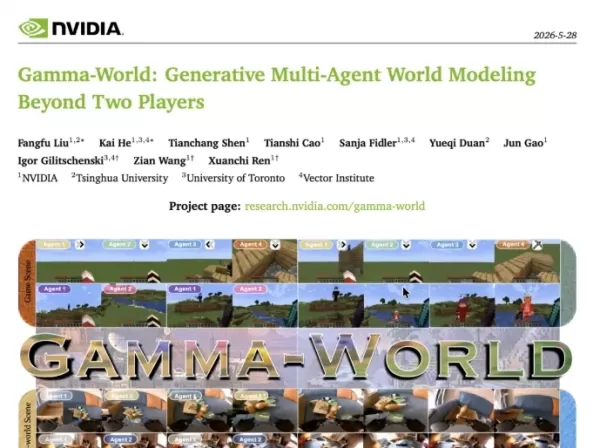
Gamma-World addresses these structural issues with a complete redesign. The team introduced Simplex Rotary Agent Encoding, which positions all players at the vertices of a geometric simplex, ensuring natural equidistance and equal status among them. This design has no learnable parameters and uses random coordinate assignment, enabling the model to train on two-agent data and directly execute four-agent scenarios without any architectural changes—a significant leap in generalization.
To tackle the computational throughput bottleneck, Gamma-World employs a Sparse Hub Attention Mechanism. This approach replaces traditional pairwise direct communication with a set of learnable hub tokens that act as compressed relays for shared world states, reducing computational cost to linear complexity. Combined with independent caching, the system achieves real-time action simulation at 24 frames per second (24 FPS).
For training, the team used a three-stage teacher-student distillation approach, where a bidirectional teacher model guides a causal student model, compressing multi-step sampling into just four steps. This maintains action controllability while significantly reducing error accumulation during autoregressive inference.
Experimental results demonstrate that across five core scenarios in a multi-player Minecraft virtual environment—including memory and construction—Gamma-World outperforms existing state-of-the-art models, achieving an average reduction of over 40% in the FVD metric for video quality. The framework has also been successfully adapted to real dual-arm robot collaboration tasks, confirming its cross-scenario applicability. This advancement not only improves multi-agent simulation but also has the potential to serve as a large-scale simulation generation infrastructure for physical AI domains such as multi-arm medical collaboration, factory multi-robot scheduling, and autonomous driving.
Related article
 IBM Report: AI-Driven Breaches Account for 25% of Incidents, with Individual Losses 20% Above Average
New research from IBM and the Ponemon Institute highlights a disturbing shift: AI-powered attacks now represent 25% of all malicious data breaches, marking a 56% year-over-year surge. These incidents result in an average loss of $6 million, significa
MegMind Unveils ForgeStencil: Dual-Agent System Automates Optimization of 100+ Industrial Software Tools in One Week
Modern industrial breakthroughs and cutting-edge research rely on large-scale high-performance computing software, with Stencil computation serving as the core computational pattern. This memory-intensive process, constrained by bandwidth, is critica
Qualcomm Snapdragon Powers Samsung’s Generative AI Ecosystem
From left: Galaxy Z Flip8, Galaxy Z Fold8 and Galaxy Z Fold8 Ultra. Credit: SamsungQualcomm’s Cristiano Amon says its Samsung partnership enables natural, context-aware AI across the new Galaxy smartphones, watches and eyewearImagine walking down a s
Related Special Topic Recommendations
Academic Research
IBM Report: AI-Driven Breaches Account for 25% of Incidents, with Individual Losses 20% Above Average
New research from IBM and the Ponemon Institute highlights a disturbing shift: AI-powered attacks now represent 25% of all malicious data breaches, marking a 56% year-over-year surge. These incidents result in an average loss of $6 million, significa
MegMind Unveils ForgeStencil: Dual-Agent System Automates Optimization of 100+ Industrial Software Tools in One Week
Modern industrial breakthroughs and cutting-edge research rely on large-scale high-performance computing software, with Stencil computation serving as the core computational pattern. This memory-intensive process, constrained by bandwidth, is critica
Qualcomm Snapdragon Powers Samsung’s Generative AI Ecosystem
From left: Galaxy Z Flip8, Galaxy Z Fold8 and Galaxy Z Fold8 Ultra. Credit: SamsungQualcomm’s Cristiano Amon says its Samsung partnership enables natural, context-aware AI across the new Galaxy smartphones, watches and eyewearImagine walking down a s
Related Special Topic Recommendations
Academic Research
 Top AI Paper Reading Tools: Extract Methods, Results, and Limits Faster
2026 Latest Top-Rated Best AI Paper Reading Tools for Researchers! This curated list offers powerful game-changing solutions to quickly extract key methods, results, and limitations from complex academic papers. XIX.AI provides weekly updated free vs paid comparison data along with real-world tests across diverse research fields. Discover your perfect tool to boost productivity and unlock your AI edge today. Explore now!
 8 tools
 xix.ai
Music composition
Best AI Vocal Demo Tools for Track Prototypes
xix.ai
Music composition
Best AI Vocal Demo Tools for Track Prototypes
2026 Latest Best Top-rated AI Vocal Demo Tools for Track Prototypes are here on XIX.AI! This curated list features powerful, game-changing tools that go through real-world tests to ensure top performance. You’ll find a free vs paid comparison, detailed rankings, and must-try options perfect for boosting creative efficiency and helping you unlock your AI edge. Explore now to discover your perfect tool!
10 tools
xix.ai
Software Development
AI API Mocking Tools for Frontend-Backend Collaboration
2026 Latest Best Top-rated AI API Mocking Tools for Frontend-Backend Collaboration are here on XIX.AI! This curated list features powerful, game-changing solutions that help teams streamline workflows, boost productivity, and create high-quality apps faster through real-world tests and strict rankings. Get a free vs paid comparison to find the must-try option that suits your needs. Explore now to unlock your AI edge!
12 tools
xix.ai
Design & Art
Midjourney Style Reference Tools for Character Concepts, Posters, and Ad Visuals
2026 Latest Best Top-rated Midjourney Style Reference Tools for Character Concepts, Posters, and Ad Visuals! XIX.AI has curated a powerful game-changing collection that undergoes weekly updated real-world tests. You can find detailed free vs paid comparison insights and reliable rankings to help you pick the must-try option that boosts your creativity and speeds up workflow significantly. Explore now to Discover your perfect tool for all your visual design needs.
11 tools
xix.ai
Music composition
AI Vocal Generation Tools: Create Demo Vocals and Harmony Layers
2026 Latest Best Top-rated AI Vocal Generation Tools for Creating Demo Vocals and Harmony Layers are here on XIX.AI. This curated collection features powerful, game-changing solutions that have passed rigorous real-world tests. We provide a weekly updated free vs paid comparison along with detailed rankings to help you find the perfect tool for boosting your creativity and productivity. Explore now to Unlock your AI edge.
12 tools
xix.ai
Productivity
Best AI Focus Assistants: Reduce Context Switching and Stay on Track
2026 Latest Best Top-rated AI Focus Assistants Curated to Slash Context Switching and Keep You Productive All Day. These powerful tools undergo rigorous real-world tests, featuring a free vs paid comparison along with weekly updated rankings. Discover your perfect tool to boost writing efficiency, unlock creative ideas, and stay focused without distraction. Explore now at XIX.AI to Unlock your AI edge.
9 tools
xix.ai

 Comments (0)
0/500
Comments (0)
0/500
Video world models are shifting from a single-agent perspective toward multi-agent collaboration. Traditional models typically assume a single agent, which limits their ability to handle complex scenarios where multiple players act and observe each other in the same virtual world. To overcome this architectural bottleneck, NVIDIA, in collaboration with Tsinghua University, the University of Toronto, and the Vector Institute, has introduced Gamma-World (γ-World), a new multi-agent world model solution.
The main challenge in multi-agent world modeling is preserving three types of consistency: temporal, cross-perspective, and interactive. Earlier efforts like Solaris advanced two-agent collaboration but revealed two critical flaws: identity encoding that disrupts permutation symmetry, and a fully connected attention mechanism that drives quadratic computational growth with the number of agents, preventing effective scaling to more participants.
Gamma-World addresses these structural issues with a complete redesign. The team introduced Simplex Rotary Agent Encoding, which positions all players at the vertices of a geometric simplex, ensuring natural equidistance and equal status among them. This design has no learnable parameters and uses random coordinate assignment, enabling the model to train on two-agent data and directly execute four-agent scenarios without any architectural changes—a significant leap in generalization.
To tackle the computational throughput bottleneck, Gamma-World employs a Sparse Hub Attention Mechanism. This approach replaces traditional pairwise direct communication with a set of learnable hub tokens that act as compressed relays for shared world states, reducing computational cost to linear complexity. Combined with independent caching, the system achieves real-time action simulation at 24 frames per second (24 FPS).
For training, the team used a three-stage teacher-student distillation approach, where a bidirectional teacher model guides a causal student model, compressing multi-step sampling into just four steps. This maintains action controllability while significantly reducing error accumulation during autoregressive inference.
Experimental results demonstrate that across five core scenarios in a multi-player Minecraft virtual environment—including memory and construction—Gamma-World outperforms existing state-of-the-art models, achieving an average reduction of over 40% in the FVD metric for video quality. The framework has also been successfully adapted to real dual-arm robot collaboration tasks, confirming its cross-scenario applicability. This advancement not only improves multi-agent simulation but also has the potential to serve as a large-scale simulation generation infrastructure for physical AI domains such as multi-arm medical collaboration, factory multi-robot scheduling, and autonomous driving.








 IBM Report: AI-Driven Breaches Account for 25% of Incidents, with Individual Losses 20% Above Average
New research from IBM and the Ponemon Institute highlights a disturbing shift: AI-powered attacks now represent 25% of all malicious data breaches, marking a 56% year-over-year surge. These incidents result in an average loss of $6 million, significa
IBM Report: AI-Driven Breaches Account for 25% of Incidents, with Individual Losses 20% Above Average
New research from IBM and the Ponemon Institute highlights a disturbing shift: AI-powered attacks now represent 25% of all malicious data breaches, marking a 56% year-over-year surge. These incidents result in an average loss of $6 million, significa
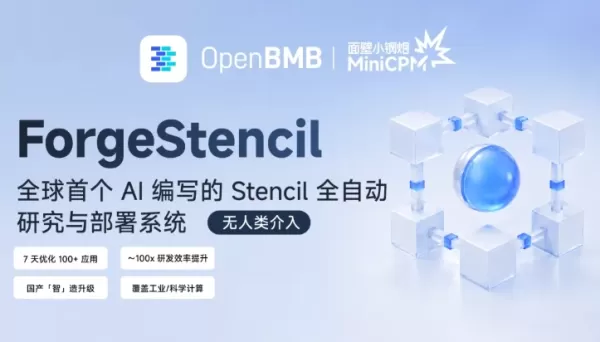 MegMind Unveils ForgeStencil: Dual-Agent System Automates Optimization of 100+ Industrial Software Tools in One Week
Modern industrial breakthroughs and cutting-edge research rely on large-scale high-performance computing software, with Stencil computation serving as the core computational pattern. This memory-intensive process, constrained by bandwidth, is critica
MegMind Unveils ForgeStencil: Dual-Agent System Automates Optimization of 100+ Industrial Software Tools in One Week
Modern industrial breakthroughs and cutting-edge research rely on large-scale high-performance computing software, with Stencil computation serving as the core computational pattern. This memory-intensive process, constrained by bandwidth, is critica
 Qualcomm Snapdragon Powers Samsung’s Generative AI Ecosystem
From left: Galaxy Z Flip8, Galaxy Z Fold8 and Galaxy Z Fold8 Ultra. Credit: SamsungQualcomm’s Cristiano Amon says its Samsung partnership enables natural, context-aware AI across the new Galaxy smartphones, watches and eyewearImagine walking down a s
Qualcomm Snapdragon Powers Samsung’s Generative AI Ecosystem
From left: Galaxy Z Flip8, Galaxy Z Fold8 and Galaxy Z Fold8 Ultra. Credit: SamsungQualcomm’s Cristiano Amon says its Samsung partnership enables natural, context-aware AI across the new Galaxy smartphones, watches and eyewearImagine walking down a s

2026 Latest Top-Rated Best AI Paper Reading Tools for Researchers! This curated list offers powerful game-changing solutions to quickly extract key methods, results, and limitations from complex academic papers. XIX.AI provides weekly updated free vs paid comparison data along with real-world tests across diverse research fields. Discover your perfect tool to boost productivity and unlock your AI edge today. Explore now!
8 tools
xix.ai

2026 Latest Best Top-rated AI Vocal Demo Tools for Track Prototypes are here on XIX.AI! This curated list features powerful, game-changing tools that go through real-world tests to ensure top performance. You’ll find a free vs paid comparison, detailed rankings, and must-try options perfect for boosting creative efficiency and helping you unlock your AI edge. Explore now to discover your perfect tool!
10 tools
xix.ai

2026 Latest Best Top-rated AI API Mocking Tools for Frontend-Backend Collaboration are here on XIX.AI! This curated list features powerful, game-changing solutions that help teams streamline workflows, boost productivity, and create high-quality apps faster through real-world tests and strict rankings. Get a free vs paid comparison to find the must-try option that suits your needs. Explore now to unlock your AI edge!
12 tools
xix.ai

2026 Latest Best Top-rated Midjourney Style Reference Tools for Character Concepts, Posters, and Ad Visuals! XIX.AI has curated a powerful game-changing collection that undergoes weekly updated real-world tests. You can find detailed free vs paid comparison insights and reliable rankings to help you pick the must-try option that boosts your creativity and speeds up workflow significantly. Explore now to Discover your perfect tool for all your visual design needs.
11 tools
xix.ai
2026 Latest Best Top-rated AI Vocal Generation Tools for Creating Demo Vocals and Harmony Layers are here on XIX.AI. This curated collection features powerful, game-changing solutions that have passed rigorous real-world tests. We provide a weekly updated free vs paid comparison along with detailed rankings to help you find the perfect tool for boosting your creativity and productivity. Explore now to Unlock your AI edge.
12 tools
xix.ai
2026 Latest Best Top-rated AI Focus Assistants Curated to Slash Context Switching and Keep You Productive All Day. These powerful tools undergo rigorous real-world tests, featuring a free vs paid comparison along with weekly updated rankings. Discover your perfect tool to boost writing efficiency, unlock creative ideas, and stay focused without distraction. Explore now at XIX.AI to Unlock your AI edge.
9 tools
xix.ai












