


 Home
HomeMeta Unveils New AI Chip to Challenge NVIDIA's H100 Performance
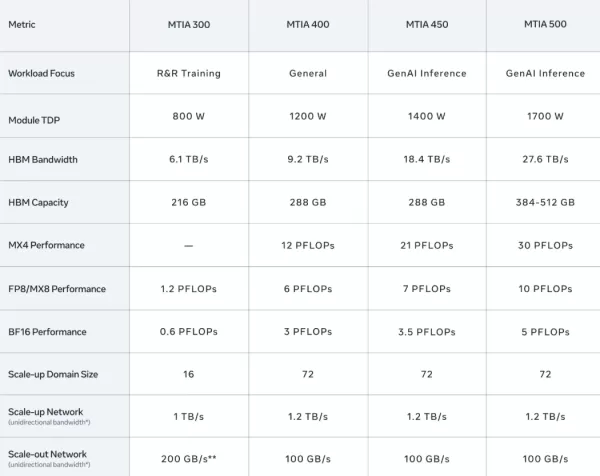
To reduce its heavy reliance on external AI chip supply chains, social media leader Meta has officially launched its latest generation of in-house AI chips. Dubbed MTIA3, this accelerator not only excels in internal benchmarks, but Meta also claims in an official statement that its inference efficiency surpasses NVIDIA's flagship H100 GPU in specific workloads.
Customization Edge: Built for Recommendation Systems and Inference
Unlike NVIDIA's focus on general-purpose computing, Meta's new chip takes a "deeply customized" path. Its core mission is to optimize the massive recommendation algorithms powering Instagram and Facebook, along with real-time inference for the Llama series of large language models:
Major Gains in Energy Efficiency: By simplifying circuitry for targeted workloads, the MTIA3 consumes far less power than general-purpose GPUs when processing large-scale recommendation models.
Higher Compute Density: The new architecture improves memory bandwidth and interconnect efficiency, enabling a single rack to support more powerful computing clusters than previous setups.
Strategic Shift: From "Buyer" to a "Self-Built Ecosystem"
While Meta remains one of NVIDIA's largest customers, the robust launch of this chip sends a clear signal:
Lowering Operational Costs: Large-scale deployment of in-house chips will progressively cut Meta's enormous annual spending on AI infrastructure.
Hardware-Software Co-Optimization: By deeply integrating its chips with its own PyTorch framework at a foundational level, Meta can deploy the latest AI algorithms faster than its rivals.
Supply Chain Security: Amid tight computing supply, in-house development is Meta's key strategic moat, ensuring its global AI roadmap remains resilient to external disruptions.
Industry Impact: Tech Giants Dive Deeper into Chipmaking
Meta's breakthrough signifies that competition among Silicon Valley titans has fully extended from the software layer down to the transistor level. As the MTIA series continues to evolve, the AI chip market is transitioning from NVIDIA's "unipolar dominance" toward a diversified landscape where general-purpose and custom computing coexist.
Meta's chief scientist, Yann LeCun, stated that hardware autonomy is a necessary step on the path to Artificial General Intelligence (AGI). With the new chip entering mass production, Meta plans to migrate most of its inference workloads to its proprietary platform within the next year—a move poised to reshape the global dynamics of AI infrastructure.
Related article
 Stripe to Acquire OpenRouter as AI Model Routing Gains Momentum
Stripe has agreed to acquire OpenRouter, an AI model-routing platform that gives developers access to hundreds of models through a single interface. The deal adds model selection and routing to Stripe’s existing work around AI usage and token-based b
Former OpenAI Researcher Barrett Zoph Returns to Google to Support Gemini Development
Barret Zoph, who previously abruptly left and joined OpenAI due to a disagreement with Thinking Machines Lab CEO Miriam Mularati, has once again changed employers. Alphabet's Google announced that Zoph will return as Vice President of Research, bring
How Recursive Intelligence Raised $335M at $4B Valuation in 4 Months
The co-founders of startup Ricursive Intelligence seemed destined to be co-founders.Anna Goldie, CEO, and Azalia Mirhoseini, CTO, are so well-known in the AI community that they were among those AI engineers who “got those weird emails from Zuckerber
Related Special Topic Recommendations
Design & Art
Stripe to Acquire OpenRouter as AI Model Routing Gains Momentum
Stripe has agreed to acquire OpenRouter, an AI model-routing platform that gives developers access to hundreds of models through a single interface. The deal adds model selection and routing to Stripe’s existing work around AI usage and token-based b
Former OpenAI Researcher Barrett Zoph Returns to Google to Support Gemini Development
Barret Zoph, who previously abruptly left and joined OpenAI due to a disagreement with Thinking Machines Lab CEO Miriam Mularati, has once again changed employers. Alphabet's Google announced that Zoph will return as Vice President of Research, bring
How Recursive Intelligence Raised $335M at $4B Valuation in 4 Months
The co-founders of startup Ricursive Intelligence seemed destined to be co-founders.Anna Goldie, CEO, and Azalia Mirhoseini, CTO, are so well-known in the AI community that they were among those AI engineers who “got those weird emails from Zuckerber
Related Special Topic Recommendations
Design & Art
 Top AI Illustration Tools: Create Editorial Scenes and Cover Art Faster
2026 Latest Top-rated AI Illustration Tools: Our curated list features the best powerfully designed tools for creating stunning editorial scenes and eye-catching cover art quickly. Each option has gone through rigorous real-world tests, offering a free vs paid comparison to help you find the perfect match for your workflow. Try these must-try solutions today to unlock your AI edge and boost your creative productivity. Explore now at XIX.AI.
 10 tools
 xix.ai
Education and Learning
Top AI Tutors for Exam Prep: Practice Math, Science, and English
xix.ai
Education and Learning
Top AI Tutors for Exam Prep: Practice Math, Science, and English
2026 Latest Top-Rated Best AI Tutors for Exam Prep are here on XIX.AI! Our curated list features powerful game-changing tools that offer free vs paid comparison, real-world tests, and weekly updated rankings. They help boost your writing efficiency, simplify complex topic learning, and unlock your academic potential. Explore now to Discover your perfect exam prep tool and Start creating today to Unlock your AI edge!
10 tools
xix.ai
Finance
AI Budget Planning Tools for Personal Money Management
2026 Latest Best Top-Rated AI Budget Planning Tools for Personal Money Management are here on XIX.AI! This curated collection features powerful, game-changing solutions that help you conduct real-world tests, understand spending habits, and create personalized plans to boost productivity. Enjoy a free vs paid comparison along with detailed rankings. Must-try tools designed to simplify money management and unlock your AI edge. Explore now!
11 tools
xix.ai
Health & Wellness
AI Sleep Tracking Assistants: Improve Recovery with Better Bedtime Habits
2026 Latest Best Top-Rated AI Sleep Tracking Assistants curated for ultimate recovery. This fully updated weekly guide features powerful tools that deliver real-world tests, free vs paid comparison, and detailed rankings to help you find the must-try solution that boosts sleep quality and supports better bedtime habits. Explore now at XIX.AI to Unlock your AI edge.
10 tools
xix.ai
Data Analysis
AI SQL Copilots for Product and Revenue Analytics
2026 Latest Best Top-Rated AI SQL Copilots for Product and Revenue Analytics! XIX.AI has curated a powerful, game-changing collection of must-try tools that undergo real-world tests through weekly updated rankings. These tools help users boost productivity significantly by accelerating data analysis, streamlining complex queries, and generating accurate insights to drive smarter business decisions. Explore now to Discover your perfect tool for unlocking your AI edge!
14 tools
xix.ai
Education and Learning
Best AI Homework Helpers That Teach: Learn Concepts, Not Just Answers
2026 Latest Best Top-Rated AI Homework Helpers That Teach Core Concepts Not Just Answers Powerful Tools for Students Must-Try Curated List Weekly Updated Free vs Paid Comparison Real-World Tests Accurate Rankings to Help You Unlock Your Full Learning Potential Explore now to Discover your perfect tool for smarter studying.
10 tools
xix.ai

 Comments (3)
0/500
Comments (3)
0/500
![EmmaJohnson]()
Metaが自社製AIチップMTIA3を発表か。NVIDIAのH100に対抗するとのことですが、結局のところコスト削減が主目的ですよね。ベンチマーク結果がどうなるか注目ですが、既存のインフラとの互換性やエコシステムの問題が解決されない限り、一般ユーザーには直接関係ない話かもしれません。ただ、競争が激化すればチップ価格が下がる可能性もあるので、業界全体には良い影響がありそうです。🤖💻 #Meta #AIChip
![KeithNelson]()
So Meta thinks they can just waltz in and take on NVIDIA? The H100 is a beast, but let's see if MTIA3 actually delivers in real-world workloads. Benchmarks are one thing, production scalability is another. Also, internal chip development sounds expensive—hope they don't just burn cash. 😅
![DonaldJackson]()
So Meta thinks they can just whip up a chip to beat NVIDIA? I'll believe it when I see real-world benchmarks, not just internal ones. 😏
To reduce its heavy reliance on external AI chip supply chains, social media leader Meta has officially launched its latest generation of in-house AI chips. Dubbed MTIA3, this accelerator not only excels in internal benchmarks, but Meta also claims in an official statement that its inference efficiency surpasses NVIDIA's flagship H100 GPU in specific workloads.
Customization Edge: Built for Recommendation Systems and Inference
Unlike NVIDIA's focus on general-purpose computing, Meta's new chip takes a "deeply customized" path. Its core mission is to optimize the massive recommendation algorithms powering Instagram and Facebook, along with real-time inference for the Llama series of large language models:
Major Gains in Energy Efficiency: By simplifying circuitry for targeted workloads, the MTIA3 consumes far less power than general-purpose GPUs when processing large-scale recommendation models.
Higher Compute Density: The new architecture improves memory bandwidth and interconnect efficiency, enabling a single rack to support more powerful computing clusters than previous setups.
Strategic Shift: From "Buyer" to a "Self-Built Ecosystem"
While Meta remains one of NVIDIA's largest customers, the robust launch of this chip sends a clear signal:
Lowering Operational Costs: Large-scale deployment of in-house chips will progressively cut Meta's enormous annual spending on AI infrastructure.
Hardware-Software Co-Optimization: By deeply integrating its chips with its own PyTorch framework at a foundational level, Meta can deploy the latest AI algorithms faster than its rivals.
Supply Chain Security: Amid tight computing supply, in-house development is Meta's key strategic moat, ensuring its global AI roadmap remains resilient to external disruptions.
Industry Impact: Tech Giants Dive Deeper into Chipmaking
Meta's breakthrough signifies that competition among Silicon Valley titans has fully extended from the software layer down to the transistor level. As the MTIA series continues to evolve, the AI chip market is transitioning from NVIDIA's "unipolar dominance" toward a diversified landscape where general-purpose and custom computing coexist.
Meta's chief scientist, Yann LeCun, stated that hardware autonomy is a necessary step on the path to Artificial General Intelligence (AGI). With the new chip entering mass production, Meta plans to migrate most of its inference workloads to its proprietary platform within the next year—a move poised to reshape the global dynamics of AI infrastructure.








 Stripe to Acquire OpenRouter as AI Model Routing Gains Momentum
Stripe has agreed to acquire OpenRouter, an AI model-routing platform that gives developers access to hundreds of models through a single interface. The deal adds model selection and routing to Stripe’s existing work around AI usage and token-based b
Stripe to Acquire OpenRouter as AI Model Routing Gains Momentum
Stripe has agreed to acquire OpenRouter, an AI model-routing platform that gives developers access to hundreds of models through a single interface. The deal adds model selection and routing to Stripe’s existing work around AI usage and token-based b
 Former OpenAI Researcher Barrett Zoph Returns to Google to Support Gemini Development
Barret Zoph, who previously abruptly left and joined OpenAI due to a disagreement with Thinking Machines Lab CEO Miriam Mularati, has once again changed employers. Alphabet's Google announced that Zoph will return as Vice President of Research, bring
Former OpenAI Researcher Barrett Zoph Returns to Google to Support Gemini Development
Barret Zoph, who previously abruptly left and joined OpenAI due to a disagreement with Thinking Machines Lab CEO Miriam Mularati, has once again changed employers. Alphabet's Google announced that Zoph will return as Vice President of Research, bring
 How Recursive Intelligence Raised $335M at $4B Valuation in 4 Months
The co-founders of startup Ricursive Intelligence seemed destined to be co-founders.Anna Goldie, CEO, and Azalia Mirhoseini, CTO, are so well-known in the AI community that they were among those AI engineers who “got those weird emails from Zuckerber
How Recursive Intelligence Raised $335M at $4B Valuation in 4 Months
The co-founders of startup Ricursive Intelligence seemed destined to be co-founders.Anna Goldie, CEO, and Azalia Mirhoseini, CTO, are so well-known in the AI community that they were among those AI engineers who “got those weird emails from Zuckerber

2026 Latest Top-rated AI Illustration Tools: Our curated list features the best powerfully designed tools for creating stunning editorial scenes and eye-catching cover art quickly. Each option has gone through rigorous real-world tests, offering a free vs paid comparison to help you find the perfect match for your workflow. Try these must-try solutions today to unlock your AI edge and boost your creative productivity. Explore now at XIX.AI.
10 tools
xix.ai

2026 Latest Top-Rated Best AI Tutors for Exam Prep are here on XIX.AI! Our curated list features powerful game-changing tools that offer free vs paid comparison, real-world tests, and weekly updated rankings. They help boost your writing efficiency, simplify complex topic learning, and unlock your academic potential. Explore now to Discover your perfect exam prep tool and Start creating today to Unlock your AI edge!
10 tools
xix.ai

2026 Latest Best Top-Rated AI Budget Planning Tools for Personal Money Management are here on XIX.AI! This curated collection features powerful, game-changing solutions that help you conduct real-world tests, understand spending habits, and create personalized plans to boost productivity. Enjoy a free vs paid comparison along with detailed rankings. Must-try tools designed to simplify money management and unlock your AI edge. Explore now!
11 tools
xix.ai

2026 Latest Best Top-Rated AI Sleep Tracking Assistants curated for ultimate recovery. This fully updated weekly guide features powerful tools that deliver real-world tests, free vs paid comparison, and detailed rankings to help you find the must-try solution that boosts sleep quality and supports better bedtime habits. Explore now at XIX.AI to Unlock your AI edge.
10 tools
xix.ai

2026 Latest Best Top-Rated AI SQL Copilots for Product and Revenue Analytics! XIX.AI has curated a powerful, game-changing collection of must-try tools that undergo real-world tests through weekly updated rankings. These tools help users boost productivity significantly by accelerating data analysis, streamlining complex queries, and generating accurate insights to drive smarter business decisions. Explore now to Discover your perfect tool for unlocking your AI edge!
14 tools
xix.ai

2026 Latest Best Top-Rated AI Homework Helpers That Teach Core Concepts Not Just Answers Powerful Tools for Students Must-Try Curated List Weekly Updated Free vs Paid Comparison Real-World Tests Accurate Rankings to Help You Unlock Your Full Learning Potential Explore now to Discover your perfect tool for smarter studying.
10 tools
xix.ai

Metaが自社製AIチップMTIA3を発表か。NVIDIAのH100に対抗するとのことですが、結局のところコスト削減が主目的ですよね。ベンチマーク結果がどうなるか注目ですが、既存のインフラとの互換性やエコシステムの問題が解決されない限り、一般ユーザーには直接関係ない話かもしれません。ただ、競争が激化すればチップ価格が下がる可能性もあるので、業界全体には良い影響がありそうです。🤖💻 #Meta #AIChip
So Meta thinks they can just waltz in and take on NVIDIA? The H100 is a beast, but let's see if MTIA3 actually delivers in real-world workloads. Benchmarks are one thing, production scalability is another. Also, internal chip development sounds expensive—hope they don't just burn cash. 😅
So Meta thinks they can just whip up a chip to beat NVIDIA? I'll believe it when I see real-world benchmarks, not just internal ones. 😏












