


 Home
Meituan LongCat Unveils Open-Source Theorem Prover Model LongCat-Flash-Prover
On March 24, 2026, the Meituan LongCat team officially open-sourced a specialized deep learning model for mathematical formalization and theorem proving: LongCat-Flash-Prover. This model overcomes the limitations of large language models in rigorous logical reasoning by breaking down formal reasoning into three core capabilities: auto-formalization, proof sketching, and final proving. It represents a paradigm shift from "probabilistic answer prediction" to "verifiable logical proof."

Using a combined Tool-Integrated Reasoning (TIR) strategy, the model achieved a 97.1% pass rate on the MiniF2F-Test benchmark with only 72 reasoning steps, setting a new state-of-the-art record for open-source theorem provers. Its performance also significantly exceeded existing open-source models on challenging competition-level benchmarks like MathOlympiad-Bench and PutnamBench.
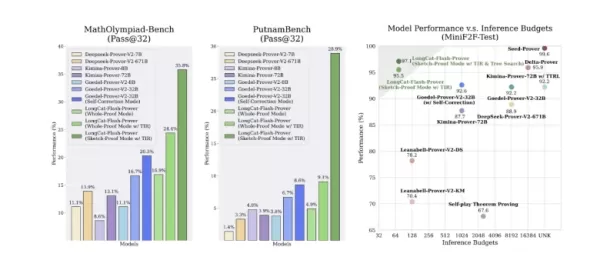
Technically, LongCat-Flash-Prover employs a TIR-based "hybrid expert iteration" framework. By integrating Lean4Server verification, semantic and theorem consistency checks, and legality verification against nine types of cheating behaviors, the model effectively addresses logical loopholes and code deception. During training, the team introduced a hierarchical masking strategy and token-level staleness control, greatly improving reinforcement learning stability under the Mixture-of-Experts (MoE) architecture.
As AI reasoning evolves from handling natural language ambiguity to working with verifiable formal languages, such theorem provers are moving beyond simple algorithmic benchmarks. They are becoming foundational infrastructure for core scientific research. This breakthrough signals an accelerating era where AI deeply participates in frontier mathematical exploration and automated document verification.
GitHub:
https://github.com/meituan-longcat/LongCat-Flash-Prover
Hugging Face:https://huggingface.co/meituan-longcat/LongCat-Flash-Prover
Report:
https://github.com/meituan-longcat/LongCat-Flash-Prover/blob/main/LongCat_Flash_Prover_Technical_Report.pdf
Related article
 Stripe to Acquire OpenRouter as AI Model Routing Gains Momentum
Stripe has agreed to acquire OpenRouter, an AI model-routing platform that gives developers access to hundreds of models through a single interface. The deal adds model selection and routing to Stripe’s existing work around AI usage and token-based b
Former OpenAI Researcher Barrett Zoph Returns to Google to Support Gemini Development
Barret Zoph, who previously abruptly left and joined OpenAI due to a disagreement with Thinking Machines Lab CEO Miriam Mularati, has once again changed employers. Alphabet's Google announced that Zoph will return as Vice President of Research, bring
How Recursive Intelligence Raised $335M at $4B Valuation in 4 Months
The co-founders of startup Ricursive Intelligence seemed destined to be co-founders.Anna Goldie, CEO, and Azalia Mirhoseini, CTO, are so well-known in the AI community that they were among those AI engineers who “got those weird emails from Zuckerber
Related Special Topic Recommendations
Design & Art
 Top AI Illustration Tools: Create Editorial Scenes and Cover Art Faster
2026 Latest Top-rated AI Illustration Tools: Our curated list features the best powerfully designed tools for creating stunning editorial scenes and eye-catching cover art quickly. Each option has gone through rigorous real-world tests, offering a free vs paid comparison to help you find the perfect match for your workflow. Try these must-try solutions today to unlock your AI edge and boost your creative productivity. Explore now at XIX.AI.
 10 tools
 xix.ai
Education and Learning
Top AI Tutors for Exam Prep: Practice Math, Science, and English
2026 Latest Top-Rated Best AI Tutors for Exam Prep are here on XIX.AI! Our curated list features powerful game-changing tools that offer free vs paid comparison, real-world tests, and weekly updated rankings. They help boost your writing efficiency, simplify complex topic learning, and unlock your academic potential. Explore now to Discover your perfect exam prep tool and Start creating today to Unlock your AI edge!
10 tools
xix.ai
Finance
AI Budget Planning Tools for Personal Money Management
2026 Latest Best Top-Rated AI Budget Planning Tools for Personal Money Management are here on XIX.AI! This curated collection features powerful, game-changing solutions that help you conduct real-world tests, understand spending habits, and create personalized plans to boost productivity. Enjoy a free vs paid comparison along with detailed rankings. Must-try tools designed to simplify money management and unlock your AI edge. Explore now!
11 tools
xix.ai
Health & Wellness
AI Sleep Tracking Assistants: Improve Recovery with Better Bedtime Habits
2026 Latest Best Top-Rated AI Sleep Tracking Assistants curated for ultimate recovery. This fully updated weekly guide features powerful tools that deliver real-world tests, free vs paid comparison, and detailed rankings to help you find the must-try solution that boosts sleep quality and supports better bedtime habits. Explore now at XIX.AI to Unlock your AI edge.
10 tools
xix.ai
Data Analysis
AI SQL Copilots for Product and Revenue Analytics
2026 Latest Best Top-Rated AI SQL Copilots for Product and Revenue Analytics! XIX.AI has curated a powerful, game-changing collection of must-try tools that undergo real-world tests through weekly updated rankings. These tools help users boost productivity significantly by accelerating data analysis, streamlining complex queries, and generating accurate insights to drive smarter business decisions. Explore now to Discover your perfect tool for unlocking your AI edge!
14 tools
xix.ai
Education and Learning
Best AI Homework Helpers That Teach: Learn Concepts, Not Just Answers
2026 Latest Best Top-Rated AI Homework Helpers That Teach Core Concepts Not Just Answers Powerful Tools for Students Must-Try Curated List Weekly Updated Free vs Paid Comparison Real-World Tests Accurate Rankings to Help You Unlock Your Full Learning Potential Explore now to Discover your perfect tool for smarter studying.
10 tools
xix.ai

 Comments (2)
0/500
![EdwardJackson]()
Finally an open-source theorem prover! 😊 But does it actually outperform existing ones like Lean's auto? Curious about the benchmarks.
![JosephEvans]()
Meituan LongCat團隊這次開源的定理證明模型真的讓人驚艷!數學形式化一直是AI的硬骨頭,看到能突破大語言模型的限制,感覺學術圈又要熱鬧起來了。不過這種專業工具到底會先被學界廣泛使用,還是被大公司搶去優化內部系統呢?🤔
On March 24, 2026, the Meituan LongCat team officially open-sourced a specialized deep learning model for mathematical formalization and theorem proving: LongCat-Flash-Prover. This model overcomes the limitations of large language models in rigorous logical reasoning by breaking down formal reasoning into three core capabilities: auto-formalization, proof sketching, and final proving. It represents a paradigm shift from "probabilistic answer prediction" to "verifiable logical proof."
Using a combined Tool-Integrated Reasoning (TIR) strategy, the model achieved a 97.1% pass rate on the MiniF2F-Test benchmark with only 72 reasoning steps, setting a new state-of-the-art record for open-source theorem provers. Its performance also significantly exceeded existing open-source models on challenging competition-level benchmarks like MathOlympiad-Bench and PutnamBench.
Technically, LongCat-Flash-Prover employs a TIR-based "hybrid expert iteration" framework. By integrating Lean4Server verification, semantic and theorem consistency checks, and legality verification against nine types of cheating behaviors, the model effectively addresses logical loopholes and code deception. During training, the team introduced a hierarchical masking strategy and token-level staleness control, greatly improving reinforcement learning stability under the Mixture-of-Experts (MoE) architecture.
As AI reasoning evolves from handling natural language ambiguity to working with verifiable formal languages, such theorem provers are moving beyond simple algorithmic benchmarks. They are becoming foundational infrastructure for core scientific research. This breakthrough signals an accelerating era where AI deeply participates in frontier mathematical exploration and automated document verification.
GitHub:
https://github.com/meituan-longcat/LongCat-Flash-Prover
Hugging Face:https://huggingface.co/meituan-longcat/LongCat-Flash-Prover
Report:
https://github.com/meituan-longcat/LongCat-Flash-Prover/blob/main/LongCat_Flash_Prover_Technical_Report.pdf








 Stripe to Acquire OpenRouter as AI Model Routing Gains Momentum
Stripe has agreed to acquire OpenRouter, an AI model-routing platform that gives developers access to hundreds of models through a single interface. The deal adds model selection and routing to Stripe’s existing work around AI usage and token-based b
 Former OpenAI Researcher Barrett Zoph Returns to Google to Support Gemini Development
Barret Zoph, who previously abruptly left and joined OpenAI due to a disagreement with Thinking Machines Lab CEO Miriam Mularati, has once again changed employers. Alphabet's Google announced that Zoph will return as Vice President of Research, bring
 How Recursive Intelligence Raised $335M at $4B Valuation in 4 Months
The co-founders of startup Ricursive Intelligence seemed destined to be co-founders.Anna Goldie, CEO, and Azalia Mirhoseini, CTO, are so well-known in the AI community that they were among those AI engineers who “got those weird emails from Zuckerber

2026 Latest Top-rated AI Illustration Tools: Our curated list features the best powerfully designed tools for creating stunning editorial scenes and eye-catching cover art quickly. Each option has gone through rigorous real-world tests, offering a free vs paid comparison to help you find the perfect match for your workflow. Try these must-try solutions today to unlock your AI edge and boost your creative productivity. Explore now at XIX.AI.
10 tools
xix.ai

2026 Latest Top-Rated Best AI Tutors for Exam Prep are here on XIX.AI! Our curated list features powerful game-changing tools that offer free vs paid comparison, real-world tests, and weekly updated rankings. They help boost your writing efficiency, simplify complex topic learning, and unlock your academic potential. Explore now to Discover your perfect exam prep tool and Start creating today to Unlock your AI edge!
10 tools
xix.ai

2026 Latest Best Top-Rated AI Budget Planning Tools for Personal Money Management are here on XIX.AI! This curated collection features powerful, game-changing solutions that help you conduct real-world tests, understand spending habits, and create personalized plans to boost productivity. Enjoy a free vs paid comparison along with detailed rankings. Must-try tools designed to simplify money management and unlock your AI edge. Explore now!
11 tools
xix.ai

2026 Latest Best Top-Rated AI Sleep Tracking Assistants curated for ultimate recovery. This fully updated weekly guide features powerful tools that deliver real-world tests, free vs paid comparison, and detailed rankings to help you find the must-try solution that boosts sleep quality and supports better bedtime habits. Explore now at XIX.AI to Unlock your AI edge.
10 tools
xix.ai

2026 Latest Best Top-Rated AI SQL Copilots for Product and Revenue Analytics! XIX.AI has curated a powerful, game-changing collection of must-try tools that undergo real-world tests through weekly updated rankings. These tools help users boost productivity significantly by accelerating data analysis, streamlining complex queries, and generating accurate insights to drive smarter business decisions. Explore now to Discover your perfect tool for unlocking your AI edge!
14 tools
xix.ai

2026 Latest Best Top-Rated AI Homework Helpers That Teach Core Concepts Not Just Answers Powerful Tools for Students Must-Try Curated List Weekly Updated Free vs Paid Comparison Real-World Tests Accurate Rankings to Help You Unlock Your Full Learning Potential Explore now to Discover your perfect tool for smarter studying.
10 tools
xix.ai

Finally an open-source theorem prover! 😊 But does it actually outperform existing ones like Lean's auto? Curious about the benchmarks.
Meituan LongCat團隊這次開源的定理證明模型真的讓人驚艷!數學形式化一直是AI的硬骨頭,看到能突破大語言模型的限制,感覺學術圈又要熱鬧起來了。不過這種專業工具到底會先被學界廣泛使用,還是被大公司搶去優化內部系統呢?🤔












