


 Home
HomeMaster SEO Content Creation Using AI: A Step-by-Step Guide
High-ranking content on search engine results pages (SERPs) is essential for driving organic traffic in today's digital environment. The process, however, can be demanding and time-intensive. AI-powered tools are transforming SEO content creation, boosting both its efficiency and impact. This guide offers a step-by-step method for mastering SEO content, using AI to strengthen your strategy, improve rankings, and enhance the user experience.
Key Points
SEO-friendly content is fundamental for attracting organic visitors to your site.
AI tools can dramatically improve the speed and quality of content production.
Thorough keyword research is the bedrock of any successful SEO content plan.
Building a strong outline ensures your content is well-organized and comprehensive.
AI can be leveraged to produce high-quality content drafts quickly and effectively.
Keeping content updated and factually correct is vital for maintaining trust and authority.
Understanding SEO Content Creation
The Importance of SEO-Friendly Content
Online visibility is crucial in a competitive digital space. Content optimized for SEO helps your website rank higher in search results, attracting more organic visitors.
High-quality content not only draws visitors in but also keeps them engaged, lowering bounce rates and boosting your site's overall performance. By mastering core SEO principles, you can create material that appeals to both search engines and your intended audience.
To achieve the best SEO results, focus on these key components:
- Keyword Integration: Seamlessly weave relevant keywords into your content to boost search engine visibility.
- High-Quality Information: Deliver accurate, valuable, and engaging information that meets user needs.
- User Experience: Make sure your content is easy to read, logically structured, and works well on all devices.
- Regular Updates: Keep content current and relevant by incorporating the latest information and industry trends.
Creating SEO Content with Outranking
Step-by-Step Guide to Using Outranking
Outranking is an AI-driven SEO platform designed to simplify content creation and optimization.
Follow this process to create effective SEO content with the tool:
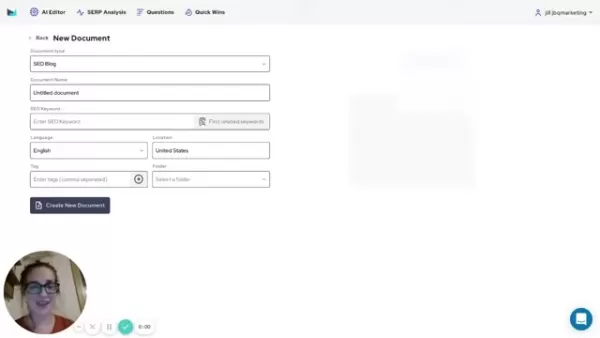
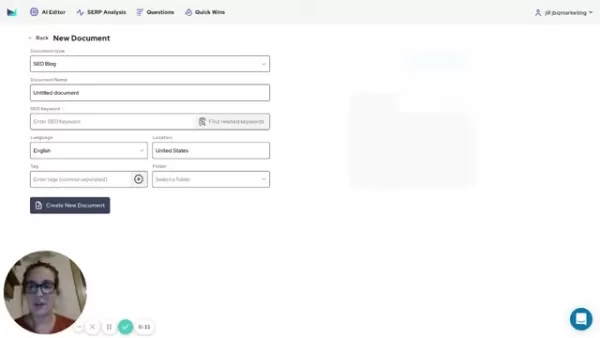
Step 1: Creating a New Document
- Document Type: Choose the right type for your project, like 'SEO Blog Post.'
- Document Name: Assign a clear, descriptive name. For instance, 'Travel Guide to California.'
- SEO Keyword: Input your primary keyword, such as 'travel to california.'
- Language and Location: Set the language (e.g., English) and target location (e.g., United States) to customize the content.
- Tags and Folders: Use tags and select a folder to keep your projects organized.
Step 2: Keyword Research and Refinement
- Finding Related Keywords: Use the tool to discover semantically related terms. This expands your topical coverage and reach.
- Analyzing Keyword Volume: Assess the search volume and competition level for potential keywords to focus on the most valuable ones.
Step 3: Generating Title Ideas
- AI Title Generation: Let the AI propose title ideas based on your keywords, sparking creativity and ensuring SEO appeal.
- Customizing Titles: Refine the suggested titles to match your brand and content goals. An example could be 'Ultimate Family Guide: Where to Go and What to Do in California with Kids.'
Step 4: Crafting Meta Descriptions
- AI Meta Description Generation: Generate initial meta descriptions using AI, incorporating key terms to improve click-through rates.
- Tailoring Meta Descriptions: Edit these descriptions to be compelling, concise, and accurately reflect your content.
Step 5: Building an Outline
- Leveraging SERP Outlines: Analyze outlines from top-ranking pages to see what competitors cover, ensuring your content is thorough and competitive.
- Incorporating Relevant Keywords: Strategically place related and high-frequency keywords within your outline to strengthen SEO.
- Creating a Detailed Structure: Develop a logical outline that fully addresses user intent and covers all key aspects of the topic.
Step 6: Auto-Writing the First Draft
- AI-Powered Content Generation: Use the AI to generate a first draft based on your outline and keywords, providing a solid foundation.
- Fact-Checking and Editing: Carefully review and edit the AI-generated text to ensure accuracy, clarity, and alignment with your brand's voice.
By following these steps, you can use Outranking to create high-quality, SEO-optimized content that ranks well and resonates with your audience.
Optimizing Content
Once you have a draft, the next step is optimization for both search engines and readers. This involves several key actions:
- Keyword Density: Naturally integrate target keywords without overuse. Aim for a density of around 1-2% to avoid keyword stuffing.
- Readability: Use clear language, short paragraphs, and bulleted lists to make content easy to digest. Tools like the Flesch Reading Ease score can help gauge readability.
- Internal and External Linking: Include relevant internal links to other pages on your site and link out to authoritative external sources. This boosts SEO and adds value.
- Visual Elements: Break up text with relevant images, videos, or infographics to increase engagement and visual appeal.
Optimizing these elements can greatly enhance your content's performance and the overall user experience.
Advanced Keywords Strategies
Moving beyond basic keyword use, advanced SEO involves understanding and deploying different keyword types effectively:
1. Long-Tail Keywords:
- These are longer, more specific phrases targeting niche queries. They often have lower search volume but can lead to higher conversion rates.
- Example: 'best affordable family vacation spots in northern california'
2. Latent Semantic Indexing (LSI) Keywords:
- LSI keywords are terms semantically related to your main topic. They help search engines grasp context and depth.
- Example: For 'travel to california,' LSI keywords might include 'California national parks,' 'Pacific Coast Highway,' 'wine country tours,' and 'beach vacations.'
3. Question Keywords:
- These are queries phrased as questions. Targeting them can help you capture featured snippets and answer direct user queries.
- Example: 'What is the best time of year to visit California?'
Strategically using these keyword types allows you to create more comprehensive and targeted SEO content.
Using Outranking to Enhance Your Content Creation Process
Create Title Ideas
The process begins by generating a variety of compelling title options. Input core keywords like 'travel' and 'california' to produce titles that are both SEO-optimized and attention-grabbing. The AI analyzes top-ranking pages to create unique, impactful titles suited to the travel niche, laying the groundwork for content that captures interest and improves search visibility.
Craft Compelling Meta Descriptions
Meta descriptions are vital for improving click-through rates from search results. Utilizing AI, you can craft concise descriptions that incorporate relevant keywords such as 'California,' 'travel,' 'best,' 'affordable,' 'kids,' and 'family.' An effective meta description entices users to click by clearly summarizing the page's value.
Build a Detailed Outline
A detailed outline is crucial for organizing your content. Gather insights from SERP data to understand the structures and subtopics that perform well. This ensures your content meets user intent and covers all necessary, competitive angles. A strong outline is the foundation for a high-quality, SEO-optimized article.
Customize Meta Descriptions for Greater Impact
Tailoring meta descriptions with targeted keywords increases the chance of attracting clicks. By focusing on user intent and search queries, you can craft descriptions that stand out and give users a compelling reason to choose your content over others in the results.
Enhance Content Visibility with AI Title Tags
Implementing optimized title tags is another key step. Well-crafted title tags signal content relevance to search engines, improving crawlability and boosting your site's ranking potential. This ensures every piece of content is fully discoverable.
Advantages and Disadvantages of Using AI for SEO Content
Pros
Greater Efficiency and Speed
Generation of Diverse Content Angles
Enhanced SEO Optimization
Cons
Risk of Factual Errors or Outdated Information
Tendency to Produce Generic or Repetitive Content
Over-Reliance on Automation Tools
Frequently Asked Questions
How can I ensure the AI-generated content is factually accurate?
Always fact-check AI-generated content against authoritative sources. Review and verify all information, updating any details that are incorrect or out of date to maintain credibility.
What if the AI suggestions are too generic?
Infuse the AI-generated framework with your brand's unique voice, insights, and personal experiences. Customize the content to add specific value and make it more engaging for your audience.
How often should I update my SEO content?
Regular updates are key. Plan to review and refresh your content at least every six months to ensure it stays relevant, accurate, and aligned with current search trends.
Related Questions
What are the benefits of using AI in SEO content creation?
AI streamlines the content workflow, generates innovative ideas, and optimizes material for better search performance. It assists with tasks like keyword research, structuring outlines, and writing meta descriptions, saving significant time while improving outcomes.
How can I stay ahead of the competition with SEO content?
Keep abreast of evolving SEO trends, perform in-depth keyword and competitor analysis, and create content that provides unique, superior value. Continuously refine your strategy based on performance data to effectively outrank competitors.
Related article
 Stripe to Acquire OpenRouter as AI Model Routing Gains Momentum
Stripe has agreed to acquire OpenRouter, an AI model-routing platform that gives developers access to hundreds of models through a single interface. The deal adds model selection and routing to Stripe’s existing work around AI usage and token-based b
Former OpenAI Researcher Barrett Zoph Returns to Google to Support Gemini Development
Barret Zoph, who previously abruptly left and joined OpenAI due to a disagreement with Thinking Machines Lab CEO Miriam Mularati, has once again changed employers. Alphabet's Google announced that Zoph will return as Vice President of Research, bring
How Recursive Intelligence Raised $335M at $4B Valuation in 4 Months
The co-founders of startup Ricursive Intelligence seemed destined to be co-founders.Anna Goldie, CEO, and Azalia Mirhoseini, CTO, are so well-known in the AI community that they were among those AI engineers who “got those weird emails from Zuckerber
Related Special Topic Recommendations
Design & Art
Stripe to Acquire OpenRouter as AI Model Routing Gains Momentum
Stripe has agreed to acquire OpenRouter, an AI model-routing platform that gives developers access to hundreds of models through a single interface. The deal adds model selection and routing to Stripe’s existing work around AI usage and token-based b
Former OpenAI Researcher Barrett Zoph Returns to Google to Support Gemini Development
Barret Zoph, who previously abruptly left and joined OpenAI due to a disagreement with Thinking Machines Lab CEO Miriam Mularati, has once again changed employers. Alphabet's Google announced that Zoph will return as Vice President of Research, bring
How Recursive Intelligence Raised $335M at $4B Valuation in 4 Months
The co-founders of startup Ricursive Intelligence seemed destined to be co-founders.Anna Goldie, CEO, and Azalia Mirhoseini, CTO, are so well-known in the AI community that they were among those AI engineers who “got those weird emails from Zuckerber
Related Special Topic Recommendations
Design & Art
 Top AI Illustration Tools: Create Editorial Scenes and Cover Art Faster
2026 Latest Top-rated AI Illustration Tools: Our curated list features the best powerfully designed tools for creating stunning editorial scenes and eye-catching cover art quickly. Each option has gone through rigorous real-world tests, offering a free vs paid comparison to help you find the perfect match for your workflow. Try these must-try solutions today to unlock your AI edge and boost your creative productivity. Explore now at XIX.AI.
 10 tools
 xix.ai
Education and Learning
Top AI Tutors for Exam Prep: Practice Math, Science, and English
xix.ai
Education and Learning
Top AI Tutors for Exam Prep: Practice Math, Science, and English
2026 Latest Top-Rated Best AI Tutors for Exam Prep are here on XIX.AI! Our curated list features powerful game-changing tools that offer free vs paid comparison, real-world tests, and weekly updated rankings. They help boost your writing efficiency, simplify complex topic learning, and unlock your academic potential. Explore now to Discover your perfect exam prep tool and Start creating today to Unlock your AI edge!
10 tools
xix.ai
Finance
AI Budget Planning Tools for Personal Money Management
2026 Latest Best Top-Rated AI Budget Planning Tools for Personal Money Management are here on XIX.AI! This curated collection features powerful, game-changing solutions that help you conduct real-world tests, understand spending habits, and create personalized plans to boost productivity. Enjoy a free vs paid comparison along with detailed rankings. Must-try tools designed to simplify money management and unlock your AI edge. Explore now!
11 tools
xix.ai
Health & Wellness
AI Sleep Tracking Assistants: Improve Recovery with Better Bedtime Habits
2026 Latest Best Top-Rated AI Sleep Tracking Assistants curated for ultimate recovery. This fully updated weekly guide features powerful tools that deliver real-world tests, free vs paid comparison, and detailed rankings to help you find the must-try solution that boosts sleep quality and supports better bedtime habits. Explore now at XIX.AI to Unlock your AI edge.
10 tools
xix.ai
Data Analysis
AI SQL Copilots for Product and Revenue Analytics
2026 Latest Best Top-Rated AI SQL Copilots for Product and Revenue Analytics! XIX.AI has curated a powerful, game-changing collection of must-try tools that undergo real-world tests through weekly updated rankings. These tools help users boost productivity significantly by accelerating data analysis, streamlining complex queries, and generating accurate insights to drive smarter business decisions. Explore now to Discover your perfect tool for unlocking your AI edge!
14 tools
xix.ai
Education and Learning
Best AI Homework Helpers That Teach: Learn Concepts, Not Just Answers
2026 Latest Best Top-Rated AI Homework Helpers That Teach Core Concepts Not Just Answers Powerful Tools for Students Must-Try Curated List Weekly Updated Free vs Paid Comparison Real-World Tests Accurate Rankings to Help You Unlock Your Full Learning Potential Explore now to Discover your perfect tool for smarter studying.
10 tools
xix.ai

 Comments (2)
0/500
Comments (2)
0/500
![TimothyAllen]()
Honestly, I've tried a few AI SEO tools and they're hit or miss. Sometimes the content feels robotic, but when it works, it saves hours. Just remember to edit for human touch, otherwise Google might penalize you. What's your experience been like? 🤔
![KevinRoberts]()
Manchmal frage ich mich, ob diese ganzen SEO und KI-Tools am Ende nicht alle gleich klingen lassen. Der Artikel ist spannend, keine Frage, aber gibt's nicht irgendwann zu viel Automatisierung? Die Gefahr, dass alles langweilig klinisch wird, ist mir ein bisschen unheimlich. 😅 Trotzdem, Schritt-für-Schritt-Anleitungen sind immer gut!
High-ranking content on search engine results pages (SERPs) is essential for driving organic traffic in today's digital environment. The process, however, can be demanding and time-intensive. AI-powered tools are transforming SEO content creation, boosting both its efficiency and impact. This guide offers a step-by-step method for mastering SEO content, using AI to strengthen your strategy, improve rankings, and enhance the user experience.
Key Points
SEO-friendly content is fundamental for attracting organic visitors to your site.
AI tools can dramatically improve the speed and quality of content production.
Thorough keyword research is the bedrock of any successful SEO content plan.
Building a strong outline ensures your content is well-organized and comprehensive.
AI can be leveraged to produce high-quality content drafts quickly and effectively.
Keeping content updated and factually correct is vital for maintaining trust and authority.
Understanding SEO Content Creation
The Importance of SEO-Friendly Content
Online visibility is crucial in a competitive digital space. Content optimized for SEO helps your website rank higher in search results, attracting more organic visitors.
High-quality content not only draws visitors in but also keeps them engaged, lowering bounce rates and boosting your site's overall performance. By mastering core SEO principles, you can create material that appeals to both search engines and your intended audience.
To achieve the best SEO results, focus on these key components:
- Keyword Integration: Seamlessly weave relevant keywords into your content to boost search engine visibility.
- High-Quality Information: Deliver accurate, valuable, and engaging information that meets user needs.
- User Experience: Make sure your content is easy to read, logically structured, and works well on all devices.
- Regular Updates: Keep content current and relevant by incorporating the latest information and industry trends.
Creating SEO Content with Outranking
Step-by-Step Guide to Using Outranking
Outranking is an AI-driven SEO platform designed to simplify content creation and optimization.
Follow this process to create effective SEO content with the tool:
Step 1: Creating a New Document
- Document Type: Choose the right type for your project, like 'SEO Blog Post.'
- Document Name: Assign a clear, descriptive name. For instance, 'Travel Guide to California.'
- SEO Keyword: Input your primary keyword, such as 'travel to california.'
- Language and Location: Set the language (e.g., English) and target location (e.g., United States) to customize the content.
- Tags and Folders: Use tags and select a folder to keep your projects organized.
Step 2: Keyword Research and Refinement
- Finding Related Keywords: Use the tool to discover semantically related terms. This expands your topical coverage and reach.
- Analyzing Keyword Volume: Assess the search volume and competition level for potential keywords to focus on the most valuable ones.
Step 3: Generating Title Ideas
- AI Title Generation: Let the AI propose title ideas based on your keywords, sparking creativity and ensuring SEO appeal.
- Customizing Titles: Refine the suggested titles to match your brand and content goals. An example could be 'Ultimate Family Guide: Where to Go and What to Do in California with Kids.'
Step 4: Crafting Meta Descriptions
- AI Meta Description Generation: Generate initial meta descriptions using AI, incorporating key terms to improve click-through rates.
- Tailoring Meta Descriptions: Edit these descriptions to be compelling, concise, and accurately reflect your content.
Step 5: Building an Outline
- Leveraging SERP Outlines: Analyze outlines from top-ranking pages to see what competitors cover, ensuring your content is thorough and competitive.
- Incorporating Relevant Keywords: Strategically place related and high-frequency keywords within your outline to strengthen SEO.
- Creating a Detailed Structure: Develop a logical outline that fully addresses user intent and covers all key aspects of the topic.
Step 6: Auto-Writing the First Draft
- AI-Powered Content Generation: Use the AI to generate a first draft based on your outline and keywords, providing a solid foundation.
- Fact-Checking and Editing: Carefully review and edit the AI-generated text to ensure accuracy, clarity, and alignment with your brand's voice.
By following these steps, you can use Outranking to create high-quality, SEO-optimized content that ranks well and resonates with your audience.
Optimizing Content
Once you have a draft, the next step is optimization for both search engines and readers. This involves several key actions:
- Keyword Density: Naturally integrate target keywords without overuse. Aim for a density of around 1-2% to avoid keyword stuffing.
- Readability: Use clear language, short paragraphs, and bulleted lists to make content easy to digest. Tools like the Flesch Reading Ease score can help gauge readability.
- Internal and External Linking: Include relevant internal links to other pages on your site and link out to authoritative external sources. This boosts SEO and adds value.
- Visual Elements: Break up text with relevant images, videos, or infographics to increase engagement and visual appeal.
Optimizing these elements can greatly enhance your content's performance and the overall user experience.
Advanced Keywords Strategies
Moving beyond basic keyword use, advanced SEO involves understanding and deploying different keyword types effectively:
1. Long-Tail Keywords:
- These are longer, more specific phrases targeting niche queries. They often have lower search volume but can lead to higher conversion rates.
- Example: 'best affordable family vacation spots in northern california'
2. Latent Semantic Indexing (LSI) Keywords:
- LSI keywords are terms semantically related to your main topic. They help search engines grasp context and depth.
- Example: For 'travel to california,' LSI keywords might include 'California national parks,' 'Pacific Coast Highway,' 'wine country tours,' and 'beach vacations.'
3. Question Keywords:
- These are queries phrased as questions. Targeting them can help you capture featured snippets and answer direct user queries.
- Example: 'What is the best time of year to visit California?'
Strategically using these keyword types allows you to create more comprehensive and targeted SEO content.
Using Outranking to Enhance Your Content Creation Process
Create Title Ideas
The process begins by generating a variety of compelling title options. Input core keywords like 'travel' and 'california' to produce titles that are both SEO-optimized and attention-grabbing. The AI analyzes top-ranking pages to create unique, impactful titles suited to the travel niche, laying the groundwork for content that captures interest and improves search visibility.
Craft Compelling Meta Descriptions
Meta descriptions are vital for improving click-through rates from search results. Utilizing AI, you can craft concise descriptions that incorporate relevant keywords such as 'California,' 'travel,' 'best,' 'affordable,' 'kids,' and 'family.' An effective meta description entices users to click by clearly summarizing the page's value.
Build a Detailed Outline
A detailed outline is crucial for organizing your content. Gather insights from SERP data to understand the structures and subtopics that perform well. This ensures your content meets user intent and covers all necessary, competitive angles. A strong outline is the foundation for a high-quality, SEO-optimized article.
Customize Meta Descriptions for Greater Impact
Tailoring meta descriptions with targeted keywords increases the chance of attracting clicks. By focusing on user intent and search queries, you can craft descriptions that stand out and give users a compelling reason to choose your content over others in the results.
Enhance Content Visibility with AI Title Tags
Implementing optimized title tags is another key step. Well-crafted title tags signal content relevance to search engines, improving crawlability and boosting your site's ranking potential. This ensures every piece of content is fully discoverable.
Advantages and Disadvantages of Using AI for SEO Content
Pros
Greater Efficiency and Speed
Generation of Diverse Content Angles
Enhanced SEO Optimization
Cons
Risk of Factual Errors or Outdated Information
Tendency to Produce Generic or Repetitive Content
Over-Reliance on Automation Tools
Frequently Asked Questions
How can I ensure the AI-generated content is factually accurate?
Always fact-check AI-generated content against authoritative sources. Review and verify all information, updating any details that are incorrect or out of date to maintain credibility.
What if the AI suggestions are too generic?
Infuse the AI-generated framework with your brand's unique voice, insights, and personal experiences. Customize the content to add specific value and make it more engaging for your audience.
How often should I update my SEO content?
Regular updates are key. Plan to review and refresh your content at least every six months to ensure it stays relevant, accurate, and aligned with current search trends.
Related Questions
What are the benefits of using AI in SEO content creation?
AI streamlines the content workflow, generates innovative ideas, and optimizes material for better search performance. It assists with tasks like keyword research, structuring outlines, and writing meta descriptions, saving significant time while improving outcomes.
How can I stay ahead of the competition with SEO content?
Keep abreast of evolving SEO trends, perform in-depth keyword and competitor analysis, and create content that provides unique, superior value. Continuously refine your strategy based on performance data to effectively outrank competitors.








 Stripe to Acquire OpenRouter as AI Model Routing Gains Momentum
Stripe has agreed to acquire OpenRouter, an AI model-routing platform that gives developers access to hundreds of models through a single interface. The deal adds model selection and routing to Stripe’s existing work around AI usage and token-based b
Stripe to Acquire OpenRouter as AI Model Routing Gains Momentum
Stripe has agreed to acquire OpenRouter, an AI model-routing platform that gives developers access to hundreds of models through a single interface. The deal adds model selection and routing to Stripe’s existing work around AI usage and token-based b
 Former OpenAI Researcher Barrett Zoph Returns to Google to Support Gemini Development
Barret Zoph, who previously abruptly left and joined OpenAI due to a disagreement with Thinking Machines Lab CEO Miriam Mularati, has once again changed employers. Alphabet's Google announced that Zoph will return as Vice President of Research, bring
Former OpenAI Researcher Barrett Zoph Returns to Google to Support Gemini Development
Barret Zoph, who previously abruptly left and joined OpenAI due to a disagreement with Thinking Machines Lab CEO Miriam Mularati, has once again changed employers. Alphabet's Google announced that Zoph will return as Vice President of Research, bring
 How Recursive Intelligence Raised $335M at $4B Valuation in 4 Months
The co-founders of startup Ricursive Intelligence seemed destined to be co-founders.Anna Goldie, CEO, and Azalia Mirhoseini, CTO, are so well-known in the AI community that they were among those AI engineers who “got those weird emails from Zuckerber
How Recursive Intelligence Raised $335M at $4B Valuation in 4 Months
The co-founders of startup Ricursive Intelligence seemed destined to be co-founders.Anna Goldie, CEO, and Azalia Mirhoseini, CTO, are so well-known in the AI community that they were among those AI engineers who “got those weird emails from Zuckerber

2026 Latest Top-rated AI Illustration Tools: Our curated list features the best powerfully designed tools for creating stunning editorial scenes and eye-catching cover art quickly. Each option has gone through rigorous real-world tests, offering a free vs paid comparison to help you find the perfect match for your workflow. Try these must-try solutions today to unlock your AI edge and boost your creative productivity. Explore now at XIX.AI.
10 tools
xix.ai

2026 Latest Top-Rated Best AI Tutors for Exam Prep are here on XIX.AI! Our curated list features powerful game-changing tools that offer free vs paid comparison, real-world tests, and weekly updated rankings. They help boost your writing efficiency, simplify complex topic learning, and unlock your academic potential. Explore now to Discover your perfect exam prep tool and Start creating today to Unlock your AI edge!
10 tools
xix.ai

2026 Latest Best Top-Rated AI Budget Planning Tools for Personal Money Management are here on XIX.AI! This curated collection features powerful, game-changing solutions that help you conduct real-world tests, understand spending habits, and create personalized plans to boost productivity. Enjoy a free vs paid comparison along with detailed rankings. Must-try tools designed to simplify money management and unlock your AI edge. Explore now!
11 tools
xix.ai

2026 Latest Best Top-Rated AI Sleep Tracking Assistants curated for ultimate recovery. This fully updated weekly guide features powerful tools that deliver real-world tests, free vs paid comparison, and detailed rankings to help you find the must-try solution that boosts sleep quality and supports better bedtime habits. Explore now at XIX.AI to Unlock your AI edge.
10 tools
xix.ai

2026 Latest Best Top-Rated AI SQL Copilots for Product and Revenue Analytics! XIX.AI has curated a powerful, game-changing collection of must-try tools that undergo real-world tests through weekly updated rankings. These tools help users boost productivity significantly by accelerating data analysis, streamlining complex queries, and generating accurate insights to drive smarter business decisions. Explore now to Discover your perfect tool for unlocking your AI edge!
14 tools
xix.ai

2026 Latest Best Top-Rated AI Homework Helpers That Teach Core Concepts Not Just Answers Powerful Tools for Students Must-Try Curated List Weekly Updated Free vs Paid Comparison Real-World Tests Accurate Rankings to Help You Unlock Your Full Learning Potential Explore now to Discover your perfect tool for smarter studying.
10 tools
xix.ai

Honestly, I've tried a few AI SEO tools and they're hit or miss. Sometimes the content feels robotic, but when it works, it saves hours. Just remember to edit for human touch, otherwise Google might penalize you. What's your experience been like? 🤔
Manchmal frage ich mich, ob diese ganzen SEO und KI-Tools am Ende nicht alle gleich klingen lassen. Der Artikel ist spannend, keine Frage, aber gibt's nicht irgendwann zu viel Automatisierung? Die Gefahr, dass alles langweilig klinisch wird, ist mir ein bisschen unheimlich. 😅 Trotzdem, Schritt-für-Schritt-Anleitungen sind immer gut!












