


 Home
HomeHarnessing AI Translation: Key Advantages and Modern Methods
In an increasingly connected world, the ability to communicate across languages has never been more vital. AI-powered language translation is advancing rapidly, offering powerful solutions for both businesses and individuals. This article explores the core functionalities, wide-ranging applications, and key technologies driving AI translation forward, showing how it dissolves communication barriers worldwide.
Key Points
AI language translation employs deep learning neural networks to accurately translate text and speech.
Natural Language Processing (NLP) is essential for capturing context, sentiment, and subtle language nuances.
Translation tools play a key role in bridging societal divides and improving global communication.
Contextual awareness is critical for translation accuracy, as meaning often depends on surrounding text.
AI models are trained on massive datasets to enhance accuracy and adapt to various language styles and dialects.
Understanding AI Language Translation
The Evolution of Digital Translators
Language translation is a core component of natural language processing, dedicated to converting text or speech from one language to another
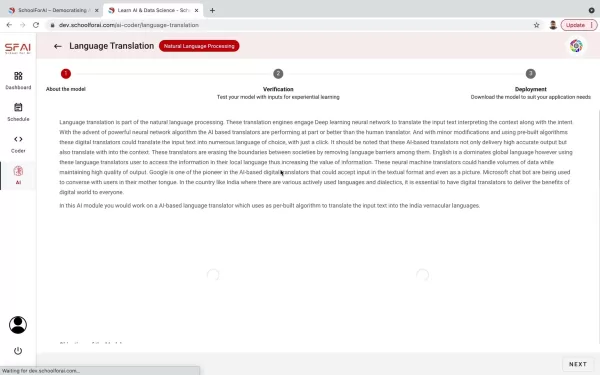
. Modern translation engines frequently use deep learning neural networks to interpret context and intent, yielding more precise and nuanced translations. The latest AI systems go beyond word-matching, learning to grasp the intent behind full sentences and paragraphs for superior results.
These digital tools can instantly translate text into numerous languages. It's important to note that AI-based translators deliver not only high accuracy but also contextual relevance. By removing language barriers, these tools are helping to connect societies globally. Although English is a dominant global language, these translators enable users to access information in their local languages, enhancing the value and reach of that information.
AI Language Translation: Bridging the Gap Between Languages
This technology has become essential across many sectors. From facilitating international business communication to promoting cross-cultural understanding in education and personal exchanges, AI translation is reshaping global connections. The goal of these systems is not just to convert words but to faithfully preserve the original message's intent and emotional tone.
Constant enhancements, fueled by expanding training data and improved machine learning algorithms, lead to more precise and context-aware translations. These improvements are key to delivering seamless communication across different languages, making global interactions more efficient and meaningful.
The Role of Deep Learning and Neural Networks
Deep learning, a branch of machine learning that uses artificial neural networks to process information, is central to AI translation
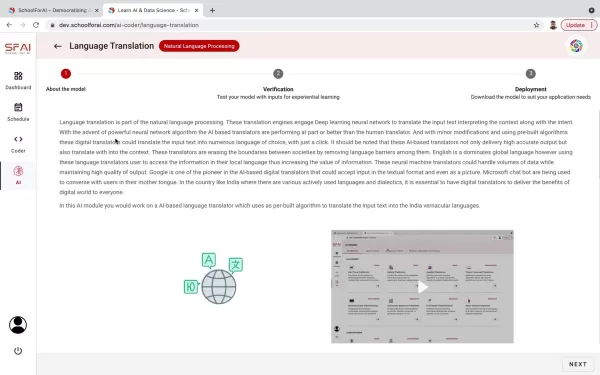
. Inspired by the human brain, these networks consist of interconnected nodes that learn from enormous datasets. In translation, neural networks analyze text and speech, recognize patterns, and generate translations accordingly.
Neural Machine Translation (NMT): A Breakthrough
Earlier rule-based systems depended on fixed grammatical rules and dictionaries, often producing stiff and unnatural translations. Neural Machine Translation (NMT) has transformed the field by enabling systems to learn directly from data, without explicit programming. NMT models, like sequence-to-sequence architectures, manage complex sentence structures and subtle nuances, resulting in more fluent and accurate output.
Training AI with Data: Enhancing Translation Accuracy
To achieve high accuracy, AI translation models undergo extensive training using parallel corpora—collections of texts in two or more languages aligned sentence by sentence. Through this process, the AI learns the relationships between words, phrases, and grammar across languages.
Handling Ambiguity and Context
A major translation challenge is ambiguity, where words or phrases have multiple meanings. AI systems use techniques like attention mechanisms and contextual embeddings to examine surrounding words and determine the correct interpretation. Google is a pioneer in AI-based digital translators that accept text and even image input. Microsoft chatbots are used to converse with users in their native tongues. In countries like India, with numerous active languages and dialects, digital translators are vital for bringing the benefits of the digital world to all citizens.
Applications and Real-World Impact
Breaking Down Language Barriers Worldwide
The influence of AI language translation spans many industries, transforming how people communicate and access information globally. By enabling smooth international business deals and fostering cross-cultural academic collaboration, these technologies are redefining global engagement
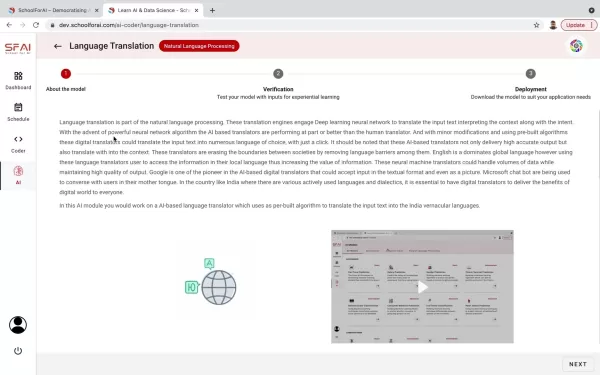
.
Global Business and Commerce
In international business, AI translation tools help companies expand their reach and engage with customers and partners worldwide. They support communication in multiple languages, aiding in market research, contract negotiations, and customer service. This leads to greater efficiency, improved customer satisfaction, and stronger global competitiveness.
Education and Academia
AI translation is revolutionizing education by making learning materials accessible to students in their native languages. Students can translate textbooks, research papers, and other resources, broadening their knowledge base and encouraging international cooperation. Furthermore, AI-driven language learning apps offer personalized lessons and feedback, simplifying the process of acquiring new languages.
Travel and Tourism
For travelers, AI translation apps provide real-time spoken and written translation, simplifying navigation and interaction in foreign countries. These apps can translate menus, signs, and conversations, helping tourists overcome language obstacles and enjoy richer travel experiences.
Eradicating Language Barriers: A Catalyst for Global Understanding
Ultimately, AI translation is more than a convenience—it's a driver of a more connected and inclusive world. As the technology evolves, we can anticipate even more innovative uses, further dismantling language barriers and creating greater opportunities for global understanding. AI is learning not only to translate but also to understand context.
Step-by-Step Guide to Using the SFAI AI Language Translation Tool
Accessing the Tool
- Navigate to the SFAI AI Platform: Open your web browser and visit the School For AI platform.
- Locate the AI Models Section: Find and click on the 'AI Models' section on the dashboard.
- Select 'Natural Language Processing': From the available AI models, choose 'Natural Language Processing'.
- Choose 'Language Translation': You will see two options: 'Sentiment Analysis' and 'Language Translation'. Select 'Language Translation' to continue.
Inputting Text and Selecting Languages
- Enter Text: In the 'Select Input & Preferences' section, type the text you wish to translate into the text box labeled 'Enter Text'.
- Select Target Language: Use the dropdown menu labeled 'Select Language to Translate' to pick your desired target language. The tool supports various languages, including Hindi, Tamil, Telugu, and others.
- Test the Translation: Click the 'TEST' button to view the translated text in the 'Result Window'.
Reviewing and Understanding the Output
- Check the Result Window: The translated text will appear in the 'Result Window' in your selected language.
- Evaluate the Translation: Review the output to confirm it accurately reflects your original text's meaning. Consider any contextual factors that could influence the translation.
- Iterate if Necessary: If the translation isn't ideal, try rephrasing your original text or experimenting with different language pairs for better results.
Advantages and Disadvantages of AI Language Translation
Pros
High-speed translation enables quick and effective communication.
Extensive language support facilitates interaction with diverse global audiences.
More affordable than employing human translators for many applications.
Consistently reliable quality for standard translation needs.
Improves accessibility for those facing language challenges.
Cons
Can struggle with idioms, sarcasm, and cultural references.
Potential for mistakes in highly specialized or technical subjects.
Performance depends on data quality and may be weak for rare or emerging languages.
Data privacy and security concerns with cloud-based translation platforms.
Less suitable for projects requiring creative or highly personalized translation.
Frequently Asked Questions about AI Language Translation
How does AI language translation work?
AI language translation relies on deep learning neural networks to process text or speech, detect patterns, and produce translations. The models are trained on extensive datasets of parallel texts in multiple languages to understand word, phrase, and grammatical relationships. Natural Language Processing (NLP) methods help interpret context, sentiment, and subtleties, producing translations that are accurate and sound natural.
What are the benefits of using AI for language translation?
Key advantages of AI language translation include:Enhanced Accuracy: AI can interpret nuanced context, providing more precise translations than older rule-based systems.Greater Efficiency: AI tools deliver real-time translation, speeding up communication and data handling.Wider Access: AI translation opens up educational content, business communications, and travel information to non-native speakers.Lower Costs: Reducing reliance on human translators can lead to significant savings for businesses and individuals.Improved Global Cooperation: By eliminating language obstacles, AI promotes better understanding and collaboration in international business, education, and personal communication.
What is the significance of understanding context in language translation?
Context is fundamental to accurate translation because word and phrase meanings can shift based on surrounding content. AI systems are trained to evaluate sentence and paragraph context to choose the correct interpretation, ensuring the translated message faithfully represents the original. Methods like attention mechanisms and contextual embeddings analyze nearby words and phrases to resolve ambiguity and handle idiomatic language.
How is AI improving in handling different languages and dialects?
AI translation models are constantly refined through ongoing training on large, diverse datasets and algorithmic advances. By learning from a wide variety of language styles and dialects, AI systems become better at adapting to linguistic variations and delivering more refined translations. Transfer learning techniques also allow knowledge from one language to boost performance in others, including those with scarce training resources.
Related Questions
What are some potential future developments in AI language translation?
The future of AI translation includes promising developments like:Deeper Contextual Comprehension: AI will get even better at understanding context, leading to increasingly accurate and nuanced translations.Expanded Language and Dialect Support: Translation tools will cover more languages and dialects, including those with minimal digital footprints.Integration with Other AI Systems: Translation will combine with other AI technologies, like virtual assistants and chatbots, for fluid multilingual communication.Customized Translation: AI tools will adapt to individual user preferences and communication styles.Real-Time Translation of Complex Content: Effective translation requires not just decoding words, but comprehending them within their specific context.
Related article
 Stripe to Acquire OpenRouter as AI Model Routing Gains Momentum
Stripe has agreed to acquire OpenRouter, an AI model-routing platform that gives developers access to hundreds of models through a single interface. The deal adds model selection and routing to Stripe’s existing work around AI usage and token-based b
Former OpenAI Researcher Barrett Zoph Returns to Google to Support Gemini Development
Barret Zoph, who previously abruptly left and joined OpenAI due to a disagreement with Thinking Machines Lab CEO Miriam Mularati, has once again changed employers. Alphabet's Google announced that Zoph will return as Vice President of Research, bring
How Recursive Intelligence Raised $335M at $4B Valuation in 4 Months
The co-founders of startup Ricursive Intelligence seemed destined to be co-founders.Anna Goldie, CEO, and Azalia Mirhoseini, CTO, are so well-known in the AI community that they were among those AI engineers who “got those weird emails from Zuckerber
Related Special Topic Recommendations
Design & Art
Stripe to Acquire OpenRouter as AI Model Routing Gains Momentum
Stripe has agreed to acquire OpenRouter, an AI model-routing platform that gives developers access to hundreds of models through a single interface. The deal adds model selection and routing to Stripe’s existing work around AI usage and token-based b
Former OpenAI Researcher Barrett Zoph Returns to Google to Support Gemini Development
Barret Zoph, who previously abruptly left and joined OpenAI due to a disagreement with Thinking Machines Lab CEO Miriam Mularati, has once again changed employers. Alphabet's Google announced that Zoph will return as Vice President of Research, bring
How Recursive Intelligence Raised $335M at $4B Valuation in 4 Months
The co-founders of startup Ricursive Intelligence seemed destined to be co-founders.Anna Goldie, CEO, and Azalia Mirhoseini, CTO, are so well-known in the AI community that they were among those AI engineers who “got those weird emails from Zuckerber
Related Special Topic Recommendations
Design & Art
 Top AI Illustration Tools: Create Editorial Scenes and Cover Art Faster
2026 Latest Top-rated AI Illustration Tools: Our curated list features the best powerfully designed tools for creating stunning editorial scenes and eye-catching cover art quickly. Each option has gone through rigorous real-world tests, offering a free vs paid comparison to help you find the perfect match for your workflow. Try these must-try solutions today to unlock your AI edge and boost your creative productivity. Explore now at XIX.AI.
 10 tools
 xix.ai
Education and Learning
Top AI Tutors for Exam Prep: Practice Math, Science, and English
xix.ai
Education and Learning
Top AI Tutors for Exam Prep: Practice Math, Science, and English
2026 Latest Top-Rated Best AI Tutors for Exam Prep are here on XIX.AI! Our curated list features powerful game-changing tools that offer free vs paid comparison, real-world tests, and weekly updated rankings. They help boost your writing efficiency, simplify complex topic learning, and unlock your academic potential. Explore now to Discover your perfect exam prep tool and Start creating today to Unlock your AI edge!
10 tools
xix.ai
Finance
AI Budget Planning Tools for Personal Money Management
2026 Latest Best Top-Rated AI Budget Planning Tools for Personal Money Management are here on XIX.AI! This curated collection features powerful, game-changing solutions that help you conduct real-world tests, understand spending habits, and create personalized plans to boost productivity. Enjoy a free vs paid comparison along with detailed rankings. Must-try tools designed to simplify money management and unlock your AI edge. Explore now!
11 tools
xix.ai
Health & Wellness
AI Sleep Tracking Assistants: Improve Recovery with Better Bedtime Habits
2026 Latest Best Top-Rated AI Sleep Tracking Assistants curated for ultimate recovery. This fully updated weekly guide features powerful tools that deliver real-world tests, free vs paid comparison, and detailed rankings to help you find the must-try solution that boosts sleep quality and supports better bedtime habits. Explore now at XIX.AI to Unlock your AI edge.
10 tools
xix.ai
Data Analysis
AI SQL Copilots for Product and Revenue Analytics
2026 Latest Best Top-Rated AI SQL Copilots for Product and Revenue Analytics! XIX.AI has curated a powerful, game-changing collection of must-try tools that undergo real-world tests through weekly updated rankings. These tools help users boost productivity significantly by accelerating data analysis, streamlining complex queries, and generating accurate insights to drive smarter business decisions. Explore now to Discover your perfect tool for unlocking your AI edge!
14 tools
xix.ai
Education and Learning
Best AI Homework Helpers That Teach: Learn Concepts, Not Just Answers
2026 Latest Best Top-Rated AI Homework Helpers That Teach Core Concepts Not Just Answers Powerful Tools for Students Must-Try Curated List Weekly Updated Free vs Paid Comparison Real-World Tests Accurate Rankings to Help You Unlock Your Full Learning Potential Explore now to Discover your perfect tool for smarter studying.
10 tools
xix.ai

 Comments (1)
0/500
Comments (1)
0/500
![EricJohnson]()
この記事を読んで、AI翻訳の進化に驚きました。特に多言語対応の精度が上がっている点が興味深いです。でも、翻訳AIが人間の通訳者を完全に置き換える日は来るのでしょうか?少し不安になる部分もありますね。🤔
In an increasingly connected world, the ability to communicate across languages has never been more vital. AI-powered language translation is advancing rapidly, offering powerful solutions for both businesses and individuals. This article explores the core functionalities, wide-ranging applications, and key technologies driving AI translation forward, showing how it dissolves communication barriers worldwide.
Key Points
AI language translation employs deep learning neural networks to accurately translate text and speech.
Natural Language Processing (NLP) is essential for capturing context, sentiment, and subtle language nuances.
Translation tools play a key role in bridging societal divides and improving global communication.
Contextual awareness is critical for translation accuracy, as meaning often depends on surrounding text.
AI models are trained on massive datasets to enhance accuracy and adapt to various language styles and dialects.
Understanding AI Language Translation
The Evolution of Digital Translators
Language translation is a core component of natural language processing, dedicated to converting text or speech from one language to another
. Modern translation engines frequently use deep learning neural networks to interpret context and intent, yielding more precise and nuanced translations. The latest AI systems go beyond word-matching, learning to grasp the intent behind full sentences and paragraphs for superior results.
These digital tools can instantly translate text into numerous languages. It's important to note that AI-based translators deliver not only high accuracy but also contextual relevance. By removing language barriers, these tools are helping to connect societies globally. Although English is a dominant global language, these translators enable users to access information in their local languages, enhancing the value and reach of that information.
AI Language Translation: Bridging the Gap Between Languages
This technology has become essential across many sectors. From facilitating international business communication to promoting cross-cultural understanding in education and personal exchanges, AI translation is reshaping global connections. The goal of these systems is not just to convert words but to faithfully preserve the original message's intent and emotional tone.
Constant enhancements, fueled by expanding training data and improved machine learning algorithms, lead to more precise and context-aware translations. These improvements are key to delivering seamless communication across different languages, making global interactions more efficient and meaningful.
The Role of Deep Learning and Neural Networks
Deep learning, a branch of machine learning that uses artificial neural networks to process information, is central to AI translation
. Inspired by the human brain, these networks consist of interconnected nodes that learn from enormous datasets. In translation, neural networks analyze text and speech, recognize patterns, and generate translations accordingly.
Neural Machine Translation (NMT): A Breakthrough
Earlier rule-based systems depended on fixed grammatical rules and dictionaries, often producing stiff and unnatural translations. Neural Machine Translation (NMT) has transformed the field by enabling systems to learn directly from data, without explicit programming. NMT models, like sequence-to-sequence architectures, manage complex sentence structures and subtle nuances, resulting in more fluent and accurate output.
Training AI with Data: Enhancing Translation Accuracy
To achieve high accuracy, AI translation models undergo extensive training using parallel corpora—collections of texts in two or more languages aligned sentence by sentence. Through this process, the AI learns the relationships between words, phrases, and grammar across languages.
Handling Ambiguity and Context
A major translation challenge is ambiguity, where words or phrases have multiple meanings. AI systems use techniques like attention mechanisms and contextual embeddings to examine surrounding words and determine the correct interpretation. Google is a pioneer in AI-based digital translators that accept text and even image input. Microsoft chatbots are used to converse with users in their native tongues. In countries like India, with numerous active languages and dialects, digital translators are vital for bringing the benefits of the digital world to all citizens.
Applications and Real-World Impact
Breaking Down Language Barriers Worldwide
The influence of AI language translation spans many industries, transforming how people communicate and access information globally. By enabling smooth international business deals and fostering cross-cultural academic collaboration, these technologies are redefining global engagement
.
Global Business and Commerce
In international business, AI translation tools help companies expand their reach and engage with customers and partners worldwide. They support communication in multiple languages, aiding in market research, contract negotiations, and customer service. This leads to greater efficiency, improved customer satisfaction, and stronger global competitiveness.
Education and Academia
AI translation is revolutionizing education by making learning materials accessible to students in their native languages. Students can translate textbooks, research papers, and other resources, broadening their knowledge base and encouraging international cooperation. Furthermore, AI-driven language learning apps offer personalized lessons and feedback, simplifying the process of acquiring new languages.
Travel and Tourism
For travelers, AI translation apps provide real-time spoken and written translation, simplifying navigation and interaction in foreign countries. These apps can translate menus, signs, and conversations, helping tourists overcome language obstacles and enjoy richer travel experiences.
Eradicating Language Barriers: A Catalyst for Global Understanding
Ultimately, AI translation is more than a convenience—it's a driver of a more connected and inclusive world. As the technology evolves, we can anticipate even more innovative uses, further dismantling language barriers and creating greater opportunities for global understanding. AI is learning not only to translate but also to understand context.
Step-by-Step Guide to Using the SFAI AI Language Translation Tool
Accessing the Tool
- Navigate to the SFAI AI Platform: Open your web browser and visit the School For AI platform.
- Locate the AI Models Section: Find and click on the 'AI Models' section on the dashboard.
- Select 'Natural Language Processing': From the available AI models, choose 'Natural Language Processing'.
- Choose 'Language Translation': You will see two options: 'Sentiment Analysis' and 'Language Translation'. Select 'Language Translation' to continue.
Inputting Text and Selecting Languages
- Enter Text: In the 'Select Input & Preferences' section, type the text you wish to translate into the text box labeled 'Enter Text'.
- Select Target Language: Use the dropdown menu labeled 'Select Language to Translate' to pick your desired target language. The tool supports various languages, including Hindi, Tamil, Telugu, and others.
- Test the Translation: Click the 'TEST' button to view the translated text in the 'Result Window'.
Reviewing and Understanding the Output
- Check the Result Window: The translated text will appear in the 'Result Window' in your selected language.
- Evaluate the Translation: Review the output to confirm it accurately reflects your original text's meaning. Consider any contextual factors that could influence the translation.
- Iterate if Necessary: If the translation isn't ideal, try rephrasing your original text or experimenting with different language pairs for better results.
Advantages and Disadvantages of AI Language Translation
Pros
High-speed translation enables quick and effective communication.
Extensive language support facilitates interaction with diverse global audiences.
More affordable than employing human translators for many applications.
Consistently reliable quality for standard translation needs.
Improves accessibility for those facing language challenges.
Cons
Can struggle with idioms, sarcasm, and cultural references.
Potential for mistakes in highly specialized or technical subjects.
Performance depends on data quality and may be weak for rare or emerging languages.
Data privacy and security concerns with cloud-based translation platforms.
Less suitable for projects requiring creative or highly personalized translation.
Frequently Asked Questions about AI Language Translation
How does AI language translation work?
AI language translation relies on deep learning neural networks to process text or speech, detect patterns, and produce translations. The models are trained on extensive datasets of parallel texts in multiple languages to understand word, phrase, and grammatical relationships. Natural Language Processing (NLP) methods help interpret context, sentiment, and subtleties, producing translations that are accurate and sound natural.
What are the benefits of using AI for language translation?
Key advantages of AI language translation include:Enhanced Accuracy: AI can interpret nuanced context, providing more precise translations than older rule-based systems.Greater Efficiency: AI tools deliver real-time translation, speeding up communication and data handling.Wider Access: AI translation opens up educational content, business communications, and travel information to non-native speakers.Lower Costs: Reducing reliance on human translators can lead to significant savings for businesses and individuals.Improved Global Cooperation: By eliminating language obstacles, AI promotes better understanding and collaboration in international business, education, and personal communication.
What is the significance of understanding context in language translation?
Context is fundamental to accurate translation because word and phrase meanings can shift based on surrounding content. AI systems are trained to evaluate sentence and paragraph context to choose the correct interpretation, ensuring the translated message faithfully represents the original. Methods like attention mechanisms and contextual embeddings analyze nearby words and phrases to resolve ambiguity and handle idiomatic language.
How is AI improving in handling different languages and dialects?
AI translation models are constantly refined through ongoing training on large, diverse datasets and algorithmic advances. By learning from a wide variety of language styles and dialects, AI systems become better at adapting to linguistic variations and delivering more refined translations. Transfer learning techniques also allow knowledge from one language to boost performance in others, including those with scarce training resources.
Related Questions
What are some potential future developments in AI language translation?
The future of AI translation includes promising developments like:Deeper Contextual Comprehension: AI will get even better at understanding context, leading to increasingly accurate and nuanced translations.Expanded Language and Dialect Support: Translation tools will cover more languages and dialects, including those with minimal digital footprints.Integration with Other AI Systems: Translation will combine with other AI technologies, like virtual assistants and chatbots, for fluid multilingual communication.Customized Translation: AI tools will adapt to individual user preferences and communication styles.Real-Time Translation of Complex Content: Effective translation requires not just decoding words, but comprehending them within their specific context.








 Stripe to Acquire OpenRouter as AI Model Routing Gains Momentum
Stripe has agreed to acquire OpenRouter, an AI model-routing platform that gives developers access to hundreds of models through a single interface. The deal adds model selection and routing to Stripe’s existing work around AI usage and token-based b
Stripe to Acquire OpenRouter as AI Model Routing Gains Momentum
Stripe has agreed to acquire OpenRouter, an AI model-routing platform that gives developers access to hundreds of models through a single interface. The deal adds model selection and routing to Stripe’s existing work around AI usage and token-based b
 Former OpenAI Researcher Barrett Zoph Returns to Google to Support Gemini Development
Barret Zoph, who previously abruptly left and joined OpenAI due to a disagreement with Thinking Machines Lab CEO Miriam Mularati, has once again changed employers. Alphabet's Google announced that Zoph will return as Vice President of Research, bring
Former OpenAI Researcher Barrett Zoph Returns to Google to Support Gemini Development
Barret Zoph, who previously abruptly left and joined OpenAI due to a disagreement with Thinking Machines Lab CEO Miriam Mularati, has once again changed employers. Alphabet's Google announced that Zoph will return as Vice President of Research, bring
 How Recursive Intelligence Raised $335M at $4B Valuation in 4 Months
The co-founders of startup Ricursive Intelligence seemed destined to be co-founders.Anna Goldie, CEO, and Azalia Mirhoseini, CTO, are so well-known in the AI community that they were among those AI engineers who “got those weird emails from Zuckerber
How Recursive Intelligence Raised $335M at $4B Valuation in 4 Months
The co-founders of startup Ricursive Intelligence seemed destined to be co-founders.Anna Goldie, CEO, and Azalia Mirhoseini, CTO, are so well-known in the AI community that they were among those AI engineers who “got those weird emails from Zuckerber

2026 Latest Top-rated AI Illustration Tools: Our curated list features the best powerfully designed tools for creating stunning editorial scenes and eye-catching cover art quickly. Each option has gone through rigorous real-world tests, offering a free vs paid comparison to help you find the perfect match for your workflow. Try these must-try solutions today to unlock your AI edge and boost your creative productivity. Explore now at XIX.AI.
10 tools
xix.ai

2026 Latest Top-Rated Best AI Tutors for Exam Prep are here on XIX.AI! Our curated list features powerful game-changing tools that offer free vs paid comparison, real-world tests, and weekly updated rankings. They help boost your writing efficiency, simplify complex topic learning, and unlock your academic potential. Explore now to Discover your perfect exam prep tool and Start creating today to Unlock your AI edge!
10 tools
xix.ai

2026 Latest Best Top-Rated AI Budget Planning Tools for Personal Money Management are here on XIX.AI! This curated collection features powerful, game-changing solutions that help you conduct real-world tests, understand spending habits, and create personalized plans to boost productivity. Enjoy a free vs paid comparison along with detailed rankings. Must-try tools designed to simplify money management and unlock your AI edge. Explore now!
11 tools
xix.ai

2026 Latest Best Top-Rated AI Sleep Tracking Assistants curated for ultimate recovery. This fully updated weekly guide features powerful tools that deliver real-world tests, free vs paid comparison, and detailed rankings to help you find the must-try solution that boosts sleep quality and supports better bedtime habits. Explore now at XIX.AI to Unlock your AI edge.
10 tools
xix.ai
2026 Latest Best Top-Rated AI SQL Copilots for Product and Revenue Analytics! XIX.AI has curated a powerful, game-changing collection of must-try tools that undergo real-world tests through weekly updated rankings. These tools help users boost productivity significantly by accelerating data analysis, streamlining complex queries, and generating accurate insights to drive smarter business decisions. Explore now to Discover your perfect tool for unlocking your AI edge!
14 tools
xix.ai

2026 Latest Best Top-Rated AI Homework Helpers That Teach Core Concepts Not Just Answers Powerful Tools for Students Must-Try Curated List Weekly Updated Free vs Paid Comparison Real-World Tests Accurate Rankings to Help You Unlock Your Full Learning Potential Explore now to Discover your perfect tool for smarter studying.
10 tools
xix.ai

この記事を読んで、AI翻訳の進化に驚きました。特に多言語対応の精度が上がっている点が興味深いです。でも、翻訳AIが人間の通訳者を完全に置き換える日は来るのでしょうか?少し不安になる部分もありますね。🤔












