Home
HomeToken Monster Automates Optimal LLM and Tool Selection for Your Tasks
Token Monster, a new AI chatbot platform, has entered its alpha preview phase with the goal of transforming how users engage with large language models (LLMs).
Created by Matt Shumer, co-founder and CEO of OthersideAI and the popular AI writing tool Hyperwrite AI, Token Monster’s standout feature is its intelligent routing of user prompts to the most suitable available LLMs for any given task. By harnessing the capabilities of multiple models, it delivers improved and more refined outputs.
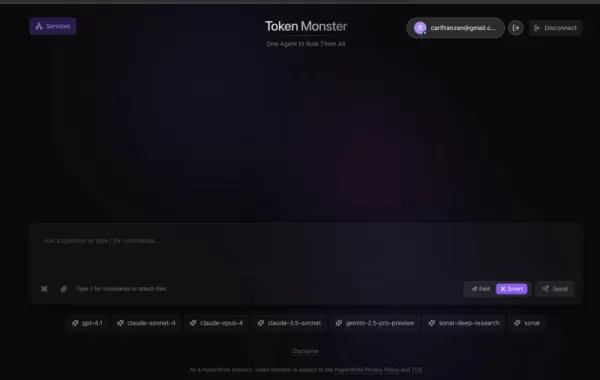
Currently, Token Monster supports seven major LLMs. When a user enters a prompt, the system applies carefully crafted pre-prompts—developed through extensive iteration by Shumer—to analyze the input, determine the ideal combination of models and connected tools, and generate a cohesive response that leverages the unique strengths of each selected AI. Available LLMs include:
- Anthropic Claude 3.5 Sonnet
- Anthropic Claude 3.5 Opus
- OpenAI GPT-4.1
- OpenAI GPT-4o
- Perplexity AI PPLX (for research)
- OpenAI o3 (for reasoning)
- Google Gemini 2.5 Pro
What sets Token Monster apart from other chatbot platforms is its ability to automatically determine the best model for every task. It also recognizes when to use connected tools—such as web search or code execution environments—and orchestrates a smooth multi-model workflow.
“We're building the connections to everything, along with an intelligent system that decides what to use and when,” explained Shumer.
For example, the system might call on Claude for creative tasks, o3 for reasoning, and PPLX for research. This eliminates the need for users to constantly switch between models manually, making it easier for anyone to receive high-quality, purpose-built results.
Feature highlights
The alpha preview, available for free sign-up at tokenmonster.ai, enables users to upload various file types—including Excel spreadsheets, PowerPoint presentations, and Google Docs.
Other notable features include webpage content extraction, persistent chat sessions, and a “FAST mode” that automatically directs prompts to the best-suited model without requiring user intervention.
At the core of Token Monster is OpenRouter, a third-party service that provides access to a wide array of LLMs. Shumer has personally invested a modest amount in the platform.
This setup allows Token Monster to integrate models from multiple providers seamlessly, without needing separate infrastructure or custom integrations.
Pricing and availability
Currently, Token Monster does not operate on a fixed monthly subscription.
Instead, users only pay for the tokens they use via OpenRouter—making the platform highly adaptable to different usage levels and budgets.
Shumer noted that this pricing approach was inspired by Cline, a tool that gives high-volume users unlimited AI processing power, enabling better outputs through increased computational resources.
Multi-step workflows produce richer LLM responses
Token Monster’s AI workflows go beyond simple model selection.
In one example, the system might begin with a research step using web search APIs, feed the gathered information to o3 to identify knowledge gaps, create an outline with Gemini 2.5 Pro, draft content with Claude Opus, and polish it using Claude 3.5 Sonnet.
This orchestrated, multi-step process aims to produce more detailed and comprehensive responses than what a single LLM could generate on its own.
Users can also save chat sessions, with data securely stored using Supabase, an open-source online database. This lets users resume projects seamlessly while maintaining control over which data is stored versus kept temporarily.
A non-traditional CEO
In a bold experiment, Token Monster’s leadership has been delegated to Anthropic’s Claude model.
Shumer has committed to following every decision made by “CEO Claude,” framing the initiative as a real-world test of AI’s ability to manage a business.
“Either we've revolutionized management forever or made a huge mistake,” he posted on X.
Emerging from the Reflection 70-B controversy
Token Monster’s arrival follows a controversial period for Shumer, who last year launched and later retracted Reflection 70B—a fine-tuned version of Meta’s Llama 3.1 model.
The model was initially promoted as the world’s highest-performing open-source AI, but soon faced criticism and fraud allegations after independent researchers couldn't replicate its claimed benchmark results.
Shumer publicly apologized, attributing the missteps to oversights caused by moving too quickly. The incident highlighted the broader challenges of rapid AI development and the need for greater transparency in model releases.
MCP integrations coming next
Shumer also shared that the Token Monster team is looking into new functionalities, such as integration with Model Context Protocol (MCP) servers.
MCP would allow websites and companies to let LLMs access their knowledge bases, tools, and products—enabling more advanced tasks beyond basic text or image creation.
This could allow Token Monster to interface with a user's internal systems, opening the door to use cases like managing customer support tickets or connecting with business applications.
He stressed that Token Monster is still in an early development phase. Although it already offers a powerful set of tools, it remains an alpha product and is expected to evolve quickly based on user input. “We’re going to keep iterating and adding things,” he said.
A promising experiment
For users who want to leverage the combined intelligence of multiple LLMs—without the complexity of manual model switching—Token Monster offers an attractive solution.
It’s built for those who prefer not to spend hours adjusting prompts or testing different models, leaving the system’s automated routing and multi-step workflows to manage the heavy lifting.
As Token Monster continues to grow, it will be interesting to observe how individuals and businesses adopt the platform—and how its experiment in AI-driven leadership unfolds. For now, it stands as a compelling new entrant in the fast-evolving world of AI chatbots and intelligent assistants.
Related article
 Greg Brockman reveals how Elon Musk departed OpenAI
In late August 2017, key figures at OpenAI—then a small nonprofit research lab—met to discuss how they would establish a for-profit entity to commercialize their technology and raise the capital needed to achieve AGI.Elon Musk was demanding full cont
Pentagon signs deals with Nvidia, Microsoft, AWS to deploy AI on classified networks
After previously reaching agreements with Google, SpaceX, and OpenAI, the U.S. Defense Department announced Friday that it has now signed deals with Nvidia, Microsoft, Amazon Web Services, and Reflection AI to deploy their AI technologies and models
OpenAI unveils voice intelligence capabilities in its API
OpenAI announced on Thursday that its API now includes several new voice intelligence features, designed to help developers build apps capable of speaking, transcribing, and translating conversations.The company's new GPT‑Realtime‑2 is another voice
Related Special Topic Recommendations
chatbot
Greg Brockman reveals how Elon Musk departed OpenAI
In late August 2017, key figures at OpenAI—then a small nonprofit research lab—met to discuss how they would establish a for-profit entity to commercialize their technology and raise the capital needed to achieve AGI.Elon Musk was demanding full cont
Pentagon signs deals with Nvidia, Microsoft, AWS to deploy AI on classified networks
After previously reaching agreements with Google, SpaceX, and OpenAI, the U.S. Defense Department announced Friday that it has now signed deals with Nvidia, Microsoft, Amazon Web Services, and Reflection AI to deploy their AI technologies and models
OpenAI unveils voice intelligence capabilities in its API
OpenAI announced on Thursday that its API now includes several new voice intelligence features, designed to help developers build apps capable of speaking, transcribing, and translating conversations.The company's new GPT‑Realtime‑2 is another voice
Related Special Topic Recommendations
chatbot
 Top-Rated AI Romantic Chatbots: Build Long-Term Relationships with Consistent Personalities
Discover the 2026 latest top-rated AI romantic chatbots for building genuine, long-term connections. Our curated list features powerful, consistent personalities, free vs paid comparisons, and real-world tests. Find your perfect companion and start building today at XIX.AI.
 10 tools
 xix.ai
Education and Learning
Best AI Data Science Mentors: Master SQL, Pandas & Machine Learning Workflows
xix.ai
Education and Learning
Best AI Data Science Mentors: Master SQL, Pandas & Machine Learning Workflows
Discover the 2026 best AI data science mentors to master SQL, Pandas & ML workflows. Explore our top-rated, curated selection at XIX.AI for powerful, game-changing guidance. Compare free vs paid options with real-world insights. Unlock your data science mastery today.
10 tools
xix.ai
chatbot
Best AI Flirting & Conversation Trainers: Improve Social Charisma and Confidence in Real-Time
Discover the 2026 best AI flirting and conversation trainers on XIX.AI. Our curated, top-rated selection helps you build social charisma and confidence in real-time. Explore must-try, game-changing tools with free vs paid comparisons and weekly updated rankings. Unlock your social edge today.
10 tools
xix.ai
code
Best AI Tools for Automated Unit Testing: Generate Jest, PyTest & JUnit Test Cases in One Click
Discover the 2026 latest top-rated AI tools for automated unit testing. Our curated selection features powerful, game-changing solutions to generate Jest, PyTest & JUnit test cases instantly. Compare free vs paid options with real-world tests and weekly updated rankings on XIX.AI. Unlock your AI edge and boost development productivity today.
10 tools
xix.ai
Data Analysis
Best AI Data Visualization Tools: Auto-Generate Interactive BI Dashboards from Raw Files
Discover the 2026 best AI data visualization tools at XIX.AI. Our curated, top-rated selection helps you auto-generate powerful, interactive BI dashboards from raw files instantly. Compare free vs paid options with real-world tests and weekly updated rankings. Unlock your data's potential today.
10 tools
xix.ai
Social Media
AI Branding Kits for Social Media: Maintain Consistent Brand Visuals Across All Channels
Discover the 2026 best AI branding kits for social media. XIX.AI's curated list features top-rated, game-changing tools to maintain perfectly consistent brand visuals across all channels. Compare free vs paid options with real-world tests. Unlock your brand's visual edge today.
10 tools
xix.ai

 Comments (1)
0/500
Comments (1)
0/500
![LawrenceLee]()
Honestly, the idea of an AI platform auto-selecting the best model for my specific task sounds super practical, especially for non-technical folks. It could cut down so much time spent on trial and error. Hope their privacy model is clear though! 🤔
Token Monster, a new AI chatbot platform, has entered its alpha preview phase with the goal of transforming how users engage with large language models (LLMs).
Created by Matt Shumer, co-founder and CEO of OthersideAI and the popular AI writing tool Hyperwrite AI, Token Monster’s standout feature is its intelligent routing of user prompts to the most suitable available LLMs for any given task. By harnessing the capabilities of multiple models, it delivers improved and more refined outputs.
Currently, Token Monster supports seven major LLMs. When a user enters a prompt, the system applies carefully crafted pre-prompts—developed through extensive iteration by Shumer—to analyze the input, determine the ideal combination of models and connected tools, and generate a cohesive response that leverages the unique strengths of each selected AI. Available LLMs include:
- Anthropic Claude 3.5 Sonnet
- Anthropic Claude 3.5 Opus
- OpenAI GPT-4.1
- OpenAI GPT-4o
- Perplexity AI PPLX (for research)
- OpenAI o3 (for reasoning)
- Google Gemini 2.5 Pro
What sets Token Monster apart from other chatbot platforms is its ability to automatically determine the best model for every task. It also recognizes when to use connected tools—such as web search or code execution environments—and orchestrates a smooth multi-model workflow.
“We're building the connections to everything, along with an intelligent system that decides what to use and when,” explained Shumer.
For example, the system might call on Claude for creative tasks, o3 for reasoning, and PPLX for research. This eliminates the need for users to constantly switch between models manually, making it easier for anyone to receive high-quality, purpose-built results.
Feature highlights
The alpha preview, available for free sign-up at tokenmonster.ai, enables users to upload various file types—including Excel spreadsheets, PowerPoint presentations, and Google Docs.
Other notable features include webpage content extraction, persistent chat sessions, and a “FAST mode” that automatically directs prompts to the best-suited model without requiring user intervention.
At the core of Token Monster is OpenRouter, a third-party service that provides access to a wide array of LLMs. Shumer has personally invested a modest amount in the platform.
This setup allows Token Monster to integrate models from multiple providers seamlessly, without needing separate infrastructure or custom integrations.
Pricing and availability
Currently, Token Monster does not operate on a fixed monthly subscription.
Instead, users only pay for the tokens they use via OpenRouter—making the platform highly adaptable to different usage levels and budgets.
Shumer noted that this pricing approach was inspired by Cline, a tool that gives high-volume users unlimited AI processing power, enabling better outputs through increased computational resources.
Multi-step workflows produce richer LLM responses
Token Monster’s AI workflows go beyond simple model selection.
In one example, the system might begin with a research step using web search APIs, feed the gathered information to o3 to identify knowledge gaps, create an outline with Gemini 2.5 Pro, draft content with Claude Opus, and polish it using Claude 3.5 Sonnet.
This orchestrated, multi-step process aims to produce more detailed and comprehensive responses than what a single LLM could generate on its own.
Users can also save chat sessions, with data securely stored using Supabase, an open-source online database. This lets users resume projects seamlessly while maintaining control over which data is stored versus kept temporarily.
A non-traditional CEO
In a bold experiment, Token Monster’s leadership has been delegated to Anthropic’s Claude model.
Shumer has committed to following every decision made by “CEO Claude,” framing the initiative as a real-world test of AI’s ability to manage a business.
“Either we've revolutionized management forever or made a huge mistake,” he posted on X.
Emerging from the Reflection 70-B controversy
Token Monster’s arrival follows a controversial period for Shumer, who last year launched and later retracted Reflection 70B—a fine-tuned version of Meta’s Llama 3.1 model.
The model was initially promoted as the world’s highest-performing open-source AI, but soon faced criticism and fraud allegations after independent researchers couldn't replicate its claimed benchmark results.
Shumer publicly apologized, attributing the missteps to oversights caused by moving too quickly. The incident highlighted the broader challenges of rapid AI development and the need for greater transparency in model releases.
MCP integrations coming next
Shumer also shared that the Token Monster team is looking into new functionalities, such as integration with Model Context Protocol (MCP) servers.
MCP would allow websites and companies to let LLMs access their knowledge bases, tools, and products—enabling more advanced tasks beyond basic text or image creation.
This could allow Token Monster to interface with a user's internal systems, opening the door to use cases like managing customer support tickets or connecting with business applications.
He stressed that Token Monster is still in an early development phase. Although it already offers a powerful set of tools, it remains an alpha product and is expected to evolve quickly based on user input. “We’re going to keep iterating and adding things,” he said.
A promising experiment
For users who want to leverage the combined intelligence of multiple LLMs—without the complexity of manual model switching—Token Monster offers an attractive solution.
It’s built for those who prefer not to spend hours adjusting prompts or testing different models, leaving the system’s automated routing and multi-step workflows to manage the heavy lifting.
As Token Monster continues to grow, it will be interesting to observe how individuals and businesses adopt the platform—and how its experiment in AI-driven leadership unfolds. For now, it stands as a compelling new entrant in the fast-evolving world of AI chatbots and intelligent assistants.








 Greg Brockman reveals how Elon Musk departed OpenAI
In late August 2017, key figures at OpenAI—then a small nonprofit research lab—met to discuss how they would establish a for-profit entity to commercialize their technology and raise the capital needed to achieve AGI.Elon Musk was demanding full cont
Greg Brockman reveals how Elon Musk departed OpenAI
In late August 2017, key figures at OpenAI—then a small nonprofit research lab—met to discuss how they would establish a for-profit entity to commercialize their technology and raise the capital needed to achieve AGI.Elon Musk was demanding full cont
 Pentagon signs deals with Nvidia, Microsoft, AWS to deploy AI on classified networks
After previously reaching agreements with Google, SpaceX, and OpenAI, the U.S. Defense Department announced Friday that it has now signed deals with Nvidia, Microsoft, Amazon Web Services, and Reflection AI to deploy their AI technologies and models
Pentagon signs deals with Nvidia, Microsoft, AWS to deploy AI on classified networks
After previously reaching agreements with Google, SpaceX, and OpenAI, the U.S. Defense Department announced Friday that it has now signed deals with Nvidia, Microsoft, Amazon Web Services, and Reflection AI to deploy their AI technologies and models
 OpenAI unveils voice intelligence capabilities in its API
OpenAI announced on Thursday that its API now includes several new voice intelligence features, designed to help developers build apps capable of speaking, transcribing, and translating conversations.The company's new GPT‑Realtime‑2 is another voice
OpenAI unveils voice intelligence capabilities in its API
OpenAI announced on Thursday that its API now includes several new voice intelligence features, designed to help developers build apps capable of speaking, transcribing, and translating conversations.The company's new GPT‑Realtime‑2 is another voice
Discover the 2026 latest top-rated AI romantic chatbots for building genuine, long-term connections. Our curated list features powerful, consistent personalities, free vs paid comparisons, and real-world tests. Find your perfect companion and start building today at XIX.AI.
10 tools
xix.ai
Discover the 2026 best AI data science mentors to master SQL, Pandas & ML workflows. Explore our top-rated, curated selection at XIX.AI for powerful, game-changing guidance. Compare free vs paid options with real-world insights. Unlock your data science mastery today.
10 tools
xix.ai

Discover the 2026 best AI flirting and conversation trainers on XIX.AI. Our curated, top-rated selection helps you build social charisma and confidence in real-time. Explore must-try, game-changing tools with free vs paid comparisons and weekly updated rankings. Unlock your social edge today.
10 tools
xix.ai
Discover the 2026 latest top-rated AI tools for automated unit testing. Our curated selection features powerful, game-changing solutions to generate Jest, PyTest & JUnit test cases instantly. Compare free vs paid options with real-world tests and weekly updated rankings on XIX.AI. Unlock your AI edge and boost development productivity today.
10 tools
xix.ai
Discover the 2026 best AI data visualization tools at XIX.AI. Our curated, top-rated selection helps you auto-generate powerful, interactive BI dashboards from raw files instantly. Compare free vs paid options with real-world tests and weekly updated rankings. Unlock your data's potential today.
10 tools
xix.ai

Discover the 2026 best AI branding kits for social media. XIX.AI's curated list features top-rated, game-changing tools to maintain perfectly consistent brand visuals across all channels. Compare free vs paid options with real-world tests. Unlock your brand's visual edge today.
10 tools
xix.ai

Honestly, the idea of an AI platform auto-selecting the best model for my specific task sounds super practical, especially for non-technical folks. It could cut down so much time spent on trial and error. Hope their privacy model is clear though! 🤔