


 Home
HomeLingguang's AI Customization Service: The New Side Gig for Youth
Can you really hire someone to develop a custom AI app for the price of a milk tea? It sounds like fiction, but it's becoming a new income stream for young people on platforms like Xianyu and Xiaohongshu.
A recent investigation found that around platforms like Lingguang, a group of ordinary individuals with no coding background are transforming into "digital solopreneurs." They're turning their life experiences into micro-businesses. Here, there are no development fees costing thousands, just practical, "handcrafted services": 5 yuan to fix a bug, 8 yuan for optimization advice, 19.9 yuan for a fully custom app. Some sellers even offer "personal growth tracker" apps, selling nearly a thousand units monthly... This "handmade app" side hustle is gaining serious traction.
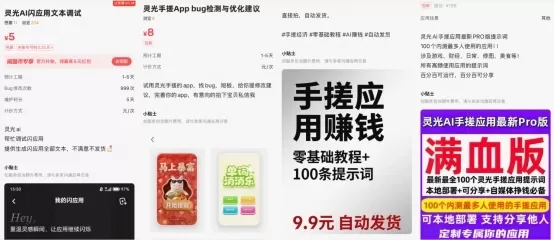
Across various platforms, numerous sellers offer services for "Lingguang Flash Apps." Some generate apps for customers, others provide debugging, fixes, and optimization. Many sell tutorials and prompt templates, teaching beginners how to build apps with AI. Prices are typically low, ranging from just a few to a few dozen yuan.
On product pages, sellers showcase a variety of small tools created with Lingguang: a "Growth Tracker" for baby milestones, a "Budget Buddy" for home renovation costs, and a "Homework Checker" for students. These apps are mostly built by non-programmers. Through persistent experimentation with AI tools, adjusting prompts and structures, they can quickly turn an idea into a working prototype.
"Before, building an app required a budget of tens of thousands and months of work. Now with AI, you describe your idea and have a prototype in minutes," shared a Xianyu seller. "It's less about coding skill now, and more about who understands the user's needs better and provides more thoughtful service."
As AI drastically lowers the barrier to app creation, skills once exclusive to professional developers are becoming "micro-skills" for everyone. This "one-person company" model requires no capital or employees. Its core asset is the seller's sharp insight into a specific, often niche, real-life scenario.
Beyond selling apps directly, selling tutorials and curated prompt packs has itself become a viable business.
One popular tutorial, "Lingguang Handmade Apps: Zero to One," costs 9.9 yuan and advertises "seven profitable niches" and "100 universal prompts." Another product, a "Full-Prompt Package" for 6.8 yuan, is marketed as "essential for media monetization." For some, "teaching others to make money with AI" has proven a more efficient path than fulfilling custom app orders.
In this ecosystem, roles are fluid. Buyers often become sellers. Many start by purchasing a tutorial, learn the ropes, and then start offering their own services. If you understand a niche—be it "pet expense tracking" or "Turkish road sign translation"—better than your potential customers, you can find a market for it in this fragmented landscape.
Industry observers note that AI tools are fundamentally reshaping software development. "Apps were once the domain of tech companies. Now, anyone can create them. AI has made building an app as simple as having a conversation."
Naturally, this boom isn't without issues, including cut-throat price competition, inconsistent service quality, and exaggerated claims in some tutorials. Yet, it undeniably reflects a massive public enthusiasm for accessible AI tools. As platforms like Lingguang grow, this "handcrafted app economy" is poised to move from the fringes toward the mainstream.
Related article
 Apple Smart Glasses Could Debut at WWDC27, Highlighting Privacy Protection
Bloomberg’s Mark Gurman reports that Apple’s smart glasses, codenamed N50, are slated for a WWDC27 debut in June 2027, with a retail launch expected in autumn 2027. Originally targeted for late this year and early 2027, the device’s release has been
Inside Details Exposed About Next-Gen Gemini: Strained Computing Power, Internal Teams Disagreed on Development Priorities and Resource Allocation
Reports indicate that the launch of Google’s highly anticipated next-generation Gemini model has been pushed back. Internal disagreements over development priorities and resource allocation, combined with limited computing capacity and complex approv
OpenAI Dismisses Growth Slowdown Concerns, Says Multiple Business Units Accelerating
In response to external scrutiny regarding decelerating sales growth and missed internal benchmarks, AI leader OpenAI issued a confident statement on Tuesday, April 28. The company clarified that its consumer products and enterprise services are adva
Related Special Topic Recommendations
Data Analysis
Apple Smart Glasses Could Debut at WWDC27, Highlighting Privacy Protection
Bloomberg’s Mark Gurman reports that Apple’s smart glasses, codenamed N50, are slated for a WWDC27 debut in June 2027, with a retail launch expected in autumn 2027. Originally targeted for late this year and early 2027, the device’s release has been
Inside Details Exposed About Next-Gen Gemini: Strained Computing Power, Internal Teams Disagreed on Development Priorities and Resource Allocation
Reports indicate that the launch of Google’s highly anticipated next-generation Gemini model has been pushed back. Internal disagreements over development priorities and resource allocation, combined with limited computing capacity and complex approv
OpenAI Dismisses Growth Slowdown Concerns, Says Multiple Business Units Accelerating
In response to external scrutiny regarding decelerating sales growth and missed internal benchmarks, AI leader OpenAI issued a confident statement on Tuesday, April 28. The company clarified that its consumer products and enterprise services are adva
Related Special Topic Recommendations
Data Analysis
 AI SQL Copilots for Revenue Dashboards, Funnel Analysis, and Product Metrics
2026 Latest Best AI SQL Copilots Ranked Top-Rated! XIX.AI curates a powerful game-changing collection for weekly updated real-world tests. These must-try tools help you generate accurate revenue dashboards, analyze sales funnels, and track product metrics swiftly, boosting productivity massively. Explore now to Discover your perfect tool for data-driven decision making! 238 characters
 9 tools
 xix.ai
Music composition
Best AI Melody Writing Tools for Song Drafts
xix.ai
Music composition
Best AI Melody Writing Tools for Song Drafts
2026 Latest Best Top-Rated AI Melody Writing Tools for Song Drafts! XIX.AI has curated a highly powerful game-changing collection that goes through rigorous real-world tests to deliver the best writing experience. You can find detailed free vs paid comparisons, accurate rankings, and must-try options designed to help you create stunning song drafts effortlessly and boost your creative productivity significantly. Explore now to discover your perfect tool!
8 tools
xix.ai
chatbot
Best AI Conversation Trainer Tools for Interview Practice
2026 Latest Best Top-rated AI Conversation Trainer Tools for Interview Practice are here on XIX.AI! This curated collection features powerful, game-changing tools that go through rigorous real-world tests to deliver accurate feedback. You’ll find a free vs paid comparison and detailed rankings to help you choose the must-try option that boosts your confidence and skills. Explore now to Discover your perfect tool for interview success!
12 tools
xix.ai
Design & Art
Best AI Style Transfer Tools for Creative Experiments
2026 Latest Best Top-rated AI Style Transfer Tools for Creative Experiments! XIX.AI has curated a powerful, game-changing collection of must-try tools that deliver exceptional results through real-world tests and rigorous rankings. These top solutions help creatives boost productivity significantly by accelerating content creation and unlocking endless creative possibilities. Explore now to discover your perfect tool and start creating today!
9 tools
xix.ai
Comic Creation
Best AI Dialogue Bubble Tools for Visual Storytelling
2026 Latest Best Top-Rated AI Dialogue Bubble Tools for Visual Storytelling are here on XIX.AI! This curated collection features powerful, game-changing tools that help creators boost productivity and overcome creative bottlenecks. Get a free vs paid comparison, see real-world tests, and check the latest rankings to find the must-try solutions perfect for crafting engaging visual narratives. Explore now to discover your ideal tool!
10 tools
xix.ai
Meeting Assistant
Top AI Meeting Summary Tools: Track Decisions and Follow-Ups Clearly
2026 Latest Top-Rated Best AI Meeting Summary Tools for Clear Decision Tracking and Effortless Follow-Ups. This curated list showcases powerful, game-changing solutions that boost productivity dramatically by automating meeting notes, identifying key action items, and streamlining team coordination across all projects. Get a free vs paid comparison along with real-world tests and weekly updated rankings to help you find the perfect tool. Explore now to unlock your AI edge!
9 tools
xix.ai

 Comments (0)
0/500
Comments (0)
0/500
Can you really hire someone to develop a custom AI app for the price of a milk tea? It sounds like fiction, but it's becoming a new income stream for young people on platforms like Xianyu and Xiaohongshu.
A recent investigation found that around platforms like Lingguang, a group of ordinary individuals with no coding background are transforming into "digital solopreneurs." They're turning their life experiences into micro-businesses. Here, there are no development fees costing thousands, just practical, "handcrafted services": 5 yuan to fix a bug, 8 yuan for optimization advice, 19.9 yuan for a fully custom app. Some sellers even offer "personal growth tracker" apps, selling nearly a thousand units monthly... This "handmade app" side hustle is gaining serious traction.
Across various platforms, numerous sellers offer services for "Lingguang Flash Apps." Some generate apps for customers, others provide debugging, fixes, and optimization. Many sell tutorials and prompt templates, teaching beginners how to build apps with AI. Prices are typically low, ranging from just a few to a few dozen yuan.
On product pages, sellers showcase a variety of small tools created with Lingguang: a "Growth Tracker" for baby milestones, a "Budget Buddy" for home renovation costs, and a "Homework Checker" for students. These apps are mostly built by non-programmers. Through persistent experimentation with AI tools, adjusting prompts and structures, they can quickly turn an idea into a working prototype.
"Before, building an app required a budget of tens of thousands and months of work. Now with AI, you describe your idea and have a prototype in minutes," shared a Xianyu seller. "It's less about coding skill now, and more about who understands the user's needs better and provides more thoughtful service."
As AI drastically lowers the barrier to app creation, skills once exclusive to professional developers are becoming "micro-skills" for everyone. This "one-person company" model requires no capital or employees. Its core asset is the seller's sharp insight into a specific, often niche, real-life scenario.
Beyond selling apps directly, selling tutorials and curated prompt packs has itself become a viable business.
One popular tutorial, "Lingguang Handmade Apps: Zero to One," costs 9.9 yuan and advertises "seven profitable niches" and "100 universal prompts." Another product, a "Full-Prompt Package" for 6.8 yuan, is marketed as "essential for media monetization." For some, "teaching others to make money with AI" has proven a more efficient path than fulfilling custom app orders.
In this ecosystem, roles are fluid. Buyers often become sellers. Many start by purchasing a tutorial, learn the ropes, and then start offering their own services. If you understand a niche—be it "pet expense tracking" or "Turkish road sign translation"—better than your potential customers, you can find a market for it in this fragmented landscape.
Industry observers note that AI tools are fundamentally reshaping software development. "Apps were once the domain of tech companies. Now, anyone can create them. AI has made building an app as simple as having a conversation."
Naturally, this boom isn't without issues, including cut-throat price competition, inconsistent service quality, and exaggerated claims in some tutorials. Yet, it undeniably reflects a massive public enthusiasm for accessible AI tools. As platforms like Lingguang grow, this "handcrafted app economy" is poised to move from the fringes toward the mainstream.








 Apple Smart Glasses Could Debut at WWDC27, Highlighting Privacy Protection
Bloomberg’s Mark Gurman reports that Apple’s smart glasses, codenamed N50, are slated for a WWDC27 debut in June 2027, with a retail launch expected in autumn 2027. Originally targeted for late this year and early 2027, the device’s release has been
Apple Smart Glasses Could Debut at WWDC27, Highlighting Privacy Protection
Bloomberg’s Mark Gurman reports that Apple’s smart glasses, codenamed N50, are slated for a WWDC27 debut in June 2027, with a retail launch expected in autumn 2027. Originally targeted for late this year and early 2027, the device’s release has been
 Inside Details Exposed About Next-Gen Gemini: Strained Computing Power, Internal Teams Disagreed on Development Priorities and Resource Allocation
Reports indicate that the launch of Google’s highly anticipated next-generation Gemini model has been pushed back. Internal disagreements over development priorities and resource allocation, combined with limited computing capacity and complex approv
Inside Details Exposed About Next-Gen Gemini: Strained Computing Power, Internal Teams Disagreed on Development Priorities and Resource Allocation
Reports indicate that the launch of Google’s highly anticipated next-generation Gemini model has been pushed back. Internal disagreements over development priorities and resource allocation, combined with limited computing capacity and complex approv
 OpenAI Dismisses Growth Slowdown Concerns, Says Multiple Business Units Accelerating
In response to external scrutiny regarding decelerating sales growth and missed internal benchmarks, AI leader OpenAI issued a confident statement on Tuesday, April 28. The company clarified that its consumer products and enterprise services are adva
OpenAI Dismisses Growth Slowdown Concerns, Says Multiple Business Units Accelerating
In response to external scrutiny regarding decelerating sales growth and missed internal benchmarks, AI leader OpenAI issued a confident statement on Tuesday, April 28. The company clarified that its consumer products and enterprise services are adva

2026 Latest Best AI SQL Copilots Ranked Top-Rated! XIX.AI curates a powerful game-changing collection for weekly updated real-world tests. These must-try tools help you generate accurate revenue dashboards, analyze sales funnels, and track product metrics swiftly, boosting productivity massively. Explore now to Discover your perfect tool for data-driven decision making! 238 characters
9 tools
xix.ai

2026 Latest Best Top-Rated AI Melody Writing Tools for Song Drafts! XIX.AI has curated a highly powerful game-changing collection that goes through rigorous real-world tests to deliver the best writing experience. You can find detailed free vs paid comparisons, accurate rankings, and must-try options designed to help you create stunning song drafts effortlessly and boost your creative productivity significantly. Explore now to discover your perfect tool!
8 tools
xix.ai
2026 Latest Best Top-rated AI Conversation Trainer Tools for Interview Practice are here on XIX.AI! This curated collection features powerful, game-changing tools that go through rigorous real-world tests to deliver accurate feedback. You’ll find a free vs paid comparison and detailed rankings to help you choose the must-try option that boosts your confidence and skills. Explore now to Discover your perfect tool for interview success!
12 tools
xix.ai

2026 Latest Best Top-rated AI Style Transfer Tools for Creative Experiments! XIX.AI has curated a powerful, game-changing collection of must-try tools that deliver exceptional results through real-world tests and rigorous rankings. These top solutions help creatives boost productivity significantly by accelerating content creation and unlocking endless creative possibilities. Explore now to discover your perfect tool and start creating today!
9 tools
xix.ai

2026 Latest Best Top-Rated AI Dialogue Bubble Tools for Visual Storytelling are here on XIX.AI! This curated collection features powerful, game-changing tools that help creators boost productivity and overcome creative bottlenecks. Get a free vs paid comparison, see real-world tests, and check the latest rankings to find the must-try solutions perfect for crafting engaging visual narratives. Explore now to discover your ideal tool!
10 tools
xix.ai

2026 Latest Top-Rated Best AI Meeting Summary Tools for Clear Decision Tracking and Effortless Follow-Ups. This curated list showcases powerful, game-changing solutions that boost productivity dramatically by automating meeting notes, identifying key action items, and streamlining team coordination across all projects. Get a free vs paid comparison along with real-world tests and weekly updated rankings to help you find the perfect tool. Explore now to unlock your AI edge!
9 tools
xix.ai












