


 Home
HomeThe Dead Can't Sue for Libel, But Deepfakes Raise New Ethical Alarms.
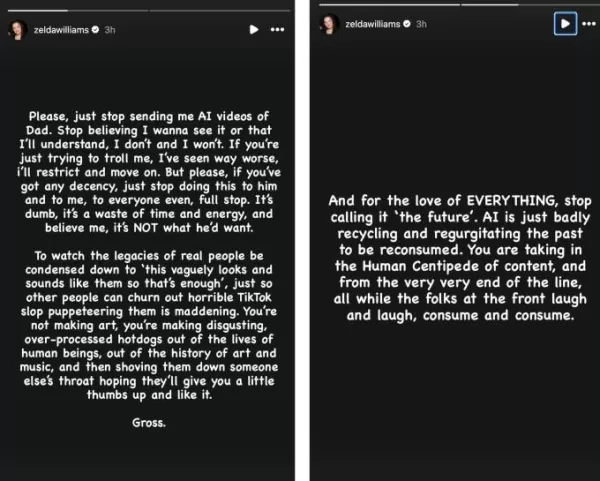
Zelda Williams, the daughter of the late actor Robin Williams, is sharing a deeply personal message with her father's fans.
"I'm asking you, please stop sending me AI-generated videos of my father. Don't think I want to see them or that I'll find them meaningful. I don't, and I won't," she expressed in an Instagram story posted on Monday. "If you have any respect, just stop doing this to him, to me, and to everyone else. It's pointless, a waste of effort, and I can assure you, it's NOT what he would have wanted."
It's likely no coincidence that Williams felt compelled to post this shortly after the launch of OpenAI's Sora 2 video model and the Sora social app, which enables users to create highly convincing deepfakes of themselves, their friends, and specific cartoon characters.
This capability extends to deceased individuals, who appear to be unprotected targets since, as noted by the Student Press Law Center, it is not illegal to defame the dead.
Sora restricts users from generating videos of living individuals—unless it's of themselves or a friend who has granted permission to use their likeness (what OpenAI refers to as a "cameo"). However, these restrictions do not cover the deceased, who can generally be recreated without hindrance. The app, currently available by invitation only, has seen an influx of videos featuring historical figures like Martin Luther King, Jr., Franklin Delano Roosevelt, and Richard Nixon, along with late celebrities such as Bob Ross, John Lennon, Alex Trebek, and, indeed, Robin Williams.
OpenAI's policy on generating videos of the dead remains ambiguous. For instance, based on TechCrunch's testing, Sora 2 will not produce videos of former President Jimmy Carter, who passed away in 2024, or Michael Jackson, who died in 2009, yet it did create content resembling Robin Williams, who died in 2014. While OpenAI's cameo feature allows living individuals to set guidelines for their appearance in videos generated by others—a response to earlier criticism of Sora—the deceased have no such control. I imagine Richard Nixon would be turning in his grave if he saw the deepfake I made of him endorsing police abolition.
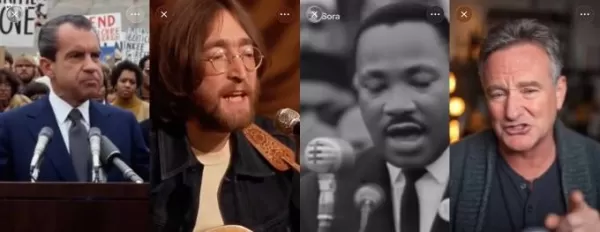
Deepfakes of Richard Nixon, John Lennon, Martin Luther King, Jr., and Robin WilliamsImage Credits:Sora, screenshots by TechCrunch OpenAI has not responded to TechCrunch's inquiry regarding the permissibility of creating deepfakes of deceased persons. Nonetheless, it's possible that generating deepfakes of late celebrities like Williams falls within the company's acceptable usage; legal precedent suggests OpenAI would likely not face liability for defaming the dead.
Join 10k+ tech and VC leaders for growth and connections at Disrupt 2025
Netflix, Box, a16z, ElevenLabs, Wayve, Hugging Face, Elad Gil, Vinod Khosla — just some of the 250+ heavy hitters leading 200+ sessions designed to deliver the insights that fuel startup growth and sharpen your edge. Don't miss the 20th anniversary of TechCrunch, and a chance to learn from the top voices in tech. Grab your ticket before doors open to save up to $444.
Join 10k+ tech and VC leaders for growth and connections at Disrupt 2025
Netflix, Box, a16z, ElevenLabs, Wayve, Hugging Face, Elad Gil, Vinod Khosla — just some of the 250+ heavy hitters leading 200+ sessions designed to deliver the insights that fuel startup growth and sharpen your edge. Don't miss a chance to learn from the top voices in tech. Grab your ticket before doors open to save up to $444.
San Francisco|October 27-29, 2025REGISTER NOW"Seeing the legacies of real people reduced to 'this vaguely resembles them, so that's good enough,' just so others can produce awful TikTok content puppeteering them, is infuriating," Williams wrote.
Critics of OpenAI argue the company has been careless on such matters, which is why Sora was quickly saturated with AI clips of copyrighted characters like Peter Griffin and Pikachu after its launch. CEO Sam Altman initially stated that Hollywood studios and agencies would need to explicitly opt out if they didn't want their intellectual property used in Sora-generated videos. The Motion Picture Association has already urged OpenAI to address this, stating that "well-established copyright law protects creators' rights and is applicable here." Altman has since announced the company will reverse this stance.
Sora is arguably the most hazardous deepfake-capable AI model available to the public to date, given the realism of its outputs. Competing platforms like xAI are less advanced but have even fewer safeguards, allowing the creation of pornographic deepfakes of real people. As other companies narrow the gap with OpenAI, we risk setting a terrifying precedent if we treat real individuals—whether living or dead—as mere playthings.
Related article
 OpenAI fears open-weight models. Should the US be concerned?
The launch of Kimi K3, the largest open-weight large language model from Chinese lab Moonshot, has ignited a debate that conflates two distinct issues: the economic strategies of American AI giants and the technological trajectory of LLMs.Dean W. Bal
OpenAI Unveils Codex Cloud Environments for Seamless Cross-Device Use
OpenAI has expanded its software engineering agent, Codex, with new capabilities that extend its utility beyond individual laptops. These updates introduce reusable cloud development environments, enabling access from any device.Announced during Open
U.S. government backs OpenAI in copyright dispute over LLM training
The Trump administration has submitted a 20-page brief supporting OpenAI in a copyright lawsuit filed by The New York Times, defending the company’s practice of using unlicensed copyrighted material to train its large language models.“The United Stat
Related Special Topic Recommendations
code
OpenAI fears open-weight models. Should the US be concerned?
The launch of Kimi K3, the largest open-weight large language model from Chinese lab Moonshot, has ignited a debate that conflates two distinct issues: the economic strategies of American AI giants and the technological trajectory of LLMs.Dean W. Bal
OpenAI Unveils Codex Cloud Environments for Seamless Cross-Device Use
OpenAI has expanded its software engineering agent, Codex, with new capabilities that extend its utility beyond individual laptops. These updates introduce reusable cloud development environments, enabling access from any device.Announced during Open
U.S. government backs OpenAI in copyright dispute over LLM training
The Trump administration has submitted a 20-page brief supporting OpenAI in a copyright lawsuit filed by The New York Times, defending the company’s practice of using unlicensed copyrighted material to train its large language models.“The United Stat
Related Special Topic Recommendations
code
 Best AI Coding Chatbots: Debug Python, JS, and SQL in One Place
2026 Latest Best Top-Rated AI Coding Chatbots Curated for Developers! Experience powerful game-changing tools that help you debug Python, JS, and SQL issues quickly. Get a free vs paid comparison along with real-world tests and detailed rankings to find the perfect fit for boosting your coding productivity. Try XIX.AI today to unlock your AI edge! Explore now.
 12 tools
 xix.ai
Prompt
AI Prompt Versioning Platforms for Reusable Claude and ChatGPT Playbooks
xix.ai
Prompt
AI Prompt Versioning Platforms for Reusable Claude and ChatGPT Playbooks
2026 Latest Best Top-rated AI Prompt Versioning Platforms for Reusable Playbooks are here on XIX.AI! Our curated list includes powerful game-changing tools that help you keep track of all prompts, test variations efficiently, and boost productivity across writing, content creation, and more. Get a free vs paid comparison along with real-world tests and updated rankings weekly. Explore now to discover your perfect tool for staying ahead in AI tasks!
9 tools
xix.ai
writing
Best AI Writing Assistants for Long Articles: Outline and Draft Faster
2026 Latest Best AI Writing Assistants for Long Articles: Outline and Draft Faster. XIX.AI curates the top-rated, must-try tools that offer powerful, game-changing support to boost writing efficiency significantly. You’ll find detailed free vs paid comparison, real-world tests, and updated rankings weekly. Explore now to Discover your perfect tool and Start creating today to Unlock your AI edge.
8 tools
xix.ai
Education and Learning
ChatGPT Study Tools for Exam Revision, Flashcards, and Homework Explanations
2026 Latest Best ChatGPT Study Tools for Exam Revision, Flashcards, and Homework Explanations! XIX.AI has curated a top-rated list of powerful game-changing tools designed to boost your productivity. These must-try solutions offer free vs paid comparison, real-world tests, and detailed rankings to help you find the perfect option for efficient exam preparation and homework support. Explore now to unlock your AI edge!
10 tools
xix.ai
Education and Learning
AI Study Planner Tools for Exam Preparation
2026 Latest Best Top-Rated AI Study Planner Tools for Exam Preparation are here on XIX.AI! This curated collection features powerful, game-changing tools that help you streamline your review process, boost focus, and create personalized study schedules. We conduct real-world tests to determine the top options, offering a free vs paid comparison along with weekly updated rankings. Must-try solutions designed to maximize your productivity and help you ace every exam. Explore now to find your perfect tool!
14 tools
xix.ai
SEO
Best AI Keyword Gap Tools for Organic Growth
2026 Latest Best Top-rated AI Keyword Gap Tools for Organic Growth! XIX.AI has carefully curated a powerful, game-changing collection of the best tools available, featuring weekly updated rankings and real-world tests. You can find a detailed free vs paid comparison to help you choose the perfect option that boosts your content creation efficiency and unlocks your AI edge. Explore now!
8 tools
xix.ai

 Comments (0)
0/500
Comments (0)
0/500
Zelda Williams, the daughter of the late actor Robin Williams, is sharing a deeply personal message with her father's fans.
"I'm asking you, please stop sending me AI-generated videos of my father. Don't think I want to see them or that I'll find them meaningful. I don't, and I won't," she expressed in an Instagram story posted on Monday. "If you have any respect, just stop doing this to him, to me, and to everyone else. It's pointless, a waste of effort, and I can assure you, it's NOT what he would have wanted."
It's likely no coincidence that Williams felt compelled to post this shortly after the launch of OpenAI's Sora 2 video model and the Sora social app, which enables users to create highly convincing deepfakes of themselves, their friends, and specific cartoon characters.
This capability extends to deceased individuals, who appear to be unprotected targets since, as noted by the Student Press Law Center, it is not illegal to defame the dead.
Sora restricts users from generating videos of living individuals—unless it's of themselves or a friend who has granted permission to use their likeness (what OpenAI refers to as a "cameo"). However, these restrictions do not cover the deceased, who can generally be recreated without hindrance. The app, currently available by invitation only, has seen an influx of videos featuring historical figures like Martin Luther King, Jr., Franklin Delano Roosevelt, and Richard Nixon, along with late celebrities such as Bob Ross, John Lennon, Alex Trebek, and, indeed, Robin Williams.
OpenAI's policy on generating videos of the dead remains ambiguous. For instance, based on TechCrunch's testing, Sora 2 will not produce videos of former President Jimmy Carter, who passed away in 2024, or Michael Jackson, who died in 2009, yet it did create content resembling Robin Williams, who died in 2014. While OpenAI's cameo feature allows living individuals to set guidelines for their appearance in videos generated by others—a response to earlier criticism of Sora—the deceased have no such control. I imagine Richard Nixon would be turning in his grave if he saw the deepfake I made of him endorsing police abolition.
OpenAI has not responded to TechCrunch's inquiry regarding the permissibility of creating deepfakes of deceased persons. Nonetheless, it's possible that generating deepfakes of late celebrities like Williams falls within the company's acceptable usage; legal precedent suggests OpenAI would likely not face liability for defaming the dead.
Join 10k+ tech and VC leaders for growth and connections at Disrupt 2025
Netflix, Box, a16z, ElevenLabs, Wayve, Hugging Face, Elad Gil, Vinod Khosla — just some of the 250+ heavy hitters leading 200+ sessions designed to deliver the insights that fuel startup growth and sharpen your edge. Don't miss the 20th anniversary of TechCrunch, and a chance to learn from the top voices in tech. Grab your ticket before doors open to save up to $444.
Join 10k+ tech and VC leaders for growth and connections at Disrupt 2025
Netflix, Box, a16z, ElevenLabs, Wayve, Hugging Face, Elad Gil, Vinod Khosla — just some of the 250+ heavy hitters leading 200+ sessions designed to deliver the insights that fuel startup growth and sharpen your edge. Don't miss a chance to learn from the top voices in tech. Grab your ticket before doors open to save up to $444.
San Francisco|October 27-29, 2025REGISTER NOW"Seeing the legacies of real people reduced to 'this vaguely resembles them, so that's good enough,' just so others can produce awful TikTok content puppeteering them, is infuriating," Williams wrote.
Critics of OpenAI argue the company has been careless on such matters, which is why Sora was quickly saturated with AI clips of copyrighted characters like Peter Griffin and Pikachu after its launch. CEO Sam Altman initially stated that Hollywood studios and agencies would need to explicitly opt out if they didn't want their intellectual property used in Sora-generated videos. The Motion Picture Association has already urged OpenAI to address this, stating that "well-established copyright law protects creators' rights and is applicable here." Altman has since announced the company will reverse this stance.
Sora is arguably the most hazardous deepfake-capable AI model available to the public to date, given the realism of its outputs. Competing platforms like xAI are less advanced but have even fewer safeguards, allowing the creation of pornographic deepfakes of real people. As other companies narrow the gap with OpenAI, we risk setting a terrifying precedent if we treat real individuals—whether living or dead—as mere playthings.








 OpenAI fears open-weight models. Should the US be concerned?
The launch of Kimi K3, the largest open-weight large language model from Chinese lab Moonshot, has ignited a debate that conflates two distinct issues: the economic strategies of American AI giants and the technological trajectory of LLMs.Dean W. Bal
OpenAI fears open-weight models. Should the US be concerned?
The launch of Kimi K3, the largest open-weight large language model from Chinese lab Moonshot, has ignited a debate that conflates two distinct issues: the economic strategies of American AI giants and the technological trajectory of LLMs.Dean W. Bal
 OpenAI Unveils Codex Cloud Environments for Seamless Cross-Device Use
OpenAI has expanded its software engineering agent, Codex, with new capabilities that extend its utility beyond individual laptops. These updates introduce reusable cloud development environments, enabling access from any device.Announced during Open
OpenAI Unveils Codex Cloud Environments for Seamless Cross-Device Use
OpenAI has expanded its software engineering agent, Codex, with new capabilities that extend its utility beyond individual laptops. These updates introduce reusable cloud development environments, enabling access from any device.Announced during Open
 U.S. government backs OpenAI in copyright dispute over LLM training
The Trump administration has submitted a 20-page brief supporting OpenAI in a copyright lawsuit filed by The New York Times, defending the company’s practice of using unlicensed copyrighted material to train its large language models.“The United Stat
U.S. government backs OpenAI in copyright dispute over LLM training
The Trump administration has submitted a 20-page brief supporting OpenAI in a copyright lawsuit filed by The New York Times, defending the company’s practice of using unlicensed copyrighted material to train its large language models.“The United Stat

2026 Latest Best Top-Rated AI Coding Chatbots Curated for Developers! Experience powerful game-changing tools that help you debug Python, JS, and SQL issues quickly. Get a free vs paid comparison along with real-world tests and detailed rankings to find the perfect fit for boosting your coding productivity. Try XIX.AI today to unlock your AI edge! Explore now.
12 tools
xix.ai

2026 Latest Best Top-rated AI Prompt Versioning Platforms for Reusable Playbooks are here on XIX.AI! Our curated list includes powerful game-changing tools that help you keep track of all prompts, test variations efficiently, and boost productivity across writing, content creation, and more. Get a free vs paid comparison along with real-world tests and updated rankings weekly. Explore now to discover your perfect tool for staying ahead in AI tasks!
9 tools
xix.ai

2026 Latest Best AI Writing Assistants for Long Articles: Outline and Draft Faster. XIX.AI curates the top-rated, must-try tools that offer powerful, game-changing support to boost writing efficiency significantly. You’ll find detailed free vs paid comparison, real-world tests, and updated rankings weekly. Explore now to Discover your perfect tool and Start creating today to Unlock your AI edge.
8 tools
xix.ai
2026 Latest Best ChatGPT Study Tools for Exam Revision, Flashcards, and Homework Explanations! XIX.AI has curated a top-rated list of powerful game-changing tools designed to boost your productivity. These must-try solutions offer free vs paid comparison, real-world tests, and detailed rankings to help you find the perfect option for efficient exam preparation and homework support. Explore now to unlock your AI edge!
10 tools
xix.ai

2026 Latest Best Top-Rated AI Study Planner Tools for Exam Preparation are here on XIX.AI! This curated collection features powerful, game-changing tools that help you streamline your review process, boost focus, and create personalized study schedules. We conduct real-world tests to determine the top options, offering a free vs paid comparison along with weekly updated rankings. Must-try solutions designed to maximize your productivity and help you ace every exam. Explore now to find your perfect tool!
14 tools
xix.ai

2026 Latest Best Top-rated AI Keyword Gap Tools for Organic Growth! XIX.AI has carefully curated a powerful, game-changing collection of the best tools available, featuring weekly updated rankings and real-world tests. You can find a detailed free vs paid comparison to help you choose the perfect option that boosts your content creation efficiency and unlocks your AI edge. Explore now!
8 tools
xix.ai












