


 Home
HomeCodilime's AI/ML-Powered Scheduler Optimizes Kubernetes Workload Deployment
In container orchestration, Kubernetes emerges as a powerful platform, though its default scheduling sometimes falls short of optimal performance. Codilime revolutionizes this with an AI/ML-driven scheduler that intelligently places workloads. This advanced solution boosts resource efficiency, minimizes errors, and automates cluster management – crucial enhancements for optimizing Kubernetes operations.
Key Points
Effective Kubernetes deployment demands mastery of workload scheduling.
Codilime's AI-driven scheduler delivers intelligent pod placement.
The solution maximizes resource usage while minimizing disruptions.
It streamlines cluster administration through automation.
The proof-of-concept framework incorporates multiple critical elements.
POC outcomes reveal substantial scheduling performance gains.
Workload Scheduling in Kubernetes Explained
What is Workload Scheduling All About?
Kubernetes scheduling fundamentally involves matching Pods (the platform's smallest deployable units) with suitable cluster Nodes.
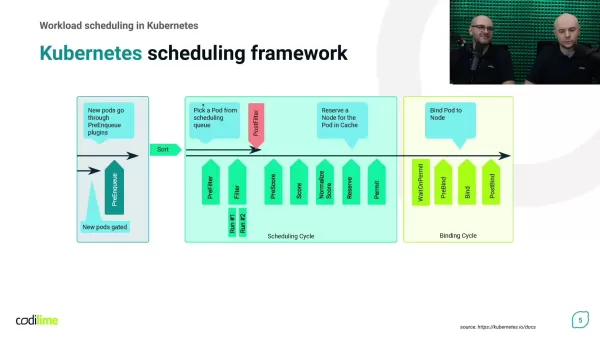
Pods represent applications or processes, while the scheduler identifies optimal Nodes considering resource availability and performance requirements. The process initiates when API server receives new Pod requests. Mastering these principles significantly improves Kubernetes effectiveness.
Consider deploying a new Pod: Kubernetes evaluates Node viability based on CPU/memory availability, affinity rules, and constraints. While the default scheduler follows baseline logic, Codilime's AI-enhanced alternative delivers superior decision-making capabilities. Understanding Kubernetes' native scheduling framework provides essential context.
The Kubernetes Scheduling Framework: A Multi-Stage Process
Kubernetes implements sophisticated multi-phase scheduling:
Queuing: Pods await evaluation in processing queues, typically following FIFO order.
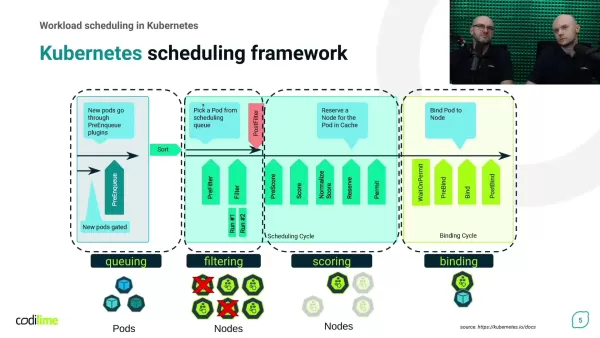
Filtering: Nodes are screened for compatibility with Pod requirements.
Scoring: Remaining Nodes receive ratings based on resource availability and affinity alignment.
Binding: Highest-scoring Node receives Pod deployment.
While robust, this framework gains significant advantage from AI-enhanced optimization.
Forecasting Resource Needs: Cyclic vs. Non-Cyclic Pods
Cyclic Pods
For predictable workloads, AI identifies recurring patterns to anticipate resource demands. Standard ML methods handle non-periodic workloads by analyzing historical usage trends.
Maximizing Efficiency: Compensating Characteristics [t:919]
Scheduling Pods On the Same Node
Strategic scheduling leverages complementary workload patterns. For instance, pairing office-hours business applications with evening/weekend customer applications optimizes Node utilization.
Codilime - Licensing
What to Expect From Codilime
Codilime's licensing details are available online, but the solution's reliability and performance benefits often justify investment.
Key considerations:
- Enhanced operational efficiency
- Seamless environment integration
- Improved Kubernetes performance
Codilime's AI/ML-Powered Kubernetes Scheduler: Pros & Cons
Pros
Resource Optimization: Better infrastructure utilization.
Improved Stability: Fewer application disruptions.
Automated Management: Streamlined administrative workflows.
Predictive Allocation: Anticipated resource provisioning.
Cons
Implementation Requirements: Initial integration effort.
Learning Investment: AI/ML concept adoption.
Data Dependency: Historical pattern reliance.
POC validation recommended.
Frequently Asked Questions
What is Kubernetes workload scheduling?
The process assigning Pods to Nodes for optimal resource usage.
How does Codilime enhance Kubernetes scheduling?
Codilime applies AI/ML for predictive resource allocation.
What are resource requests and limits in Kubernetes?
Minimum required and maximum allowable resource specifications.
What are compensating characteristics?
Complementary workload patterns enabling efficient co-scheduling.
What is the benefit of using AI/ML for workload scheduling?
Predictive capacity planning and automated optimization.
Related Questions
How do I optimize resource utilization in Kubernetes?
Effective strategies include proper resource definitions, affinity rules, workload analysis, and intelligent scheduling solutions.
How can I reduce errors and restarts in Kubernetes deployments?
Adequate resources, health checks, rolling updates, and predictive scheduling minimize disruptions.
What is the role of automation in Kubernetes cluster administration?
Automation simplifies deployment, scaling, monitoring and security tasks while reducing manual effort.
Related article
 Apple Smart Glasses Could Debut at WWDC27, Highlighting Privacy Protection
Bloomberg’s Mark Gurman reports that Apple’s smart glasses, codenamed N50, are slated for a WWDC27 debut in June 2027, with a retail launch expected in autumn 2027. Originally targeted for late this year and early 2027, the device’s release has been
Inside Details Exposed About Next-Gen Gemini: Strained Computing Power, Internal Teams Disagreed on Development Priorities and Resource Allocation
Reports indicate that the launch of Google’s highly anticipated next-generation Gemini model has been pushed back. Internal disagreements over development priorities and resource allocation, combined with limited computing capacity and complex approv
OpenAI Dismisses Growth Slowdown Concerns, Says Multiple Business Units Accelerating
In response to external scrutiny regarding decelerating sales growth and missed internal benchmarks, AI leader OpenAI issued a confident statement on Tuesday, April 28. The company clarified that its consumer products and enterprise services are adva
Related Special Topic Recommendations
Data Analysis
Apple Smart Glasses Could Debut at WWDC27, Highlighting Privacy Protection
Bloomberg’s Mark Gurman reports that Apple’s smart glasses, codenamed N50, are slated for a WWDC27 debut in June 2027, with a retail launch expected in autumn 2027. Originally targeted for late this year and early 2027, the device’s release has been
Inside Details Exposed About Next-Gen Gemini: Strained Computing Power, Internal Teams Disagreed on Development Priorities and Resource Allocation
Reports indicate that the launch of Google’s highly anticipated next-generation Gemini model has been pushed back. Internal disagreements over development priorities and resource allocation, combined with limited computing capacity and complex approv
OpenAI Dismisses Growth Slowdown Concerns, Says Multiple Business Units Accelerating
In response to external scrutiny regarding decelerating sales growth and missed internal benchmarks, AI leader OpenAI issued a confident statement on Tuesday, April 28. The company clarified that its consumer products and enterprise services are adva
Related Special Topic Recommendations
Data Analysis
 AI SQL Copilots for Revenue Dashboards, Funnel Analysis, and Product Metrics
2026 Latest Best AI SQL Copilots Ranked Top-Rated! XIX.AI curates a powerful game-changing collection for weekly updated real-world tests. These must-try tools help you generate accurate revenue dashboards, analyze sales funnels, and track product metrics swiftly, boosting productivity massively. Explore now to Discover your perfect tool for data-driven decision making! 238 characters
 9 tools
 xix.ai
Music composition
Best AI Melody Writing Tools for Song Drafts
xix.ai
Music composition
Best AI Melody Writing Tools for Song Drafts
2026 Latest Best Top-Rated AI Melody Writing Tools for Song Drafts! XIX.AI has curated a highly powerful game-changing collection that goes through rigorous real-world tests to deliver the best writing experience. You can find detailed free vs paid comparisons, accurate rankings, and must-try options designed to help you create stunning song drafts effortlessly and boost your creative productivity significantly. Explore now to discover your perfect tool!
8 tools
xix.ai
chatbot
Best AI Conversation Trainer Tools for Interview Practice
2026 Latest Best Top-rated AI Conversation Trainer Tools for Interview Practice are here on XIX.AI! This curated collection features powerful, game-changing tools that go through rigorous real-world tests to deliver accurate feedback. You’ll find a free vs paid comparison and detailed rankings to help you choose the must-try option that boosts your confidence and skills. Explore now to Discover your perfect tool for interview success!
12 tools
xix.ai
Design & Art
Best AI Style Transfer Tools for Creative Experiments
2026 Latest Best Top-rated AI Style Transfer Tools for Creative Experiments! XIX.AI has curated a powerful, game-changing collection of must-try tools that deliver exceptional results through real-world tests and rigorous rankings. These top solutions help creatives boost productivity significantly by accelerating content creation and unlocking endless creative possibilities. Explore now to discover your perfect tool and start creating today!
9 tools
xix.ai
Comic Creation
Best AI Dialogue Bubble Tools for Visual Storytelling
2026 Latest Best Top-Rated AI Dialogue Bubble Tools for Visual Storytelling are here on XIX.AI! This curated collection features powerful, game-changing tools that help creators boost productivity and overcome creative bottlenecks. Get a free vs paid comparison, see real-world tests, and check the latest rankings to find the must-try solutions perfect for crafting engaging visual narratives. Explore now to discover your ideal tool!
10 tools
xix.ai
Meeting Assistant
Top AI Meeting Summary Tools: Track Decisions and Follow-Ups Clearly
2026 Latest Top-Rated Best AI Meeting Summary Tools for Clear Decision Tracking and Effortless Follow-Ups. This curated list showcases powerful, game-changing solutions that boost productivity dramatically by automating meeting notes, identifying key action items, and streamlining team coordination across all projects. Get a free vs paid comparison along with real-world tests and weekly updated rankings to help you find the perfect tool. Explore now to unlock your AI edge!
9 tools
xix.ai

 Comments (2)
0/500
Comments (2)
0/500
![MarkScott]()
This AI scheduler sounds promising! Always felt like the default Kubernetes scheduler could be unpredictable under heavy loads. If it learns from real cluster behavior and optimizes placements dynamically, that could be a huge win for performance & costs. Hope they consider open-sourcing it! 🚀
![StevenNelson]()
すごい!AIでKubernetesのスケジューリングを最適化できるなんて😲 普段はカスタムスケジューラ使ってるけど、こんな機械学習ベースのアプローチは新鮮。でも、これってクラウド提供独自のスケジューラとの競争はどうなるんだろう。オンプレの方が向いてるのかな? 気になる…
In container orchestration, Kubernetes emerges as a powerful platform, though its default scheduling sometimes falls short of optimal performance. Codilime revolutionizes this with an AI/ML-driven scheduler that intelligently places workloads. This advanced solution boosts resource efficiency, minimizes errors, and automates cluster management – crucial enhancements for optimizing Kubernetes operations.
Key Points
Effective Kubernetes deployment demands mastery of workload scheduling.
Codilime's AI-driven scheduler delivers intelligent pod placement.
The solution maximizes resource usage while minimizing disruptions.
It streamlines cluster administration through automation.
The proof-of-concept framework incorporates multiple critical elements.
POC outcomes reveal substantial scheduling performance gains.
Workload Scheduling in Kubernetes Explained
What is Workload Scheduling All About?
Kubernetes scheduling fundamentally involves matching Pods (the platform's smallest deployable units) with suitable cluster Nodes.
Pods represent applications or processes, while the scheduler identifies optimal Nodes considering resource availability and performance requirements. The process initiates when API server receives new Pod requests. Mastering these principles significantly improves Kubernetes effectiveness.
Consider deploying a new Pod: Kubernetes evaluates Node viability based on CPU/memory availability, affinity rules, and constraints. While the default scheduler follows baseline logic, Codilime's AI-enhanced alternative delivers superior decision-making capabilities. Understanding Kubernetes' native scheduling framework provides essential context.
The Kubernetes Scheduling Framework: A Multi-Stage Process
Kubernetes implements sophisticated multi-phase scheduling:
Queuing: Pods await evaluation in processing queues, typically following FIFO order.
Filtering: Nodes are screened for compatibility with Pod requirements.
Scoring: Remaining Nodes receive ratings based on resource availability and affinity alignment.
Binding: Highest-scoring Node receives Pod deployment.
While robust, this framework gains significant advantage from AI-enhanced optimization.
Forecasting Resource Needs: Cyclic vs. Non-Cyclic Pods
Cyclic Pods
For predictable workloads, AI identifies recurring patterns to anticipate resource demands. Standard ML methods handle non-periodic workloads by analyzing historical usage trends.
Maximizing Efficiency: Compensating Characteristics [t:919]
Scheduling Pods On the Same Node
Strategic scheduling leverages complementary workload patterns. For instance, pairing office-hours business applications with evening/weekend customer applications optimizes Node utilization.
Codilime - Licensing
What to Expect From Codilime
Codilime's licensing details are available online, but the solution's reliability and performance benefits often justify investment.
Key considerations:
- Enhanced operational efficiency
- Seamless environment integration
- Improved Kubernetes performance
Codilime's AI/ML-Powered Kubernetes Scheduler: Pros & Cons
Pros
Resource Optimization: Better infrastructure utilization.
Improved Stability: Fewer application disruptions.
Automated Management: Streamlined administrative workflows.
Predictive Allocation: Anticipated resource provisioning.
Cons
Implementation Requirements: Initial integration effort.
Learning Investment: AI/ML concept adoption.
Data Dependency: Historical pattern reliance.
POC validation recommended.
Frequently Asked Questions
What is Kubernetes workload scheduling?
The process assigning Pods to Nodes for optimal resource usage.
How does Codilime enhance Kubernetes scheduling?
Codilime applies AI/ML for predictive resource allocation.
What are resource requests and limits in Kubernetes?
Minimum required and maximum allowable resource specifications.
What are compensating characteristics?
Complementary workload patterns enabling efficient co-scheduling.
What is the benefit of using AI/ML for workload scheduling?
Predictive capacity planning and automated optimization.
Related Questions
How do I optimize resource utilization in Kubernetes?
Effective strategies include proper resource definitions, affinity rules, workload analysis, and intelligent scheduling solutions.
How can I reduce errors and restarts in Kubernetes deployments?
Adequate resources, health checks, rolling updates, and predictive scheduling minimize disruptions.
What is the role of automation in Kubernetes cluster administration?
Automation simplifies deployment, scaling, monitoring and security tasks while reducing manual effort.








 Apple Smart Glasses Could Debut at WWDC27, Highlighting Privacy Protection
Bloomberg’s Mark Gurman reports that Apple’s smart glasses, codenamed N50, are slated for a WWDC27 debut in June 2027, with a retail launch expected in autumn 2027. Originally targeted for late this year and early 2027, the device’s release has been
Apple Smart Glasses Could Debut at WWDC27, Highlighting Privacy Protection
Bloomberg’s Mark Gurman reports that Apple’s smart glasses, codenamed N50, are slated for a WWDC27 debut in June 2027, with a retail launch expected in autumn 2027. Originally targeted for late this year and early 2027, the device’s release has been
 Inside Details Exposed About Next-Gen Gemini: Strained Computing Power, Internal Teams Disagreed on Development Priorities and Resource Allocation
Reports indicate that the launch of Google’s highly anticipated next-generation Gemini model has been pushed back. Internal disagreements over development priorities and resource allocation, combined with limited computing capacity and complex approv
Inside Details Exposed About Next-Gen Gemini: Strained Computing Power, Internal Teams Disagreed on Development Priorities and Resource Allocation
Reports indicate that the launch of Google’s highly anticipated next-generation Gemini model has been pushed back. Internal disagreements over development priorities and resource allocation, combined with limited computing capacity and complex approv
 OpenAI Dismisses Growth Slowdown Concerns, Says Multiple Business Units Accelerating
In response to external scrutiny regarding decelerating sales growth and missed internal benchmarks, AI leader OpenAI issued a confident statement on Tuesday, April 28. The company clarified that its consumer products and enterprise services are adva
OpenAI Dismisses Growth Slowdown Concerns, Says Multiple Business Units Accelerating
In response to external scrutiny regarding decelerating sales growth and missed internal benchmarks, AI leader OpenAI issued a confident statement on Tuesday, April 28. The company clarified that its consumer products and enterprise services are adva

2026 Latest Best AI SQL Copilots Ranked Top-Rated! XIX.AI curates a powerful game-changing collection for weekly updated real-world tests. These must-try tools help you generate accurate revenue dashboards, analyze sales funnels, and track product metrics swiftly, boosting productivity massively. Explore now to Discover your perfect tool for data-driven decision making! 238 characters
9 tools
xix.ai

2026 Latest Best Top-Rated AI Melody Writing Tools for Song Drafts! XIX.AI has curated a highly powerful game-changing collection that goes through rigorous real-world tests to deliver the best writing experience. You can find detailed free vs paid comparisons, accurate rankings, and must-try options designed to help you create stunning song drafts effortlessly and boost your creative productivity significantly. Explore now to discover your perfect tool!
8 tools
xix.ai

2026 Latest Best Top-rated AI Conversation Trainer Tools for Interview Practice are here on XIX.AI! This curated collection features powerful, game-changing tools that go through rigorous real-world tests to deliver accurate feedback. You’ll find a free vs paid comparison and detailed rankings to help you choose the must-try option that boosts your confidence and skills. Explore now to Discover your perfect tool for interview success!
12 tools
xix.ai

2026 Latest Best Top-rated AI Style Transfer Tools for Creative Experiments! XIX.AI has curated a powerful, game-changing collection of must-try tools that deliver exceptional results through real-world tests and rigorous rankings. These top solutions help creatives boost productivity significantly by accelerating content creation and unlocking endless creative possibilities. Explore now to discover your perfect tool and start creating today!
9 tools
xix.ai

2026 Latest Best Top-Rated AI Dialogue Bubble Tools for Visual Storytelling are here on XIX.AI! This curated collection features powerful, game-changing tools that help creators boost productivity and overcome creative bottlenecks. Get a free vs paid comparison, see real-world tests, and check the latest rankings to find the must-try solutions perfect for crafting engaging visual narratives. Explore now to discover your ideal tool!
10 tools
xix.ai
2026 Latest Top-Rated Best AI Meeting Summary Tools for Clear Decision Tracking and Effortless Follow-Ups. This curated list showcases powerful, game-changing solutions that boost productivity dramatically by automating meeting notes, identifying key action items, and streamlining team coordination across all projects. Get a free vs paid comparison along with real-world tests and weekly updated rankings to help you find the perfect tool. Explore now to unlock your AI edge!
9 tools
xix.ai

This AI scheduler sounds promising! Always felt like the default Kubernetes scheduler could be unpredictable under heavy loads. If it learns from real cluster behavior and optimizes placements dynamically, that could be a huge win for performance & costs. Hope they consider open-sourcing it! 🚀
すごい!AIでKubernetesのスケジューリングを最適化できるなんて😲 普段はカスタムスケジューラ使ってるけど、こんな機械学習ベースのアプローチは新鮮。でも、これってクラウド提供独自のスケジューラとの競争はどうなるんだろう。オンプレの方が向いてるのかな? 気になる…












