


 Home
HomeHuawei Unveils Open-Source AI Roadmap at Annual Connect Event
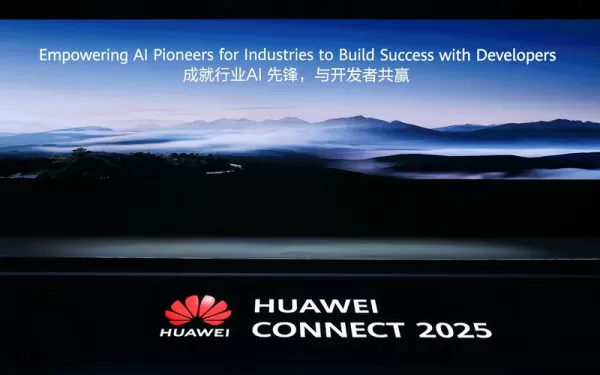
Open-source AI development became a central focus at Huawei Connect 2025, with the company detailing concrete timelines and technical specifics for releasing its entire AI software stack to the public by the end of the year.
The announcements were particularly meaningful for developers, featuring candid acknowledgments of past difficulties, clear commitments on which components would be released, and specifics on how the software would integrate with existing developer workflows and operating systems.
Developer friction acknowledged
In his keynote, Eric Xu, Huawei's Deputy Chairman and Rotating Chairman, began with unusually frank remarks regarding challenges developers have experienced with Ascend infrastructure. Referencing the impact of DeepSeek-R1's release earlier this year, Xu stated, "From January through April 30, our AI R&D teams worked intensively to ensure the inference capabilities of our Ascend 910B and 910C chips met evolving customer demands."
Following customer feedback sessions, Xu added, "Our customers have shared numerous concerns and expectations regarding Ascend, consistently providing us with valuable suggestions."
This acknowledgment of developer challenges set the stage for the comprehensive open-source commitments first announced at the Ascend Computing Industry Development Summit on August 5, 2025, and later reiterated by Xu at Huawei Connect.
For developers who have faced hurdles with Ascend's tooling, documentation, or ecosystem maturity, this candid assessment signals Huawei's awareness of the gap between the platform's technical potential and its practical usability. The open-source strategy appears directly aimed at resolving these friction points by enabling community contributions, transparency, and external enhancements.
CANN: Compiler and virtual instruction set details
The most technically significant pledge involves CANN (Compute Architecture for Neural Networks), Huawei's core toolkit bridging AI frameworks and Ascend hardware. At the August summit, Xu specified, "For CANN, we will open the interfaces for the compiler and virtual instruction set, while fully open-sourcing the remaining software."
This tiered approach differentiates between components receiving a full open-source release and those for which Huawei will provide open interfaces, potentially with proprietary implementations. The compiler and virtual instruction set—critical translation layers that convert high-level code into hardware-executable instructions—will have open interfaces. This grants developers insight into how their code is compiled for Ascend processors, enabling potential optimizations, even if the compiler's core implementation remains partially closed.
This distinction is crucial for performance tuning. Developers require visibility into the compilation process when building latency-sensitive applications or striving for maximum hardware efficiency. Open interfaces provide that transparency; full open-source would additionally allow for modifying or replacing the compiler itself. Huawei's approach offers optimization visibility while retaining certain proprietary elements.
The timeline is firm: "We will open source and provide open access to CANN (based on the existing Ascend 910B/910C design) by December 31, 2025." The clarification "based on existing Ascend 910B/910C design" indicates the release will correspond to current-generation hardware, not future architectures.
Mind series: Application enablement kits and toolchains
Beyond the foundational CANN layer, Huawei committed to open-sourcing the tools developers use daily. "For our Mind series application enablement kits and toolchains, we will go fully open-source by December 31, 2025," Xu stated at Huawei Connect, reinforcing the commitment made at the Ascend Computing Industry Development Summit on August 5, 2025.
The Mind series encompasses the practical development environment—the SDKs, libraries, debugging tools, profilers, and utilities used for building AI applications. Unlike CANN's tiered approach with open interfaces for some components, the Mind series receives a blanket commitment to full open-source.
This means the entire application-layer toolchain becomes inspectable, modifiable, and extensible by the community. Debugging tools can be enhanced with needed functionality, libraries optimized for specific use cases, and utilities wrapped in more user-friendly interfaces. In short, the development ecosystem can evolve through community contributions rather than relying solely on vendor updates.
However, the announcement did not specify which tools exactly comprise the Mind series, which programming languages they support, or how comprehensive the accompanying documentation will be. Developers evaluating whether to invest time in the platform will need to assess the toolchain's completeness once the December release arrives.
OpenPangu foundation models
Huawei has also committed to "fully open-source our openPangu foundation models." This positions Huawei alongside Meta's Llama series, Mistral AI's offerings, and other initiatives in the open-source foundation model space that emphasize community involvement.
The announcement provided no specifics regarding openPangu's capabilities, parameter counts, training data, or licensing terms. Open-sourcing foundation models raises questions beyond mere availability, particularly concerning commercial use restrictions, training dataset composition, potential biases, and the permissibility of fine-tuning and redistribution. These details remain unresolved, at least publicly.
For developers, open-source foundation models provide starting points for domain-specific applications without requiring the massive computational resources needed for training from scratch. However, a model's practical utility is determined by its quality, licensing flexibility, and available documentation. The December release will reveal whether openPangu models represent competitive alternatives to established open-source options.
Operating system integration flexibility
A practical implementation detail that emerged at Huawei Connect 2025 addresses a common barrier to adopting new AI infrastructure: operating system compatibility. Huawei announced that it "has made the entire UB OS Component open-source, so that its code can be integrated into upstream open-source OS communities like openEuler."
The integration approach offers notable flexibility. According to the announcements, "Users can integrate part or all of the UB OS Component's source code into their existing OSes, to support independent iteration and version maintenance. Users can also embed the entire component into their existing OSes as a plug-in to ensure it can evolve in-step with open-source communities."
This modular design means organizations running Ubuntu, Red Hat Enterprise Linux, or other distributions are not forced to migrate to a Huawei-specific operating system. The UB OS Component—which handles SuperPod interconnect management at the operating system level—can be integrated into existing environments. For developers and system administrators, this significantly lowers deployment friction.
However, flexibility comes with responsibility. Organizations choosing to integrate the UB OS Component source code into their own systems become responsible for testing, maintenance, and updates. Huawei is providing the component as open-source software rather than as a vendor-supported product for arbitrary Linux distributions. This approach works well for organizations with strong Linux expertise but may prove challenging for those expecting turnkey vendor support.
Framework compatibility strategy
Perhaps the most critical factor for developer adoption is compatibility with existing AI frameworks. Rather than forcing developers to abandon familiar tools, Huawei is building integration layers. According to Huawei, it "has been prioritizing support for open-source communities like PyTorch and vLLM to help developers independently innovate."
PyTorch compatibility is particularly significant given that framework's dominance in both AI research and production deployments. If developers can write standard PyTorch code that executes efficiently on Ascend hardware without extensive modifications, the barrier to experimentation drops substantially. Organizations could evaluate Ascend infrastructure using their existing codebases with minimal tweaks rather than requiring full rewrites.
The vLLM integration targets a specific high-demand use case: optimized large language model inference. As organizations deploy LLM-based applications, inference performance and cost become critical factors. Native vLLM support suggests Huawei is addressing practical deployment concerns, not just research capabilities.
However, the announcements did not detail the completeness of these integrations. Partial PyTorch compatibility that requires workarounds for certain operations or delivers suboptimal performance may prove more frustrating than helpful. The quality of framework integrations will ultimately determine whether they genuinely lower adoption barriers or simply create new categories of compatibility issues.
December 31 deadline and what follows
The December 31, 2025, deadline for open-sourcing CANN, the Mind series, and openPangu models is approximately three months away. This near-term timeline suggests substantial preparation work is already complete: code has been cleaned of internal dependencies, documentation is being written, licensing terms are being finalized, and repository infrastructure is being established.
Initial release quality will largely determine community response. Open-source projects that arrive with incomplete documentation, limited examples, missing features, or immature tooling often fail to attract contributors, regardless of their underlying technical merit. Developers evaluating unfamiliar platforms need comprehensive learning resources, working examples, and clear pathways to success.
The weeks and months following the release will be crucial. Successful open-source projects require active maintenance, responsive governance, and a welcoming community. The long-term trajectory will depend on whether developers find sufficient value to contribute back, creating a virtuous cycle of improvement, or if the platform remains primarily vendor-driven.
Looking ahead
For developers and organizations watching Huawei's open-source moves, the December release represents a starting point, not a conclusion. The real test will be how the software evolves in the hands of the community, the quality of the integrations, and whether the platform can carve out a sustainable niche in a competitive ecosystem. The coming months will provide the answers.
Related article
 Former OpenAI Chief Scientist Ilya’s SSI Unveils First Model
AI has achieved another major milestone. Following his departure from OpenAI, former chief scientist Ilya Sutskever established Safe Superintelligence Inc. (SSI), which has recently unveiled details regarding its inaugural model. Reports from oversea
Lovable Leads Atech's Seed Round as AI Ambient Coding Officially Enters the Hardware Field
On May 14, 2026, AI application development platform Lovable announced its participation in the $800,000 seed funding round for Danish hardware startup Atech. Led by Lovable, the round attracted top-tier venture capital firms including the a16z Scout
Anthropic Expands Claude AI Coding Tools to Japan in Push for Overseas Growth
Anthropic, a prominent U.S. artificial intelligence firm, is intensifying its global outreach. On Wednesday, the company hosted a major developer gathering, "Code with Claude," in Tokyo, drawing close to 500 software engineers. This initiative seeks
Related Special Topic Recommendations
chatbot
Former OpenAI Chief Scientist Ilya’s SSI Unveils First Model
AI has achieved another major milestone. Following his departure from OpenAI, former chief scientist Ilya Sutskever established Safe Superintelligence Inc. (SSI), which has recently unveiled details regarding its inaugural model. Reports from oversea
Lovable Leads Atech's Seed Round as AI Ambient Coding Officially Enters the Hardware Field
On May 14, 2026, AI application development platform Lovable announced its participation in the $800,000 seed funding round for Danish hardware startup Atech. Led by Lovable, the round attracted top-tier venture capital firms including the a16z Scout
Anthropic Expands Claude AI Coding Tools to Japan in Push for Overseas Growth
Anthropic, a prominent U.S. artificial intelligence firm, is intensifying its global outreach. On Wednesday, the company hosted a major developer gathering, "Code with Claude," in Tokyo, drawing close to 500 software engineers. This initiative seeks
Related Special Topic Recommendations
chatbot
 Best AI Conversation Trainer Tools for Interview Practice
2026 Latest Best Top-rated AI Conversation Trainer Tools for Interview Practice are here on XIX.AI! This curated collection features powerful, game-changing tools that go through rigorous real-world tests to deliver accurate feedback. You’ll find a free vs paid comparison and detailed rankings to help you choose the must-try option that boosts your confidence and skills. Explore now to Discover your perfect tool for interview success!
 12 tools
 xix.ai
Design & Art
Best AI Style Transfer Tools for Creative Experiments
xix.ai
Design & Art
Best AI Style Transfer Tools for Creative Experiments
2026 Latest Best Top-rated AI Style Transfer Tools for Creative Experiments! XIX.AI has curated a powerful, game-changing collection of must-try tools that deliver exceptional results through real-world tests and rigorous rankings. These top solutions help creatives boost productivity significantly by accelerating content creation and unlocking endless creative possibilities. Explore now to discover your perfect tool and start creating today!
9 tools
xix.ai
Comic Creation
Best AI Dialogue Bubble Tools for Visual Storytelling
2026 Latest Best Top-Rated AI Dialogue Bubble Tools for Visual Storytelling are here on XIX.AI! This curated collection features powerful, game-changing tools that help creators boost productivity and overcome creative bottlenecks. Get a free vs paid comparison, see real-world tests, and check the latest rankings to find the must-try solutions perfect for crafting engaging visual narratives. Explore now to discover your ideal tool!
10 tools
xix.ai
Meeting Assistant
Top AI Meeting Summary Tools: Track Decisions and Follow-Ups Clearly
2026 Latest Top-Rated Best AI Meeting Summary Tools for Clear Decision Tracking and Effortless Follow-Ups. This curated list showcases powerful, game-changing solutions that boost productivity dramatically by automating meeting notes, identifying key action items, and streamlining team coordination across all projects. Get a free vs paid comparison along with real-world tests and weekly updated rankings to help you find the perfect tool. Explore now to unlock your AI edge!
9 tools
xix.ai
Data Analysis
Best AI Data Cleaning Tools: Fix Missing Values and Duplicates Fast
2026 Latest Best Top-rated AI Data Cleaning Tools for quick fixing of missing values and duplicates. This curated list showcases powerful, game-changing solutions that boost productivity significantly. Each option has undergone rigorous real-world tests to ensure reliability. Get a free vs paid comparison and discover the must-try tool that fits your needs best. Explore now at XIX.AI to Unlock your AI edge.
11 tools
xix.ai
Design & Art
Best AI Creative Ideation Tools for Artists: Break Through Visual Blocks
2026 Latest Best Top-Rated AI Creative Ideation Tools for Artists are curated by XIX.AI to help creators break through visual blocks and boost creativity instantly. These powerful game-changing tools offer real-world tests, detailed free vs paid comparison, and weekly updated rankings. Discover your perfect tool to accelerate content creation and unlock your AI edge today. Explore now!
14 tools
xix.ai

 Comments (1)
0/500
Comments (1)
0/500
![RalphMitchell]()
華為這步棋走得真大膽,直接把AI家底都開源了!不過我好奇的是,他們要怎麼平衡商業利益和開源生態?畢竟養活這麼大一個團隊,光靠情懷可不夠啊。🤔 話說回來,這對中小開發者來說肯定是福音,不用從頭造輪子了。
Open-source AI development became a central focus at Huawei Connect 2025, with the company detailing concrete timelines and technical specifics for releasing its entire AI software stack to the public by the end of the year.
The announcements were particularly meaningful for developers, featuring candid acknowledgments of past difficulties, clear commitments on which components would be released, and specifics on how the software would integrate with existing developer workflows and operating systems.
Developer friction acknowledged
In his keynote, Eric Xu, Huawei's Deputy Chairman and Rotating Chairman, began with unusually frank remarks regarding challenges developers have experienced with Ascend infrastructure. Referencing the impact of DeepSeek-R1's release earlier this year, Xu stated, "From January through April 30, our AI R&D teams worked intensively to ensure the inference capabilities of our Ascend 910B and 910C chips met evolving customer demands."
Following customer feedback sessions, Xu added, "Our customers have shared numerous concerns and expectations regarding Ascend, consistently providing us with valuable suggestions."
This acknowledgment of developer challenges set the stage for the comprehensive open-source commitments first announced at the Ascend Computing Industry Development Summit on August 5, 2025, and later reiterated by Xu at Huawei Connect.
For developers who have faced hurdles with Ascend's tooling, documentation, or ecosystem maturity, this candid assessment signals Huawei's awareness of the gap between the platform's technical potential and its practical usability. The open-source strategy appears directly aimed at resolving these friction points by enabling community contributions, transparency, and external enhancements.
CANN: Compiler and virtual instruction set details
The most technically significant pledge involves CANN (Compute Architecture for Neural Networks), Huawei's core toolkit bridging AI frameworks and Ascend hardware. At the August summit, Xu specified, "For CANN, we will open the interfaces for the compiler and virtual instruction set, while fully open-sourcing the remaining software."
This tiered approach differentiates between components receiving a full open-source release and those for which Huawei will provide open interfaces, potentially with proprietary implementations. The compiler and virtual instruction set—critical translation layers that convert high-level code into hardware-executable instructions—will have open interfaces. This grants developers insight into how their code is compiled for Ascend processors, enabling potential optimizations, even if the compiler's core implementation remains partially closed.
This distinction is crucial for performance tuning. Developers require visibility into the compilation process when building latency-sensitive applications or striving for maximum hardware efficiency. Open interfaces provide that transparency; full open-source would additionally allow for modifying or replacing the compiler itself. Huawei's approach offers optimization visibility while retaining certain proprietary elements.
The timeline is firm: "We will open source and provide open access to CANN (based on the existing Ascend 910B/910C design) by December 31, 2025." The clarification "based on existing Ascend 910B/910C design" indicates the release will correspond to current-generation hardware, not future architectures.
Mind series: Application enablement kits and toolchains
Beyond the foundational CANN layer, Huawei committed to open-sourcing the tools developers use daily. "For our Mind series application enablement kits and toolchains, we will go fully open-source by December 31, 2025," Xu stated at Huawei Connect, reinforcing the commitment made at the Ascend Computing Industry Development Summit on August 5, 2025.
The Mind series encompasses the practical development environment—the SDKs, libraries, debugging tools, profilers, and utilities used for building AI applications. Unlike CANN's tiered approach with open interfaces for some components, the Mind series receives a blanket commitment to full open-source.
This means the entire application-layer toolchain becomes inspectable, modifiable, and extensible by the community. Debugging tools can be enhanced with needed functionality, libraries optimized for specific use cases, and utilities wrapped in more user-friendly interfaces. In short, the development ecosystem can evolve through community contributions rather than relying solely on vendor updates.
However, the announcement did not specify which tools exactly comprise the Mind series, which programming languages they support, or how comprehensive the accompanying documentation will be. Developers evaluating whether to invest time in the platform will need to assess the toolchain's completeness once the December release arrives.
OpenPangu foundation models
Huawei has also committed to "fully open-source our openPangu foundation models." This positions Huawei alongside Meta's Llama series, Mistral AI's offerings, and other initiatives in the open-source foundation model space that emphasize community involvement.
The announcement provided no specifics regarding openPangu's capabilities, parameter counts, training data, or licensing terms. Open-sourcing foundation models raises questions beyond mere availability, particularly concerning commercial use restrictions, training dataset composition, potential biases, and the permissibility of fine-tuning and redistribution. These details remain unresolved, at least publicly.
For developers, open-source foundation models provide starting points for domain-specific applications without requiring the massive computational resources needed for training from scratch. However, a model's practical utility is determined by its quality, licensing flexibility, and available documentation. The December release will reveal whether openPangu models represent competitive alternatives to established open-source options.
Operating system integration flexibility
A practical implementation detail that emerged at Huawei Connect 2025 addresses a common barrier to adopting new AI infrastructure: operating system compatibility. Huawei announced that it "has made the entire UB OS Component open-source, so that its code can be integrated into upstream open-source OS communities like openEuler."
The integration approach offers notable flexibility. According to the announcements, "Users can integrate part or all of the UB OS Component's source code into their existing OSes, to support independent iteration and version maintenance. Users can also embed the entire component into their existing OSes as a plug-in to ensure it can evolve in-step with open-source communities."
This modular design means organizations running Ubuntu, Red Hat Enterprise Linux, or other distributions are not forced to migrate to a Huawei-specific operating system. The UB OS Component—which handles SuperPod interconnect management at the operating system level—can be integrated into existing environments. For developers and system administrators, this significantly lowers deployment friction.
However, flexibility comes with responsibility. Organizations choosing to integrate the UB OS Component source code into their own systems become responsible for testing, maintenance, and updates. Huawei is providing the component as open-source software rather than as a vendor-supported product for arbitrary Linux distributions. This approach works well for organizations with strong Linux expertise but may prove challenging for those expecting turnkey vendor support.
Framework compatibility strategy
Perhaps the most critical factor for developer adoption is compatibility with existing AI frameworks. Rather than forcing developers to abandon familiar tools, Huawei is building integration layers. According to Huawei, it "has been prioritizing support for open-source communities like PyTorch and vLLM to help developers independently innovate."
PyTorch compatibility is particularly significant given that framework's dominance in both AI research and production deployments. If developers can write standard PyTorch code that executes efficiently on Ascend hardware without extensive modifications, the barrier to experimentation drops substantially. Organizations could evaluate Ascend infrastructure using their existing codebases with minimal tweaks rather than requiring full rewrites.
The vLLM integration targets a specific high-demand use case: optimized large language model inference. As organizations deploy LLM-based applications, inference performance and cost become critical factors. Native vLLM support suggests Huawei is addressing practical deployment concerns, not just research capabilities.
However, the announcements did not detail the completeness of these integrations. Partial PyTorch compatibility that requires workarounds for certain operations or delivers suboptimal performance may prove more frustrating than helpful. The quality of framework integrations will ultimately determine whether they genuinely lower adoption barriers or simply create new categories of compatibility issues.
December 31 deadline and what follows
The December 31, 2025, deadline for open-sourcing CANN, the Mind series, and openPangu models is approximately three months away. This near-term timeline suggests substantial preparation work is already complete: code has been cleaned of internal dependencies, documentation is being written, licensing terms are being finalized, and repository infrastructure is being established.
Initial release quality will largely determine community response. Open-source projects that arrive with incomplete documentation, limited examples, missing features, or immature tooling often fail to attract contributors, regardless of their underlying technical merit. Developers evaluating unfamiliar platforms need comprehensive learning resources, working examples, and clear pathways to success.
The weeks and months following the release will be crucial. Successful open-source projects require active maintenance, responsive governance, and a welcoming community. The long-term trajectory will depend on whether developers find sufficient value to contribute back, creating a virtuous cycle of improvement, or if the platform remains primarily vendor-driven.
Looking ahead
For developers and organizations watching Huawei's open-source moves, the December release represents a starting point, not a conclusion. The real test will be how the software evolves in the hands of the community, the quality of the integrations, and whether the platform can carve out a sustainable niche in a competitive ecosystem. The coming months will provide the answers.








 Former OpenAI Chief Scientist Ilya’s SSI Unveils First Model
AI has achieved another major milestone. Following his departure from OpenAI, former chief scientist Ilya Sutskever established Safe Superintelligence Inc. (SSI), which has recently unveiled details regarding its inaugural model. Reports from oversea
Former OpenAI Chief Scientist Ilya’s SSI Unveils First Model
AI has achieved another major milestone. Following his departure from OpenAI, former chief scientist Ilya Sutskever established Safe Superintelligence Inc. (SSI), which has recently unveiled details regarding its inaugural model. Reports from oversea
 Lovable Leads Atech's Seed Round as AI Ambient Coding Officially Enters the Hardware Field
On May 14, 2026, AI application development platform Lovable announced its participation in the $800,000 seed funding round for Danish hardware startup Atech. Led by Lovable, the round attracted top-tier venture capital firms including the a16z Scout
Lovable Leads Atech's Seed Round as AI Ambient Coding Officially Enters the Hardware Field
On May 14, 2026, AI application development platform Lovable announced its participation in the $800,000 seed funding round for Danish hardware startup Atech. Led by Lovable, the round attracted top-tier venture capital firms including the a16z Scout
 Anthropic Expands Claude AI Coding Tools to Japan in Push for Overseas Growth
Anthropic, a prominent U.S. artificial intelligence firm, is intensifying its global outreach. On Wednesday, the company hosted a major developer gathering, "Code with Claude," in Tokyo, drawing close to 500 software engineers. This initiative seeks
Anthropic Expands Claude AI Coding Tools to Japan in Push for Overseas Growth
Anthropic, a prominent U.S. artificial intelligence firm, is intensifying its global outreach. On Wednesday, the company hosted a major developer gathering, "Code with Claude," in Tokyo, drawing close to 500 software engineers. This initiative seeks
2026 Latest Best Top-rated AI Conversation Trainer Tools for Interview Practice are here on XIX.AI! This curated collection features powerful, game-changing tools that go through rigorous real-world tests to deliver accurate feedback. You’ll find a free vs paid comparison and detailed rankings to help you choose the must-try option that boosts your confidence and skills. Explore now to Discover your perfect tool for interview success!
12 tools
xix.ai

2026 Latest Best Top-rated AI Style Transfer Tools for Creative Experiments! XIX.AI has curated a powerful, game-changing collection of must-try tools that deliver exceptional results through real-world tests and rigorous rankings. These top solutions help creatives boost productivity significantly by accelerating content creation and unlocking endless creative possibilities. Explore now to discover your perfect tool and start creating today!
9 tools
xix.ai

2026 Latest Best Top-Rated AI Dialogue Bubble Tools for Visual Storytelling are here on XIX.AI! This curated collection features powerful, game-changing tools that help creators boost productivity and overcome creative bottlenecks. Get a free vs paid comparison, see real-world tests, and check the latest rankings to find the must-try solutions perfect for crafting engaging visual narratives. Explore now to discover your ideal tool!
10 tools
xix.ai

2026 Latest Top-Rated Best AI Meeting Summary Tools for Clear Decision Tracking and Effortless Follow-Ups. This curated list showcases powerful, game-changing solutions that boost productivity dramatically by automating meeting notes, identifying key action items, and streamlining team coordination across all projects. Get a free vs paid comparison along with real-world tests and weekly updated rankings to help you find the perfect tool. Explore now to unlock your AI edge!
9 tools
xix.ai

2026 Latest Best Top-rated AI Data Cleaning Tools for quick fixing of missing values and duplicates. This curated list showcases powerful, game-changing solutions that boost productivity significantly. Each option has undergone rigorous real-world tests to ensure reliability. Get a free vs paid comparison and discover the must-try tool that fits your needs best. Explore now at XIX.AI to Unlock your AI edge.
11 tools
xix.ai

2026 Latest Best Top-Rated AI Creative Ideation Tools for Artists are curated by XIX.AI to help creators break through visual blocks and boost creativity instantly. These powerful game-changing tools offer real-world tests, detailed free vs paid comparison, and weekly updated rankings. Discover your perfect tool to accelerate content creation and unlock your AI edge today. Explore now!
14 tools
xix.ai

華為這步棋走得真大膽,直接把AI家底都開源了!不過我好奇的是,他們要怎麼平衡商業利益和開源生態?畢竟養活這麼大一個團隊,光靠情懷可不夠啊。🤔 話說回來,這對中小開發者來說肯定是福音,不用從頭造輪子了。












