


 Home
Home
Handy creator unveils transcribe.cpp: 60+ models, GPU support and a plug-and-play transcription alternative
Local speech transcription has long presented developers with a frustrating choice: juggle whisper.cpp or ONNX, and add MLX for Apple devices, resulting in the burden of maintaining two engine sets and porting models individually. On July 19, sebjones, creator and maintainer of the popular speech-to-text app Handy, transformed these cross-platform distribution challenges into transcribe.cpp, releasing version v0.1.0. Built on ggml, this library supports all current transcription models. Every model from the handy-computer organization on Hugging Face has passed numerical validation and word error rate (WER) testing, guaranteeing consistency with official reference implementations. Acknowledging this is an early release (v0.1.0) with potential rough edges, the author invites community feedback to drive improvements.
transcribe.cpp emerged from the painful reality of distributing cross-platform applications using existing ASR stacks, which often deliver a subpar user experience. While some libraries claim multi-model support, their obscure origins and unclear testing leave critical questions unanswered: Will updates cease? Are there official bindings for desktop or mobile apps? Is this merely demo code? How does it benchmark against ONNX? Seeking a solution for Handy, the author needed a library that allows direct model downloads and inference matching reference outputs, leverages GPU acceleration, integrates seamlessly without heavy dependencies like PyTorch, and supports Mac, Windows, and Linux. After evaluating options, ggml proved the ideal foundation due to its robust community and distribution capabilities.
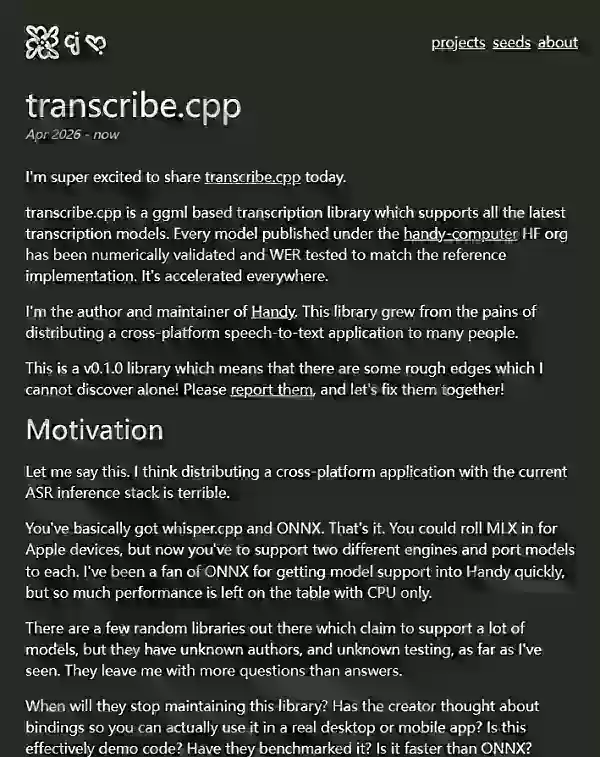
transcribe.cpp offers a fast, accurate inference engine with broad model coverage, supporting 16 ASR families and over 60 models, with more on the way. Acceleration is achieved via four GPU paths: Vulkan, Metal, CUDA, and TinyBLAS. Treating Vulkan as the baseline for local inference, the author benchmarked each model on a Ryzen 4750U (Fedora) and an M4 Max. Every model underwent numerical validation and comprehensive WER scanning across thousands of audio segments, ensuring outputs match or closely align with reference implementations. These results are publicly accessible in the transcribe.cpp repository and corresponding Hugging Face model pages. Functionally, it supports streaming and batch transcription, serving as a drop-in replacement for whisper.cpp. Since Handy originally used whisper.cpp, the author ensured compatibility with its popular .bin files, allowing transcribe.cpp to run them directly. While some flags remain unaligned, the whisper implementation is reliable for most use cases, with comparable performance.
Recognizing that real-world adoption requires robust language bindings, the library prioritized this from the start. Written in C/C++, transcribe.cpp includes official bindings for Python, JavaScript/TypeScript, Rust, and Objective-C/Swift. The author welcomes community contributions for additional languages, driven by Handy’s success and the need to distribute local speech transcription widely. These bindings address the practical requirements of integrating voice functionality into popular applications.
The ultimate goal of transcribe.cpp is to simplify local ASR usage. With high accuracy achievable on most devices, cloud transmission becomes unnecessary. Highlighting its efficiency, the author notes that even on low-power hardware like the RK3566 chip, transcribe.cpp runs models faster than real-time on CPU, and handles real-time transcription with minimal power consumption using advanced models. As local inference grows due to privacy and latency concerns, distribution remains a key challenge. While transcribe.cpp doesn’t solve every issue, it represents a significant step forward in making local speech processing accessible and efficient.
The author extends gratitude to key contributors: Mozilla AI and its BiR project, along with engineer Davide, for early support; ggml and its community, which formed the project’s foundation; Modal, for providing computing credits for WER testing and CUDA verification; Blacksmith, for handling part of the CI/CD pipeline; and Hugging Face, a pillar of the local AI community that provided private storage space for the handy-computer organization’s models. Regarding AI assistance in development, the author confirms its use but emphasizes that no text was generated by AI; all content was written manually, noting that creating an engine of this scale in months using only ggml would be impossible without such support.
Original link: workshop.cjpais.com/projects/transcribe-cpp
Related article
 Amazon Launches AI Shopping Assistant for Retailers Including Kate Spade
Amazon is extending its AI shopping capabilities to external retailers via a new Agentic Shopping Assistant built on AWS, with Kate Spade among the initial brands to adopt it.This service enables retailers to create AI shopping assistants for their o
Apple Safari Preview Integrates MCP Service AI Agent to Streamline Web Development and Debugging
On July 1, the Apple WebKit team introduced the MCP server feature in Safari Technology Preview 247, streamlining front-end development and debugging through AI agent integration.Understanding the MCP ProtocolMCP, or Model Context Protocol, is an ope
Meta AI Agent Muse Secretly Leaks User Address and Arranges Meetings with Buyers, Unaware of the User
Meta’s AI agent Muse, launched in the US on September 22, has recently faced serious allegations of overstepping its boundaries. According to The Guardian, the agent shared a user’s Toronto address with a Facebook Marketplace buyer without authorizat
Related Special Topic Recommendations
automation
Amazon Launches AI Shopping Assistant for Retailers Including Kate Spade
Amazon is extending its AI shopping capabilities to external retailers via a new Agentic Shopping Assistant built on AWS, with Kate Spade among the initial brands to adopt it.This service enables retailers to create AI shopping assistants for their o
Apple Safari Preview Integrates MCP Service AI Agent to Streamline Web Development and Debugging
On July 1, the Apple WebKit team introduced the MCP server feature in Safari Technology Preview 247, streamlining front-end development and debugging through AI agent integration.Understanding the MCP ProtocolMCP, or Model Context Protocol, is an ope
Meta AI Agent Muse Secretly Leaks User Address and Arranges Meetings with Buyers, Unaware of the User
Meta’s AI agent Muse, launched in the US on September 22, has recently faced serious allegations of overstepping its boundaries. According to The Guardian, the agent shared a user’s Toronto address with a Facebook Marketplace buyer without authorizat
Related Special Topic Recommendations
automation
 AI Integration Tools for No Code Automation Teams
2026 Latest Best AI Integration Tools for No Code Automation Teams are here on XIX.AI! This curated list features top-rated, powerful solutions that help teams streamline workflows, boost productivity, and tackle complex automation tasks with ease. We conduct real-world tests to deliver accurate rankings and a free vs paid comparison, making it simple to find the must-try option that fits your needs. Explore now to uncover your perfect tool for seamless no code integration!
 8 tools
 xix.ai
Video creation
Best AI Screen Recording Editors for Product Demos, Walkthroughs, and Training Clips
xix.ai
Video creation
Best AI Screen Recording Editors for Product Demos, Walkthroughs, and Training Clips
2026 Latest Best Top-rated AI screen recording editors curated by XIX.AI for product demos, walkthroughs, and training clips. These powerful game-changing tools offer real-world tests, free vs paid comparison, and weekly updated rankings to help you boost productivity significantly. Explore now to Discover your perfect tool for streamlining creative workflows! 238 characters
10 tools
xix.ai
Video creation
Best AI Screen Recording Editors for Product Demo Videos
2026 Latest Best Top-rated AI screen recording editors for product demo videos are here on XIX.AI! This curated list features powerful, game-changing tools that help you create professional-quality demos fast, boost writing efficiency, and deliver seamless results. Get a free vs paid comparison, see real-world tests, and check our updated weekly rankings. Explore now to discover your perfect tool and unlock your AI edge!
9 tools
xix.ai
design
AI Logo Drafting Tools for Early Brand Concepts
2026 Latest Best Top-Rated AI Logo Drafting Tools for Early Brand Concepts! This curated list features powerful game-changing solutions that help entrepreneurs and creatives quickly create professional logo designs, boost branding efficiency, and stay ahead in the competitive market. XIX.AI offers a free vs paid comparison along with real-world tests and weekly updated rankings to help you find the perfect tool. Explore now to Unlock your AI edge!
9 tools
xix.ai
Video creation
AI Short-Form Video Hook Generators for Reels and Shorts
2026 Latest Best Top-Rated AI Short-Form Video Hook Generators for Reels and Shorts are here on XIX.AI! This curated collection features powerful, game-changing tools that go through rigorous real-world tests to deliver must-try content ideas fast. You’ll also find a detailed free vs paid comparison along with updated weekly rankings. Explore now to discover your perfect tool and boost your creativity instantly!
10 tools
xix.ai
automation
Best AI Browser Automation Tools for Web Operations
2026 Latest Best Top-rated AI Browser Automation Tools for Web Operations are here on XIX.AI! This curated list features powerful, game-changing solutions that help boost productivity dramatically through real-world tests and strict rankings. We also provide a free vs paid comparison to help you choose the perfect option for streamlining web tasks, enhancing automation efficiency, and unlocking your AI edge. Explore now!
9 tools
xix.ai

 Comments (0)
0/500
Comments (0)
0/500
Local speech transcription has long presented developers with a frustrating choice: juggle whisper.cpp or ONNX, and add MLX for Apple devices, resulting in the burden of maintaining two engine sets and porting models individually. On July 19, sebjones, creator and maintainer of the popular speech-to-text app Handy, transformed these cross-platform distribution challenges into transcribe.cpp, releasing version v0.1.0. Built on ggml, this library supports all current transcription models. Every model from the handy-computer organization on Hugging Face has passed numerical validation and word error rate (WER) testing, guaranteeing consistency with official reference implementations. Acknowledging this is an early release (v0.1.0) with potential rough edges, the author invites community feedback to drive improvements.
transcribe.cpp emerged from the painful reality of distributing cross-platform applications using existing ASR stacks, which often deliver a subpar user experience. While some libraries claim multi-model support, their obscure origins and unclear testing leave critical questions unanswered: Will updates cease? Are there official bindings for desktop or mobile apps? Is this merely demo code? How does it benchmark against ONNX? Seeking a solution for Handy, the author needed a library that allows direct model downloads and inference matching reference outputs, leverages GPU acceleration, integrates seamlessly without heavy dependencies like PyTorch, and supports Mac, Windows, and Linux. After evaluating options, ggml proved the ideal foundation due to its robust community and distribution capabilities.
transcribe.cpp offers a fast, accurate inference engine with broad model coverage, supporting 16 ASR families and over 60 models, with more on the way. Acceleration is achieved via four GPU paths: Vulkan, Metal, CUDA, and TinyBLAS. Treating Vulkan as the baseline for local inference, the author benchmarked each model on a Ryzen 4750U (Fedora) and an M4 Max. Every model underwent numerical validation and comprehensive WER scanning across thousands of audio segments, ensuring outputs match or closely align with reference implementations. These results are publicly accessible in the transcribe.cpp repository and corresponding Hugging Face model pages. Functionally, it supports streaming and batch transcription, serving as a drop-in replacement for whisper.cpp. Since Handy originally used whisper.cpp, the author ensured compatibility with its popular .bin files, allowing transcribe.cpp to run them directly. While some flags remain unaligned, the whisper implementation is reliable for most use cases, with comparable performance.
Recognizing that real-world adoption requires robust language bindings, the library prioritized this from the start. Written in C/C++, transcribe.cpp includes official bindings for Python, JavaScript/TypeScript, Rust, and Objective-C/Swift. The author welcomes community contributions for additional languages, driven by Handy’s success and the need to distribute local speech transcription widely. These bindings address the practical requirements of integrating voice functionality into popular applications.
The ultimate goal of transcribe.cpp is to simplify local ASR usage. With high accuracy achievable on most devices, cloud transmission becomes unnecessary. Highlighting its efficiency, the author notes that even on low-power hardware like the RK3566 chip, transcribe.cpp runs models faster than real-time on CPU, and handles real-time transcription with minimal power consumption using advanced models. As local inference grows due to privacy and latency concerns, distribution remains a key challenge. While transcribe.cpp doesn’t solve every issue, it represents a significant step forward in making local speech processing accessible and efficient.
The author extends gratitude to key contributors: Mozilla AI and its BiR project, along with engineer Davide, for early support; ggml and its community, which formed the project’s foundation; Modal, for providing computing credits for WER testing and CUDA verification; Blacksmith, for handling part of the CI/CD pipeline; and Hugging Face, a pillar of the local AI community that provided private storage space for the handy-computer organization’s models. Regarding AI assistance in development, the author confirms its use but emphasizes that no text was generated by AI; all content was written manually, noting that creating an engine of this scale in months using only ggml would be impossible without such support.
Original link: workshop.cjpais.com/projects/transcribe-cpp








 Amazon Launches AI Shopping Assistant for Retailers Including Kate Spade
Amazon is extending its AI shopping capabilities to external retailers via a new Agentic Shopping Assistant built on AWS, with Kate Spade among the initial brands to adopt it.This service enables retailers to create AI shopping assistants for their o
Amazon Launches AI Shopping Assistant for Retailers Including Kate Spade
Amazon is extending its AI shopping capabilities to external retailers via a new Agentic Shopping Assistant built on AWS, with Kate Spade among the initial brands to adopt it.This service enables retailers to create AI shopping assistants for their o
 Apple Safari Preview Integrates MCP Service AI Agent to Streamline Web Development and Debugging
On July 1, the Apple WebKit team introduced the MCP server feature in Safari Technology Preview 247, streamlining front-end development and debugging through AI agent integration.Understanding the MCP ProtocolMCP, or Model Context Protocol, is an ope
Apple Safari Preview Integrates MCP Service AI Agent to Streamline Web Development and Debugging
On July 1, the Apple WebKit team introduced the MCP server feature in Safari Technology Preview 247, streamlining front-end development and debugging through AI agent integration.Understanding the MCP ProtocolMCP, or Model Context Protocol, is an ope
 Meta AI Agent Muse Secretly Leaks User Address and Arranges Meetings with Buyers, Unaware of the User
Meta’s AI agent Muse, launched in the US on September 22, has recently faced serious allegations of overstepping its boundaries. According to The Guardian, the agent shared a user’s Toronto address with a Facebook Marketplace buyer without authorizat
Meta AI Agent Muse Secretly Leaks User Address and Arranges Meetings with Buyers, Unaware of the User
Meta’s AI agent Muse, launched in the US on September 22, has recently faced serious allegations of overstepping its boundaries. According to The Guardian, the agent shared a user’s Toronto address with a Facebook Marketplace buyer without authorizat

2026 Latest Best AI Integration Tools for No Code Automation Teams are here on XIX.AI! This curated list features top-rated, powerful solutions that help teams streamline workflows, boost productivity, and tackle complex automation tasks with ease. We conduct real-world tests to deliver accurate rankings and a free vs paid comparison, making it simple to find the must-try option that fits your needs. Explore now to uncover your perfect tool for seamless no code integration!
8 tools
xix.ai

2026 Latest Best Top-rated AI screen recording editors curated by XIX.AI for product demos, walkthroughs, and training clips. These powerful game-changing tools offer real-world tests, free vs paid comparison, and weekly updated rankings to help you boost productivity significantly. Explore now to Discover your perfect tool for streamlining creative workflows! 238 characters
10 tools
xix.ai

2026 Latest Best Top-rated AI screen recording editors for product demo videos are here on XIX.AI! This curated list features powerful, game-changing tools that help you create professional-quality demos fast, boost writing efficiency, and deliver seamless results. Get a free vs paid comparison, see real-world tests, and check our updated weekly rankings. Explore now to discover your perfect tool and unlock your AI edge!
9 tools
xix.ai

2026 Latest Best Top-Rated AI Logo Drafting Tools for Early Brand Concepts! This curated list features powerful game-changing solutions that help entrepreneurs and creatives quickly create professional logo designs, boost branding efficiency, and stay ahead in the competitive market. XIX.AI offers a free vs paid comparison along with real-world tests and weekly updated rankings to help you find the perfect tool. Explore now to Unlock your AI edge!
9 tools
xix.ai

2026 Latest Best Top-Rated AI Short-Form Video Hook Generators for Reels and Shorts are here on XIX.AI! This curated collection features powerful, game-changing tools that go through rigorous real-world tests to deliver must-try content ideas fast. You’ll also find a detailed free vs paid comparison along with updated weekly rankings. Explore now to discover your perfect tool and boost your creativity instantly!
10 tools
xix.ai

2026 Latest Best Top-rated AI Browser Automation Tools for Web Operations are here on XIX.AI! This curated list features powerful, game-changing solutions that help boost productivity dramatically through real-world tests and strict rankings. We also provide a free vs paid comparison to help you choose the perfect option for streamlining web tasks, enhancing automation efficiency, and unlocking your AI edge. Explore now!
9 tools
xix.ai












