


 Home
HomeGoogle’s latest AI weather model gives you no excuse to forget your umbrella
Google DeepMind and Google Research have unveiled a new AI-driven weather forecasting model that offers clearer insights into atmospheric changes and more frequent, reliable predictions.
WeatherNext 3 represents a significant leap in meteorology, driven by deep learning. Google plans to integrate this model into Search, Google Maps, and Gemini, while making it accessible to researchers and users via its cloud platforms.
“This marks the first time core variables will directly power a wide range of Google products,” said Samier Merchant, a senior staff engineer at Google, in an interview with TechCrunch.
Tested on Operational WeatherBench—a benchmark created by startup Brightband to compare AI forecasts—WeatherNext 3 has demonstrated superior accuracy across key metrics such as temperature, wind speed, and humidity.
It outperforms other deep-learning models from Google, Microsoft, Nvidia, and the European Centre for Medium-Range Weather Forecasts (ECMWF), as well as traditional forecasts from the US National Weather Service and ECMWF.
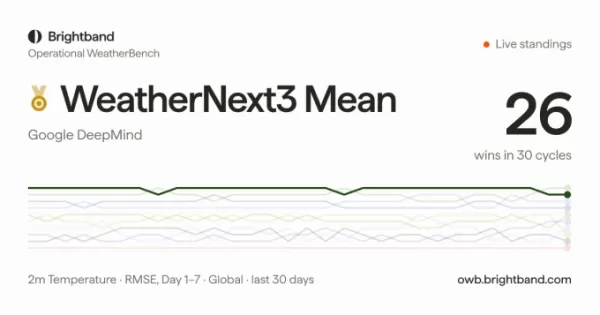
Image Credits:Brightband / Brightband
Traditional weather forecasts rely on government supercomputers solving complex physical equations. While accurate, these systems are costly and slow. Since 2018, when the ECMWF released decades of historical data, researchers have used deep learning to create faster models with comparable accuracy.
“Weather is chaotic; small differences can lead to massive perturbations,” explained Ferran Alet, a staff research scientist manager at DeepMind. “Machine learning addresses the core challenge: approximating noisy physics using incomplete information and limited compute, allowing it to learn patterns from vast datasets.”
Previous AI forecasting models faced key limitations: they covered broad areas (15–25 square km) with limited practical use, struggled with rain prediction, and relied on pre-processed government data.
WeatherNext 3 addresses these issues. It offers a resolution of 5km, improves rain prediction accuracy by 60% compared to WeatherNext 2, and generates hourly forecasts instead of the standard six-hour intervals.
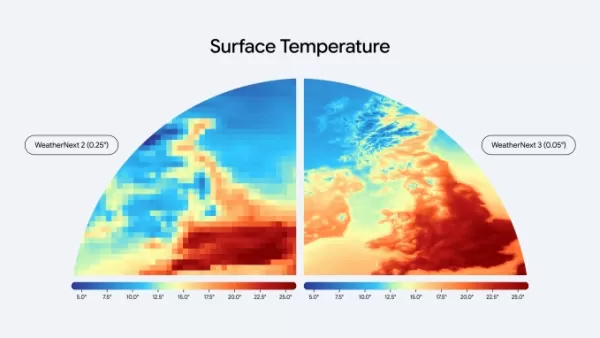
Image Credits:Google / Google
These improvements stem from specific design choices. WeatherNext 3 has 2.4 times more parameters than its predecessor, with decoder heads tailored to provide more actionable insights. Unlike standard forecasts that average data across 3D grids, DeepMind’s model can visualize specific events like cyclone paths.
Additionally, the model is trained to predict data for specific weather stations. This enhances prediction granularity and allows for evaluation against ground-truth data.
“The goal with many AI applications is to run tasks end-to-end,” said Daniel Rothenberg, an atmospheric scientist at Brightband. “By predicting specific station data, such as hourly conditions at Denver’s airport, we connect forecasting more closely to real-world utility.”
The model’s increased frequency is enabled by ingesting real-time satellite data hourly. Using raw empirical observations rather than supercomputer-generated analysis improves accuracy, though handling unformatted data remains technically challenging.
Google claims WeatherNext 3 is the first AI model to incorporate raw observations for high-resolution global forecasts. However, AI startup WindBorne states its WeatherMesh 6 model has used raw data from weather balloons since late 2025. Google notes its forecasts offer higher global resolution. Both models still rely on national datasets, indicating further work is needed for true direct data assimilation.
While large language models dominate headlines, the transformer revolution in meteorology is equally transformative. Weather agencies in Europe and the US are already using AI in their forecasts, offering speed and cost benefits that could make accurate predictions accessible to poorer regions.
Bill Gates recently highlighted AI weather forecasting as a key benefit, noting its potential to improve crop yields in developing nations. Ferran Alet added that higher-resolution forecasts of wind, rain, and cloud cover will help make renewable energy projects more reliable.
“Ultimately, Google aims to provide useful information to users, and weather is a central part of that,” Alet concluded.
Related article
 Ollmo v0.1.0 Launches as Production-Grade RAG and Agent Visualization Platform
Ollmo, a production-grade RAG and Agent visualization platform for private deployment and team collaboration, has officially released version 0.1.0. This platform aims to help users quickly obtain answers with precise sources by uploading documents a
Industry Giant Refuses to Take Advantage of AI Benefits: Wang Ning Says Don't Let Algorithms Ruin Emotional Value
In an era where investment in AI-driven pop culture toys has skyrocketed by 80 times, industry leader Pop Mart is taking a surprisingly restrained approach. Founder Wang Ning has explicitly confirmed that none of the company’s flagship IPs, such as L
Domestic Embodied Large Model Wall-OSS-0.5 Makes a Big Splash with Open Source: Zero-Shot Deployment After Pre-training
In May 2026, China’s embodied intelligence sector achieved a significant milestone with X Square Robot’s open-source release of its latest Vision-Language-Action (VLA) model, Wall-OSS-0.5. Breaking from the industry norm of pre-exam fine-tuning, this
Related Special Topic Recommendations
Health & Wellness
Ollmo v0.1.0 Launches as Production-Grade RAG and Agent Visualization Platform
Ollmo, a production-grade RAG and Agent visualization platform for private deployment and team collaboration, has officially released version 0.1.0. This platform aims to help users quickly obtain answers with precise sources by uploading documents a
Industry Giant Refuses to Take Advantage of AI Benefits: Wang Ning Says Don't Let Algorithms Ruin Emotional Value
In an era where investment in AI-driven pop culture toys has skyrocketed by 80 times, industry leader Pop Mart is taking a surprisingly restrained approach. Founder Wang Ning has explicitly confirmed that none of the company’s flagship IPs, such as L
Domestic Embodied Large Model Wall-OSS-0.5 Makes a Big Splash with Open Source: Zero-Shot Deployment After Pre-training
In May 2026, China’s embodied intelligence sector achieved a significant milestone with X Square Robot’s open-source release of its latest Vision-Language-Action (VLA) model, Wall-OSS-0.5. Breaking from the industry norm of pre-exam fine-tuning, this
Related Special Topic Recommendations
Health & Wellness
 AI Habit Tracking Tools for Personal Health Goals
2026 Latest Best AI Habit Tracking Tools for Personal Health Goals are here on XIX.AI! Our curated top-rated list includes powerful, game-changing solutions that help you stay consistent with your goals through real-world tests and strict rankings. We also offer a free vs paid comparison to help you choose the perfect fit. Explore now to Unlock your AI edge in achieving better health outcomes.
 10 tools
 xix.ai
Data Analysis
Best AI Anomaly Detection Tools for Dashboard Monitoring
xix.ai
Data Analysis
Best AI Anomaly Detection Tools for Dashboard Monitoring
2026 Latest Best Top-rated AI Anomaly Detection Tools for Dashboard Monitoring are here on XIX.AI! This curated list features powerful, game-changing solutions that deliver accurate real-world tests through weekly updated rankings. You’ll find a free vs paid comparison and insights into how these tools boost productivity by helping users spot issues fast, streamlining workflow efficiency. Discover your perfect tool to unlock your AI edge today. Explore now!
9 tools
xix.ai
Animation Creation
AI Lip-Sync Generators for Dialogue-Driven Character Animation and Motion Scenes
2026 Latest Best AI Lip-Sync Generators for Dialogue-Driven Character Animation and Motion Scenes! XIX.AI has curated a top-rated list of powerful, game-changing tools that deliver flawless synchronized lip movements for animated characters. Each option undergoes rigorous real-world tests to ensure reliability, and our weekly updated rankings help you find the must-try solution that boosts your animation workflow efficiency. Explore now to discover your perfect tool!
9 tools
xix.ai
Social Media
Best AI Social Reply Assistants for Brand Community Management
2026 Latest Best Top-rated AI Social Reply Assistants for Brand Community Management! XIX.AI has curated a powerful game-changing collection of must-try tools, all going through rigorous real-world tests to deliver consistent top-quality results. You can find detailed free vs paid comparison insights and up-to-date weekly updated rankings here. Explore now to unlock your AI edge in efficient community management!
12 tools
xix.ai
Productivity
Top AI Daily Planner Apps: Build Realistic Schedules for Deep Work
2026 Latest Top-Rated AI Daily Planner Apps make creating realistic deep work schedules effortless. This curated list features powerful, game-changing tools that go through real-world tests to ensure accuracy and effectiveness. You’ll find a free vs paid comparison along with detailed rankings based on usability and results. XIX.AI is part of this trusted collection. Explore now to discover your perfect tool and unlock your AI edge for staying focused and productive every day.
11 tools
xix.ai
Data Analysis
Best AI Chart Builder Tools for Fast Reporting
2026 Latest Best Top-rated AI Chart Builder Tools for Fast Reporting are here on XIX.AI! This curated list features powerful game-changing tools that deliver accurate professional charts with just a few clicks, helping you boost writing efficiency and streamline content creation. Get a free vs paid comparison along with real-world tests and detailed rankings to find the must-try solution for your needs. Explore now to unlock your AI edge!
9 tools
xix.ai

 Comments (0)
0/500
Comments (0)
0/500
Google DeepMind and Google Research have unveiled a new AI-driven weather forecasting model that offers clearer insights into atmospheric changes and more frequent, reliable predictions.
WeatherNext 3 represents a significant leap in meteorology, driven by deep learning. Google plans to integrate this model into Search, Google Maps, and Gemini, while making it accessible to researchers and users via its cloud platforms.
“This marks the first time core variables will directly power a wide range of Google products,” said Samier Merchant, a senior staff engineer at Google, in an interview with TechCrunch.
Tested on Operational WeatherBench—a benchmark created by startup Brightband to compare AI forecasts—WeatherNext 3 has demonstrated superior accuracy across key metrics such as temperature, wind speed, and humidity.
It outperforms other deep-learning models from Google, Microsoft, Nvidia, and the European Centre for Medium-Range Weather Forecasts (ECMWF), as well as traditional forecasts from the US National Weather Service and ECMWF.
Image Credits:Brightband / Brightband
Traditional weather forecasts rely on government supercomputers solving complex physical equations. While accurate, these systems are costly and slow. Since 2018, when the ECMWF released decades of historical data, researchers have used deep learning to create faster models with comparable accuracy.
“Weather is chaotic; small differences can lead to massive perturbations,” explained Ferran Alet, a staff research scientist manager at DeepMind. “Machine learning addresses the core challenge: approximating noisy physics using incomplete information and limited compute, allowing it to learn patterns from vast datasets.”
Previous AI forecasting models faced key limitations: they covered broad areas (15–25 square km) with limited practical use, struggled with rain prediction, and relied on pre-processed government data.
WeatherNext 3 addresses these issues. It offers a resolution of 5km, improves rain prediction accuracy by 60% compared to WeatherNext 2, and generates hourly forecasts instead of the standard six-hour intervals.
Image Credits:Google / Google
These improvements stem from specific design choices. WeatherNext 3 has 2.4 times more parameters than its predecessor, with decoder heads tailored to provide more actionable insights. Unlike standard forecasts that average data across 3D grids, DeepMind’s model can visualize specific events like cyclone paths.
Additionally, the model is trained to predict data for specific weather stations. This enhances prediction granularity and allows for evaluation against ground-truth data.
“The goal with many AI applications is to run tasks end-to-end,” said Daniel Rothenberg, an atmospheric scientist at Brightband. “By predicting specific station data, such as hourly conditions at Denver’s airport, we connect forecasting more closely to real-world utility.”
The model’s increased frequency is enabled by ingesting real-time satellite data hourly. Using raw empirical observations rather than supercomputer-generated analysis improves accuracy, though handling unformatted data remains technically challenging.
Google claims WeatherNext 3 is the first AI model to incorporate raw observations for high-resolution global forecasts. However, AI startup WindBorne states its WeatherMesh 6 model has used raw data from weather balloons since late 2025. Google notes its forecasts offer higher global resolution. Both models still rely on national datasets, indicating further work is needed for true direct data assimilation.
While large language models dominate headlines, the transformer revolution in meteorology is equally transformative. Weather agencies in Europe and the US are already using AI in their forecasts, offering speed and cost benefits that could make accurate predictions accessible to poorer regions.
Bill Gates recently highlighted AI weather forecasting as a key benefit, noting its potential to improve crop yields in developing nations. Ferran Alet added that higher-resolution forecasts of wind, rain, and cloud cover will help make renewable energy projects more reliable.
“Ultimately, Google aims to provide useful information to users, and weather is a central part of that,” Alet concluded.








 Ollmo v0.1.0 Launches as Production-Grade RAG and Agent Visualization Platform
Ollmo, a production-grade RAG and Agent visualization platform for private deployment and team collaboration, has officially released version 0.1.0. This platform aims to help users quickly obtain answers with precise sources by uploading documents a
Ollmo v0.1.0 Launches as Production-Grade RAG and Agent Visualization Platform
Ollmo, a production-grade RAG and Agent visualization platform for private deployment and team collaboration, has officially released version 0.1.0. This platform aims to help users quickly obtain answers with precise sources by uploading documents a
 Industry Giant Refuses to Take Advantage of AI Benefits: Wang Ning Says Don't Let Algorithms Ruin Emotional Value
In an era where investment in AI-driven pop culture toys has skyrocketed by 80 times, industry leader Pop Mart is taking a surprisingly restrained approach. Founder Wang Ning has explicitly confirmed that none of the company’s flagship IPs, such as L
Industry Giant Refuses to Take Advantage of AI Benefits: Wang Ning Says Don't Let Algorithms Ruin Emotional Value
In an era where investment in AI-driven pop culture toys has skyrocketed by 80 times, industry leader Pop Mart is taking a surprisingly restrained approach. Founder Wang Ning has explicitly confirmed that none of the company’s flagship IPs, such as L
 Domestic Embodied Large Model Wall-OSS-0.5 Makes a Big Splash with Open Source: Zero-Shot Deployment After Pre-training
In May 2026, China’s embodied intelligence sector achieved a significant milestone with X Square Robot’s open-source release of its latest Vision-Language-Action (VLA) model, Wall-OSS-0.5. Breaking from the industry norm of pre-exam fine-tuning, this
Domestic Embodied Large Model Wall-OSS-0.5 Makes a Big Splash with Open Source: Zero-Shot Deployment After Pre-training
In May 2026, China’s embodied intelligence sector achieved a significant milestone with X Square Robot’s open-source release of its latest Vision-Language-Action (VLA) model, Wall-OSS-0.5. Breaking from the industry norm of pre-exam fine-tuning, this
2026 Latest Best AI Habit Tracking Tools for Personal Health Goals are here on XIX.AI! Our curated top-rated list includes powerful, game-changing solutions that help you stay consistent with your goals through real-world tests and strict rankings. We also offer a free vs paid comparison to help you choose the perfect fit. Explore now to Unlock your AI edge in achieving better health outcomes.
10 tools
xix.ai

2026 Latest Best Top-rated AI Anomaly Detection Tools for Dashboard Monitoring are here on XIX.AI! This curated list features powerful, game-changing solutions that deliver accurate real-world tests through weekly updated rankings. You’ll find a free vs paid comparison and insights into how these tools boost productivity by helping users spot issues fast, streamlining workflow efficiency. Discover your perfect tool to unlock your AI edge today. Explore now!
9 tools
xix.ai
2026 Latest Best AI Lip-Sync Generators for Dialogue-Driven Character Animation and Motion Scenes! XIX.AI has curated a top-rated list of powerful, game-changing tools that deliver flawless synchronized lip movements for animated characters. Each option undergoes rigorous real-world tests to ensure reliability, and our weekly updated rankings help you find the must-try solution that boosts your animation workflow efficiency. Explore now to discover your perfect tool!
9 tools
xix.ai

2026 Latest Best Top-rated AI Social Reply Assistants for Brand Community Management! XIX.AI has curated a powerful game-changing collection of must-try tools, all going through rigorous real-world tests to deliver consistent top-quality results. You can find detailed free vs paid comparison insights and up-to-date weekly updated rankings here. Explore now to unlock your AI edge in efficient community management!
12 tools
xix.ai
2026 Latest Top-Rated AI Daily Planner Apps make creating realistic deep work schedules effortless. This curated list features powerful, game-changing tools that go through real-world tests to ensure accuracy and effectiveness. You’ll find a free vs paid comparison along with detailed rankings based on usability and results. XIX.AI is part of this trusted collection. Explore now to discover your perfect tool and unlock your AI edge for staying focused and productive every day.
11 tools
xix.ai
2026 Latest Best Top-rated AI Chart Builder Tools for Fast Reporting are here on XIX.AI! This curated list features powerful game-changing tools that deliver accurate professional charts with just a few clicks, helping you boost writing efficiency and streamline content creation. Get a free vs paid comparison along with real-world tests and detailed rankings to find the must-try solution for your needs. Explore now to unlock your AI edge!
9 tools
xix.ai












